Key Takeaways
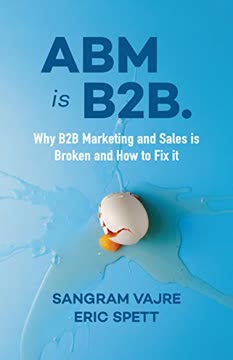
1. ABM is B2B: The New Standard for Revenue-Driven Marketing.
Account-Based Marketing is an organizational strategy designed specifically to create more revenue. Business-to-Business Marketing (B2B) is an organizational strategy designed specifically to create more revenue. Yes, they are the same.
Core Declaration. The book boldly declares that Account-Based Marketing (ABM) is not merely a trend or an improved tactic, but the fundamental essence of modern Business-to-Business (B2B) marketing. It asserts that ABM and B2B are synonymous, both serving the singular purpose of generating revenue through strategic organizational efforts. This perspective challenges traditional B2B approaches that often fall short, with statistics showing that fewer than one percent of leads convert into customers.
Transformative Shift. This isn't about incremental improvement; it's about a transformative shift from "boring to boring" B2B marketing to creating phenomenal, personalized customer experiences. The authors emphasize that successful B2B organizations today must target the right customers, craft tailored experiences for them, and cultivate them into advocates. This philosophy, at its core, is what ABM delivers, making it indispensable for any B2B company aiming for exponential growth.
Beyond Debate. The time for debating ABM's efficacy is over. The book focuses on how to implement ABM, guiding readers to navigate the waters of this new reality based on their specific business goals. By adopting an account-based mindset, organizations can move beyond outdated lead-centric models and embrace a strategy that directly aligns marketing efforts with tangible business outcomes, ensuring every action contributes to revenue generation.
2. A Fundamental Mindset Shift: Marketing's Value is Sales-Defined, Ditching Vanity Metrics.
The value of marketing is defined by sales.
Marketing's Purpose. This truth challenges marketers to redefine their role: marketing's ultimate value is measured by its contribution to sales and revenue, not by traditional vanity metrics. While marketers might feel threatened by this notion, it liberates them to focus on purposeful work. When marketing aligns with revenue goals, designers and writers are empowered to create content that directly drives business outcomes, rather than vanishing into the void of unmeasured efforts.
Beyond Vanity. Traditional marketing often obsesses over "pretty numbers" like total leads, website clicks, or form fills, which rarely translate into actual sales. The book urges a shift from these vanity metrics to meaningful business outcomes such as engagement, progression, and velocity. For instance, a 30% drop in website traffic might seem alarming, but if 70% of the previous traffic came from non-target accounts, the reduction signifies a more efficient and focused approach, leading to better business results.
New Metrics. To truly measure impact, marketers must adopt new metrics that reflect account-centric success. Instead of lead conversion rates, focus on conversion rates from total accounts to engaged accounts, to opportunities, and ultimately to closed deals. This new "One Scorecard" approach provides a complete story of marketing's influence, ensuring that every effort is tied to tangible revenue growth and operational efficiency, making marketing's contribution undeniable to the C-suite.
3. Organizational Imperative: Break Silos and Secure C-Suite Buy-in for #OneTeam Success.
Your silos should burn to the ground.
Siloed Dysfunction. The traditional rivalry between sales and marketing, often driven by misaligned goals (marketing for brand awareness/leads, sales for revenue), creates organizational dysfunction. This "mass hysteria" prevents effective collaboration and leads to blame games when sales numbers dip. The book emphasizes that successful organizations operate as #OneTeam, where sales, marketing, and customer success share common goals and work in unison towards business outcomes.
Marketing's Leadership. Marketing leaders are tasked with initiating this critical alignment, bringing all departments together early and often. ABM is not a marketing-only initiative; it's a cross-functional approach requiring ownership and leadership from marketing to foster an account-centric and customer-obsessed culture. Without this unified front, efforts to deliver hand-picked leads or implement new programs will fail, as demonstrated by early Terminus attempts where sales ignored marketing's "top 500 list."
C-Suite Alignment. Securing executive buy-in is paramount for this transformation. CEOs are driven by business outcomes and operational efficiency, not new marketing technologies or traditional metrics like MQLs. Marketers must educate the C-suite on why shrinking volume (of leads) is beneficial when focusing on accounts, and how marketing and sales alignment drives significant business transformations. Starting with pilot programs and demonstrating tangible results in the "CEO language" of revenue and efficiency can secure the necessary top-level support.
4. Strategic Execution: Embrace a Full Lifecycle Approach, Start Small, and Tier Accounts.
Strategy eats your tactics for breakfast.
Beyond Acquisition. ABM is far more than an acquisition strategy; it's a multifaceted approach adaptable for the entire customer lifecycle, encompassing acquisition, pipeline velocity (acceleration), and expansion. Early ABM efforts often focused solely on acquiring new accounts, but successful companies realized the power of applying account-based thinking to accelerate deals already in the pipeline and grow existing customer relationships. This strategic depth transforms ABM from a mere targeting tactic into a comprehensive revenue-generating engine.
Incremental Growth. Implementing a full ABM strategy cannot be done overnight. The book advises starting small, like a "scrawny gym rat" building strength incrementally, rather than attempting to "bench-press 500 pounds on day one." Running short sprints with a small number of accounts (e.g., 10 instead of 500) allows for data-driven learning, iteration, and adaptation. This interval training approach helps identify what works, double down on successes, and slowly increase intensity, overcoming the "bias toward inaction" that often hinders transformation.
Value-Based Tiering. Not all accounts are created equal, and therefore, they shouldn't receive equal treatment. Tiering accounts based on their potential value (e.g., Tier 1 for million-dollar accounts, Tier 3 for smaller ones) is essential for efficient resource allocation. This allows for highly personalized, high-touch experiences for top-tier clients (e.g., private dinners, microsites) while still providing impressive personalization for lower tiers. This "champagne vs. sparkling water" approach ensures that marketing efforts are proportional to the potential return, maximizing impact and demonstrating care where it matters most.
5. The B2B Maturity Curve: Your Roadmap from Status Quo to Efficient Growth at Scale.
Companies that are finding their way and jumping in with their own programs finally can plot where they are on their ABM journey. We call it the B2B Maturity Curve.
Navigating the Shift. The B2B Maturity Curve provides a clear roadmap for organizations to assess and advance their marketing efforts from "Status Quo" to "B2B 2.0." Many companies are still in the early stages, grappling with the transition from lead-centric models to account-based strategies. This curve helps identify where an organization stands in terms of targeting, engagement, activation, and measurement, offering a structured path for evolution.
Stages of Maturity. The curve outlines three distinct stages:
- Status Quo (Average Marketing): Characterized by disconnected targeting, quantity-focused engagement, reactive sales alerts, and traditional funnel measurement. This stage is inefficient, hindering growth.
- B2B 1.0 (Good Marketing): Involves static targeting (e.g., "Top 100 list"), quality-focused engagement, proactive sales alerts, and a "double funnel" for measurement. This stage shows efficient growth in isolation but lacks full scale.
- B2B 2.0 (Great Marketing): Achieves dynamic targeting, experiential engagement, prioritized sales alerts, and a "One Scorecard" for measurement. This represents efficient growth at scale, with full marketing, sales, and customer success alignment.
Strategic Progression. The ultimate goal is to reach B2B 2.0, where marketing drives efficient growth at scale. This progression isn't linear across all aspects simultaneously; an organization might be advanced in one area while still at status quo in another. The curve encourages dedication, patience, and continuous iteration, using data to identify gaps, make adjustments, and trust the strategic lens that ties all efforts together for sustained success.
6. The TEAM Framework: Your Actionable Blueprint for Account-Based Success.
This framework provides a simple, execution-focused method for accelerating revenue generation, aligning marketing and sales, and improving critical acquisition and retention metrics.
Universal Language. The TEAM Framework (Target, Engage, Activate, Measure) serves as the "Rosetta Stone" for ABM, providing a common language and actionable steps for all go-to-market teams. It organizes thinking, aligns marketing, sales, and customer success, and ensures everyone is on the same page. This framework is crucial for translating high-level ABM strategy into daily execution, driving consistent results across the entire customer lifecycle.
Dynamic Feedback. Unlike a linear process, TEAM is an ever-evolving feedback loop. Insights from measurement continually inform and refine targeting, engagement tactics, and sales activation. This dynamic approach allows organizations to learn and grow, adapting quickly to new data and optimizing programs for maximum impact. It ensures that ABM is not a one-time implementation but a continuous journey of improvement.
Core Components. The framework's four pillars are:
- Target: Focus on best-fit accounts using Ideal Customer Profiles (ICP) and comprehensive account intelligence (Fit, Intent, Relationship, Engagement data).
- Engage: Deliver personalized messages across multiple channels to all decision-makers within target accounts.
- Activate: Trigger timely, personalized sales outreach based on account-level engagement and intent signals.
- Measure: Track success using new metrics focused on account penetration, progression, and overall return on investment (ROI).
This framework ensures that every marketing effort is scrutinized against its contribution to these four pillars, driving a business transformation.
7. Target: Define Your ICP and Gather 360-Degree Account Intelligence.
Your ICP is a precise profile of the companies who are the best fit for your product or service, as you determined.
Precision Targeting. Effective ABM begins with precise targeting, moving beyond the broad "total addressable market" to focus on an "Ideal Customer Profile" (ICP). An ICP identifies the characteristics of companies most likely to become valuable customers, leading to 68% higher account win rates for organizations with a strong ICP. This strategic narrowing of focus ensures that valuable marketing and sales resources are invested in accounts with the highest potential for conversion, shortest sales cycles, and highest customer satisfaction.
Comprehensive Account View. To build a robust ICP and target effectively, a 360-degree view of accounts is essential, combining two types of data:
- Fit Data: Firmographic features (size, industry, technographic profile) that match your ICP. This can be self-assembled or AI-assisted.
- Behavioral Data:
- Intent Data: What accounts are researching on third-party sites (e.g., Bombora, G2Crowd), indicating active interest.
- Engagement Data: How accounts interact with your company (website, marketing, sales activities), measuring quality of interaction.
- Relationship Data: Past interactions with sales or success teams, useful for acceleration and expansion.
Dynamic Segmentation. Account lists are not static; they are dynamically segmented into one-to-many, one-to-few, and one-to-one tiers based on value and engagement. This allows for tailored messaging and resource allocation, from broad email campaigns for one-to-many to highly personalized direct mail and microsites for high-value one-to-one accounts. Continuous updating of these lists based on new data ensures that accounts receive the most relevant messaging as they progress through the buyer's journey.
8. Engage: Orchestrate Authentic, Personalized Multichannel Campaigns.
The more authentically you can communicate and the more realistic your conversations are, the more people will trust you.
Authentic Communication. Successful engagement in ABM hinges on authentic, human communication. Marketers must move beyond generic messaging to truly understand and meet customers where they are, building trust by acting as trusted advisors and connectors. This involves actively listening to customer needs, sharing relevant (even third-party) content, and facilitating valuable networking opportunities, demonstrating genuine care rather than just pitching a product.
Meaningful Engagement. The concept of "meaningful engagement" replaces outdated MQLs, focusing on the quality and depth of interactions from all stakeholders within a target account. This involves aggregating known and anonymous data, such as high-value website visits, campaign responses (content downloads, webinar views), and email interactions. Defining what constitutes "meaningful" for your organization is crucial, allowing for customized models that track engagement spikes and trigger timely actions.
Multichannel Orchestration. To maximize impact, personalized messages must be orchestrated across multiple channels. A campaign orchestration matrix outlines digital channels (account advertising, web personalization, human emails) and physical channels (field marketing events, direct mail) tailored to specific sales stages and triggers. This "surround-sound" strategy ensures that all relevant contacts in an account are reached on their preferred platforms, increasing response rates and moving accounts towards deeper, one-to-one conversations.
9. Activate: Empower Sales with Real-Time Data and a Cohesive Playbook.
Marketing must activate salespeople by delivering advanced account intelligence and personalization tools to help prioritize and personalize their outreach.
Sales as Account Executives. Sales teams are "account executives," not "lead executives," and they care about closing deals on specific accounts, not just receiving a high volume of unqualified leads. ABM bridges the historical gap between marketing and sales incentives by empowering sales with the precise data and tools needed to prioritize and personalize their outreach. This ensures that marketing's efforts translate directly into actionable intelligence for sales, preventing fumbled handoffs and maximizing conversion potential.
Next-Show-Go Approach. The "Next-Show-Go" approach provides sales with immediate answers to critical questions:
- Which account do I need to take action on next?
- What engagement signals is that account showing?
- What action or play should I take based on those signals?
These insights, ideally delivered directly within the CRM, combine activity from known and anonymous visitors, intent data, and campaign responses. This real-time intelligence allows sales reps to have more valuable conversations and execute focused plays.
Cohesive Playbook. A reliable sales playbook, developed in collaboration with marketing and sales leadership, is essential. This playbook outlines a series of focused plays, content, and personalization instructions, ensuring a consistent and effective experience for target accounts. Examples include alerting sales reps to "surging" website activity, launching event plays for engaged accounts in specific locations, or deploying direct mail campaigns for inactive accounts. This iterative approach, starting small and automating triggers as maturity grows, ensures sales is always equipped to engage accounts at the optimal moment.
10. Measure: Implement a Unified B2B Scorecard for Account Progression and ROI.
B2B IS NOT ABOUT LEADS! It’s about winning the accounts that you can serve the best, and that bring the highest value to your organization. And winning is a team sport!
Beyond Lead Metrics. The core of ABM measurement is a radical departure from traditional lead-centric metrics. The new B2B funnel focuses on winning high-value accounts and their progression, not just lead volume. This requires a "One Scorecard" approach that provides deep insight into account performance across the entire lifecycle. Organizations must understand that initial quantity metrics might decrease, but the quality and efficiency of engagement will drive superior long-term results.
Key Measurement Areas. Success in ABM is measured across three critical areas:
- Creating and deepening relationships: Tracking engaged accounts and the quality/depth of their interactions (e.g., website visits, webinar views, event attendance).
- Moving accounts to desired results: Monitoring conversion rates from target accounts to engaged, to opportunities, and to closed deals.
- Achieving account-based ROI: Comparing the performance of target accounts against non-target accounts to demonstrate the financial benefits.
This holistic view allows marketers to optimize programs and allocate resources effectively.
C-Suite Reporting. Reporting to the C-suite and board requires clear, simple dashboards that highlight business outcomes and ROI, not vanity metrics. This includes comparing target account pipelines to non-target ones, showcasing average contract value, win rates, sales cycle length, retention rates, and Net Promoter Score. By presenting data that directly addresses organizational goals, marketers can confidently demonstrate the transformative power of their account-centric programs and secure continued buy-in for a predictable, revenue-driven business model.
Last updated:
Similar Books