Plot Summary
Glittering Facades, Hidden Sins
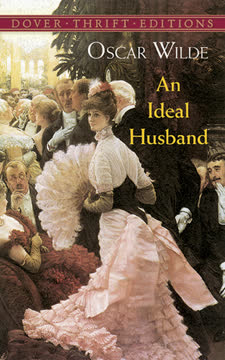
In the opulent home of Sir Robert Chiltern, a respected politician, London's elite gather for a night of wit and social maneuvering. Beneath the sparkling surface, Sir Robert's reputation as an "ideal husband" is the pride of his wife, Gertrude. Their marriage seems flawless, admired by all, especially by Gertrude's vivacious brother, Lord Goring, and her charming sister-in-law, Mabel. But the arrival of Mrs. Cheveley, a cunning and beautiful woman from Gertrude's past, hints at trouble. She brings with her not just memories, but a dangerous knowledge that threatens to shatter the Chilterns' perfect world. The stage is set for a collision between public virtue and private vice, as the guests' laughter masks the tension simmering beneath.
The Blackmail Proposition
Alone with Sir Robert, Mrs. Cheveley unveils her true purpose: she possesses a letter proving that, years ago, Robert sold a government secret for personal gain. She demands he support a fraudulent Argentine Canal scheme in Parliament, or she will expose his past, destroying his career and marriage. Robert is horrified, torn between his public image and the shameful truth. Mrs. Cheveley's threat is cold and calculated, exploiting the era's obsession with moral purity. The idealized life Robert has built teeters on the edge, as he faces the price of a single youthful transgression. The cost of ambition, and the fragility of reputation, become painfully clear.
Masks and Moral Pedestals
Gertrude, who worships Robert as the embodiment of honor, is oblivious to the storm brewing. She believes in absolute morality, holding her husband to an impossible standard. When Mrs. Cheveley hints at Robert's support for the canal scheme, Gertrude is confused and distressed. Her faith in Robert's incorruptibility is unshakeable, and she urges him to reject any compromise. The tension between love and idealization grows, as Gertrude's rigid expectations threaten to isolate Robert further. The mask of perfection becomes a prison, and the seeds of tragedy are sown in her inability to accept human frailty.
The Ideal Cracks
Pressured by Gertrude's demands and Mrs. Cheveley's threats, Robert's composure falters. He tries to justify his past to Lord Goring, his closest friend, revealing the desperation and ambition that led to his fateful decision. Goring, a dandy with hidden depth, urges honesty but recognizes the peril of confession. Meanwhile, Gertrude's confrontation with Mrs. Cheveley turns bitter, as old school rivalries and moral judgments resurface. The Chiltern marriage, once a model of virtue, is now haunted by suspicion and fear. The ideal husband is revealed to be all too human, and the cost of secrets grows heavier.
Confessions and Compromises
Mrs. Cheveley confronts Gertrude, exposing Robert's crime and shattering Gertrude's illusions. Gertrude recoils in horror, devastated by the revelation that her idolized husband is flawed. Robert pleads for understanding, but Gertrude's rigid morality leaves no room for forgiveness. The couple is torn apart by the gulf between ideal and reality. Lord Goring counsels Robert to fight back, but the damage is done. The play's central question emerges: can love survive the collapse of ideals? The answer seems bleak, as both Robert and Gertrude are left isolated by their own uncompromising standards.
The Power of the Past
Robert's youthful mistake, once buried, now dominates his life. He agonizes over the injustice of being judged for a single act, while others' sins remain hidden. Goring, ever the pragmatist, points out that everyone has weaknesses, and that society's obsession with scandal is itself corrupt. The play explores the tension between public and private morality, and the impossibility of living up to society's expectations. Robert's struggle is universal: the fear that one's past will destroy everything built in the present. The past, it seems, is never truly dead.
A Woman's Threat
With Gertrude now aware of Robert's secret, Mrs. Cheveley tightens her grip. She gives the Chilterns an ultimatum: support her scheme or face public ruin. Her manipulation is ruthless, exploiting both Robert's guilt and Gertrude's moral rigidity. The couple's relationship is at its lowest ebb, with trust shattered and love poisoned by disappointment. Mrs. Cheveley's power lies not just in the letter she holds, but in her ability to exploit the Chilterns' emotional vulnerabilities. The threat of exposure becomes a weapon, and the play's tension reaches its peak.
Love and Disillusionment
Gertrude, unable to forgive, withdraws from Robert, who is left in despair. He laments the cruelty of being placed on a pedestal, arguing that true love should embrace imperfection. Gertrude's disillusionment is profound; she mourns not just her husband's fall, but the loss of her own faith in goodness. The emotional gulf between them seems unbridgeable. Wilde's wit gives way to raw emotion, as both characters confront the pain of shattered ideals. The question of whether love can survive disillusionment hangs in the air, unresolved.
Goring's Dilemma
As Robert's confidant, Goring is drawn into the crisis. He is approached by both Gertrude and Mrs. Cheveley, each seeking his help. Goring's own past with Mrs. Cheveley complicates matters, but his loyalty to the Chilterns is unwavering. He devises a plan to outwit Mrs. Cheveley, using her own greed and carelessness against her. Goring's wit and resourcefulness contrast with the moral rigidity of the other characters, offering a more flexible, compassionate approach to life's dilemmas. He becomes the play's moral center, advocating forgiveness and understanding over judgment.
The Snake Brooch Trap
Goring discovers that Mrs. Cheveley possesses a brooch she once stole from his cousin. He uses this knowledge to trap her, threatening exposure unless she surrenders Robert's incriminating letter. Cornered, Mrs. Cheveley is forced to comply, and Goring destroys the evidence of Robert's crime. The balance of power shifts, and Mrs. Cheveley's schemes unravel. The brooch, a symbol of hidden guilt, becomes the instrument of justice. Goring's cleverness saves Robert, but the emotional wounds within the Chiltern marriage remain.
Letters and Lies
In a final twist, Mrs. Cheveley steals a letter from Gertrude to Goring, intending to use it to suggest an affair and further ruin the Chilterns. The letter falls into Robert's hands, but he misinterprets it as a sign of Gertrude's renewed trust in him. This misunderstanding, rather than truth, brings about reconciliation. The play satirizes the fragility of reputation and the ease with which appearances can be manipulated. Ultimately, it is not honesty, but a fortunate mistake, that restores the Chilterns' marriage.
Redemption or Ruin
With the threat of exposure gone, Robert must decide whether to accept a seat in the Cabinet, offered as a reward for his public integrity. Gertrude, still clinging to her ideals, urges him to retire from public life as penance. Robert is torn between ambition and the desire to atone. Goring intervenes, arguing that forgiveness, not sacrifice, is the true path to redemption. The play's moral complexity deepens, as each character grapples with the meaning of honor, love, and forgiveness.
The Triumph of Forgiveness
Persuaded by Goring, Gertrude realizes that her love for Robert must include acceptance of his flaws. She tears up his letter of resignation, choosing to support his career and embrace a more compassionate, realistic view of marriage. The couple is reconciled, their love deepened by adversity. Wilde suggests that true partnership is built not on ideals, but on mutual forgiveness and understanding. The play's emotional arc resolves in a moment of grace, as the Chilterns move beyond the constraints of perfection.
Ambition and Sacrifice
Robert's ambition, once a source of pride, is now seen as both a blessing and a curse. The play questions whether personal happiness can coexist with public duty, and whether sacrifice is noble or destructive. Gertrude's willingness to let go of her own ambitions for Robert marks a turning point, as both characters learn the limits of self-denial. The tension between private fulfillment and public expectation is left unresolved, reflecting the complexities of modern life.
The Real Ideal
The Chilterns' journey leads them to a more mature, nuanced vision of marriage. The "ideal husband" is no longer a flawless paragon, but a man capable of error, growth, and forgiveness. Gertrude's transformation is profound: she moves from worship to partnership, from judgment to empathy. Robert, in turn, learns humility and gratitude. The play's title is ironic; the real ideal is not perfection, but the courage to love in spite of imperfection.
New Beginnings, True Love
With the crisis resolved, Lord Goring proposes to Mabel, whose wit and independence match his own. Their engagement, full of playful banter, offers a lighter, more hopeful vision of love. The Chilterns, too, look forward to a renewed life together, their bond strengthened by adversity. Mrs. Cheveley, defeated, exits the stage, her schemes undone. The play ends with laughter, reconciliation, and the promise of new beginnings. Wilde's wit sparkles to the last, but beneath the comedy lies a profound meditation on love, forgiveness, and the human condition.
Characters
Sir Robert Chiltern
Sir Robert is the play's central figure, a rising politician whose public image is built on integrity and honor. Privately, he is haunted by a single act of corruption: selling a government secret for personal gain in his youth. His marriage to Gertrude is both his greatest joy and his greatest vulnerability, as her idealization of him leaves no room for error. Robert's psychological journey is one of fear, shame, and ultimately humility, as he confronts the consequences of his actions. His relationship with Lord Goring provides a counterpoint, highlighting the tension between ambition and conscience. By the play's end, Robert is transformed by suffering, learning the value of forgiveness and the limits of perfection.
Lady Gertrude Chiltern
Gertrude is the emotional heart of the play, fiercely devoted to her husband and to the principles of honesty and virtue. Her love for Robert is inseparable from her worship of his supposed perfection, making her both his greatest support and his harshest critic. Gertrude's psychological rigidity blinds her to the complexities of human nature, and her inability to forgive nearly destroys her marriage. Her journey is one of painful disillusionment, as she learns to accept Robert's flaws and to embrace a more compassionate, realistic view of love. Her transformation from judge to partner is the play's true redemption.
Lord Arthur Goring
Goring is the play's comic relief and moral compass, a man who hides depth behind frivolity. His friendship with Robert is marked by loyalty and candor, and his past entanglement with Mrs. Cheveley adds complexity to his role. Goring's psychological insight allows him to navigate the play's moral dilemmas with flexibility and humor. He advocates forgiveness over judgment, and his actions ultimately save the Chilterns from ruin. His romance with Mabel reveals a capacity for genuine love beneath his cynicism, making him the play's most fully realized character.
Mrs. Laura Cheveley
Mrs. Cheveley is the antagonist, driven by ambition, resentment, and a desire for power. Her knowledge of Robert's secret gives her leverage, and her willingness to exploit others' weaknesses makes her a formidable foe. Psychologically, she is both a product and a critic of the society she manipulates, exposing its hypocrisies while embodying its vices. Her past with Goring adds a personal dimension to her schemes. Ultimately, her downfall comes through her own carelessness and greed, as well as Goring's cleverness. She is a symbol of the dangers of unchecked ambition and the corrosive effects of revenge.
Mabel Chiltern
Mabel is Robert's sister, whose lightheartedness and intelligence provide a contrast to the play's heavier themes. Her flirtatious banter with Goring masks a deep understanding of love's realities. Mabel's independence and refusal to conform to societal expectations make her a modern heroine. Her relationship with Goring is based on mutual respect and affection, offering a hopeful vision of partnership. She represents the possibility of happiness unburdened by impossible ideals.
Lord Caversham
Goring's father, Lord Caversham, is a figure of old-fashioned values and blunt opinions. He pressures his son to marry and pursue a conventional career, serving as a foil to Goring's modern sensibility. His interactions with Mabel and Goring provide comic relief, but also highlight the generational tensions at play. Caversham's inability to understand his son's choices underscores the theme of changing social norms.
Lady Markby
Lady Markby is a minor but memorable character, representing the voice of conventional society. Her gossip and commentary provide context for the play's events, and her friendship with Mrs. Cheveley brings the antagonist into the Chilterns' circle. She is both a source of humor and a reminder of the pressures of reputation and propriety.
Vicomte de Nanjac
The Vicomte is a minor character whose presence underscores the international dimension of London society. His flirtations and observations add color to the social scenes, highlighting the play's themes of appearance and reality.
Mason and Phipps
Mason (the Chilterns' butler) and Phipps (Goring's servant) are background figures who observe the drama without comment. Their presence emphasizes the divide between public and private life, and their discretion contrasts with the indiscretions of their employers.
Tommy Trafford
Tommy's repeated proposals to Mabel provide comic relief and highlight her independence. He represents the conventional path of marriage, which Mabel ultimately rejects in favor of true love with Goring.
Plot Devices
Blackmail and the Power of Secrets
The central device is Mrs. Cheveley's possession of a letter proving Robert's past corruption. This secret gives her power, allowing her to manipulate both Robert and Gertrude. The threat of exposure is a constant source of tension, reflecting the era's obsession with reputation and the dangers of hidden sins. The letter's journey—from Robert to Mrs. Cheveley, to Goring, and finally to destruction—structures the narrative and symbolizes the possibility of redemption through forgiveness rather than punishment.
Irony and Satire
The play is structured around sharp dialogue and social satire, using irony to highlight the gap between appearance and reality. The "ideal husband" is revealed to be flawed, and the society that worships him is itself corrupt. Wilde's use of paradox and epigram challenges conventional morality, inviting the audience to question their own assumptions.
Mistaken Identity and Misunderstanding
The plot's resolution hinges on a series of misunderstandings, particularly the misinterpretation of Gertrude's letter to Goring. This device allows for reconciliation without full confession, satirizing the fragility of reputation and the role of chance in human affairs.
Foreshadowing and Symbolism
The snake brooch, a symbol of hidden guilt, foreshadows Mrs. Cheveley's downfall. The repeated references to masks, pedestals, and ideals underscore the play's themes of appearance versus reality. Wilde's use of foreshadowing creates a sense of inevitability, while his symbols invite deeper reflection on the nature of love and forgiveness.
Analysis
Oscar Wilde's An Ideal Husband is a brilliant social comedy that doubles as a profound exploration of morality, love, and the human condition. Beneath its sparkling wit and satirical surface, the play interrogates the dangers of idealization—how holding others to impossible standards can destroy intimacy and happiness. Wilde exposes the hypocrisy of a society obsessed with reputation, where a single secret can ruin a life, and where forgiveness is often harder to come by than condemnation. Through the Chilterns' journey, Wilde argues that true love is not the worship of perfection, but the acceptance of imperfection; that redemption is found not in public penance, but in private forgiveness. Lord Goring, with his blend of humor and wisdom, embodies Wilde's ideal: a person who sees through the masks of society and chooses compassion over judgment. The play's enduring relevance lies in its challenge to moral absolutism and its celebration of empathy, making it as resonant today as in Wilde's own time.
Last updated:
Review Summary
An Ideal Husband is a witty and entertaining play by Oscar Wilde that explores themes of marriage, politics, and morality. Reviewers praise Wilde's sharp dialogue and clever plot twists, though some note dated gender views. The play centers on a politician facing blackmail and the strain it puts on his marriage. Many readers appreciate Wilde's blend of humor and social commentary, finding the work both amusing and thought-provoking. Some consider it among Wilde's best plays, while others prefer his other works.