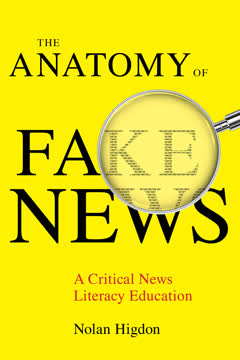
Key Takeaways
1. Fake News: An Ancient and Persistent Threat to Democracy
What is new is the amount of fake news being consumed and legitimized.
Historical deception. Fake news, defined as false or misleading content presented as news, is not a modern phenomenon. Its roots stretch back centuries, with documented instances like the 1475 false accusation against a Jewish man in Trent or the 1755 pamphlet claiming Virgin Mary's rescue during the Lisbon Earthquake. These early examples demonstrate its capacity to incite violence and shape public perception.
Modern ubiquity. While fake news has always existed, its current volume and widespread legitimization are unprecedented. Today, about two-thirds of Americans regularly encounter fake news, yet many struggle to differentiate it from legitimate journalism. This inability is exploited by politicians, media personalities, and online outlets who weaponize the term "fake news" to dismiss inconvenient facts and discredit credible reporting.
Eroding democracy. The pervasive consumption and legitimization of fake news pose an existential threat to democracy. When citizens cannot distinguish truth from falsehood, their agency in democratic processes is undermined, leading to manipulation and the potential rise of authoritarian regimes. Effective solutions require a comprehensive understanding of fake news's definition, producers, themes, purposes, and influence.
2. The Press: A Flawed but Essential Pillar of Democracy
freedom of the press is not just important to democracy, it is democracy.
Fourth Estate's role. The press, often called the "fourth estate," has historically been considered vital for democratic self-government, a sentiment echoed by Enlightenment thinkers like John Milton and Thomas Jefferson. From the printing press's advent to early American newspapers like the New York Packet, the press informed the public and mobilized citizens, even receiving legal protections and economic incentives in the U.S.
Five critical functions. In a democracy, the press is tasked with five crucial functions:
- Marketplace of Ideas: Offering diverse facts and perspectives for informed decisions.
- Agenda Setter: Informing the public about important issues.
- Watchdog: Exposing corruption and oppression.
- Information Disseminator: Spreading fact-based information and facilitating communication between leaders.
- Public Mobilizer: Convincing the public of the importance of key issues.
However, the effectiveness of these functions depends on responsible reporting and the ability to distinguish newsworthy content from "junk food news."
Challenges to integrity. Despite its vital role, the press faces significant challenges that compromise its democratic function. Journalists grapple with defining "newsworthy" content, distinguishing between mere "reporting" and in-depth "journalism," and managing bias, spin, and slant. The digital age exacerbates these issues, prioritizing speed over accuracy and viral content over democratic discourse, further eroding public trust and making the press vulnerable to political and economic pressures.
3. Propaganda Machines: Orchestrating Public Opinion for Political Gain
A political party propaganda apparatus is the loosely connected group of actors and institutions who, sometimes through coordination and other times through overlapping interests and actions, strive to influence public opinion.
Evolution of manipulation. Political propaganda apparatuses, originating from firms like Campaigns Inc. in the 1930s, have evolved to achieve political domination through public opinion manipulation. Early tactics included reframing negative press, publishing quotes out of context, and spreading fake news to defeat policy initiatives. Modern apparatuses, heavily influenced by strategists like Lee Atwater, weaponized fake news to exploit voter biases.
Tactics and themes. These apparatuses employ sophisticated tactics to influence elections and policy debates. Examples include:
- Push-polling: Spreading fake news about opponents under the guise of collecting data.
- "Message of the day": Repeating the same message to create an illusion of authenticity.
- Exploiting racism: The "Willie Horton" ad, which manipulated content to appeal to racial fears and secure electoral victory.
- Fabricating scandals: Creating false narratives about political figures, such as the Whitewater scandal or the "birther conspiracy" against Barack Obama.
These divisive tactics aim to polarize party adherents and incite extreme action against opponents.
Media integration. In the late 20th and early 21st centuries, news media outlets became increasingly integrated into political propaganda apparatuses. Corporate press, driven by profit and audience size, adopted the hyperpartisan, sensationalist style of satirical news. Outlets like Fox News (under Roger Ailes) and MSNBC became de facto propaganda wings for the Republican and Democratic parties, respectively, prioritizing ideological attacks over objective journalism and further blurring the lines between news and political advocacy.
4. State-Sponsored Deception: A Global Weapon of Control
A propaganda machine is a hegemonic force that organizes people and resources to construct and circulate dominant messages that seek to control and influence human behavior and attitudes.
Wartime origins. State-sponsored propaganda machines emerged during World War I, aiming to build national support for war efforts. Great Britain's Lord Kitchener used fake news to dehumanize Germans and provoke moral outrage, while the U.S. Committee on Public Information (CPI) transformed public opinion from isolationist to interventionist. Censorship, like the Espionage Act, ensured that only pro-war narratives circulated, often with journalists unknowingly repeating government-produced fake news.
Nazi Germany's model. Adolf Hitler, inspired by WWI propaganda, dramatically redefined state-sponsored deception. Paul Joseph Goebbels's Nazi propaganda machine controlled all media, forcing citizens to consume messages that:
- Centralized power: Blamed "others" (Jews, communists) for Germany's problems, stoking fear and justifying persecution.
- Used "Lügenpresse": Discredited critical journalists as "lying press" to normalize censorship.
- Pioneered false flags: Orchestrated fake attacks to justify invasions, like the staged attack on a German customs post to rationalize invading Poland.
- Denied reality: Fabricated stories of heroism and victory despite massive wartime losses, obscuring the truth from the public.
This machine resulted in the deaths of millions and demonstrated the power of saturating communication with falsehoods.
Cold War to War on Terror. The Cold War saw both the USSR and the U.S. deploy sophisticated propaganda machines. The USSR controlled information in satellite states and sowed division in the U.S. (e.g., claiming AIDS was a weapon against black people). The U.S. used the Smith-Mundt Act to spread propaganda internationally and the CIA's "Operation Mockingbird" to plant stories in domestic media, often collaborating with journalists. This continued into the War on Terror, with the Pentagon manufacturing fake news about soldiers (Jessica Lynch, Pat Tillman) and using "military analysts" to shape public opinion, later legalized by the Smith-Mundt Modernization Act of 2012.
5. The Internet Economy: A Potent Catalyst for Fake News Proliferation
The political economy of the internet incentivizes the spread of fake news.
From promise to surveillance. The internet, once hailed as an "information superhighway" promising freedom, transformed into an engine of "Surveillance Capitalism." The post-2000 recession and post-9/11 government demands for intelligence incentivized tech companies to exploit user data. This new economic order, as Shoshana Zuboff describes, claims human experience as raw material for hidden commercial practices, prioritizing behavioral modification over user autonomy.
Data, algorithms, and bubbles. The internet's political economy thrives on massive data collection (2.5 quintillion bytes daily) and machine intelligence. Algorithms, designed to maximize user engagement, create "filter bubbles" that reinforce existing beliefs by filtering out contradictory content. This constant confirmation makes users conflate familiarity with veracity, explaining why fake news spreads 70% faster than truth on social media and leading to screen addiction and "brain-hacking."
Profiteers and violence. This environment creates a profitable market for fake news peddlers. Internet fake news outlets, from early hoaxes to modern "deepfake" videos, exploit engaging, emotion-filled content (fear, disgust, surprise) to generate advertising revenue. Hyperpartisan sites like Drudge Report, Breitbart, and InfoWars thrive by spreading racist, xenophobic, and Islamophobic narratives, often leading to real-world violence, as seen in the Pizzagate shooting or attacks inspired by Alex Jones's conspiracy theories.
6. Traditional Solutions: Why Censorship, Regulation, and Tech Fixes Fall Short
Many of the non-education-based proposals are ineffective because they ignore the central reason why fake news is effective: news consumers cannot distinguish fake news from journalism.
Censorship's futility. Historically, governmental attempts at censorship, from colonial Massachusetts to the Alien and Sedition Act, have failed to curb fake news. Modern "censorship by proxy," where tech companies suppress content at government behest, also proves ineffective. Censorship often backfires, increasing demand for the targeted content (the Streisand effect) and fostering a chilling effect that silences legitimate journalists and creates an antidemocratic climate.
Regulation's limitations. Government regulation, such as the Communication Act of 1934 or the Fairness Doctrine, has also largely failed. These policies often operate on the false premise that citizens can differentiate fake news from journalism, or they inadvertently create opportunities for fake news producers. For example, the Rumor Project during WWII, designed to discredit false rumors, actually helped spread them, demonstrating that simply presenting facts does not guarantee their acceptance.
Techno-utopian pitfalls. Twenty-first-century techno-utopian solutions, driven by the belief that technology can solve societal problems, are equally flawed. Proposals like crowdsourcing (e.g., YouTube's Wikipedia integration, Facebook's trust rankings) are ineffective because the majority often cannot discern truth. "Customizing the crowd" solutions, like NewsGuard, empower political and economic elites, whose biases can further entrench fake news narratives, rather than genuinely educating the public.
7. Critical News Literacy: The Indispensable Defense for an Informed Citizenry
The most accepted theoretical design of a critical media literacy pedagogy derives from Douglas Kellner and Jeff Share of University of California, Los Angeles, who argue that effective critical media literacy is demonstrated when students can critically dissect media forms; discriminate and evaluate media content; investigate media effects and uses; construct alternative media; and use media intelligently.
The urgent need. Given the failures of traditional solutions and the pervasive nature of fake news, critical news literacy education is paramount. Few Americans receive adequate media literacy, and even fewer receive specific news literacy training. Acritical media literacy, often influenced by tech corporations, normalizes rather than critically examines media, failing to equip citizens with the tools to identify and resist manipulation.
A critical framework. A critical approach, rooted in the Frankfurt School, emphasizes understanding the power dynamics embedded in media content. It interrogates how media positions audiences to interpret race, class, gender, and other identity markers, exploring pathways to liberation through self-actualization and democracy. This framework is essential for conceptualizing a news literacy pedagogy that empowers citizens rather than the producers of fake news.
Empowering citizens. Effective critical news literacy pedagogy aims for "intelligent media use," defined as liberation from dominant ideologies. It encourages students to:
- Critically dissect media forms: Understanding how different media (print, digital, video) convey messages.
- Discriminate and evaluate content: Assessing the veracity and intent behind news stories.
- Investigate media effects: Analyzing how media influences attitudes and behaviors.
- Construct alternative media: Creating and engaging with diverse, ethical information sources.
- Use media intelligently: Recognizing technology's dual role as a tool for exploitation and liberation, and actively resisting cognitive subjugation.
8. The Fake News Detection Kit: A 10-Point Process for Media Citizens
Collectively, these skills, organized in a series of questions, will help you better determine the validity of news content.
Becoming media citizens. To safeguard democracy, individuals must transform from passive "media consumers" into active "media citizens." This involves prioritizing informed decision-making over simply sharing or liking content. The goal is to scrutinize quality information rather than succumbing to "news inflation" by consuming an endless stream of unverified content. Slowing down and investigating before reacting is crucial.
Self-reflection and source analysis. The detection kit begins with self-awareness and critical examination of the source:
- Do I want to be informed or a fake news disseminator? Avoid sharing unread content; scrutinize headlines.
- Should I react or investigate? Resist emotional triggers; slow down before acting.
- Why was my attention drawn to this content? Reflect on personal biases and limit data sharing permissions.
- Who is the publisher/author of this content? Identify their intent, potential conflicts of interest, and history of accuracy using fact-checking resources like Media Matters, FAIR, Snopes, PolitiFact, and FactCheck.
Content evaluation and journalistic ethics. The process culminates in a thorough evaluation of the content itself:
- Do I understand the content? Use the 5Ws and H (Who, What, Where, When, Why, How) to ensure comprehension.
- Does the evidence hold up under scrutiny? Identify logical fallacies (e.g., ad hominem, slippery slope), verify sources (independent, multiple, verifiable, authoritative, named), and cross-check with diverse news outlets (All Sides, Project Censored).
- What is missing from this content? Compare narratives across different ideological and identity-based sources; consult experts.
- Who might benefit from or be harmed by this message? Identify if the content aims to produce moral panic, outrage, radicalization, division, or bolster authoritarianism, especially if it targets identity groups with themes of nationalism, fear, hate, or celebrity gossip.
- Does the content qualify as journalism? Assess if it adheres to the five critical democratic functions of the press, meets newsworthiness criteria, and follows ethical principles: truth and accuracy, independence, fairness and impartiality, humanity, and accountability.
Last updated: