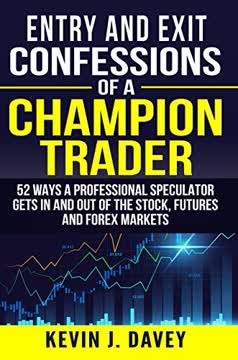
Key Takeaways
1. Trading Algos: Simple Entries & Exits are the Foundation
My experience is that overly complicated strategies are just too much.
Simplicity reigns supreme. The core philosophy for building successful trading algorithms (algos) is to keep the entry and exit conditions straightforward. Complex strategies with numerous rules and filters often lead to spurious relationships that perform well in historical backtests but fail in live trading. The market, in the author's 25+ years of experience, tends to favor simple, understandable logic.
Building blocks. This book provides 41 unique entry and 11 exit ideas, all battle-tested and used by the author in real-money trading or extensive evaluations. These are not complete strategies but fundamental components that traders can combine, modify, and test to create their own algos. The goal is to empower traders to "fish for themselves" rather than being spoon-fed ready-made solutions.
Beyond indicators. While many entries use classic indicators like RSI or moving averages, the emphasis is on the underlying logical reasoning. The author prefers entries and exits that can be reasonably explained, rather than relying solely on machine learning to find potentially fluke relationships. This ensures a deeper understanding and greater confidence in the strategy's robustness.
2. The Champion Trader's Mantra: Test, Test, Test
But don’t take my word for it – TEST THESE YOURSELF!
Verification is vital. The author, a three-time champion in real-money futures trading contests, attributes his success to developing and rigorously testing trading strategies. He stresses that every idea, every entry, and every exit must be put through its paces on historical data to determine its profitability and viability. This hands-on testing builds confidence, which is essential for self-sufficient trading.
Not a "plug and play." The entries and exits provided are valuable pieces, but they are not ready-to-trade strategies. Simply combining an entry and an exit and throwing them on a chart without thorough testing is deemed foolish. Traders must actively engage in the process of:
- Modifying ideas to suit their needs.
- Combining components into a complete strategy.
- Evaluating performance on historical data.
Market specificity. No single entry or exit works universally across all markets or timeframes. What performs well in metals might not work in forex, and a daily bar strategy will differ from a 30-minute bar strategy. Therefore, a defined plan for testing across various markets and bar sizes is crucial to uncover where these components truly shine.
3. Beware the Pitfalls: Over-optimization and Ready-Made Strategies
Just optimizing is not going to work!
The illusion of perfection. A common trap for new algo traders is to over-optimize strategy parameters on historical data, leading to impressive backtest results that rarely translate to real-time profits. The author explicitly warns against this "testing success by torture," where an entry is tweaked until it finally yields good results, often resulting in a "curve-fit, over-optimized piece of garbage."
No free lunch. Profitable, complete trading strategies are not given away for free or minimal cost. The author advises skepticism towards internet educators offering "secret" strategies. Published strategies tend to degrade over time, either due to normal market evolution or because widespread adoption erodes their edge. The true value lies in learning the development process, not in acquiring pre-made solutions.
Learning from mistakes. The author openly admits to falling into these traps early in his trading journey, with negative consequences. He urges readers to learn from his past errors:
- Do not trade strategies without a proven testing process.
- Avoid excessive optimization that creates unrealistic expectations.
- Understand that a great backtest does not guarantee future success.
4. Structured Development: The Strategy Factory Approach
The process to properly develop an algo is complicated – it is not as simple as applying the strategy to a chart and optimizing like crazy– and is advanced material not included in this book.
Methodology is critical. Success in algo trading hinges on a structured, proven methodology for developing and testing strategies. The author emphasizes his "Strategy Factory® approach," which he used to win trading championships and has taught to other successful traders. This process is designed to identify robust strategies that deliver real-money profits, avoiding the pitfalls of haphazard testing.
A defined plan. Before diving into testing entries and exits, traders need a clear plan. This plan should outline:
- Target Markets: Which specific markets will be tested?
- Bar Sizes: What timeframes (e.g., 30-minute, daily) will be examined?
- Testing Process: A robust, repeatable method for evaluating strategies.
Essential components. Every strategy, regardless of its complexity, must include fundamental components. These elements ensure a complete and functional trading system, even if some are initially simple or inherent in the entry/exit logic.
- Long entry rule
- Short entry rule
- Long exit rule
- Short exit rule
- Position Sizing (optional, often added later)
5. Entries: Momentum, Breakouts, and Patterns Drive Signals
I don’t have (or recommend) entries with 10 or 20 conditions, rules or filters just to get a buy or sell signal.
Diverse signal generation. The book presents a wide array of entry techniques, categorized broadly into momentum, breakout, and pattern-based approaches. These range from simple 1-bar momentum ("Go With The Flow") to more complex intraday breakouts with expanding ranges, or patterns based on recent closes. Each entry is designed to capture specific market behaviors.
Filtered approaches. Many entries incorporate filters to enhance signal quality. For instance, the "Breakout With A Twist" entry uses the ADX indicator to only take breakouts during non-trending periods, aiming to catch the start of new, significant trends. Other filters include:
- Day of week restrictions ("Everyone Loves Friday," "Day Of Week Trading")
- Volatility filters (e.g., Average True Range based breakouts)
- Time of day constraints for intraday strategies ("Intraday Breakout")
Beyond the obvious. Some entries challenge conventional wisdom, like "Not Day Of Week Trading," which excludes specific days rather than including them. Others introduce concepts like "Serial Correlation," where entry depends on the profitability and timing of previous trades, suggesting that trades are not always independent events. The variety encourages exploration and adaptation.
6. Exits: Timed, Trailing, and Profit Protection Secure Gains
I am going to reveal my absolute favorite exit. I like it because it performs very well, in a variety of markets and timeframes!
The power of simplicity. The author's "absolute favorite exit" is the "Timed Exit," which simply exits a position after a specified number of bars. This seemingly basic approach, also favored by legendary traders like John Henry, works surprisingly well across various markets and timeframes, suggesting that entry signals have a limited validity period.
Beyond fixed stops. While traditional stop losses and profit targets are covered, the book introduces more dynamic exit strategies. These include:
- Percentile Exit: Exiting when the current close falls into lower (for long) or upper (for short) percentiles of recent prices, signaling a turn.
- "Don't Give It All Back": A trailing exit that closes a position if the open profit drops by a certain multiple of the Average True Range from its peak.
- "Profit Protector": Similar to the above, but exits if the current profit falls below a specified percentage of the maximum profit achieved, after a certain profit threshold is met.
Hidden exits and real-world considerations. The concept of "No Exit Can Still Be An Exit" highlights that a stop-and-reverse entry implicitly acts as an exit. The book also addresses practical issues like Tradestation's setexitonclose keyword not working in real-time, offering a custom "End Of Day Exit" solution. These insights underscore the importance of understanding how exits function both theoretically and practically.
7. Symmetry in Strategy Design: A Guard Against Curve-fitting
For most markets, you do not want to restrict the ability to go long or short. Going long should be just as easy as going short.
Mirror image logic. The author intentionally designs most entries and exits to be symmetric, meaning the logic for short trades is a mirror image of long trades. This approach is preferred because most markets historically exhibit near-equal frequency of upward and downward movements. Maintaining symmetry helps to limit curve-fitting, as it reduces the number of parameters that can be independently optimized.
Exceptions to the rule. While symmetry is generally favored, the author acknowledges exceptions, particularly in markets with inherent biases. The stock market, for instance, has an upward bias, which might justify asymmetric strategies that favor long trades. However, even in such cases, the advice is to use minimal optimization to avoid creating strategies that perform well only in backtests.
The risk of asymmetry. Asymmetric entries, like "Asymmetric Triple" or "Asymmetric Again," are presented with a caveat. Having separate calculation methods for long and short entries introduces more "degrees of freedom," making it easier to tweak and optimize for better backtest results. This increased flexibility, however, often leads to strategies that underperform in real-time trading due to over-optimization.
8. Order Types and Their Real-World Impact on Execution
I primarily use market orders in my trading. When all the pieces of my strategy signal “buy,” I don’t want to miss that trade.
Prioritizing execution. The author's preference for market orders stems from a desire to ensure trades are executed immediately when a signal is generated, even if it means incurring slippage. Missing a valid trade signal is often seen as a greater cost than the potential slippage associated with market orders. This pragmatic approach prioritizes getting into the market when the strategy dictates.
Understanding stop orders. Stop orders, while often perceived as protective, are essentially market orders triggered at a specific price. They can also experience slippage, sometimes extreme, especially in fast-moving or illiquid markets. Traders should be aware that stops do not guarantee execution at the exact stop price, and this reality must be factored into risk management.
Caution with limit orders. Limit orders, which guarantee a specific price or better, are generally avoided by the author despite their lack of slippage. The primary reason is the frustration of missed trades: price might touch the limit, but the order isn't filled, and the market moves away. Limit orders also add complexity when trading multiple contracts and dealing with partial fills, making them more trouble than they are worth for many automated strategies.
9. The Synergy of Entries and Exits Defines Strategy Performance
One important thing to remember is that entries and exits together make the strategies, not just one or the other.
Holistic strategy design. A crucial insight is that a trading strategy's performance is a result of the interaction between its entry and exit components, not just the individual strength of each. An entry that performs poorly with one exit might excel when paired with a different one, and vice versa. This emphasizes the need for a comprehensive approach to strategy development.
Iterative testing. Traders should not discard an entry simply because its initial test with a single exit yields terrible results. The recommendation is to experiment with various exits to find optimal pairings. This iterative process of combining and testing different entry-exit combinations is key to uncovering robust and profitable strategies.
Beyond individual components. The book provides a toolkit of entries and exits, but the true art lies in how these tools are combined. The interaction between when a trade is initiated and when it is closed dictates the overall profitability and risk profile. This synergy is what transforms individual ideas into a cohesive and effective trading system.
10. Patience and Continuous Learning in Algo Development
Don’t get discouraged. Most of the tests you run will result in failure, even for the proven entries and exits in this book.
Embrace failure. Developing good trading strategies is hard work, and the vast majority of tests will result in failure. Even the proven entries and exits in this book are not universal and will not work in all markets or situations. The author stresses that this is a normal part of the process and encourages persistence, reminding traders that finding profitable strategies, much like trading itself, requires resilience.
Ongoing evolution. Markets are dynamic, constantly evolving. A strategy that works today might not work tomorrow. Therefore, the strategy development process is never-ending. Even after years of success, the author continues to test new strategies regularly to adapt to changing market conditions. This commitment to continuous learning and adaptation is vital for long-term success.
Document and reflect. To maximize learning and avoid repeating efforts, traders are advised to meticulously document their work. Keeping track of what was tested, what worked, and what didn't helps to:
- See progress over time.
- Prevent redundant tests or analyses.
- Build a knowledge base for future development.
Last updated:
Review Summary
Entry and Exit Confessions of a Champion Trader receives mixed reviews, with an average rating of 3.59 out of 5. Some readers find it useful for beginners, offering simple entry and exit concepts to build upon. Others criticize its lack of rationale and performance data for the strategies presented. The book is described as a collection of basic ideas that require further development and testing to be profitable. While some appreciate the straightforward approach and potential for sparking ideas, others feel the content could have been presented more effectively as blog posts or with additional details.

About the Author
Download PDF
Download EPUB
.epub digital book format is ideal for reading ebooks on phones, tablets, and e-readers.





