Key Takeaways
1. Understand the Nature of Expectation Hangovers
We suffer when our reality does not match the expectations we are so attached to.
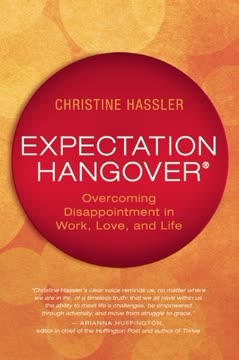
Defining the discomfort. An Expectation Hangover® is the profound disappointment and suffering experienced when reality deviates from our plans, desires, or self-imposed standards, or when expected fulfillment from achieving goals doesn't materialize. It's a universal human experience, fueled by a life "drunk with expectations" and the inevitable crash when things don't go as hoped. These hangovers are not just about external events; they deeply impact our internal state.
Symptoms and categories. The symptoms mirror an alcohol hangover but are far more miserable and lasting, including lack of motivation, depression, anxiety, self-judgment, and strained relationships. Expectation Hangovers typically fall into three categories:
- Situational: When events don't turn out as planned (e.g., a job loss).
- Interpersonal: When others let us down (e.g., a relationship ends).
- Self-imposed: When we fail to meet our own standards (e.g., not achieving a personal goal).
These experiences often trigger debilitating thoughts like "I am not enough" or "Things never work out for me," threatening our sense of identity and plummeting self-esteem.
Life's lessons. Ultimately, Expectation Hangovers serve as paradigm-shifting life lessons, acting as a "wild card" that forces us to look inward and consider new directions. They teach us that control is an illusion, our comfort zone is a trap, true fulfillment comes from within, and that life's challenges are not punishments but opportunities for growth. These moments, though painful, are doorways to healing past issues, changing present behaviors, and creating a future aligned with our true selves.
2. Recognize and Abandon Ineffective Coping Strategies
Numbing the pain for a while will make it worse when you finally feel it.
Temporary relief, lasting damage. When faced with an Expectation Hangover, our immediate impulse is to alleviate the discomfort, leading us to employ six common, yet ultimately ineffective, coping strategies. These methods offer fleeting relief but prevent genuine healing and often exacerbate the underlying issues, creating a cycle of repeated disappointment. They are like putting a Band-Aid on a deep wound, ensuring it will reopen later.
The six pitfalls:
- Distraction: Channeling energy into busyness to avoid acknowledging the pain.
- Numbing the Pain: Using substances (alcohol, food, drugs) or behaviors (TV, social media, overworking) to suppress feelings. This is highly damaging as it requires increasing stimulation over time.
- Being Strong: Suppressing emotions and pretending everything is fine, often due to societal conditioning, which prevents vulnerability and genuine processing.
- Pep Talks: Forcing positive affirmations that feel inauthentic amidst disappointment, leading to self-judgment and avoidance.
- The Next Best Thing: Seeking external replacements (new job, city, relationship) without addressing internal issues, building a "house on sand."
- Spiritual Bypass: Attempting to jump straight to blessings or spiritual platitudes without doing the necessary emotional, mental, and behavioral work.
Breaking the cycle. These strategies, while understandable, deny us the opportunity for valuable learning and healing. They keep us stuck in limiting patterns, perpetuating the hangover. True transformation requires acknowledging these patterns and committing to a multi-dimensional approach that addresses the root causes, rather than just masking the symptoms.
3. Embrace Awareness and Acceptance as Your First Step
Life is simple. Everything happens for you, not to you. Everything happens at exactly the right moment, neither too soon nor too late. You don’t have to like it…it’s just easier if you do.
The power of knowing. The first crucial step out of disappointment is to become fully aware of your Expectation Hangover and how it impacts you across emotional, mental, behavioral, and spiritual levels. Just as a doctor needs a comprehensive assessment, you must thoroughly examine your symptoms and their origins. This deep self-assessment is your primary tool for understanding and effective treatment.
Acceptance over resistance. Once aware, the next vital step is acceptance. This doesn't mean condoning or liking what happened, but rather releasing judgment about it. Judgment labels events as "good," "bad," "right," or "wrong," creating resistance that drains energy and perpetuates suffering. Acceptance means letting go of these interpretations and the attachment to how things "should" have been, freeing up immense energy for healing.
Shifting perspective. By choosing acceptance, you stop fighting reality and open yourself to a more expansive attitude. This shift from "why is this happening to me?" to "what am I learning from this experience?" transforms you from a victim into an empowered learner. This non-judgmental stance allows you to move forward with grace, recognizing that every circumstance, even the most challenging, holds a potential blessing for your growth.
4. Heal Emotionally by Riding the Waves with The Surfer
As a natural life force, emotions are intended to flow freely through our bodymind, then dissipate once we have fully experienced them and assimilated their valuable message.
Emotions as waves. Our emotions, especially the "negative" ones triggered by an Expectation Hangover, are not to be avoided or suppressed. Instead, they are like ocean waves: they have peaks and valleys, and if allowed to flow, they will eventually subside. The role of The Surfer is to ride these emotional waves without judgment, analysis, or the desire to escape, trusting that they will carry you to a place of peace and release. Suppressing emotions, a habit learned in childhood, leads to unhealthy thoughts, behaviors, and even illness.
Tools for emotional release. To effectively surf your emotions, two powerful techniques are introduced:
- Release Writing: A stream-of-consciousness dumping of thoughts and feelings onto paper, written as fast as possible without editing or analysis. The purpose is to embody the emotion and let it flow out, then destroy the paper to release the energy, preventing recycling.
- Temper Tantrum Technique: An adult version of a child's tantrum, allowing full, uninhibited expression of anger, sadness, fear, or shame in a safe, private space. This technique helps purge decades of repressed emotions, often leading to profound breakthroughs and a renewed sense of confidence and energy.
Self-compassion and vulnerability. Your "surfboard" in this process is self-compassion – an unconditionally loving and nurturing part of yourself that keeps you safe. Vulnerability, being raw and real with trusted others, is also crucial. Shame, the painful feeling of a perceived flaw that must be hidden, dissolves when brought into the light through authentic sharing. This creates deeper connections and reinforces that you are loved "even if" you have dark, scary feelings.
5. Master Your Mind by Reining in Thoughts with The Horseback Rider
If you can get more control over what happens between your ears, you can transform yourself to become happier, stronger, more resilient, more loving, more able to help yourself and others.
Thoughts shape reality. During an Expectation Hangover, our minds often become our worst enemies, racing with negative self-talk, guilt, regret, anxiety, and worry. The role of The Horseback Rider is to gain mastery over these thoughts, recognizing that while we have thoughts, we are not our thoughts. This involves observing the mind's direction, reining it in, and redirecting it towards more positive, life-affirming pathways.
Rewiring your brain. Repetitive thoughts create neural nets in the brain, forming "grooves" that thoughts habitually follow. By consciously steering thoughts off these well-worn paths, we can create new neural pathways through self-directed neuroplasticity. Key tools include:
- Whoaing: Using the sound "Whoa!" to instantly slow down and stop runaway negative thoughts, bringing awareness back to the present moment.
- Redirecting: Actively steering thoughts towards simple truths like "I did the best I could" or "I am enough," especially when battling negative self-talk or pendulum thinking. This involves reframing beliefs and questioning assumptions that perpetuate suffering.
Time travel and presence. The mind often "time-travels" to the past (fuelling guilt and regret) or the future (fuelling anxiety and fear).
- Past-Hacking: Releasing guilt and regret by learning from past "mistakes" and committing to different future responses, rather than replaying scenarios. It also involves getting your past "off a pedestal" by recalling the full truth, not just romanticized memories.
- Future-Tripping: Combating anxiety and worry by bringing awareness back to the present moment through deep breathing and meditation. This involves answering "what-if" questions with neutral or empowering possibilities, using imagination for desirable outcomes instead of dread.
6. Transform Behavior by Acting from Your Superpowers with The Scientist
If you don’t go after what you want, you’ll never have it. If you don’t ask, the answer is always no. If you don’t step forward, you’re always in the same place.
Awareness without action is entertainment. Inner clarity about your Expectation Hangover is vital, but without corresponding action, nothing changes in your physical reality. The role of The Scientist is to observe your behavior without judgment, investigate what drives it, hypothesize new actions, and test them to create desired results. This proactive approach moves you from unconscious habits to conscious, intentional choices.
Self-care and breaking addictions. Your first experiment involves examining and modifying self-care habits. Expectation Hangovers often lead to self-sabotaging behaviors (e.g., overeating, excessive drinking, lack of sleep) that deplete your "basic self" and trigger primal fears. The Scientist identifies these addictive patterns and replaces them with nurturing actions, recognizing that true liberation comes from aligning actions with what truly feeds your body, mind, heart, and spirit.
Uncovering compensatory strategies. Many behaviors are driven by compensatory strategies developed in childhood to cope with feelings of unworthiness, unsafety, or unlovability (e.g., high achiever, people pleaser, control freak, rescuer, perfectionist). These strategies offer temporary payoffs but come with the cost of Expectation Hangovers. The Scientist investigates these underlying motivations to understand why you do what you do, paving the way for lasting change.
Activating your superpowers and values. Instead of being driven by compensatory strategies, you are inspired by your intrinsic "superpowers"—qualities you were born with (e.g., compassion, creativity, joy). The Scientist helps you identify these and align your actions with your core values (e.g., connection, service, empowerment). This shift from "away from" motivation (avoiding pain) to "toward" motivation (moving towards values) creates value-inspired action, leading to fulfillment rather than just survival.
7. Connect Spiritually by Exploring Your Soul Line with The Seeker
Know that everything is in perfect order whether you understand it or not.
Beyond the physical. From a spiritual perspective, disappointment is an opportunity for learning and growth. The Soul Line represents our spiritual curriculum—the life lessons we are here to learn and the evolution of our internal awareness towards unconditional Love (Agape Love). Expectation Hangovers, hitting hardest on the physical Goal Line, often propel us onto the Soul Line, revealing where we've been most externally invested.
Life as a classroom. Every event, person, and Expectation Hangover is part of our unique spiritual curriculum, designed to help us grow. The Seeker approaches life with curiosity, asking "Why is this happening for me, and what am I learning?" This perspective transforms challenges into gifts, fostering spiritual growth and connection. It moves us from a victim consciousness to an empowered one, where there are no mistakes, only lessons.
Disintegration and integration. Treating Expectation Hangovers spiritually is a process of disintegrating the separation between the Goal Line and Soul Line, allowing us to integrate and experience ourselves as spiritual beings having a human experience. This involves:
- Discernment over judgment: Choosing what serves us without labeling things as "good" or "bad."
- Living Inside Out: Recognizing that true contentment and everything we desire resides within us, not in external circumstances.
- Surrender: Laying down our will and trusting a Higher Power, not as resignation, but as "proactive surrender"—taking value-aligned action while being open to divine guidance.
8. Live Inside Out: Cultivate Inner Fulfillment
As long as anyone believes that his ideal and purpose is outside him, that it is above the clouds, in the past or in the future, he will go outside himself and seek fulfillment where it cannot be found. He will look for solutions and answers at every point except where they can be found — in himself.
The illusion of external happiness. Most of us live "out-in," allowing external circumstances to dictate our internal state. We constantly seek something outside ourselves—a soul mate, a career, possessions—to bring us confidence, happiness, and fulfillment. This cycle of external seeking inevitably leads to Expectation Hangovers because true contentment is an internal state, our natural condition from a soul-line perspective.
Generating inner joy. The truth is, everything you desire is within you. Memories of past joy don't give you joy; they elicit the joy that already resides inside. By reorienting from "out-in" to "in-out," you recognize your ability to generate these feelings independently of external events. This doesn't mean minimizing external pleasures, but rather not relying on them as the source of your internal state.
The "wherever you go, there you are" principle. You cannot outrun your insecurities or weaknesses by changing your external environment. True healing and fulfillment come from looking inward with compassion and allowing those parts of yourself to heal. By putting your ego aside and asking what your soul truly needs, you gain clarity and build a more solid internal foundation, realizing that the "everything" you ever wanted is already inside you.
9. Practice Forgiveness to Liberate Yourself
Forgiveness is the fragrance a violet sheds on the heel that has crushed it.
Setting yourself free. Forgiveness is a powerful spiritual tool, often misunderstood and underused. It's not about condoning what happened or letting someone else "off the hook"; it's about liberating yourself from the burden of blame, resentment, and grudges. Holding onto judgments against others or ourselves perpetuates suffering and keeps us trapped in the past.
Forgiving others. From the Seeker's perspective, everyone in our lives, even those who seemingly caused us pain, are "soul mates" here to teach us valuable lessons. They are doing the best they can, given their own life curriculum and profound disconnections. Forgiving others means releasing the judgments we've harbored against them, seeing their pain with compassion, and understanding that their actions were often triggered by their own Expectation Hangovers. This act of self-love frees us from the toxic energy of blame.
Self-forgiveness. Often, the hardest person to forgive is ourselves. Plagued by regret and guilt, we believe that self-forgiveness means letting ourselves off the hook or failing to learn. This is untrue. Self-forgiveness is about releasing the judgments we've made against ourselves and the limiting beliefs we've bought into. It recognizes our humanness, acknowledging that we always do the best we can with what we know at the time. The energy of compassion is key to this process, dissolving the illusion of separation and unlocking power previously trapped in judgment-based emotions.
10. Surrender to a Higher Power with Proactive Trust
Some people believe holding on and hanging in there are signs of great strength. However, there are times when it takes much more strength to know when to let go and then do it.
The wall of uncertainty. Expectation Hangovers often hit us in our most tender areas, repeatedly, not as punishment, but to wake us up. They bring us to a personal "wall"—the edge of what we knew ourselves to be—challenging our faith. Surrender, though difficult, is about laying down our will and trusting in a Higher Power, recognizing that we don't have to navigate life entirely alone. This deepens our connection to Spirit, the truest source of love and comfort.
Proactive surrender. This isn't passive resignation or giving up on dreams; it's a dynamic process of letting things happen naturally while being attuned to divine guidance. It means taking value-aligned action steps in support of a dream, but remaining unattached to the specific outcome or timeline. Spirit meets us at our point of action and intention, often revealing opportunities in unexpected forms.
Faith in the unknown. Surrender is where true faith is developed, not in times of certainty, but in the vast sea of the unknown. It means being at peace with "what is" and trusting the Universe even when the path ahead is unclear. This involves:
- Not looking down (avoiding worst-case scenarios).
- Not looking behind (releasing regret).
- Staying present and open to the excitement of uncertainty.
This practice transforms the loneliness of Expectation Hangovers into a profound connection with a Higher Power, bringing peace and liberation.
11. Manage Expectations with High Involvement, Low Attachment
My happiness grows in direct proportion to my acceptance, and in inverse proportion to my expectations.
Growth is a process. Overcoming an Expectation Hangover doesn't mean never experiencing disappointment again; it means being equipped to reduce its frequency and duration. Growth is not a linear event but a continuous process, often involving steps forward and backward. The key is persistence and applying the learned treatment plan consistently.
The secret sauce for goals. The most effective way to pursue goals without setting yourself up for an Expectation Hangover is through high involvement and low attachment.
- High Involvement: Proactively participating and taking inspired action towards your goals, aligning with your values and superpowers.
- Low Attachment: Not tying your well-being, worthiness, or happiness to specific outcomes. Remaining open to things manifesting in unexpected forms.
This "through me" consciousness recognizes that effort is important, but results are not entirely up to you, and your worth is not dictated by them.
Realistic expectations. Managing expectations means becoming aware of when you're falling into the illusion of control or "when/then" thinking. It's about making room for life's inherent variety—bad days, curveballs, and others' imperfections—without lowering your standards or accepting poor treatment. This approach fosters grace and synchronicity, allowing more opportunities aligned with your heartfelt dreams to flow into your life.
12. Implement Quick Fixes for Lasting Prevention
It’s not whether you get knocked down, it’s whether you get up.
Proactive well-being. Once you've processed your Expectation Hangover, certain "quick fixes" become powerful preventive measures. These aren't superficial solutions but conscious shifts in mindset and behavior that, when consistently applied, foster resilience and joy. They work because you've cleared the underlying emotional and mental clutter, allowing these practices to take root deeply.
Seven powerful shifts:
- Stop People-Pleasing: Prioritize self-honoring choices over seeking external validation. Your worth isn't dependent on others' opinions.
- Go Your Own Way: Listen to your intuition, your inner compass, which guides you one moment at a time towards experiences that feed your soul.
- Don't Go to a Chinese Restaurant for Nachos: Have realistic expectations of others. Seek support from those who genuinely have what you need to offer, accepting others for who they are.
- Wake Up from Comparison Comas: Stop comparing yourself to others, which robs joy and blinds you to your own gifts. Instead, use admiration as a positive projection of your own unexpressed potential.
- Be of Service: Shift from "What can I get?" to "What can I give?" Service, without expectation, replaces potential hangovers with profound fulfillment.
- Be a Kid: Reclaim playfulness, creativity, and joy. Don't take yourself too seriously; find the comedy in your humanness and laugh at the unexpected.
- Gorge on Gratitude: Cultivate appreciation for everything—pleasant blessings, challenges, and even past disappointments. Gratitude fills you so completely that there's no room for disappointment.
A life of freedom. These practices, combined with the holistic treatment plan, empower you to live a life unconstrained by external circumstances. You gain the freedom to choose your inner response in every moment, embracing life's unexpected surprises with grace, compassion, and loving awareness, knowing that a wonderful gift is always wrapped inside your Expectation Hangover.
Last updated:
Review Summary
Expectation Hangover receives mixed reviews, averaging 3.88 stars. Positive reviewers praise its comprehensive approach to handling disappointment, with useful exercises and meditations for processing emotions and reframing expectations. Many found it life-changing and transformative. Critics note the book feels disjointed, like compiled articles rather than cohesive writing, with excessive quotes disrupting flow. The spiritual content, rooted in transpersonal psychology, receives mixed reactions—some appreciate it while others find it ungrounded or overly "woo woo." Several readers suggest the content could be condensed, though they acknowledge the core concept is valuable.
Similar Books