Key Takeaways
1. Futures Contracts: Standardized Agreements for Future Price Discovery
A futures contract is a legally binding, standardised agreement to buy or sell a commodity or financial instrument of specific quality and quantity on a specified future delivery date at a given location.
Evolution and standardization. Futures contracts evolved from informal "forward contracts" in ancient marketplaces, formalizing in the 1800s with the Chicago Board of Trade (CBOT) to address issues like default and lack of liquidity. These standardized agreements specify quantity, quality, and delivery date, with only the price remaining variable, discovered through continuous competitive bidding. This standardization, coupled with the concept of "fungibility" (mutual substitution), allows contracts to be traded multiple times before expiry.
Core mechanics. Unlike direct commodity purchases, futures contracts are primarily used for price speculation or hedging, with less than 5% resulting in physical delivery. Traders can "offset" their positions by taking an opposite trade before the expiry date, realizing a profit or loss from price fluctuations. This flexibility makes futures accessible to a broad range of participants who may have no interest in owning the underlying asset.
Cash vs. physical. Futures contracts can be either cash-settled (e.g., S&P 500 index) or physically delivered (e.g., wheat). While physical delivery ensures futures prices converge with cash prices at expiry, cash settlement offers convenience for instruments where physical transfer is impractical. The ongoing price discovery process, now largely electronic, ensures transparency and efficiency in these global markets.
2. The Clearing House: Guaranteeing Trade Integrity and Mitigating Risk
By serving as the counterparty in every transaction, the clearing house becomes ‘the buyer to every seller and the seller to every buyer’.
Central counterparty role. The clearing house is a critical intermediary in every futures transaction, stepping in between the buyer and seller. This "novation" process means traders effectively transact with the clearing house, not each other, eliminating third-party counterparty risk. This structure is a significant advantage over Over-The-Counter (OTC) markets, where participants deal directly and bear each other's default risk.
Margin requirements. To ensure financial integrity, the clearing house mandates two types of margin: initial margin (a good faith deposit to open a trade) and variation or maintenance margin (funds required to cover daily mark-to-market losses). These margins are dynamic, adjusted based on contract volatility, and protect against large losses accumulating. If an account balance falls below the maintenance margin, a "margin call" is issued, requiring additional funds or position liquidation.
Risk management for all. Daily "mark to market" adjustments ensure that individual trading accounts maintain sufficient capital, preventing excessive debt accumulation. This robust system provides confidence to all market participants—from individual traders to large institutions—that all transactions will be honored, even in volatile market conditions.
3. Hedging and Speculation: The Dual Economic Functions of Futures Markets
Futures markets facilitate the transfer of risk from hedgers to speculators.
Hedging for risk management. Hedging is the primary economic function of futures markets, allowing producers and consumers to manage price risk in the cash market by taking equal and opposite positions in the futures market. This strategy "locks in" a known price, protecting against unfavorable price movements, though it means foregoing potential benefits from favorable ones. Examples include:
- A farmer selling futures to protect against falling crop prices ("short hedge").
- A manufacturer buying futures to protect against rising raw material costs ("long hedge").
Speculation for profit and liquidity. Speculators, on the other hand, actively seek to profit from anticipated price increases ("going long") or decreases ("going short"). By willingly taking on the risk that hedgers wish to avoid, speculators inject crucial capital and liquidity into the markets. This ensures that hedgers can always find a counterparty for their transactions, making the markets more efficient and robust.
Diverse market participants. Both hedgers and speculators contribute to the market's vitality. Hedgers include commodity producers (e.g., gold miners, oil companies), commodity buyers (e.g., food processors, airlines), and portfolio managers. Speculators range from independent retail traders to large hedge funds and proprietary trading firms, each employing various strategies and timeframes to capitalize on market movements.
4. Leverage: A Powerful Tool Requiring Prudent Risk Management
Buying and selling futures contracts has exactly the same profit or loss potential when measured in dollars and cents as does buying or selling the actual underlying commodity or financial instrument.
Magnifying returns. Leverage is a major attraction of futures trading, allowing traders to control large positions with a relatively small amount of capital (the initial margin). This means a small percentage movement in the underlying asset's price can translate into a significantly magnified percentage profit or loss on the margin invested. For instance, a 1% price move in a contract with 35:1 leverage results in a 37% return on margin.
The double-edged sword. While leverage can dramatically amplify profits, it equally magnifies losses. A small adverse price movement can quickly erode a substantial portion of a trading account if positions are over-leveraged. This inherent risk underscores the critical importance of understanding and managing leverage effectively.
Account capitalization. Proper account capitalization is essential. Trading with insufficient funds relative to the contract size can lead to rapid account depletion, especially if multiple contracts are traded without understanding the total exposure. The book emphasizes that using leverage incorrectly is a primary cause of trading account destruction.
5. Trading Mechanics: Mastering Diverse Order Types for Market Engagement
Competency with the various order types that apply to the futures markets is an essential skill to acquire and master for those wanting to participate in these markets.
Entering and exiting trades. Futures trading allows for equal ease in "going long" (buying in anticipation of price rises) or "going short" (selling in anticipation of price falls). Every trade involves at least two orders: one to enter and one to exit. Understanding how to confidently execute both long and short trades unlocks significant profit opportunities, especially in downtrending markets which can often move faster than uptrends.
Essential order types. Traders utilize various order types to manage entry, exit, and risk:
- Market Orders: Execute immediately at the best available price, suitable for urgent entry/exit but prone to "slippage" in fast markets.
- Limit Orders: Set a specific price for entry (below market for buys, above for sells) or profit-taking (above for long exits, below for short exits), but may not be filled if the price isn't met.
- Stop Orders: Convert to a market order once a specified price is touched, used for entering trades (above market for buys, below for sells) or, crucially, for limiting losses ("stop-loss").
- OCO (One Cancels Other): Links entry, stop-loss, and profit target orders, automatically cancelling the others once one is filled, providing automated risk and profit management.
Advanced order considerations. Other order types like "Stop Limit" (to control slippage on stop orders) and "Iceberg" (to conceal large orders) offer further control. Traders must also understand "Good Until Cancelled" (GTC) vs. "Day Orders" and ensure orders are "Good All Markets" (GAM) for continuous electronic trading. Proficiency in these mechanics, whether placing orders verbally or via electronic platforms, is vital for efficient and confident market interaction.
6. Risk and Money Management: The Cornerstone of Long-Term Trading Success
All trading, regardless of the market or the specific instrument, involves risk.
Defining risk and money management. Risk management focuses on identifying the maximum capital one is willing to lose per trade, setting appropriate stop-loss limits, and determining position size within defined risk parameters. Money management, conversely, encompasses strategies for growing the trading account over time, including adjusting contract numbers during drawdowns or periods of growth, and overall equity management. These two concepts are distinct but interdependent, forming the bedrock of sustainable trading.
Capital preservation is paramount. The most critical mistake traders make is failing to define their maximum acceptable loss per trade. The book highlights that recovering from large losses requires disproportionately larger gains; for example, a 50% loss demands a 100% return just to break even. Therefore, limiting losses to a small percentage (e.g., 1-2%) of total capital is crucial for long-term survival and the ability to continue trading.
The discipline of stop-losses. Every trade must have a predefined stop-loss level set before entry, ensuring that losing trades are exited automatically at a predetermined maximum loss. This removes emotional attachment, frees up capital for new opportunities, and allows traders to accept that losses are an inevitable part of the game. Successful traders embrace losing as a necessary component of probing the market for profitable opportunities, always prioritizing capital preservation.
7. Dispelling Myths: Futures Offer Distinct Advantages Over Shares
The underlying instrument or commodity on which a futures contract is based is real.
Tangibility vs. reality. Many new traders perceive shares as "safer" due to the "tangible" ownership of a company, while futures are seen as "intangible" speculation. However, the book argues that shares in a company can plummet to zero (as seen with numerous bankruptcies post-GFC), making their "tangibility" illusory. Futures, conversely, are based on real, essential commodities (e.g., wheat, crude oil, gold) or financial instruments (e.g., interest rates, equity indices) that will always retain some value, as the world cannot function without them.
Fundamental drivers. While share prices can be driven by "intangibles" like intellectual property or sentiment, commodity futures prices are primarily influenced by real supply and demand dynamics. A drought impacting corn production or geopolitical events affecting oil supply are concrete drivers, leading to price trends that speculators can capitalize on. This contrasts with share markets, where emotional overreactions can lead to inflated or undervalued prices.
Trading flexibility and market hours. Futures markets offer superior flexibility, allowing traders to easily profit from both rising ("long") and falling ("short") markets, a capability often hindered by restrictions in share markets. Furthermore, most global futures markets operate electronically for over 20 hours a day, significantly reducing the "gaps" in price that frequently occur in equity markets (which are often closed for longer than they are open), thereby reducing volatility and uncertainty.
8. Natural Commodities: Price Drivers in Grains, Softs, Energy, and Metals
The relationships between carryover stock levels, export demand, livestock feed requirements and the ever-present impact of the weather on the production of all grain crops can cause sharp upward and downward price spikes in the grain markets.
Grains: Food and feed. Grains like corn, wheat, and soybeans are vital for human and livestock consumption. Their prices are heavily influenced by:
- Weather: Droughts, floods, or extreme temperatures during growing seasons.
- Demand: Livestock herd sizes, biofuel production (e.g., ethanol from corn), and global population growth.
- Carryover stocks: Levels of stored grain from previous harvests.
- Government policies: Subsidies, tariffs, and trade agreements.
Softs: Tropical and volatile. Commodities like cocoa, coffee, cotton, orange juice, and sugar are grown in specific climates, making them highly susceptible to:
- Weather: Frosts, hurricanes, and droughts can cause explosive price moves.
- Political stability: Unrest in major producing countries (e.g., Ivory Coast for cocoa) can disrupt supply.
- Substitution: Competition from synthetic fibers (cotton) or alternative edible oils (soybean oil).
Energy: Global economic pulse. Crude oil, RBOB gasoline, heating oil, and natural gas are critical for modern society. Their prices are driven by:
- Global economic strength: Demand rises with economic expansion, falls with contraction.
- Geopolitical events: Wars, instability in oil-producing regions, and OPEC decisions.
- Seasonal demand: Heating oil and gasoline demand peaks in winter and summer, respectively.
- Technological advancements: New extraction methods (e.g., shale gas) can dramatically alter supply.
Metals: Industrial and safe-haven. Gold, silver, and copper serve both industrial and investment purposes. Their prices are influenced by:
- Economic conditions: Copper demand correlates with construction and manufacturing.
- Fear and inflation: Gold and silver act as "safe-haven" assets during economic/political instability or high inflation.
- Industrial demand: Silver's use in electronics, copper's in wiring.
- Scarcity: Gold's limited supply contributes to its perceived value.
9. Financial Futures: Navigating Interest Rates and Equity Indices
When trading interest rate products it is important to remember that the price or value of the interest rate product is inverse to the quoted interest rate.
Interest rate products. Financial futures include debt instruments like Eurodollars, US 30-year Treasury bonds, and US 10-year Treasury notes. These contracts allow traders to speculate on or hedge against changes in interest rates. A key principle is the inverse relationship between interest rates and the price of debt instruments:
- Rising interest rates: Price of debt instruments decreases.
- Falling interest rates: Price of debt instruments increases.
Price drivers include: - Central bank policy: US Federal Reserve announcements and actions.
- Economic indicators: GDP, employment, inflation data.
- Global stability: "Flight to quality" during international crises can boost demand for safe government bonds.
Equity index futures. These contracts are based on the market price of a "basket" of shares, such as the S&P 500, Euro Stoxx 50, FTSE 100, and Nikkei 225. They offer a flexible way to:
- Speculate: Profit from overall market direction without picking individual stocks.
- Hedge: Protect diversified share portfolios during market downturns.
Price drivers include: - Economic outlook: Overall business sentiment and growth prospects.
- Corporate earnings: Performance of constituent companies.
- Investor sentiment: Broad market psychology, which can lead to overvalued or undervalued periods.
Efficiency and diversification. Trading index futures provides diversification and efficiency compared to managing individual stock positions. The E-mini S&P 500, for instance, offers smaller contract sizes and high liquidity, making it accessible to a wider range of traders.
10. Technical vs. Fundamental Analysis: Different Lenses for Market Insight
Technical analysis is based on the concept that the marketplace, and the participants that constitute that market, consider ALL the information known about that market, including the fundamental information, and then determine fair value through the process of price discovery.
Fundamental analysis. This approach involves a detailed examination of underlying economic, political, and supply/demand factors that could influence a commodity or financial instrument's price. Fundamental analysts interpret data such as crop reports, interest rate announcements, geopolitical events, and economic conditions to forecast future price movements. While comprehensive, it can be time-consuming, and market prices often react to information before it becomes widely public, making it challenging to profit solely from news.
Technical analysis. Technical analysts focus on studying price and volume relationships displayed on charts to predict future price direction. They believe that all known information, including fundamentals, is already "priced into" the market. Using various technical indicators, chart patterns, and mathematical models, they identify trends, support/resistance levels, and entry/exit points. This method is particularly suited for short- to medium-term traders and is often automated with specialized software.
Complementary approaches. While distinct, both analytical methods aim to gain an edge in predicting market direction. Technical analysis is often preferred by active traders for its objectivity and speed in generating trading signals, while fundamental analysis provides a broader context for long-term trends. Many successful traders integrate elements of both to form a comprehensive market view.
11. The Trader's Mindset: Embracing Losses and Preserving Capital
Knowing how to accept losing trades through the application of clearly defined exit rules will contribute significantly to your long-term trading success.
Accepting the inevitable. A crucial aspect of successful futures trading is the psychological acceptance of losing trades. No trader, regardless of skill, gets every trade right, and "losing streaks" are an unavoidable part of the journey. The key is not to avoid losses, but to manage them effectively, preventing small setbacks from becoming catastrophic account blow-ups.
Discipline over emotion. Many traders spend excessive time on entry rules but neglect exit strategies. Clearly defined exit rules, particularly stop-losses, are vital for separating professional traders from "punters." These rules dictate when to admit a trade is not working, cutting losses unemotionally, and moving on. This discipline preserves capital and mental energy, allowing the trader to focus on the next opportunity.
Capital preservation first. The ultimate priority in all trading activities is capital preservation. By consistently applying conservative leverage, maintaining adequate account capitalization, and rigorously using stop-losses and position sizing, traders can ensure that individual losses remain manageable. This approach guarantees solvency, allowing the trader to remain in the game and capitalize on the continuous stream of opportunities offered by global futures markets.
Last updated:
Review Summary
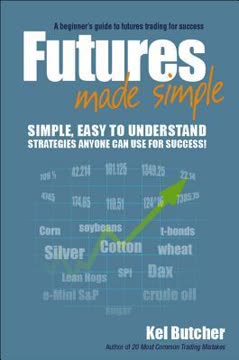
Futures Made Simple by Kel Butcher is an accessible guide for beginners in futures trading. With an overall rating of 3.48/5, readers appreciate-structured and systematic, covering essential topics like contract types, market analysis, and risk management. Butcher's experience traders may find it too basic, but novice investors appreciate its straightforward examples and summaries. The book is praised for its clear explanations and basic calculations, though it lacks in-depth technical analysis. It's considered ideal for those for those seeking to navigate the futures market without a financial advisor.