Key Takeaways
1. Redefine Happiness: Focus on Core Well-being, Not External Success
I believe that for most people the single biggest reason they’re walking around with a hole in their heart which they try unsuccessfully to fill with a whole host of compensatory behaviors—such as alcohol, junk food, sugar, and overwork—is because they’ve made this fundamental error.
Happiness is internal. Many of us mistakenly equate happiness with external achievements like a nicer car, a bigger house, or a prestigious job title. Society often brainwashes us from a young age to believe that success, defined by material possessions and career advancement, will lead to contentment. However, this pursuit often leaves us feeling empty, leading to "Junk Happiness" habits like overeating or excessive drinking to numb the underlying dissatisfaction. True happiness isn't about what you acquire; it's about how you feel about your life.
The "Want Brain." Our evolutionary "Want Brain" constantly whispers that external things will make us happy, driving us to compete and accumulate. This ancient system, designed for survival in times of scarcity, is not interested in our long-term well-being. It conspires with modern consumer culture, through advertising and the constant cycle of new products, to keep us on a treadmill of desire. While money can remove sources of unhappiness by covering basic needs, it doesn't inherently bring happiness itself.
Cultivate Core Happiness. Instead of chasing fleeting external rewards, focus on building "Core Happiness," a resilient baseline of well-being. This is a three-legged stool comprising:
- Contentment: Being at peace with your life and decisions.
- Control: Feeling able to make meaningful choices and not be overwhelmed.
- Alignment: Your inner values matching your day-to-day actions.
To achieve this, redefine success by identifying "Happiness Habits" (e.g., a walk in nature, family meals) and envisioning your "Happy Ending" (e.g., contributing to others, undistracted time with loved ones). Redefine your identity based on values like curiosity or kindness, rather than societal labels, ensuring your actions align with the person you aspire to be.
2. Master Your Mind: Tame the "Want Brain" and Embrace Self-Compassion
It’s just not possible to achieve long-term health or happiness if you hate yourself.
The inner critic. Many of us treat ourselves with a chronic lack of respect, fueled by an inner critic born from childhood criticisms. This negative self-talk, like calling ourselves a "loser" or "idiot," activates our body's stress response, releasing hormones like adrenaline and cortisol. This internal conflict not only damages our mental well-being but also has profound biological effects, impacting everything from blood sugar to digestion. This "winning shallow" approach, where success comes at the cost of self-loathing, ultimately leads to emptiness.
Self-compassion is key. The magic ingredient for lasting health and happiness is self-compassion—extending kindness, warmth, and understanding to ourselves, just as we would to a close friend or child. Research shows a strong link between self-compassion and physical health, including improved immune function and better sleep. It also makes us more likely to adopt healthy lifestyle habits and more resilient in the face of setbacks.
Rewire your self-talk. To cultivate self-compassion, actively challenge your inner critic. Practice speaking to yourself like a supportive coach, even using your own name to create distance from problems. Engage in exercises like writing a "love letter" to yourself, listing qualities you admire, or practicing the "mirror exercise" to foster self-acceptance. Understanding that our "not enough" belief often stems from childhood helps us dismantle it. By replacing self-loathing with self-respect, we break free from "Junk Happiness" addictions and unlock our true potential, becoming more successful and happier in the process.
3. Simplify Your Life: Eliminate Unnecessary Choices and Reduce Stress
Every day, every single decision we make takes something from us.
The choice trap. Modern life bombards us with an overwhelming number of choices, from streaming services to supermarket aisles, leading to an astonishing 35,000 decisions daily. While choice is often equated with freedom, too much of it creates stress, drains cognitive energy, and erodes our peace of mind. This "choice trap" leaves us less confident in our decisions and constantly wondering "what if," weakening our contentment and control—two pillars of Core Happiness.
Micro Stress Doses (MSDs). Each unnecessary decision contributes to our daily accumulation of "Micro Stress Doses" (MSDs). These tiny moments of anxiety or frustration, whether from choosing a film or a phone model, push us closer to our personal stress threshold. Once crossed, we become reactive, emotional, and prone to physical symptoms like migraines or IBS. Chronic stress from excessive choice can lead to insomnia, anxiety, depression, and other health problems, making it impossible to be truly happy.
Strategies to eliminate choice. Liberate yourself from the burden of excessive decision-making by implementing personal rules and routines.
- Wardrobe simplification: Like Courtney Carver's Project 3-33, limit clothing options.
- Meal planning: Decide meals for the week to reduce daily stress.
- Personal rules: Always buy the second-cheapest wine, use dice for restaurant choices.
- Selective consumption: Stick to one or two podcasts, listen to full albums.
- Accept recommendations: Trust others' advice for purchases.
By consciously reducing false choices, you conserve mental energy, lower your stress load, and strengthen your Core Happiness, feeling more in control and content with your life.
4. Reclaim Your Time: Cultivate Flow and Daily Solitude
Time is life.
The illusion of time poverty. Despite having more leisure time than previous generations, many adults feel "time poor." Modern technology fragments our attention, degrading the quality of our "me-time." We often prioritize money over time, spending hours to save pennies, without realizing we're sacrificing our most precious resource. This perception of scarcity leads to increased stress, reduced productivity, and a higher risk of unhealthy behaviors and chronic disease.
Time is fluid. Our perception of time is subjective; an hour lost in a hobby feels different from an hour spent waiting. We can create the sensation of having more time by using it intentionally and engaging in activities that induce a "flow state." Coined by Professor Mihaly Csikszentmihalyi, flow is a state of complete absorption where thoughts and actions become one, the ego quiets, and time perception changes. This releases a powerful cocktail of pleasure neurochemicals, making it the most addictive natural feeling.
Daily "vacations" for flow. To access flow, engage in activities that are slightly more challenging than your current skill level (the "4% rule"). This could be learning a new skill, playing an instrument, or engaging in creative pursuits. Aim for 1-2 flow experiences per week. Additionally, cultivate daily solitude, a "daily vacation" that offers mental stillness, reflection, and perspective. This can be achieved through:
- Moving vacations: Walking, running, swimming, cycling.
- Sitting stillness: Meditation, breathwork, journaling.
These practices help you tune into your body's early warning signals, process anxieties, and strengthen your Core Happiness by fostering contentment, control, and alignment. Make these practices rituals—daily acts of self-love—to reprogram your mind for calmness and well-being.
5. Embrace Social Friction: Use Challenges to Build Resilience and Compassion
The greatest prison you’ll ever live in is the prison you create inside your mind.
Friction as a teacher. Life is inherently full of challenges and interactions with others that can cause anger, frustration, or disappointment. Instead of becoming a victim of these "social frictions," view them as opportunities for self-examination and growth—a "social gym." When someone triggers a negative reaction, ask yourself: "Why is this comment affecting me? What within me is causing this response?" This shifts control back to you, strengthening your Core Happiness.
Choose your story. We all construct our own subjective reality. When faced with conflict or criticism, we can choose to tell ourselves a negative story, casting others as villains and ourselves as victims. Alternatively, we can consciously reframe the narrative, making everyone a "hero." For example, instead of judging someone for hoarding toilet paper, imagine they have a valid, compassionate reason. This practice of choosing an empowering story, rather than one that holds you hostage, fosters kindness, calmness, and reduces judgment.
Cultivate compassion. Understanding that everyone is doing the best they can, based on their unique upbringing, knowledge, and life experiences, builds deep empathy. As the saying goes, "If you were them, with their childhood, their parents, and their exact same life experiences, you would almost certainly be acting in exactly the same way." This perspective increases your sense of control and makes it easier to forgive and be compassionate. Regularly "working out" in the social gym by analyzing friction, reframing situations, and practicing compassion will make you less reactive, more confident, and ultimately, much happier.
6. Connect Authentically: Prioritize Maskless Conversations and Real-World Interactions
It’s only when we understand who we really are that we open up the possibility of becoming the person we wish to be.
The cost of social masks. While social masks can be useful in certain situations, wearing them too often can lead us to forget who we truly are, causing feelings of isolation and loneliness. This disconnect weakens our Core Happiness by making us feel out of alignment and out of control. Loneliness is a significant health risk, comparable to smoking, and is linked to higher rates of depression, anxiety, and chronic illness.
Maskless conversations. To combat this, prioritize "maskless conversations"—raw, honest, and intimate exchanges with trusted friends and family where you expose your true self without fear of judgment. These risky conversations, though sometimes emotional, lighten your load and foster deeper self-understanding. When in-person meetings aren't possible, an old-fashioned phone call is often more intimate than a video call, which can create anxiety and reduce genuine connection due to self-view and subtle delays.
Integrity over performative authenticity. Be wary of "performative authenticity," where oversharing is used to gain attention. Instead, strive for integrity: being honest with yourself and others about who you are now, while also aspiring to be the person you wish to become. Expand your "mask-free zone" by revealing more of your true self in appropriate contexts, like sharing genuine feelings with a trusted colleague. When listening to others, practice "connect first, educate second," offering non-judgmental empathy and full attention. This creates a safe space for others to drop their masks, fostering mutual understanding and strengthening your own Core Happiness.
7. Manage Your Digital Life: Treat Your Phone Like a Person, Not a Master
Your loved ones simply cannot compete with modern technology. No human being can.
The electronic shadow. Our smartphones have become constant companions, electronic shadows that follow us everywhere. These devices, designed by Silicon Valley's brightest minds, exploit our psychological weak spots to capture our attention. They generate "Time Confetti," shredding our precious minutes with unproductive multitasking and constant distractions. Even when not actively used, their mere presence reduces cognitive capacity and degrades the quality of our real-world experiences and relationships.
Phone Brain. Constant exposure to online conversations and social media can lead to "Phone Brain," where our thoughts and values become influenced by external noise and groupthink. This disconnects us from our own inner wisdom and pushes us out of alignment with who we want to be. Research shows that staying off social media can have a greater impact on happiness than significant financial gains or even marriage, highlighting the profound negative effects these devices have on our well-being.
Reclaim control. To protect your Core Happiness, treat your phone like a person you control, not a master. Implement "phone norms" for your household:
- Delete unnecessary apps: Especially social media and work email, to reduce temptation.
- Customize home screen: Move distracting apps to less accessible folders.
- Turn off notifications: Reclaim control over your attention.
- Designate phone-free zones/times: Bedrooms, mealtimes, an hour before bed.
- Use "Do Not Disturb": Program your phone to silence alerts during specific periods.
Consider if you truly need a smartphone, or if a simpler device for calls and texts would enhance your presence and relationships. By putting "steps back in" to create distance from your device, you become more intentional, present, and aligned with your values.
8. Give Yourself Away: Practice Kindness, Gratitude, and Service to Others
This is life’s most perfect irony: when we prioritize the happiness of others, it’s ourselves who end up smiling.
Wired to give. While previous chapters focused on self-improvement, true happiness flourishes when we look outward and give ourselves away. Humans are tribal, wired for social connection and service to others. Research overwhelmingly shows that other-focused individuals are happier, whether through donating money, volunteering time, or simply performing acts of kindness. This outward focus powerfully strengthens all three legs of the Core Happiness stool: contentment, control, and alignment.
The wisdom of traditions. Religions have long understood the profound benefits of giving, gratitude, and forgiveness. These practices push us beyond the "Want Brain's" selfish impulses. Holding onto grudges, jealousy, or anger keeps us in a stress state, while forgiveness and gratitude reverse this, sending us on an upward spiral toward happiness. Gratitude, in particular, counters our brain's natural negativity bias, lowering anxiety, improving sleep, and strengthening relationships.
Cultivate a giving mindset. Integrate giving into your daily life through intentional practices:
- Gratitude letters: Write to someone who has made a difference, even if you don't send it.
- Gratitude journaling: List 3-5 specific things you're grateful for daily.
- Share gratitude: At dinner, have family members share what they're thankful for.
- Acts of kindness: Perform one small act daily (e.g., holding a door, cooking for a neighbor).
- Loving Kindness Meditation: Send warmth and compassion to loved ones, neutral people, and even those you dislike.
Volunteering, like the "social intervention" of parkrun, provides a powerful sense of community and purpose. By giving yourself away, you not only boost your own happiness and health but also create a ripple effect of kindness that positively impacts countless others.
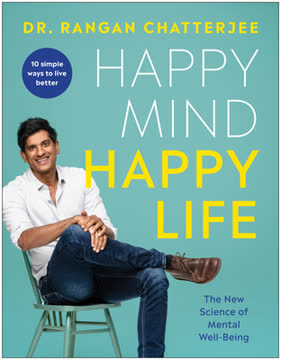
Last updated:
Review Summary
Happy Mind, Happy Life by Dr. Rangan Chatterjee receives mostly positive reviews (4.23/5 average). Readers praise its accessible advice, practical tips, and scientific backing. Common takeaways include limiting screen time, practicing meditation, finding solitude, and building daily happiness habits. Some criticisms include the book's bulky physical format, perceived smugness, lack of original ideas, and frequent podcast references. Many appreciate Chatterjee's down-to-earth approach, case studies, and personal vulnerability. Several reviewers note it's less impactful than his earlier works, while others consider it his best book yet.