Key Takeaways
1. Herodotus pioneered "history" as an inquiry into human actions and their causes.
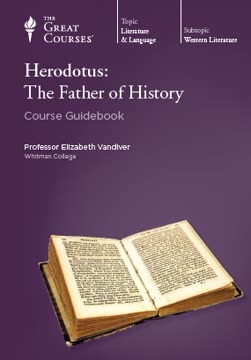
Herodotus is called the “Father of History” because he was the first Greek writer to attempt fully to describe events of the recent human past and to explain the causes of those events.
Defining history. Herodotus, born in Halicarnassus around 484 B.C.E., established a new literary genre by focusing on human achievements and their underlying causes. Unlike earlier writers who merely listed events, Herodotus sought to understand why things happened, particularly the monumental Persian Wars. His work, Histories, aimed to preserve the memory of "great and astonishing works or deeds" (erga megala te kai thômasta) of both Greeks and "barbarians" (foreigners), ensuring they would not be forgotten or "without glory" (aklea).
A new genre. The very word "history" derives from Herodotus' term historiê, meaning "inquiry" or "research." This signifies his innovative approach: a systematic investigation into the human past. He wasn't just a chronicler; he was an explorer of human motivations and the intricate web of events that led to major conflicts. This foundational work also earned him titles like "Father of Ethnography," "Father of Anthropology," and "Father of Travelogues," reflecting the breadth of his investigative spirit.
Contextualizing conflict. Herodotus' primary subject, the Persian Wars (490 and 480–79 B.C.E.), served as both the focus and catalyst for his extensive inquiry. To explain this conflict, he delved into the backgrounds of various ancient cultures and events predating his own time by centuries. His work provided a comprehensive context for understanding the clash between East and West, setting a precedent for future historical narratives that sought to explain, rather than just recount, the past.
2. Oral tradition and myth shaped Herodotus' narrative, yet he sought verifiable accounts.
This is sometimes referred to as “three-generation reachback”; oral tradition does not extend with accuracy beyond this timeframe.
Myth's pervasive role. In preliterate Greek culture, traditional myths served as the primary means of explaining the world, transmitting cultural values, and understanding phenomena. These stories, often concerning gods and heroes, were considered "true" accounts of the past. Herodotus, writing during a transition to literacy, was deeply influenced by this oral tradition, relying heavily on what he heard (akoê) and observed (opsis) from local informants.
Navigating myth and fact. While Herodotus did not make a clear terminological distinction between myth and history, he did employ a crucial chronological one. He accepted the existence of mythic figures like those from the Trojan War but focused his verifiable accounts on the "recent past." This meant concentrating on events that occurred no more than three generations before his own time, allowing him to interview eyewitnesses or those who had spoken to them, thus establishing a rudimentary form of historical verification.
Folktales and historicity. Herodotus often attached elements we would categorize as folktales to historical figures, such as the story of Polycrates' excessive luck. This demonstrates his comfort with integrating traditional narratives into his historical framework, even when they bordered on the fabulous. However, his stated intention to begin his main account with Croesus, "the first barbarian he knows to have wronged the Greeks," signals his commitment to focusing on events he believed could be corroborated, marking a significant step toward modern historical methodology.
3. Homeric epic provided a foundational literary model for Herodotus' storytelling and focus on great individuals.
For Herodotus, the Homeric epics suggested both the subject matter and the structure of his work.
Epic's enduring legacy. The Iliad and Odyssey, the earliest works of Greek literature, profoundly influenced Herodotus. These epics, which culminated centuries of oral tradition before being written down, served as an inexhaustible source of plots, characters, and narrative techniques. For Herodotus, they offered a powerful template for structuring his own grand narrative of conflict and exploration.
Echoes of Homer. Herodotus' Histories mirrored Homeric epic in several key ways. Like Homer, he chose a war between Greeks and an Eastern empire (Persia) as his central subject. His narrative focused on the deeds, decisions, and triumphs of great men, attributing historical events to individual actions rather than broad political or economic forces. Furthermore, Herodotus, much like an omniscient Homeric bard, included speeches in the mouths of his characters without explaining how he knew their exact words.
Departures from epic. Despite these similarities, Herodotus also diverged significantly from his epic predecessors. He chose to write in prose, a form that reflected the growing importance of writing in Greek society and allowed for the vast scope of his work. Unlike Homer, Herodotus did not assume the role of an omniscient narrator who could report divine conversations. While he acknowledged the gods' influence, they were not characters in his narrative, and his focus remained firmly on human actions and responsibility.
4. The Ionian Enlightenment's rational inquiry profoundly influenced Herodotus' quest for historical explanation.
The key factor in their work is that they attempted to find rational explanations for events.
A hub of innovation. Ionia, located on the western coast of modern-day Turkey, emerged as a crucial cultural crossroads in the late seventh century B.C.E. This region fostered an intellectual movement known as the Ionian Enlightenment, which gave rise to the first Pre-Socratic philosophers. These thinkers, often more akin to scientists than philosophers, initiated the Western tradition of seeking rational explanations for natural phenomena.
Pioneers of reason. Figures like Thales, Anaximander, Anaximenes, and Heraclitus challenged traditional, anthropomorphic views of the gods by proposing that the universe operated according to discoverable natural laws. Thales, for instance, was credited with predicting a solar eclipse, suggesting that such events were natural occurrences rather than arbitrary divine interventions. Anaximander theorized about the "unlimited" (apeiron) as the basic material of the universe, while Heraclitus emphasized logos (measure, proportion) and the constant flux of the world.
Herodotus' intellectual inheritance. The unifying thread among these Ionian thinkers was their reliance on observation and reason to understand causation. Herodotus, as their intellectual heir, applied this same spirit of inquiry to human events. While he didn't assume immutable laws governed human affairs, he believed that investigation and reason could uncover the causes behind historical developments. He effectively combined the Ionian philosophers' methodological rigor with the logographers' interest in diverse cultures, creating a new form of historical narrative.
5. Athenian political and cultural evolution provided a rich context for Herodotus' exploration of governance and human nature.
Cleisthenes’ reforms had opened the way to demokratia, or rule by the people (demos).
From aristocracy to democracy. Athens, a dominant polis in Attica, underwent significant political transformations during the Archaic Age, laying the groundwork for its renowned democracy. Initially ruled by hereditary kings, power shifted to annually elected archons from noble families, who then joined the advisory Areopagus Council. Landmark events like Cylon's failed tyranny and Draco's harsh law code highlighted the need for stability.
Solon's foundational reforms. In 594/93 B.C.E., Solon was appointed to address pressing issues like debt-slavery and land ownership. His "shaking off of burdens" (seisachtheia) freed the enslaved and abolished debts, while his constitutional changes linked political office to wealth rather than birth, creating four property classes. Though not immediately leading to democracy, Solon's reforms mitigated social strife and set the stage for further political evolution.
Cleisthenes' democratic leap. After a period of tyranny under Peisistratus and his sons, Cleisthenes' reforms in 508/07 B.C.E. were pivotal. He reorganized the citizen body into ten new tribes based on residence, not heredity, and structured voting by tribe. This system, called isonomia ("equality before the law"), deliberately broke down traditional power bases and opened the door for the direct democracy that flourished in fifth-century Athens, profoundly influencing the intellectual and political landscape in which Herodotus wrote.
6. Herodotus' Histories are a meticulously structured inquiry, integrating ethnographic "logoi" to explain the East-West conflict.
To explain Persia and the nature of its threat to Greece, he needed to look at other major empires.
Beyond simple chronology. Unlike Homeric epics that begin in medias res, Herodotus' Histories meticulously trace the origins and background of the Greco-Persian conflict. His stated purpose was not merely to recount events but to uncover their aitiê (cause), necessitating a deep dive into the histories and cultures of both the Persian Empire and the various Greek city-states. This comprehensive approach gives his work a unique, expansive quality.
Purposeful "digressions." What modern scholars often label "digressions" – extensive descriptions of Egypt, Scythia, and other nations – Herodotus referred to as logoi ("accounts"). These were not deviations but integral components of his overarching narrative. By examining the customs, governments, and geographies of the cultures the Persians had conquered, Herodotus illuminated the nature of the Persian threat and established the fundamental East-West conflict that drives his work.
Methodology in action. Herodotus' ethnographic and geographical explorations, such as his detailed discussion of the Nile's annual flooding, reveal his rigorous methodology. He combined information gathered orally (akoê) from local informants with his own observations (opsis), often applying reasoning based on probability and likelihood to verify or challenge received wisdom. These sections also subtly convey his "psychological worldview," where continents represent natural boundaries, and Persian transgressions of these boundaries foreshadow their ultimate downfall.
7. The tragic fall of Croesus exemplifies Herodotus' themes of human hubris, mutable fortune, and divine retribution.
Solon says that it is possible to call someone olbios only after he is dead.
A king's hubris. Herodotus introduces Croesus, the fabulously wealthy king of Lydia, as the first barbarian to wrong the Greeks, making him a pivotal figure in the East-West conflict. Croesus' story begins with the treachery of his ancestor Gyges, foreshadowing a fated downfall. At the height of his power, Croesus' arrogance leads him to believe himself the happiest (olbios) of men, a hubris that attracts "great divine retribution" (ek theou nemesis megalê).
Solon's timeless wisdom. The chronologically impossible but narratively essential meeting between Croesus and the Athenian sage Solon serves as a vehicle for Herodotus' core themes. Solon, representing Greek wisdom, warns Croesus that true happiness can only be judged at the end of a life, as fortune is mutable and divinity is "jealous and troublesome." He illustrates this with tales of Tellus the Athenian and the brothers Cleobis and Biton, whose lives ended at their peak, thus securing their olbios status.
Fate and human error. Croesus' downfall unfolds through a series of tragic events, including the accidental death of his son Atys and his misinterpretation of the Delphic oracle regarding his invasion of Persia. His hamartia, or error in judgment, lies in believing he could circumvent fate and control outcomes, forgetting his human limitations. This narrative, rich with parallels to Greek tragedy, underscores Herodotus' belief that excessive good fortune and hubris inevitably lead to a reversal of fate, regardless of wealth or power.
8. Herodotus blends legend and fact in portraying figures like Cyrus the Great, emphasizing individual agency in empire-building.
Cyrus is a legendary figure, with a childhood narrative worthy of a mythic hero; but he is also an important historical figure, some of whose deeds and conquests can be verified independently of Herodotus’ account.
The rise of an empire. Cyrus the Great, the first Persian king to forge an empire, is a central figure in Herodotus' narrative. Before Cyrus, the Persians were subordinate to the Medes, but Cyrus' conquest of Ecbatana in 550 B.C.E. marked the beginning of Persian dominance. His subsequent victories over Lydia and Babylon, though sometimes differing in detail from Babylonian records, are largely corroborated, establishing him as a significant historical figure.
A hero's legendary birth. Herodotus provides a detailed, legendary account of Cyrus' birth and childhood, replete with motifs common to Greek hero tales. King Astyages, fearing a dream that his grandson would overthrow him, orders the infant Cyrus killed. However, Cyrus is secretly saved by a herdsman, grows up ignorant of his true identity, and is eventually recognized through exceptional deeds. This narrative, while clearly mythic, serves to underline Cyrus' extraordinary destiny and importance.
Individual agency and historical impact. The blend of legend and verifiable fact in Cyrus' story highlights Herodotus' narrative approach: history is often driven by the actions and motivations of memorable individuals. Even Astyages' gruesome revenge on Harpagus, who failed to kill Cyrus, is presented as a personal interaction with far-reaching political consequences. Cyrus, as the paradigmatic Persian king, embodies the larger-than-life forces that shape empires, even as Herodotus occasionally offers rationalized explanations for the more fantastic elements of his tale.
9. Herodotus' account of Egypt highlights his comparative methodology and the challenges of reconciling diverse cultural narratives.
Herodotus assumes that there must be direct correspondences between the major gods of the Egyptians and the Greeks.
Egypt: a land of wonders. Herodotus dedicates an entire book to Egypt, describing it as a land of unparalleled wonders (thômasia) and monumental works (erga). He meticulously details its geography, marvels (both natural and man-made, like the pyramids), customs, and history. For Herodotus, Egypt was a fascinating paradox: a culture both ancient and wise, yet often "topsy-turvy" with customs that inverted Greek norms.
Comparative cultural lens. Herodotus' approach to Egyptian customs is distinctly comparative. He notes practices that are "backward" from a Greek perspective (e.g., women conducting business, men weaving) but also identifies numerous significant customs and knowledge that he believes the Greeks borrowed from the Egyptians, particularly in religious rites and the "significant names" (epônumias) of the gods. This reflects his deep-seated belief that older cultures, like Egypt, must have "taught" younger ones.
Reconciling chronologies and myths. A key challenge for Herodotus was reconciling Egyptian antiquity with Greek traditions. The Egyptian priests' claims of 341 generations of kings and a divine Heracles living 17,000 years ago directly conflicted with the Greek Heroic Age, which placed Heracles as a hero only 800 years prior. Herodotus' solution, positing two Heracleses (a god and a hero), demonstrates his earnest attempt to integrate disparate religious and historical narratives, even when they presented logical difficulties. His acceptance of the Egyptian version of Helen's story, based on likelihood and perceived Homeric traces, further illustrates his complex methodology.
10. Herodotus' focus on individuals and nomos reveals history driven by personal motivations and cultural differences.
Herodotus sums this up by quoting the poet Pindar: nomos is king of all.
Individuals as historical drivers. Throughout the Histories, Herodotus consistently attributes major historical events to the personal desires, impulses, and decisions of individuals rather than to abstract economic or political forces. The Ionian Revolt, for instance, is explained by the ambitions of Aristagoras and Histiaeus, and Darius' invasion of Greece by his desire for revenge. This focus on individual agency, often conveyed through compelling tales and speeches, reflects his reliance on oral tradition, which naturally preserves the past through memorable stories about people.
The wise advisor motif. A recurring character type in Herodotus' work is the "wise advisor," who offers counsel that is often unheeded by arrogant monarchs. Figures like Solon, Croesus (in his later role), and Artabanus serve as tragic warners, highlighting the dangers of hubris and the mutability of fortune. Conversely, "practical advisors" like Themistocles offer strategic insights. These interactions, along with the portrayal of powerful women and hubristic kings, underscore how personal interactions and character flaws drive the course of history.
The power of nomos. Beyond individual personalities, Herodotus demonstrates a profound interest in the nomoi (customs or laws) of different peoples. He meticulously catalogs the unique practices of various cultures, recognizing that each society believes its own nomoi to be superior. His anecdote about Darius' experiment with Greeks and Indians, who each recoiled at the thought of violating their own burial customs, culminates in the powerful assertion that "nomos is king of all." This emphasis reveals his debt to the Ionian logographers and the Sophists, who debated the interplay of nomos and physis (nature), and underscores his understanding of cultural relativism.
Last updated:
Review Summary
Herodotus: The Father of History by Elizabeth Vandiver receives overwhelmingly positive reviews (4.24/5 stars). Readers praise the lecture series as an excellent companion to reading Herodotus' Histories, providing essential historical and cultural context. Vandiver is lauded for her clear speaking, expertise, and engaging delivery, including her discussion of Ancient Greek language and translation challenges. Reviewers appreciate her coverage of the Persian Wars, Spartan customs, and Herodotus' revolutionary empirical methodology. Many listeners became motivated to read the original Histories after completing the course.