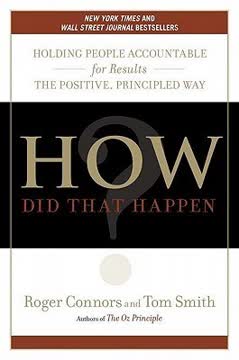
Key Takeaways
1. Accountability is a Positive, Principled Sequence, not a Punishment.
To hold someone accountable means “to effectively form, communicate, align, and inspect the fulfillment of an expectation in the positive, principled way that enables people to achieve results now and in the future.”
Redefining accountability. Traditional views often equate accountability with blame or punishment after things go wrong, leading to a destructive cycle of "Discover, Hunt, Scramble, and Hide." This book champions a proactive, positive, and principled approach, emphasizing that true accountability is about influencing outcomes before problems arise. It's a systematic process designed to inspire people and achieve desired results.
Shifting perspective. Instead of asking "How did that happen?" when expectations are missed, leaders should ask "How did I let that happen?" This subtle but powerful shift encourages self-reflection and personal ownership, recognizing one's role in setting up others for success or failure. This approach fosters positive relationships and a learning environment, rather than one of fear.
Foundational axioms. The process is built on three axioms: the Accountability Fallacy (assuming flaws in others), the Accountability Assumption (people are doing their best), and the Accountability Truth (when things go wrong, "I" am usually part of the problem). Embracing these allows leaders to take control of future outcomes and continuously improve their effectiveness in getting things done through others.
2. Form "Best" Expectations using the FORM Checklist.
When it comes to forming key expectations, we cannot afford to settle for anything but “best.”
Clarity is paramount. Holding others accountable effectively begins with forming crystal-clear expectations. Just as Michelin's run-flat tire failed due to unformed expectations about market integration, or the "Ark" building remained empty due to a disconnect between exterior design and interior utility, vague expectations pave the road to disappointment. "Best" expectations are those where not delivering is simply not an option.
The FORM Checklist. This practical tool ensures expectations are well-defined and actionable. It prompts leaders to consider four crucial characteristics:
- Framable: Consistent with vision, strategy, and priorities.
- Obtainable: Achievable given resources and capacity constraints.
- Repeatable: Simple and clear enough to be easily transferred throughout the Expectations Chain.
- Measurable: Allows for tracking progress and ultimate achievement.
Avoiding costly oversights. Applying FORM upfront, especially for "key" expectations, is a vital investment that prevents costly mistakes and wasted resources later. It forces a deliberate and conscious effort to define what needs to happen, who is involved, and how success will be measured, ensuring everyone is aligned from the start.
3. Communicate Expectations with the Why-What-When Approach.
Without it, you cannot hope to capture people’s imagination and harness their collective energy to achieve key expectations.
Beyond "Command & Control." The traditional "What-When" approach, while seemingly efficient, often fails to engage the hearts and minds of today's workforce, leading to mere compliance rather than genuine commitment. The "Why-What-When" framework transforms communication into a compelling dialogue that inspires ownership and ensures successful outcomes.
Crafting a compelling "Why." The "Why" must precede the "What" and "When," speaking to individuals on a personal level and connecting their efforts to a larger purpose. Six ways to craft a compelling "Why" include:
- Tailoring it to the audience
- Making it short, simple, and clear
- Being candid and honest
- Making it a dialogue, not a monologue
- Creating a "hook" for buy-in
- Framing it in a strategic context
Clarifying "What" and "When." The "What" involves three discussions: communicating the formed expectation, clarifying boundaries (acceptable practices, resources, legal/ethical considerations), and establishing available support (training, coaching, resources). The "When" requires attaching a concrete "By When" deadline, specifying both date and time, to instill urgency and prevent procrastination.
4. Achieve Complete Alignment, not just mere Complyment.
When you bring people into Complete Alignment, they not only invest their “hands and feet” in the undertaking, they also invest their “hearts and minds” in getting it done.
The power of agreement. Complete Alignment goes beyond mere compliance, where people move forward out of self-interest. It signifies a deep level of agreement and commitment, where individuals fully believe in and are personally invested in fulfilling expectations. This "hearts and minds" engagement ignites a powerful chain reaction, improving everyone's alignment and driving exceptional results, as seen in Johnson Controls' safety and customer satisfaction improvements.
The Alignment Dialogue. This three-step process helps leaders achieve Complete Alignment:
- Score It: Restate the expectation and ask individuals to rate their level of agreement (1-10), encouraging candid feedback.
- Evaluate It: Explore reasons for misalignment by asking: "Is it clear?", "Is it achievable?", "Is it needed?", and "Is it linked?" This uncovers underlying issues like conflicting priorities or resource constraints.
- Resolve It: Address concerns through persuasion, not coercion, providing information, coaching, and feedback. This builds trust and confidence, leading to either confirmation of the original expectation or a revised, mutually agreed-upon plan.
Moving the boulder. Just as a dozen men moved a thousand-pound boulder for Tiger Woods, Complete Alignment ensures everyone pushes in the same direction. Without it, like the K2 climbing disaster or Chris Solomon's departure from BHC, efforts can be fragmented, leading to unmet expectations and organizational setbacks. Regular Alignment Meetings help maintain this crucial unity.
5. Inspect What You Expect using the LOOK Model.
If you don’t, all the hard work you put into forming, communicating, and aligning key expectations will go unrewarded.
The final Outer Ring step. Inspecting expectations is crucial for ensuring that all the effort put into forming, communicating, and aligning expectations actually translates into results. Without consistent inspection, even the best-laid plans can derail, leading to surprises and disappointment, as Perry Lowe at AXIS Dental discovered when sales plummeted due to a lack of focus on end-user sell-through.
Purpose of inspection. A positive and principled inspection is a thoughtful, planned activity designed to:
- Assess the condition of expectation fulfillment.
- Ensure continued alignment.
- Provide needed support.
- Reinforce progress.
- Promote learning.
This approach transforms inspection from a dreaded "test" into a supportive "check-in."
The LOOK Model. This memorable acronym provides a framework for effective inspection:
- Listen: Ask the right questions to gauge "heart and mind" engagement, focusing on issues, not personal blame.
- Observe: Stay close enough to the situation to see what's happening, looking for signs of team bonding and progress.
- Objectify: Use concrete plans and tools (dashboards, reports) to track progress, ensuring data reflects reality, not just "milk runs."
- Know: Stay engaged by frequently applying the first three steps to predict outcomes and make necessary corrections.
6. Manage Unmet Expectations with the Inner Ring Solutions.
When you understand these potential solutions, you will also find it easier to prevent these same problems from recurring.
Addressing the inevitable. Even with perfect execution of the Outer Ring, unmet expectations are a reality. The Inner Ring provides a structured approach to dealing with these disappointments, offering solutions beyond simply lowering expectations or replacing personnel. It's about diagnosing the root cause and implementing targeted interventions.
The Accountability Conversation. This three-step process guides leaders through managing unmet expectations:
- Outer Ring Check: First, examine your own accountability. Did you effectively Form, Communicate, Align, and Inspect the expectation? Often, revisiting these steps more effectively can resolve the issue.
- Inner Ring Solution Selection: Diagnose the problem's true nature. Is it a lack of Motivation, Training, Accountability, or a flawed Culture?
- Outer Ring Implementation: Use the Outer Ring steps again to establish new expectations around improvement, ensuring the chosen solution is effectively implemented and managed.
Beyond "unwilling" or "unable." The traditional view of unmet expectations often attributes failure to a lack of willingness or ability. However, the Inner Ring expands this to include a lack of personal accountability or a hindering organizational culture. This comprehensive model allows for a more accurate diagnosis and a more effective, lasting solution.
7. Diagnose Problems with the Reality Window.
When you fail to see things as they really are and rely instead on a Phantom Reality, you cannot possibly solve the problems that really do exist.
Seeing clearly. Before effectively tackling unmet expectations, it's crucial to accurately perceive the situation. The Reality Window helps leaders distinguish between three distinct realities, ensuring they solve the right problem. Failing to do so, like the Memphis Tigers coach ignoring free-throw statistics or Boeing's misjudgment of supplier capabilities, leads to misdirected efforts and continued failure.
Three views of reality:
- Phantom Reality: An inaccurate description of how things really are, often based on old information, assumptions, or wishful thinking. It leads to wrong decisions and wasted effort.
- Reality: An accurate, objective description of the current situation, obtained by breaking through Phantom Realities and gathering credible information.
- Desired Reality: What you want to have happen, embodying the clearly defined expectations established in the Outer Ring.
Breaking through illusions. Leaders must actively perform "Reality Checks" by asking critical questions like "What am I pretending not to know?" or "Am I ignoring the obvious?" This continuous questioning, ideally involving others in the Expectations Chain, helps recalibrate actions and prevent costly errors. The ability to accurately "See It" is the first step to taking accountability and finding effective solutions.
8. Address Motivation by Enrolling People in a Compelling Cause.
When people see a compelling reason to do something, they will work much harder to achieve desired results.
Beyond compliance. When unmet expectations stem from a lack of motivation, simply demanding performance yields only "hands and feet" effort, not the "hearts and minds" commitment needed for key results. True motivation comes from connecting individuals to a compelling "cause" that aligns with their personal goals and makes them feel they can make a difference.
Enrolling others in the "Cause." Four steps help leaders inspire this deep commitment:
- Define It: Craft a compelling story with a clear plot, setting, and characters (protagonist/antagonist) that captures imagination and makes the objective tangible.
- Sell It: Become a persuasive storyteller, harnessing the power of ideas to answer "Why" questions (Why is it important? Why me? Why now? Why this way? Why would I want to do this?).
- Advocate It: Continuously support the cause publicly, reinforcing the story with evidence and retelling it over time to maintain momentum, especially during challenges.
- Celebrate It: Publicly acknowledge and praise successes, both ultimate goals and milestones, to energize people and reinforce their investment.
The power of purpose. Whether it's saving lives in an ER (Liz's team), transforming a struggling plant (Jeff), or proving a scientific theory (Marshall and Warren), a strong cause transcends monetary incentives. It fosters innovation, resilience, and a collective drive to overcome obstacles, turning ordinary tasks into extraordinary achievements.
9. Provide Targeted Training using the Training Triggers Model.
Providing people with the right training at the right time can quickly improve results and mark the difference between success and failure.
Bridging the skill gap. When unmet expectations are due to a deficiency in skills or knowledge, targeted training is the solution. Many organizations face a significant gap between required skills and employee capabilities, leading to underperformance. Effective training not only solves immediate problems but also builds long-term organizational capability.
Phases of Competency. Understanding how people learn is key to effective training. The model outlines four phases:
- Unaware & Unable (Novice): Lacks knowledge and skill.
- Aware & Unable: Knows what needs to be done but can't yet do it.
- Aware & Able: Can perform the task with conscious effort.
- Unaware & Able (Master): Performs tasks automatically and proficiently.
Training aims to move individuals through these phases, with "aware" stages offering prime coaching opportunities.
Training Triggers Model. This model helps identify the appropriate level of intervention based on performance issues:
- Level One (Problem): Occasional missed delivery; requires quick coaching, demonstration, and practice.
- Level Two (Pattern): Consistent missed delivery; needs significant coaching, feedback, and potentially external mentorship.
- Level Three (Performance): Serious, persistent problems; requires formal schooling, off-site courses, and dedicated study.
- Level Four (Placement): No response to training; triggers reassignment or counseling out of the organization.
10. Cultivate Personal Accountability by Moving Above the Line.
The truly accountable person doesn’t ask “Who can I blame for this problem?” but “What else can I do to achieve the result?”
The core of individual ownership. A lack of personal accountability, even among motivated and trained individuals, can derail expectations. The "Steps to Accountability" model (See It, Own It, Solve It, Do It) provides a framework for individuals to rise "Above the Line," taking ownership of their circumstances and proactively seeking solutions. Conversely, "Below the Line" behavior involves the Blame Game, excuses, and inaction.
Shifting the Accountability Current. In many organizations, accountability flows "top-down," with leaders constantly chasing updates and feeling solely responsible. This fosters a "tell-me-what-to-do" mentality. The goal is to cultivate a "bottom-up" flow, or "360° Accountability," where individuals at all levels proactively report, raise issues, and solve problems, taking initiative without constant oversight.
Accountability Attitudes. People exhibit different attitudes towards accountability:
- Deflecting: Avoids ownership, blames others, operates Below the Line.
- Calculating: Practices selective accountability, weighing personal risk and interest.
- Embracing: Eagerly takes ownership, acknowledges mistakes, relentlessly seeks solutions, operates Above the Line.
Encouraging an "Embracing" attitude is crucial for fostering a results-driven environment.
11. Build a Culture of Accountability with Organizational Integrity.
In such a culture everyone continually asks, “What else can I do to achieve results, attain objectives, and accomplish goals?”
Culture as a solution. An organization's culture can either be a powerful enabler or a significant obstacle to fulfilling expectations. When culture itself is the problem, it requires deliberate change to foster a "Culture of Accountability" where people consistently think and act in ways that drive results.
The Results Pyramid. This model explains how culture develops and how to change it:
- Results: Clearly define desired outcomes.
- Actions: Identify the specific behaviors needed to achieve those results (e.g., taking initiative, innovating).
- Beliefs: Determine the underlying beliefs people must hold to drive those actions (e.g., "I can make a difference").
- Experiences: Create new, consistent experiences that reinforce desired beliefs, shifting the cultural narrative. Stories, both positive and negative, are powerful "experiences by proxy."
Five Accountability Cultures. Organizations typically fall into one of these:
- Complacency: Narrow focus, "not my job" mentality.
- Confusion: Unclear accountability, unpredictable follow-up.
- Intimidation: Accountability driven by fear of consequences.
- Abdication: Avoids accountability, pervasive powerlessness.
- Accountability: Proactive ownership, continuous problem-solving.
12. Your Accountability Style Influences Every Step.
Your own Accountability Style will reflect a natural preference for one of two different sides of a continuum.
Understanding your default. Everyone leans towards one of two primary Accountability Styles: "Coerce & Compel" or "Wait & See." Recognizing your natural style is the first step to improving your ability to hold others accountable effectively, as it influences how you approach every step of the Accountability Sequence.
Coerce & Compel Style.
- Strengths: Decisive, action-oriented, drives results, sets high standards.
- Weaknesses: Can be perceived as intimidating, sets unrealistic expectations, impatient with process, may foster compliance over true ownership.
- Adjustment: Needs to slow down, listen more, persuade rather than command, and ensure clarity and buy-in, especially for "Why."
Wait & See Style.
- Strengths: People-oriented, trusting, fosters freedom, supportive.
- Weaknesses: Can be overly sympathetic, avoids confrontation, may lack follow-through, struggles with firm deadlines, can be perceived as indecisive.
- Adjustment: Needs to be more direct, set clear deadlines, formalize inspection processes, and provide candid feedback, understanding that honesty builds stronger rapport.
The Positive, Principled Way. The ideal approach blends the strengths of both styles, creating a thoughtful, deliberate, and methodical process. By consciously adjusting your style to the situation and the individual, you can mitigate weaknesses and maximize effectiveness in forming, communicating, aligning, and inspecting expectations, as well as in managing unmet expectations.
Last updated:
Similar Books