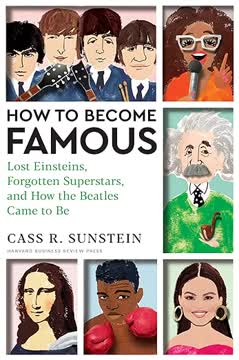
Key Takeaways
1. Fame is a Lottery: Luck and Serendipity Reign Supreme
The race is not to the swift, nor the battle to the strong, neither bread to the wise, nor yet riches to men of understanding, nor yet favor to men of skill; but time and chance happeneth to them all.
Life's unpredictable lotteries. Fame, like many forms of success, is often a result of random draws in life's numerous lotteries. While talent and hard work are often present in famous individuals, they are rarely sufficient. Countless extraordinary people, across all fields, never achieve widespread recognition because "time and chance" simply don't align in their favor.
Serendipity's crucial role. The path to fame is paved with twists and turns, many of which are purely accidental. These include:
- Where and when one is born
- Fortuitous encounters with influential people
- Unexpected encouragement or inspiration
- Receiving a crucial "link or a megaphone" (like a record deal or a platform)
The author emphasizes that for every positive twist, there's a non-encounter or a missed opportunity, highlighting the fragility of the journey to renown.
Engineering one's chances. While luck is undeniable, the author suggests that serendipity isn't entirely beyond influence. It's possible to increase one's chances in these lotteries, though the exact "recipe" remains elusive. The core message is to acknowledge the profound role of chance, rather than solely attributing spectacular success to intrinsic qualities, which often overlooks the millions of equally talented but unknown individuals.
2. Quality Alone Isn't Enough: The "Lost Geniuses" Prove It
Countless extraordinary people, in business, politics, science, and the arts, never get very far.
Unrecognized brilliance. The world is full of "lost Beatles, lost Swifts, lost Dylans, lost da Vincis," individuals of immense talent who never got their chance or were forgotten. Connie Converse, a pioneering folk singer, wrote poetic and original songs before Bob Dylan but never released a commercial album or played to a large audience. She disappeared in 1974, only to be "discovered" decades later through a series of improbable accidents, her music going viral on Spotify.
The Robert Johnson enigma. Similarly, Robert Johnson, a stunning blues guitarist and songwriter, died in 1938 at 27, far from famous and making little money. His two recording sessions yielded only 29 songs. Yet, in 1961, an album of his songs was accidentally released, creating a cult following among legendary musicians like Eric Clapton and Bob Dylan, who called him "the most important blues singer that ever lived." Johnson's posthumous fame highlights how intrinsic quality, while present, needed a massive stroke of luck to be recognized.
The "Music Lab" experiment. Research confirms that quality alone doesn't guarantee success. In the "Music Lab" experiment, unknown songs were rated by participants. In a "social influence" group, participants could see how many times songs were downloaded. Results showed that initial, random popularity significantly influenced ultimate success. Almost any song could become popular or a flop, depending on early downloads, demonstrating that even with inherent quality, social dynamics often dictate widespread recognition.
3. Social Dynamics Drive Fame: Cascades, Networks, and Polarization
The psychology of a society of individuals each of whom is endeavoring to copy the others leads to what we may strictly term a conventional judgment.
Informational cascades. People often rely on the judgments of others, especially when uncertain. If early adopters show enthusiasm for a product, book, or idea, others are likely to follow, even if their own information suggests otherwise. This creates "informational cascades," where collective behavior is driven by perceived popularity rather than independent judgment. The Music Lab experiment vividly demonstrated this, showing how initial, random downloads could make or break a song's popularity.
Reputational cascades. Beyond seeking information, people also conform to avoid social disapproval or to be perceived favorably. This leads to "reputational cascades," where individuals publicly endorse something they might privately doubt, simply to align with the perceived majority. This dynamic can amplify initial signals, creating a powerful, self-reinforcing cycle of popularity, even for products or ideas of questionable merit.
Network effects and group polarization. The value of some cultural goods increases with the number of users (network effects), making people want to join the "club" of those who know about it (e.g., Star Wars, Taylor Swift). Additionally, "group polarization" occurs when like-minded individuals discuss a topic, pushing their collective views to extremes of enthusiasm or opposition. This phenomenon is crucial for cult followings and fan bases, as seen with the Beatles or Stan Lee's Marvel comics, where shared excitement intensifies within the group.
4. The Matthew Effect: Success Breeds More Success
For whosoever hath, to him shall be given, and he shall have more abundance: but whosoever hath not, from him shall be taken away even that he hath.
The rich get richer. Coined by sociologist Robert Merton, the "Matthew Effect" describes how initial advantages, however small, accumulate over time, leading to disproportionate success. In the realm of fame, this means that once a person or product gains a degree of recognition, it becomes easier to gain even more. This principle explains the power law distribution seen in cultural markets, where a tiny fraction of "winners" capture a massive share of attention and rewards.
Cumulative advantage. This phenomenon of "cumulative advantage" means that early visibility or popularity snowballs. For example, a book that makes a bestseller list due to early sales is more likely to stay there, attracting more readers simply because it's a bestseller. This creates a self-perpetuating cycle where:
- Well-known scientists receive more credit for collaborations.
- Established authors find it easier to publish and promote new works.
- Already popular artists gain exponential appeal.
This dynamic makes it incredibly difficult for lesser-known talents to catch up, even if their intrinsic quality is comparable.
Unpredictable outcomes. A key implication of the Matthew Effect is that while it explains how success becomes concentrated, it doesn't predict who will initially benefit. If history were replayed, the same power law distribution of fame would likely emerge, but the specific individuals or works at the top might be entirely different. This highlights the role of initial, often random, triggers that set off the cumulative advantage cycle.
5. Champions and Timing: The Unsung Architects of Stardom
Tireless champions matter a lot, and they can be critical: individual advocates, managers, fans, societies, descendants, devoted children, and keepers of the flame.
The power of advocacy. Many iconic figures owe their fame, at least in part, to dedicated "champions" who tirelessly promoted their work. These advocates can be:
- Managers (like Brian Epstein for the Beatles)
- Publishers (like Edward Moxon for Keats)
- Family members (like Lavinia Dickinson for Emily Dickinson, or Jo van Gogh-Bonger for Vincent van Gogh)
- Influential critics or fans (like Robert Shelton for Bob Dylan)
Without such relentless support, many talents might have remained obscure, regardless of their intrinsic merit.
The right place, right time. Timing, or the "Zeitgeist," also plays a critical role. A product or person might resonate perfectly with the prevailing mood, concerns, or aspirations of an era. Stan Lee's Marvel superheroes, with their vulnerable, irreverent, and rebellious personalities, perfectly captured the dynamism and distrust of platitudes in the 1960s, making them irresistible to a generation. Conversely, being "ahead of one's time" can lead to initial obscurity, as seen with Connie Converse.
Oprah's Book Club effect. The impact of a powerful champion is dramatically illustrated by Oprah Winfrey's Book Club. Her recommendations guaranteed a book would become a bestseller, often for months, even if it was previously obscure. This wasn't just about her credibility; it created:
- An immediate network effect
- Prompt display by booksellers
- A social imperative for people to read the pick to avoid being "left out"
This demonstrates how a single, influential champion can trigger massive cascade effects, transforming a book's fate.
6. The Zeitgeist: Resonating with the Spirit of the Age
The tradition of the Church includes “an entire series of particular traditions, which seem to disappear in certain periods but to reappear in others.”
Cultural resonance. The "Zeitgeist," or the prevailing spirit of an age, significantly influences what becomes famous. A work or individual might perfectly align with contemporary exigencies, needs, and aspirations, making them resonate deeply with the public. For example, Star Wars, released in 1977, tapped into a public need for uplifting mythology amidst national trauma (Vietnam, Watergate, economic downturn), offering a clear good-vs-evil narrative.
Shifting values and reinterpretation. What is celebrated or vilified can change dramatically across generations, or even within years. Martin Luther King Jr.'s legacy, for instance, is continually reinterpreted to align with contemporary political and social concerns. Similarly, historical figures like Genghis Khan can be seen as a "terrible tyrant" in one culture and a "great hero" in another, reflecting differing collective memories and national narratives.
The challenge of proof. While "Zeitgeist-type arguments" are tempting, they are difficult to prove definitively. It's easy to retroactively explain success by pointing to cultural conditions, but it's hard to predict in advance. The author questions whether Star Wars would have been a hit in any decade, suggesting that while it resonated with the late 1970s, its success might have been equally plausible in other eras, with different "Zeitgeist" explanations crafted post-hoc.
7. Beware of Success Stories: The Fallacy of Dependent Variable Selection
Suppose we learned that a large number of spectacularly successful people did indeed have something in common. Would we know that what they had in common was responsible for their spectacular success? Not at all.
Misleading correlations. Many popular books and studies attempt to identify the "secrets" of success by analyzing common characteristics among successful individuals or companies. However, this approach, known as "selecting on the dependent variable," is fundamentally flawed. Finding a shared trait (e.g., impatience, difficult childhoods, a "culture of discipline") among successful people doesn't prove it caused their success.
The missing failures. The critical flaw is the absence of a control group: the countless individuals or companies who share the same characteristics but failed. For instance, while many successful leaders might be tenacious, millions of tenacious people are not leaders at all, or are terrible ones. Without comparing successes to failures, any identified commonality could be coincidental or incidental, offering no predictive or causal power.
Narrative bias. People are highly susceptible to "success stories" because they offer plausible, satisfying causal explanations. Studies show that if people are given examples of successful college dropouts, they'll bet on dropouts; if given examples of successful graduates, they'll bet on graduates. This "immense power of narratives" can make even weak correlations seem convincing, leading to false beliefs about what truly drives success.
8. Dishabituation: The Art of Staying Fresh and Relevant
Music in particular, and art in general, are often dishabituating; they make you move your head.
Escaping the mundane. Human beings habituate to experiences; novelty fades, and the familiar becomes routine. Enduring art and music, however, often "dishabituate" us, jolting us out of the mundane and making us see things anew. The most successful creators strike a balance: their work is familiar enough to be comprehensible but novel enough to be interesting and produce a "click of recognition."
Dylan's philosophy of change. Bob Dylan, a master of dishabituation, constantly reinvented himself—from folk singer to rock musician, country artist, and gospel singer. He famously stated, "He not busy being born is busy dying," reflecting his antipathy to anything "already dead" or predictable. His shifts were driven by a need to avoid the "deadening" routine, to "remain totally there" rather than letting his mind drift in automatic performances.
Psychologically rich lives. Beyond pleasure and purpose, people also value a "psychologically rich life" characterized by variety and diversity of experiences. This aligns with the dishabituating nature of enduring art. Dylan's complex lyrics, unexpected shifts in musical style, and refusal to be categorized ("I don't write no protest songs") kept audiences engaged, offering a constant stream of newness that defied habituation and definition.
9. Historical Reinterpretation: Canons Are Not Immutable
The vision any group has of Jane Austen tells us much more about that group than it does about her.
Fluidity of canons. Literary, artistic, and philosophical "canons" are not fixed or divinely ordained; they are products of historical construction and reinterpretation. The content of prestigious anthologies, like The Norton Anthology of English Literature, changes over time, reflecting evolving values and critical perspectives. Authors once central can fade, and marginalized figures can be rediscovered.
Posthumous careers. Jane Austen, now a literary giant, was largely overlooked in her lifetime and for decades after her death. Her "extraordinary posthumous career" was meticulously crafted by her family, publishers, and later, a burgeoning "Austen cult." Similarly, William Blake, obscure in his lifetime, was "rescued from literary oblivion" by a biography decades after his death, becoming an "icon of youthful radicalism" in the mid-20th century.
The "rules" change. The criteria by which we evaluate art, literature, or music are often established by the very works that become iconic. If Keats's work ascended due to "accidental advantages," it then shaped the standards by which other poets were judged. This means that enduring fame can be self-reinforcing, not necessarily because the "best" always win, but because the winners define what "best" means for subsequent generations.
10. The "Death Bonus": When Passing Away Boosts Sales
As Gore Vidal said when told of the death of Truman Capote, “a wise career move.”
Death as a publicity campaign. Counterintuitively, a writer's death can significantly boost book sales, especially if they are already somewhat known and their passing receives prominent media attention. Studies show that the probability of a deceased author appearing on a bestseller list can increase by over 100%. This "death bonus" is often larger for authors who die young, adding a tragic allure.
Attention and network effects. The primary driver of this phenomenon is increased attention. A well-known author's death prompts widespread media coverage, focusing public attention on their life and work. This acts like a massive, well-financed publicity campaign, or an "Oprah pick," triggering:
- A surge in purchases as people remember or discover the author.
- An instant network effect, as people feel compelled to engage with the deceased's work.
- An emotional response, as readers seek to connect with the author through their work during a period of collective mourning.
Not for everyone. It's crucial to note that this "death bonus" is not universal. It primarily benefits authors who have already achieved a certain level of renown. For the vast majority of obscure writers, death does not translate into increased sales. This highlights that while death can be a powerful catalyst for fame, it typically amplifies existing recognition rather than creating it from scratch.
Last updated:
Review Summary
How to Become Famous receives mixed reviews averaging 3.5/5 stars. Critics praise Sunstein's examination of luck, timing, and opportunity in achieving fame, featuring case studies from The Beatles to forgotten artists. However, many find the title misleading—it doesn't provide a formula for fame but explores randomness behind success. Common complaints include repetitive content, lack of analytical depth, excessive biographical tangents, and stretched anecdotes. Supporters appreciate the thought-provoking exploration of information cascades and serendipity, finding it entertaining and humbling regarding fame's unpredictability.
Similar Books