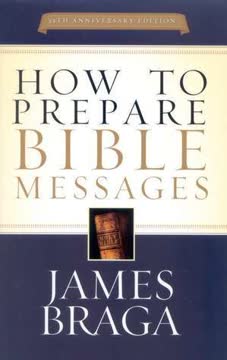
Key Takeaways
1. Master the Three Core Sermon Types: Topical, Textual, and Expository
There are other methods of classifying sermons, but perhaps the least complicated method is to classify them as topical, textual, and expository.
Understand sermon foundations. Effective biblical preaching begins with mastering three fundamental sermon types, each drawing its main divisions from a distinct source. The topical sermon derives its main points from a chosen theme, supported by various Scriptures, ensuring a focused discussion on a single idea. For example, a sermon on "reasons for unanswered prayer" would draw its divisions directly from biblical reasons for prayer hindrances.
Textual sermons originate from a brief Scripture portion (up to three verses), with main divisions directly from the text itself. These divisions then serve as "lines of suggestion," which can be developed using other Scriptures. An example from Ezra 7:10, focusing on Ezra's heart, would derive points like "His heart was set on knowing the Word of God" directly from the verse.
Expository sermons interpret an extended passage (four or more verses) in relation to one central theme, with the bulk of the material, including all main divisions and subdivisions, drawn directly from that passage. This method ensures a Bible-taught congregation, as it systematically unfolds the meaning and details of a specific biblical unit. This approach is considered the most effective for interpreting biblical truth.
2. Build Sermons on a Clear, Unifying Proposition
The proposition is a simple declaration of the subject a preacher intends to discuss, develop, prove, or explain in the sermon.
Foundation of thought. The proposition, also known as the thesis or big idea, is the single, declarative sentence that encapsulates the sermon's main spiritual lesson or timeless truth. It acts as the bedrock for the entire sermon, ensuring that all content—from introduction to conclusion—contributes to developing this one specific principle. A well-formulated proposition guides the preacher and clarifies the sermon's direction for the audience.
Developing the proposition involves a meticulous process, starting with a thorough exegetical study of the passage to identify its core subject and complement(s). This leads to an exegetical idea—a statement of what the text actually says. From this, the preacher discerns the timeless truth the passage intends to convey, which becomes the proposition. For instance, from Mark 16:1-4, the exegetical idea about women worrying about a stone leads to the proposition: "The Lord’s people are sometimes confronted with problems that are too big for them."
Key principles for propositions:
- Single Idea: Must express only one main idea.
- Declarative: A positive assertion, not a question or command.
- Timeless Truth: Universal, scripturally sound, usually in the present tense.
- Simple & Clear: Unambiguous and easy to understand.
- Vital & Specific: Significant to people's lives, not trivial or overly general.
- Concise: Brief, ideally under seventeen words, without sacrificing clarity.
This ensures the proposition is a powerful, guiding statement for the sermon.
3. Structure Your Message for Clarity and Retention
A sermon must be constructed in such a way that the hearers will be able to easily grasp both the main thrust of the message and the various elements that make up the message.
Organized thought flow. A sermon's homiletic structure is paramount for clarity and impact, ensuring listeners can effortlessly follow the message. This involves a distinct format: title, text, introduction, proposition, interrogative sentence, transitional sentence, main divisions, subdivisions, discussion, illustrations, application, and conclusion, all connected by smooth transitions. This systematic arrangement helps both the preacher in preparation and the congregation in comprehension.
Value for preacher and hearer. For the preacher, a clear outline promotes distinct and unified thought, aids in proper subject treatment, and helps recall main points during delivery, fostering eye contact and natural flow. For the congregation, well-defined divisions make the sermon's main points clear, allowing them to grasp the progression of ideas and retain the core truths.
Principles for main divisions:
- Grow from Proposition: Each division must develop the central thesis.
- Distinct: No overlapping ideas between divisions.
- Progressive: Arranged logically or chronologically, moving towards a climax.
- Adequate Proof: Sufficient divisions to validate the proposition.
- Single Idea: Each division focuses on one basic concept.
- Clear & Complete: Expressed so meaning is immediately evident.
- Few as Possible: Generally 3-7 divisions, avoiding unnecessary complexity.
- Varied Plan: Avoid monotony by changing the number and introduction style of divisions.
- Parallel Structure: Maintain symmetry in phrasing and word emphasis for balance.
These guidelines ensure a sermon is not only well-organized but also memorable and impactful.
4. Ground Every Sermon in Thorough Biblical Exegesis
One of the first tasks in the development of an expository outline is to discover the theme of a passage, as doing so usually simplifies the development of the outline.
Indispensable textual study. Thorough exegetical study is the non-negotiable prerequisite for accurate and faithful biblical preaching. It involves diligently investigating the text to understand its original meaning, context, and the sacred writer's intent. This deep dive into Scripture illuminates truths previously unnoticed and reveals the main subject and natural divisions of the passage.
Methods of explanation:
- Contextual Analysis: Examining both immediate and remote contexts prevents misinterpretation.
- Cross-Referencing: Comparing the text with parallel passages in Scripture clarifies meaning.
- Linguistic Laws: Paying attention to grammar, nuances of original words, figures of speech, and etymology.
- Historical/Cultural Background: Understanding the setting, customs, and geography for proper interpretation.
- Scholarly Resources: Utilizing commentaries, Bible dictionaries, and handbooks for deeper insight.
The goal is to explain the text clearly and accurately, making its meaning intelligible to the congregation without overwhelming them with academic jargon.
Handling difficult passages. When encountering obscure texts, a preacher should respect scholarly interpretations and, if personal research remains inconclusive, humbly admit the difficulty rather than offering a poor or dogmatic explanation. The focus should always be on clarifying the meaning for the audience, presenting the results of exegesis, not the process. This ensures the sermon remains authoritative, grounded in God's Word, and relevant to the hearers.
5. Engage Your Audience with Vivid Illustrations and Explanations
An illustration is to the sermon what a window is to a building. Just as a window admits light into a building, so a good illustration illuminates a sermon.
Illuminating the message. Illustrations are vital for clarifying profound or abstract truths, making sermons interesting, vivid, and memorable. They transform dull facts into living truth, capturing attention and relaxing the mind. The Lord Jesus himself used simple analogies like the vine and branches to explain deep spiritual concepts, demonstrating their power.
Values of good illustrations:
- Clarity: Explaining complex truths through simple examples.
- Interest: Enlivening the message and preventing listener disengagement.
- Vividness: Making abstract concepts tangible and memorable.
- Emphasis: Highlighting the importance of a particular truth.
Illustrations can take many forms: parables, analogies, allegories, stories, personal experiences, historical events, or imaginative scenarios, all serving to connect the message with the audience's understanding.
Principles for effective illustration:
- Aptness: Directly clarify the point being discussed.
- Clarity: Easy to understand without further explanation.
- Credibility: True to life and believable, even if factual.
- Accuracy: Details must be correct and truthfully presented.
- Brevity: Concise, not overshadowing the main message.
- Discrimination: Avoid bizarre, coarse, or excessive use; maintain dignity.
- Variety: Diverse types and sources to keep sermons fresh.
Preachers should continuously accumulate and organize illustrations from the Bible, literature, personal experience, and observation, filing them for easy access to avoid repetition and enhance sermon impact.
6. Apply Biblical Truth Directly and Personally to Life
Application is the rhetorical process by which truth is brought to bear directly and personally upon people in order to persuade them to respond properly to it.
Connecting truth to life. Application is a crucial element that demonstrates the relevancy of Scripture to a person's life, prompting a favorable response—whether a change in attitude, a decision to act, or submission to truth. It's a process where the preacher, recognizing his own shared spiritual needs, links biblical truths directly to the congregation's circumstances, problems, and temptations.
When to apply truth:
- Throughout the sermon: Woven into the fabric as each spiritual truth is discussed.
- At subdivision/main division close: To reinforce specific points.
- At the conclusion: Especially for sustained arguments or evangelistic messages, to deliver a final, focused appeal.
The timing and amount of application should be balanced, avoiding both excessive appeals and insufficient relevance, ensuring the message resonates without becoming preachy or overwhelming.
Principles for relevant application:
- Address Basic Needs: Relate sermons to universal human problems (guilt, fear, loneliness) and daily perplexities.
- Use Imagination: Make biblical scenes and characters relatable to contemporary struggles.
- Show Workaday Relevance: Illustrate how biblical truths apply to daily pressures, frustrations, and temptations.
- Extract Universal Principles: Derive timeless truths from the text that are applicable across all eras.
- Align with Text: Ensure applications are consistent with the accurate interpretation of the Scripture.
- Be Specific: Use direct questions (e.g., "Has this been our experience today?") and definite challenges, avoiding vague appeals.
- Motivate Rightly: Appeal to noble instincts and warn of consequences, providing incentive for action.
- Relate to the Times: Interpret Scripture in light of current political, social, and moral changes, focusing on the Gospel, evangelism, and prophecy, while avoiding partisan politics.
7. Cultivate a Godly Life and Depend on the Holy Spirit
Only the man who walks with God and lives a holy life can inspire others to grow in the grace and knowledge of Christ.
Preacher's personal walk. Effective application of biblical truth hinges on the preacher's intimate and continuous fellowship with God. A life lived close to Christ, characterized by spiritual disciplines and a loving concern for others, is the most powerful sermon a pastor can preach. This personal godliness transforms character and fosters a gracious attitude, enabling the preacher to minister authentically and effectively.
Essential prerequisites for effective application:
- Live Close to God: Intimate fellowship and a holy life are paramount.
- Be Well Educated: Broad academic training, deep scriptural knowledge, and awareness of contemporary affairs.
- Understand Human Nature: Insight into temperaments, needs, and behaviors across age groups.
- Know Your People: Awareness of their circumstances, joys, sorrows, and spiritual needs.
- Speak Naturally: Deliver messages in a conversational, relaxed, yet enthusiastic manner.
- Depend on the Holy Spirit: Recognize that persuasion is ultimately the Spirit's work, empowering words and quickening hearts.
These prerequisites underscore that the preacher's spiritual and intellectual preparation is as crucial as the sermon's content.
Spirit-endued preaching. Ultimately, the sermon's impact relies on the Holy Spirit. Despite faithful preaching and fervent appeals, it is the Spirit who quickens hearts, stirs consciences, and sanctifies souls. Just as Christ depended on the Spirit, so must the minister of God be controlled by the Holy Spirit, allowing divine power to accompany his words. This dependence is often linked to fervent, persistent prayer, as exemplified by figures like Jonathan Edwards, whose prayers preceded powerful revivals.
8. Craft Compelling Introductions and Powerful Conclusions
The conclusion is the climax of the entire sermon, in which the preacher’s one constant aim reaches its goal in a forceful impression.
Captivating the audience. The introduction is a vital part of the sermon, designed to prepare minds and secure the interest of hearers from the outset. It must be brief, interesting, and directly lead to the sermon's dominant idea or theme. Avoiding dullness, a preacher can arouse curiosity, use varied approaches (quotes, questions, life situations), or state the title/text to immediately engage the congregation.
Purpose of the introduction:
- Secure Goodwill: Overcome potential disinterest or negative attitudes towards the preacher or theme.
- Arouse Interest: Challenge thinking and engage the audience in the subject matter.
Effective introductions, like the story of a child's emergency call or a conversation with an unbeliever, connect the message to real-life concerns, making it relevant and appealing.
Climaxing the message. The conclusion is the sermon's most potent part, focusing all previous content to produce a powerful, decisive impact. It is not a place for new ideas but for establishing, emphasizing, or reaffirming the sermon's main truth. A poorly executed conclusion can weaken the entire message, while a strong one can heighten its impression.
Forms of conclusion:
- Recapitulation: Briefly restating main ideas to reinforce the central truth.
- Illustration: A powerful story that summarizes and vividly brings home the message.
- Application/Appeal: A direct call for response to the sermon's truths.
- Motivation: Providing incentive (divine approval, noble ideals, warnings) to spur action.
Conclusions should be brief, simple, and use carefully chosen final words—a vivid thought, a Scripture quote, poetry, or a forceful challenge—to leave a lasting impression. The aim is to elicit a personal response, delivered with tenderness and sincerity, not vehemence.
Last updated: