Key Takeaways
1. Romania: A Personal and Geopolitical Awakening
That book made me a foreign correspondent, even though no one had hired me.
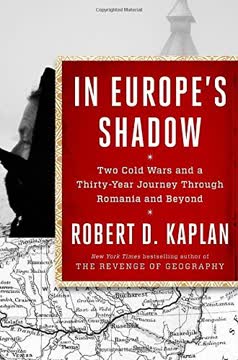
A Directionless Life Transformed. In 1981, fresh out of the Israeli army and feeling directionless, Robert D. Kaplan stumbled upon H. Gordon Skilling's "The Governments of Communist East Europe" in a dusty Jerusalem bookstore. This seemingly drab academic text ignited a lifelong passion for Eastern Europe, particularly Romania, and provided him with a clear vocation: foreign correspondent. The book revealed a region of intense national conflict, internal political weakness, and geographical vulnerability, ripe for external manipulation.
First Encounters with a Bleak Landscape. Kaplan's initial trip to Romania in 1973, and his return in 1981, exposed him to a country starkly different from the liberalized atmosphere of Poland or Hungary. Under Nicolae Ceausescu's regime, Romania was a "black-and-white engraving," marked by:
- Food and fuel lines
- Empty streets and silent boulevards
- People dressed in shapeless coats, clutching jute bags
- An pervasive atmosphere of fear and repression
A New Lens for Understanding. This visceral experience in Bucharest, a "Cold War backwater," forced Kaplan to confront the history he had been missing. It shifted his intellectual focus from the Mediterranean to the colder, more abstract climes of the north, leading him to embrace a realist discipline in his writing. Romania became his "master key" for understanding the Balkans, a region he realized was a journalistic void, offering a unique opportunity to report on a forgotten part of Europe.
2. The Cold War's Stark Reality and Moral Imperative
In terms of human suffering, Romania was the ideological front line between Communism and capitalism.
Totalitarianism's Grip. Romania in the 1980s, under Ceausescu, presented a chilling spectacle of totalitarian control, often compared to Stalin's Russia or North Korea. The regime's "national Stalinism" was a Kremlin-approved variant of Moscow's imperial system, characterized by:
- Widespread shortages of food, fuel, water, and electricity
- Pervasive secret police (Securitate) surveillance
- Massive propaganda, personality cults, and forced public demonstrations
- The deliberate destruction of historical neighborhoods for grandiose civic projects
The Journalist's Role in a Suppressed World. In this environment, ordinary Romanians were too terrified to speak freely, making Western diplomats crucial sources of information and analysis. Kaplan learned the importance of separating himself from the "journalistic horde," seeking out obscure stories that revealed the true extent of the nightmare. His reporting on Ceausescu's "Ceaushima" project, the demolition of thousands of historic structures, led to him being declared persona non grata for five years.
A Glimmer of Hope Amidst Despair. Despite the overwhelming oppression, the daily bread lines and the sheer moral illegitimacy of the Soviet empire led Kaplan to a profound realization: "This could not last, not inside Europe." This insight, initially dismissed, was reinforced by the arguments of Russian-American seminary students who believed the godless Soviet regime lacked moral purpose and would eventually collapse. The suffering in Romania, though immense, contained the seeds of its own undoing.
3. Byzantium's Enduring Cultural and Spiritual Legacy
Romania is a fusion of Roman Latinity and Greek Orthodox Christianity, so that ancient Rome and Greece live on, however vaguely and indirectly, inside the Romanian soul.
A Unique Blend of East and West. While geographically outside the direct confines of the Byzantine Empire, Romania's historical and cultural experience is deeply intertwined with Byzantium. This "fusion of Roman Latinity and Greek Orthodox Christianity" gives Romania a distinct identity, setting it apart from its Slavic and Hungarian neighbors. The sound of Italian alongside the icons of Greek Byzantium creates a unique cultural tapestry.
Byzantium's Gifts to Romania. Robert Byron's revisionist history highlights Byzantium as a spiritual and temporal triumph, a "solitary bulwark" against Asian peoples. Its legacy provided Romania with:
- A rich cultural and religious identity through the Eastern Orthodox Church.
- Inspiration for its late medieval and early modern voivodes.
- A tradition of ingenious national survival against powerful geopolitical forces.
- A "psychological" strategic advantage rooted in a "triple identity" (Hellenic-Roman-Orthodox).
The Orthodox Church as a National Anchor. The Orthodox Church, with its stirring liturgies, music, and icons, served as a vital source of spiritual sustenance and communal survival for Romanians through centuries of invasions and oppression. Even in the 20th century, the Church, though sometimes nationalistic, provided a bulwark against the dehumanizing forces of Communism. The restoration of monasteries and churches post-1989 symbolizes a return to this deep-seated spiritual heritage.
4. Imperial Plaything: Ottoman and Russian Domination
The larger truth, as Jelavich, Seton-Watson, and other historians intimate, is that Wallachia and Moldavia were for centuries the plaything of Russia and Turkey, with Austria and later Austria-Hungary having a critical role, too.
Wallachia and Moldavia: A Frontier of Empires. The flat, easily invadable plains of Wallachia and Moldavia made them perennial battlegrounds and buffer zones for competing empires. While Byzantium offered cultural inspiration, the Ottoman and Russian empires exerted direct and often brutal control. This constant external pressure shaped Romania's "frontier people" identity, forcing them to develop resilience and cunning.
The Ottoman Paradox. The Ottoman Empire, though a "hostile world religion," was also a cosmopolitan civilization that inherited Greek and Roman traditions. Its rule over Wallachia and Moldavia, often indirect through vassal states or Greek Phanariots, was complex:
- It provided a balancing force against Hungarian ambitions.
- It integrated Romania into a wider Orthodox Balkan world.
- It allowed Romanian lands to avoid direct occupation and Islamization, unlike Serbia and Bulgaria.
- However, it also brought periods of terror, banditry, and economic exploitation.
Russia: Protector and Oppressor. Russia's relationship with Romania was contradictory. As the "third Rome" and champion of Orthodoxy, Russia saw itself as a protector of fellow Orthodox Christians in the principalities. Yet, its strategic appetite for Romania's agricultural lands and its pathway to the Mediterranean led to repeated invasions and territorial annexations, particularly of Bessarabia. This dual role meant that while Russia offered a bulwark against Turkey, it also became a dominant, often oppressive, imperial force.
5. The Holocaust's Shadow and Antonescu's Ambiguous Guilt
Marshal Ion Antonescu’s Romania was Adolf Hitler’s second most important Axis ally after Benito Mussolini’s Italy, though one might easily consider Antonescu more formidable and useful from Hitler's point of view than Mussolini was.
A Crucial Axis Ally. Marshal Ion Antonescu, Romania's dictator during World War II, was a pivotal figure in the Holocaust, responsible for the deaths of up to 300,000 Jews. His regime contributed significantly to Hitler's war machine, supplying troops and vital resources like oil. Antonescu's meetings with Hitler and his direct orchestration of mass killings in territories recaptured from the Soviet Union underscore his deep complicity.
The "Great Cemetery of the Jews." The atrocities committed by Romanian troops under Antonescu in northern Bukovina, Bessarabia, and Transdniestria were horrific. Jews were subjected to:
- Deliberate starvation and mass butchery
- Forced marches into ghettos and trenches
- Beatings, gasoline dousing, and burning
- "Death trains" where thousands suffocated without food or water
A Complex and Contradictory Figure. Despite his role as a mass murderer and ethnic cleanser, Antonescu's actions were marked by a certain opportunism. He decimated the fascist Iron Guard early in his rule and, crucially, prevented the deportation of up to 375,000 Jews from Romania proper to German death camps. This "opportunistic mercy" was largely influenced by shifting geopolitical winds after the Nazi defeat at Stalingrad, as Antonescu, a realist, began to fear Hitler's ultimate defeat. His proud, autocratic nature also resisted Hitler's direct orders regarding "his" Jews.
6. Habsburg Transylvania: A Central European Identity
The very idea that I was in former Habsburg Central Europe while still in the middle of Romania, even as other parts of the country might arguably be labeled the Near East, ignited my thoughts in disparate directions.
A Mosaic of Cultures. Crossing the Carpathians northward into Transylvania reveals a distinct Central European ambiance, a stark contrast to the "Near East" feel of Wallachia and Moldavia. This region, historically part of the Austro-Hungarian Empire, boasts a rich cultural mosaic shaped by:
- Saxon Germans (Kronstadt, Hermannstadt, Schassburg)
- Hungarians (Kolozsvar, Marosvasarhely)
- Romanians (peasants)
Habsburg Legacy of Order and Toleration. The Habsburg Empire, a "seismograph of Europe" with its polyglot composition, prioritized conservative order and toleration over ethnic nationalism. It served as a buffer against Turkish advances and Russian Panslavism, elevating stability as its highest moral principle. This influence is evident in Transylvania's:
- Gothic, baroque, and neoclassical architecture
- Vibrant bookstore culture and pastry traditions
- The Lutheran Black Church in Brasov, a testament to German influence
Metternich's Enduring Wisdom. Prince Clemens von Metternich, the Austrian statesman, personified Habsburg values, advocating for legal states over ethnic nations and order over romantic chaos. His diplomatic efforts after the Napoleonic Wars provided Europe with a century of relative peace. Metternich's emphasis on:
- Balance of power and secrecy in diplomacy
- Reason over emotion
- Order over risky populist experiments
remains profoundly relevant for safeguarding stability in a fragile Europe, especially in regions like Transylvania.
7. Post-Communist Romania: Uneven Progress and Lingering Vulnerabilities
But looking all the way back to my first visit in 1981 from 2014 in Sighisoara, it was like comparing a lonely and empty house to one where a family had been firmly and noisily established, with all of their belongings and with the love that came with them.
From Desolation to Dynamic Change. Post-1989 Romania has undergone a dramatic, albeit uneven, transformation. The "lonely and empty house" of Ceausescu's era has been replaced by a "firmly and noisily established" family, reflecting a return to normalcy and individual aspirations. Cities like Bucharest, Jassy, Sighisoara, and Sibiu, once grim and dilapidated, now exhibit:
- Renovated historic buildings and vibrant public spaces
- A proliferation of cafés, shops, and cultural events
- A burgeoning middle class and a sense of urban dynamism
- A shift from state-controlled uniformity to diverse individual expression
Challenges of Transition. Despite progress, Romania still grapples with the deep scars of Communism and the complexities of post-Soviet transition. Lingering issues include:
- Broken judicial systems and partial rule of law
- Corruption within political and economic spheres
- The slow pace of institutional reform
- The loss of traditional communities and the rise of a "garbagey modernity"
A Fragile New Normal. The country's entry into NATO (2004) and the EU (2007) brought hopes of escaping history, but these institutions themselves face crises. Romania's leaders, with a vivid memory of the brutal past, remain sober about the country's vulnerabilities. The current "interregnum" is a period of relative normality, but one that could be threatened by external pressures or internal failures, highlighting the ongoing need for vigilance and reform.
8. The "New Cold War" and Russia's Subversive Strategy
Putin knows that in this battle Gazprom is more useful than the Russian army.
A Resurgent Russian Threat. The Ukraine crisis of 2014 dramatically reshaped Europe's geopolitical landscape, thrusting Romania and Moldova back into the role of "front-line states" in a "new Cold War." Russian President Vladimir Putin's actions, from the annexation of Crimea to the destabilization of eastern Ukraine, signaled a clear intent to undermine post-Cold War assumptions of Russian containment.
Unconventional Warfare and Subversion. This new conflict is less about conventional military invasion and more about "active measures" of subversion, as described by Romanian national security officials. Russia's strategy includes:
- Intelligence activities and criminal networks
- Buying up banks, strategic assets, and media organs
- Funding right-wing, anti-NATO, and anti-EU parties
- Exploiting energy dependence (Gazprom as a weapon)
Moldova: A Vulnerable Pivot. Moldova, historically Bessarabia, is particularly vulnerable due to its small size, weak institutions, and strategic location. Russian influence is formidable, especially through its control of Transdniestria, a "Stalin-invented logistics and intelligence base." Any attempt by Moldova to unite with NATO-member Romania would be fiercely resisted by the Kremlin, which views the region as crucial to its security and its ambition to become a "world power."
9. Geography's Immutable Hand vs. Human Agency
Romania’s fate in the 1980s was without question a product of its geography, that is, of its closeness to the Soviet Union, even as Romania’s distinctive brand of Latinity within Eastern Europe (another product of history and geography) allowed for its psychological isolation—and from that a peculiar, almost North Korean form of Communism could take root.
The Enduring Power of Location. Throughout its history, Romania's fate has been profoundly shaped by its geography, situated at the crossroads of empires and invasion routes. This "ultimate marchland" has meant constant exposure to external forces, from Byzantine and Ottoman armies to Russian and Habsburg expansion. The flat plains of Wallachia and Moldavia were "infinitely invadable," while the Carpathians served as a cultural and strategic divide.
Bending Fate Through Choice. While geography imposes undeniable constraints, human agency and political decisions can bend, though not entirely break, the dictates of fate. Romanian leaders, from medieval voivodes to modern dictators, have often employed cunning diplomacy and strategic maneuvering to navigate their precarious position. The post-Communist era, despite its challenges, offers a new opportunity for Romania to take its "fate into its own hands" through good governance and strong institutions.
Institutions as a Defense. As former Foreign Minister Mircea Geoana argued, the best defense against outside geopolitical forces is robust internal governance. Strong institutions, rule of law, and transparency can transform a marchland into a "nodal point of global interactions." The election of an ethnic German president, Klaus Iohannis, promising reforms and Western alignment, symbolizes Romania's ongoing effort to transcend its historical vulnerabilities and build a more resilient state.
10. The Journalist's Ethos: Cold-Blooded Objectivity and Empathy
A journalist should be less concerned with outcomes—tragic or not—than with getting the analysis right.
The Pursuit of Impersonal Truth. Kaplan's experiences in Bucharest in 1981 profoundly shaped his understanding of journalism, particularly the "true character of objectivity." He learned that while empathy is essential for understanding human suffering, sympathy can distort analysis. Drawing on thinkers like Robert Musil and Thomas Mann, he embraced the idea that "truth arises when the blood is cold," advocating for an "impersonal and inhuman" approach to observation.
Balancing Involvement and Detachment. The foreign correspondent's dilemma lies in getting "morally involved while also retaining a heart of ice." Joseph Conrad's works, particularly "Lord Jim" and "Nostromo," provided Kaplan with a model for this balance: depicting overwhelming human experience with a "majestic, godlike objectivity" that simultaneously loves and pities humankind. This allows for a relentless pursuit of truth, even when it is unsettling or unwelcome.
Outcomes vs. Analysis. A journalist's primary responsibility is to provide a realistic assessment of facts on the ground, regardless of the consequences. Outcomes are the domain of policymakers, who must base their decisions on accurate, unsentimental reporting. Kaplan's own experience with "Balkan Ghosts," which reportedly influenced a White House policy of inaction, taught him the heavy burden of unintended consequences, reinforcing the imperative for honest, unvarnished observation.
11. Nationalism's Dual Edge: Identity and Destructive Passion
The tragedy occurs when this natural sentiment ceases to mean just ‘love for the little platoon we belong to in society’ (Edmund Burke), and is exacerbated into an ideology of hostility, hatred, and envy.
The Search for Identity. Nationalism, as Vladimir Tismaneanu explains, is a "response to degradation and a search for dignity," and societies need "foundation myths" rooted in common cultural experience. For Romanians, this has meant a deep connection to their Latin heritage, peasant life, and Orthodox Christianity, often expressed through heroic narratives of resistance against foreign invaders. This communal pride, when healthy, can be a powerful force for cultural preservation and resilience.
The Perils of Exclusivist Nationalism. However, Romanian intellectual and political life has also shown a marked tendency towards right-wing, exclusivist nationalism, often conflating ethnic identity with national purity. Figures like Mihai Eminescu and Mircea Eliade, despite their brilliance, were drawn to anti-Semitic and fascist ideologies. This "fetishization and idealization of the past" can easily devolve into:
- Hostility towards minorities (Jews, Roma, Hungarians)
- "Blood-and-soil" nativism
- A rejection of cosmopolitan values
Escaping the "Ethnic Straitjacket." The horrors of the 20th century, including the Holocaust and Communist totalitarianism, demonstrated the lethal consequences of rigid, "hard nationalist categories." Timothy Snyder's work highlights the fluidity of early modern identities, contrasting them with the "ethnic straitjackets" demanded by modern nationalists. The aspiration for the postmodern European Union, despite its flaws, represents a desire to move beyond these destructive nationalisms towards a world of individual rights and diverse, overlapping identities.
12. The Transformative Power of Deep Travel and Reading
We travel in order to defeat oblivion.
Immersion as a Path to Understanding. For Kaplan, true travel is a "mental adventure" involving total immersion in a place, unburdened by external distractions. This intense focus allows for a deeper appreciation of history and landscape, making experiences "vivid and life-transforming." The absence of modern communication in Cold War Eastern Europe forced a concentrated engagement with people and surroundings, etching memories "deep into memory."
Books as Guides and Companions. Reading is an integral part of this journey, serving as an "act of resistance" against the distractions of the electronic age. Books provide:
- Historical context and philosophical frameworks for understanding the present.
- A means to connect with past eras and different perspectives.
- A source of "spiritual beauty, aesthetic abundance, and geopolitical inspiration."
- A way to "defeat oblivion" by preserving the richness of human experience.
A Continuous Evolution of Self and Place. Kaplan's multiple visits to Romania across different political eras (1973, 1981, 1990, 1998, 2013, 2014) reveal how both the country and his own understanding evolved. Each visit, shaped by different personal and intellectual phases, presented a "different country" and a "different person." This ongoing process of observation, reflection, and intellectual engagement underscores that understanding is never static, and the pursuit of knowledge is a lifelong journey.
Last updated:
Review Summary
In Europe's Shadow offers a blend of travel memoir, history, and geopolitical analysis about Romania. Kaplan draws on visits spanning from the 1970s through 2014, chronicling the country's transformation from Ceaușescu's brutal communist regime to EU membership. Reviewers praise his immersive writing style, historical depth, and insights into Romanian culture, geography, and politics. Some criticize the rambling structure and self-indulgent tone. The book explores Romania's unique position between East and West, its complex history including the Holocaust, and Russia's continuing influence. Most find it informative and engaging despite occasional organizational issues.