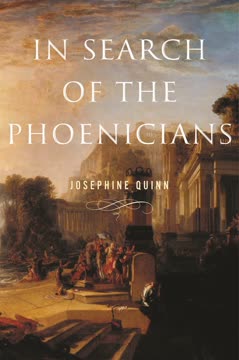
Key Takeaways
1. The "Phoenician People" Are a Modern Nationalist Invention
As Ernest Gellner put it, “Nationalism is not the awakening of nations to self-consciousness: it invents nations where they do not exist”.
Modern political utility. The concept of a unified "Phoenician people" with a shared history and culture is largely a product of modern nationalist ideologies, particularly in the 19th and 20th centuries. New nation-states like Lebanon and Tunisia found it advantageous to claim the ancient Phoenicians as literal or spiritual ancestors, providing a deep historical root for their national identity and distinguishing themselves from broader Arab or colonial narratives. This allowed them to project a timeless national character onto a distinct geographical space.
European scholarly origins. This modern conceptualization was heavily influenced by 19th-century European scholarship, which, in its own quest to define "nations" and "civilizations," began to categorize the ancient Phoenicians as a distinct ethnocultural group. Scholars like Ernest Renan, through expeditions and publications, solidified the image of Phoenicia as a "people" or "nation" with unique characteristics, even if these were often based on selective interpretations or projections of contemporary ideas about race and environment. This academic framework provided the intellectual scaffolding for later nationalist appropriations.
A constructed identity. The book argues that this process of "inventing" the Phoenicians served to naturalize the progression of modern nation-states, obscuring historical discontinuities and fluid identities. It highlights how external identifications, whether by colonial administrators or scholars, can profoundly shape internal affiliations and self-understandings, even leading to the adoption of these imposed labels by the very groups they describe. The modern "Phoenician" identity is thus a powerful example of how the past is continually re-imagined to serve present political and cultural needs.
2. Ancient Phoenician-Speakers Lacked a Unified Collective Identity
Although we have more than ten thousand inscriptions in Phoenician, almost all of which are votive or funerary, and so identify a dedicant or defunct, they identify that person according to their family relationships, or, occasionally, their cities or islands of origin.
Absence of self-designation. Despite extensive epigraphic evidence, there is no clear indication that ancient Phoenician-speakers ever referred to themselves collectively as "Phoenicians" (a Greek term) or by any other overarching communal self-designation like "Canaanites." The few instances where "Phoinix" appears in Greek inscriptions are often personal names or refer to the palm tree, not an ethnic group. The claim of "Canaanite" self-identification is also largely debunked, based on misreadings or later, context-specific uses.
Local and familial affiliations. Instead, ancient Phoenician-speakers primarily defined themselves by their immediate social units: their families and their city-states. Inscriptions consistently list individuals by their patronymics, sometimes extending back several generations, emphasizing lineage. When civic identity is mentioned, it's usually through simple adjectives like "Sidonian" or "Tyrian," or phrases like "sons of Tyre," which refer to the most distant ancestor's city of origin rather than the individual's current residence.
No shared national myth. Unlike Greeks or Israelites, Phoenician-speakers left no literary tradition of shared origin myths, epic poems, or historical narratives that would foster a broader collective identity. The absence of such literature, coupled with the focus on local and familial ties in their inscriptions, suggests that the concept of a unified "Phoenician people" was not a significant part of their self-understanding. Their world was one of interconnected city-states, not a single nation.
3. External Perceptions of "Phoenicians" Were Vague and Stereotypical
Even when they defined “Phoenicians” as a collective, they used the term as a rather vague label invoking a variety of social and cultural distinctions, including linguistic differences, rather than to denote a distinct ethnic group linked by history, territory, or descent.
Greek and Roman ambiguity. Greek and Roman authors, the primary source of the term "Phoenician," did not consistently define them as a homogenous ethnic group. Early Greek texts, like Homer's, portray them vaguely as "sea people" or "traders," often associating them with Sidon, without a monolithic character. Herodotus, while clearer on Phoenicia's geography, still offers no organized description of their customs, unlike other peoples, and often refers to their naval contingents by city rather than a collective "Phoenician" identity.
Shifting stereotypes. Over time, the external perception evolved. From the late 5th century BCE, as Greek identity hardened, "Phoenicians" were sometimes labeled "barbarians" and associated with deceit, a stereotype amplified by the Punic Wars and applied to Carthaginians. However, this was often intertwined with admiration for their maritime skills and commercial prowess. Roman authors continued this trend, using terms like poenus and punicus interchangeably for eastern Phoenicians and western Carthaginians, and even for North Africans in general, often with linguistic connotations.
More about the observer. These external labels reveal more about the Greek and Roman authors' own identity construction and political contexts than about the Phoenicians themselves. By highlighting similarities (e.g., shared maritime culture) or differences (e.g., "Punic faith"), these narratives served to define Greek and Roman identity, justify conflicts, or explain cultural phenomena. The fluidity and inconsistency of these external descriptions underscore the lack of a clear, stable "Phoenician" ethnic reality.
4. Material Culture Reveals Diverse, Not Unified, "Phoenician" Traits
Instead of revealing a single shared “culture,” different artifacts and practices turn out to be characteristic of smaller or larger regions, or in some cases, simply different ones.
"Pots are not people." The idea of a singular "Phoenician civilization" with a distinctive material culture is problematic, often stemming from a "culture-history" model that maps cultural blocks onto ethnic groups. In reality, archaeological evidence shows a complex tapestry of local variations and extensive interactions with other cultures, rather than a neatly bounded Phoenician cultural entity. Many famously "Phoenician" luxury items, like metal bowls and ivories, are rarely found in Phoenicia itself and reflect a broader "international style" of the Late Bronze Age.
Cosmopolitanism and localism. Phoenician cities, while sharing basic urban models, exhibited diverse architectural and artistic tastes. Sidon, for example, drew heavily on Persian, Egyptian, Cypriot, and Greek motifs for its monumental art and funerary practices, creating a hybrid culture that emphasized cosmopolitanism rather than a unique "Phoenician" style. Even within the Levant, cultural practices like cremation varied significantly by city and region, suggesting local rather than pan-Phoenician identities.
Western complexities. In the western Mediterranean, the concept of a homogenous "Punic world" is also challenged. While Phoenician-speaking communities shared some cultural traits due to proximity and common language, they also developed distinct "Punicities" influenced by local populations and other migrants. Their material culture often incorporated Greek and Egyptian elements, and military alliances and trade networks frequently crossed perceived ethnic lines, demonstrating a fluid and interconnected Mediterranean world.
5. The Tophet Cult Forged a Distinct, Exclusive Diasporic Community
The relative scarcity of this cult means that the users of the tophets must have formed a self-conscious group: this was a rare and highly distinctive ritual choice, and we see evidence for the same basic practices at all the surviving sites, practices that identified the worshippers with each other in a way that also served to differentiate them from their neighbors—including other Levantine migrants in the western Mediterranean.
A unique ritual practice. The tophet cult, characterized by the ritual sacrifice and cremation of infants and animals, commemorated by inscribed stone markers, was a highly distinctive phenomenon. While child sacrifice is attested in the Levant, the institutionalized tophet sanctuaries are unique to a specific cluster of Phoenician-speaking settlements in the central Mediterranean, including Carthage, Motya, and Sulcis. This shared, unusual practice created a strong, self-conscious community among its adherents.
Differentiating from homeland and others. The tophets marked a deliberate break from homeland traditions, as no equivalent sites have been found in the Levant. This "after the break" cultural identity simultaneously preserved and transformed Levantine practices, fostering a sense of distinctiveness. The cult also differentiated these communities from earlier Levantine settlements further west (like Gadir or Utica) that lacked tophets, and from local populations, whose disapproval of child sacrifice sometimes led to its use as a marker of defiance against Greek-speaking rivals.
A network of religious extremists. The early tophets, established around the 8th century BCE, formed a "small world" network of settlements strategically located around the Straits of Sicily. This suggests a community perhaps united by a shared, unusual religious tradition, possibly even having migrated due to disapproval of their practices in the East. This religious-commercial network operated as peers, with diverse local expressions in their markers, rather than under a centralized Carthaginian control, until later imperial shifts.
6. Melqart's Network: An Inclusive Imperial Tool for Connection
Carthage may even have promoted this legend on its coinage. Some intriguing silver tetradrachms it issued in Sicily around 320 BCE or a little later depict on their obverse an elegant woman wearing a pleated Phrygian tiara.
Tyre's colonial god. Melqart, the principal god of Tyre, was central to the foundation myths of many western Phoenician settlements, particularly Carthage and Gadir. These myths often involved the transfer of Melqart's sacred objects from Tyre, establishing a vertical kinship between the mother city and its colonies. This connection was reinforced by practices like Carthage sending tithes and sacred ambassadors to Tyre, highlighting a continuous, formal relationship.
A broad, open network. Unlike the exclusive tophet cult, Melqart's network was expansive and inclusive. His identification with the Greek hero Herakles, a figure associated with colonization and rebirth through fire, made him easily translatable across cultures. This syncretism, evident in Carthaginian coinage depicting "Herakles" (Melqart) and in the decoration of Melqart's temples with Herakles's labors, allowed Phoenician-speakers to connect not only with Tyre and each other but also with Greek colonial populations and even indigenous groups, like the Sardinians who adopted Melqart as an ancestor to their local god.
Imperial legitimation. The Melqart network gained prominence in the 4th century BCE, coinciding with Carthage's rise as an imperial power. By emphasizing shared Tyrian origins and the unifying figure of Melqart, Carthage could legitimize its expansion over other western Levantine settlements and local populations. This strategy presented Carthaginian hegemony not as hostile conquest but as a rediscovery of ancient brotherhood, fostering a broader, albeit externally defined, "Phoenician" identity, as seen in the palm tree imagery on Carthaginian coinage.
7. Roman Rule Transformed "Phoenicia" into a Political Construct
It was not until around 400 CE that a Roman province called Phoenicia mapped onto the original Greek geographical conception of Phoenicia: in this period, the province of Syria Phoenice was split again, this time from north to south, with its western half becoming “Phoenice prima” or “Paralia” (“old” Phoenicia, with its administrative center at Tyre) and the eastern region “Phoenice secunda” or “Libanum,” which included Palmyra and Heliopolis, and had Emesa as its capital.
Administrative redefinition. Under Roman rule, "Phoenicia" evolved from a vague geographical or cultural label into a formal political entity. Initially a district within the province of Syria, it was later elevated to a province in its own right by Septimius Severus in the late 2nd century CE. This Roman "Phoenicia" often extended far inland, encompassing cities like Emesa, which had no traditional Phoenician coastal ties, demonstrating a Roman re-imagining of the region for administrative convenience.
Civic rivalry and imperial patronage. The Roman designation of Phoenicia as a province fueled ongoing rivalries among coastal cities like Tyre and Sidon, who competed for the title of "metropolis" (leading city) and asserted their claims to Phoenician colonial heritage. This competition was often expressed through coinage depicting legendary founders like Europa, Kadmos, and Dido, and through honorific inscriptions. These claims served local political positioning within the Roman imperial hierarchy, rather than fostering a unified Phoenician identity.
Emesa's Phoenician identity. The inclusion of Emesa in Syria Phoenice, and the subsequent imperial patronage under the Severan dynasty (whose emperor Elagabalus was from Emesa), led to the city's reinvention as "Phoenician." Roman authors described Emesans, including the imperial family, as Phoenician, and Elagabalus even promoted Phoenician customs and deities in Rome. This imperial enthusiasm for "Phoenicia" provided a context for authors like Heliodorus of Emesa to playfully adopt a "Phoenician" self-description, highlighting the constructed and fluid nature of identity.
8. Punic Persistence: An Evolving African Identity, Not Mere Survival
Despite the Roman annexation of Sicily and then Sardinia in the mid-third century BCE, the fall of Spain after the Second Punic War, and even the destruction of Carthage in 146 BCE, the phenomenon of “Punic persistence” in the western Mediterranean is well known.
Beyond mere survival. The continued presence of Punic language, institutions (like sufetes), and religious practices (like tophet-style sanctuaries) in Roman North Africa was not simply a passive "survival" of pre-Roman culture. Instead, it represented a dynamic and innovative adaptation, creating new forms of "Punic culture" that evolved under Roman rule. This "Punic persistence" was particularly strong in Africa, where these elements spread far beyond the original Levantine settlements.
A cultural package for autonomy. This "cultural package" served as a means for local communities to assert and maintain a degree of autonomy within the Roman Empire. By adopting institutions associated with the prestigious, yet no longer threatening, Carthage, African towns could differentiate themselves from Roman cultural hegemony. The use of Punic alongside Latin in inscriptions, for example, allowed local elites to demonstrate both their Roman connections and their solidarity with the Punic-speaking majority, creating a complex, multilingual identity that complicated Roman administrative control.
An African identity. Over time, these practices became less "Carthaginian" or "Phoenician" and more distinctly "African." The new tophet-style sanctuaries, for instance, often involved new worshippers, new offerings (like birds), and communal dedications, diverging from older Carthaginian models. The widespread adoption of sufetes and the Punic language across diverse African towns, including those far inland, fostered a decentralized network of African civic communities. This evolving identity was recognized by Roman authors, who increasingly used punicus to mean "North African," often with linguistic connotations, a label even embraced by figures like Augustine.
9. Phoenicianism: A Versatile Tool for Imperial and Anti-Imperial Narratives
In Ireland, unlike in Britain, the Phoenicians were not an alternative to medieval legends but an addition to them.
British national origins. From the 16th century, British intellectuals, like John Twyne and Aylett Sammes, invoked Phoenician settlement in Britain to construct national origin myths. This provided a venerable, non-Trojan, and non-Roman ancestry for the nascent British nation, particularly emphasizing connections with Wales and Cornwall. This "Phoenicianism" supported an inclusive, albeit hierarchical, vision of British identity, accommodating diverse regional ancestries within a consolidating empire.
Imperial comparisons. In the 18th and 19th centuries, as Britain's overseas empire grew, the focus shifted from direct ancestry to comparative Phoenicianism. British writers like Daniel Defoe and Edward Wortley Montagu drew parallels between Britain's commercial, maritime, and colonial power and that of the ancient Phoenicians and Carthaginians. This served to glorify British imperial ambitions and, in the context of rivalry with "Roman" France, to justify British dominance, even if the Carthaginian comparison sometimes carried negative connotations of deceit or eventual decline.
Irish anti-colonial resistance. In Ireland, Phoenicianism took on an anti-colonial dimension. Scholars like Roderic O’Flaherty and Charles Vallancey integrated Phoenician origins into Irish Gaelic history, arguing for a noble, ancient Irish civilization predating and superior to Anglo-Saxon or Roman influences. This narrative, often linking Irish language and customs to Phoenician and Carthaginian roots, became a tool for asserting Irish national identity against British cultural and political imperialism, portraying Ireland as a civilized "Carthage" resisting a brutal "Rome."
Last updated: