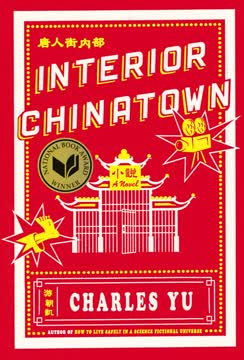
Plot Summary
Dreaming of Kung Fu Guy
Willis Wu, a young Asian American man, grows up in the shadow of Chinatown's rigid role hierarchy, dreaming of one day becoming "Kung Fu Guy"—the highest, most visible role available to someone like him. But for now, he's stuck as "Generic Asian Man," a background character in the endless cop show that is his life. The world he inhabits is a set, both literally and metaphorically, where Asian faces are relegated to the margins, always waiting for a chance to step into the light. Willis's longing is not just for fame, but for recognition, for the chance to be seen as more than a stereotype. His journey begins with hope, but is tinged with the quiet resignation of someone who knows the odds are stacked against him.
Life at Golden Palace
The Golden Palace, a Chinatown restaurant, is both workplace and community hub for Willis and his family. Here, everyone plays a part: waiters, cooks, hostesses, all cycling through roles dictated by the expectations of outsiders. The restaurant's atmosphere is thick with the scent of food and the weight of dreams deferred. The staff, mostly immigrants or their children, navigate the daily grind while rehearsing for the roles they hope to one day earn. The Golden Palace is a microcosm of Chinatown itself—a place of survival, camaraderie, and quiet desperation, where the line between performance and reality blurs, and where the hope for something more persists, even as the world outside remains indifferent.
Family Roles and Hierarchies
Willis's parents, like him, are trapped in roles assigned by both society and the entertainment industry. His mother cycles through "Pretty Oriental Flower" and "Old Asian Woman," while his father, once a kung fu master, is now "Old Asian Man." Their marriage, once passionate, has faded into a partnership of necessity, shaped by poverty and the relentless demands of survival. The family's story is one of sacrifice and adaptation, each member internalizing the roles they are given, even as they yearn for something more. The Wu family's experience reflects the broader Asian American struggle: to be seen, to be valued, and to break free from the constraints of stereotype.
Sifu's Decline
Willis's father, once revered as Sifu—a kung fu master and community leader—has grown old and frail. His decline is both physical and symbolic, marking the erosion of dignity that comes with age, poverty, and invisibility. Sifu's wisdom and strength, once sources of pride, are now reminders of what has been lost. Willis visits him out of duty and love, but their interactions are tinged with sadness and the unspoken knowledge that the roles have reversed: the son now cares for the father. Sifu's journey from master to background extra mirrors the fate of many immigrants, whose skills and histories are erased in the pursuit of survival in America.
Older Brother Mythos
Older Brother is the mythic figure of Chinatown—a prodigy who achieved the coveted role of Kung Fu Guy, inspiring hope in everyone around him. He is everything Willis aspires to be: skilled, charismatic, and seemingly limitless. Yet, even Older Brother hits a ceiling, forced out of the spotlight by forces beyond his control. His story is both inspiration and cautionary tale, illustrating the limits placed on Asian Americans, no matter how talented. The myth of Older Brother sustains the community, but also perpetuates the illusion that individual excellence can overcome systemic barriers. His absence leaves a void, and his legend becomes a bittersweet reminder of what could have been.
Black and White: The Cop Show
The world outside Chinatown is dominated by the cop show "Black and White," where Asian characters are relegated to the background or cast as suspects and victims. Willis and his peers are extras in a story that isn't theirs, their lives reduced to punchlines and plot devices. The show's stars, Black and White, embody the binary of American race relations, leaving no room for the complexity of Asian American experience. Willis's attempts to break into the main cast are met with indifference or condescension. The cop show becomes a metaphor for the broader American narrative, where Asians are always outsiders, never fully part of the story.
SRO: Life Upstairs
Above the Golden Palace, the Single Room Occupancy (SRO) apartments house the workers and their families. Life here is cramped, noisy, and communal, with each floor its own ecosystem. The SRO is a place of both solidarity and struggle, where neighbors become extended family and privacy is a luxury. The building's residents share stories, food, and gossip, their lives intertwined by circumstance and necessity. The SRO is also a place of generational transition, where the dreams of the old country collide with the realities of American life. For Willis, it is both home and prison, a place he longs to escape but cannot leave behind.
Mother's Sacrifice
Willis's mother, Dorothy, embodies the sacrifices of immigrant women. Her journey from Taiwan to America is marked by hardship, resilience, and the constant negotiation of identity. She endures menial jobs, discrimination, and the indignities of poverty, all for the sake of her family. Her love is expressed through small acts—packing lunches, soothing wounds, and offering quiet encouragement. Yet, she also carries scars, both literal and emotional, from a lifetime of being overlooked and undervalued. Dorothy's story is a testament to the strength and complexity of Asian American mothers, whose sacrifices often go unrecognized but are foundational to their children's survival and success.
The Ladder of Roles
In Chinatown, there is a rigid hierarchy of roles for Asian men, from "Background Oriental Male" to "Kung Fu Guy." Willis and his peers compete for these limited parts, each step up the ladder offering the illusion of progress. Yet, even the top role is a trap—Kung Fu Guy is still a stereotype, still defined by what others expect. The pursuit of these roles becomes a cycle of aspiration and disappointment, reinforcing the very system that oppresses them. Willis's journey up the ladder is both a personal quest and a commentary on the broader struggle for representation and agency in American culture.
The Case of the Missing Asian
When a crime rocks the community, Willis is drawn into the narrative as a "Special Guest Star," assisting the detectives of Black and White. The investigation becomes a metaphor for the search for self, as Willis navigates the expectations of both his own community and the dominant culture. The case exposes the ways in which Asians are rendered invisible, their stories reduced to background noise or exotic intrigue. As Willis steps into the spotlight, he is forced to confront the limits of his own ambition and the cost of assimilation. The case is never just about the missing person—it is about the missing place of Asians in the American story.
Love and Loss in Chinatown
Amid the chaos of Chinatown, Willis finds love with Karen Lee, a fellow actor who understands the complexities of their shared world. Their relationship offers a glimpse of hope and possibility, a chance to build something real beyond the confines of stereotype. Yet, love is not enough to overcome the pressures of ambition, family, and societal expectation. As their careers diverge and the demands of parenthood mount, Willis and Karen are forced to choose between personal fulfillment and collective responsibility. Their story is one of tenderness and regret, a reminder that even in the margins, love can flourish—and falter.
Striving Immigrants
The Wu family's history is a tapestry of migration, adaptation, and resilience. From the trauma of political violence in Taiwan to the indignities of American racism, each generation faces its own challenges. The narrative weaves together personal stories with historical context, highlighting the ways in which laws and policies have shaped the lives of Asian Americans. The family's struggles are both unique and universal, reflecting the broader immigrant experience of striving for acceptance, security, and dignity in a country that often refuses to see them as fully human.
Breaking the Script
As Willis rises through the ranks, he begins to question the value of the roles he has worked so hard to attain. The realization that even "Kung Fu Guy" is just another form of Generic Asian Man prompts a crisis of identity. Willis confronts the systems that have defined him, both external and internal, and begins to imagine a life beyond the script. This act of rebellion is both liberating and terrifying, as it means stepping into the unknown without the safety of familiar roles. Breaking the script is an act of self-creation, a declaration of agency in a world that prefers him silent.
Kung Fu Dad
Willis's journey comes full circle as he becomes a father to Phoebe. The experience of parenthood forces him to reevaluate his priorities and redefine success. No longer content to chase the approval of others, Willis finds meaning in the everyday acts of caring for his daughter. Fatherhood is both a continuation of the immigrant struggle and a break from the past—a chance to build something new, to be more than a role. Through Phoebe, Willis glimpses the possibility of a future unburdened by the expectations of others, where identity is not a performance but a lived reality.
Phoebe's World
Phoebe, Willis's daughter, represents hope and renewal. Her world is brighter, more open, and less constrained by the roles that defined her parents' lives. Through her eyes, we see the possibility of assimilation without erasure, of belonging without compromise. Phoebe's imagination and resilience are testaments to the strength of those who came before her, and her story is a promise that the cycle of invisibility can be broken. In her, the dreams of generations find new expression, and the future of Chinatown—and America—looks a little less scripted.
The Courtroom Reckoning
In a surreal courtroom scene, Willis stands trial for his own disappearance, with Older Brother as his lawyer and the entire community as witnesses. The proceedings become a meditation on the history of Asian exclusion, the absurdity of racial categories, and the struggle for recognition. The trial exposes the contradictions of American identity, where Asians are perpetually foreign, always on the margins. Willis's testimony is both confession and indictment, acknowledging his complicity in perpetuating stereotypes while demanding a place in the narrative. The courtroom becomes a stage for collective reckoning, a space where the invisible can finally be seen.
The Verdict and Beyond
The jury finds Willis guilty—not of a crime, but of internalizing the roles imposed upon him. Yet, this verdict is not an end, but a beginning. In the chaos that follows, Willis and his community fight back, reclaiming their agency and rewriting the script. The struggle is messy and incomplete, but it marks a turning point: the recognition that true freedom lies not in escaping the margins, but in embracing the fullness of one's identity. The verdict is a call to action, a reminder that the story is not over, and that the future is still unwritten.
Becoming More Than a Role
In the aftermath, Willis reconciles with his family and community, finding peace in the knowledge that he is more than the sum of his roles. He is a son, a father, a husband, and a member of a vibrant, complicated community. The journey from Generic Asian Man to Kung Fu Dad to just Willis Wu is one of self-discovery and acceptance. The story ends not with triumph or defeat, but with the quiet dignity of a life lived authentically, in all its messiness and beauty. Willis's story is a testament to the power of narrative—to wound, to heal, and to transform.
Characters
Willis Wu
Willis Wu is the protagonist, a second-generation Taiwanese American trapped in the roles assigned to him by both Hollywood and society. He is earnest, self-aware, and deeply conflicted, longing to be seen as more than a stereotype. His journey is marked by ambition, disappointment, and gradual self-realization. Willis's relationships—with his parents, his peers, and his daughter—are fraught with the tension between duty and desire, tradition and change. Psychologically, Willis is shaped by internalized racism and the pressure to assimilate, but he ultimately finds strength in embracing his own complexity. His development is a microcosm of the Asian American experience: striving, suffering, and, finally, becoming.
Ming-Chen Wu (Sifu/Old Asian Man)
Ming-Chen Wu, Willis's father, is a former kung fu master whose decline mirrors the erosion of dignity faced by many immigrants. Once a figure of strength and wisdom, he becomes increasingly frail and marginalized, both in his family and in the broader community. His relationship with Willis is marked by unspoken love, disappointment, and the pain of generational misunderstanding. Sifu's life is a testament to the costs of survival in America—the loss of identity, the burden of invisibility, and the quiet heroism of endurance. His journey from master to extra is both tragic and deeply human.
Dorothy Wu (Old Asian Woman)
Dorothy is Willis's mother, a woman whose life is defined by sacrifice and perseverance. Her journey from Taiwan to America is marked by hardship, discrimination, and the constant negotiation of identity. She is both nurturing and tough, carrying the scars of her struggles with grace. Dorothy's love for her family is expressed through small acts of care and resilience, even as she is forced to play roles that diminish her. Her psychological complexity lies in her ability to endure pain for the sake of her children, and her quiet insistence that they "be more" than the roles assigned to them.
Older Brother
Older Brother is the legendary figure of Chinatown, the one who made it to the top but was ultimately forced out. He is charismatic, talented, and admired by all, but his story is one of both inspiration and warning. Older Brother's success is limited by the ceiling imposed on Asian Americans, and his eventual disappearance leaves a void in the community. Psychologically, he represents both the hope and the futility of individual achievement in the face of systemic barriers. His return as Willis's lawyer in the courtroom scene underscores the importance of solidarity and collective action.
Karen Lee
Karen is a fellow actor and Willis's romantic partner, later the mother of his child. She is intelligent, ambitious, and empathetic, navigating the complexities of identity with pragmatism and grace. Karen's relationship with Willis is both a source of joy and tension, as they struggle to balance personal ambition with family and community. She represents the possibility of a new kind of Asian American identity—one that is not defined by roles or stereotypes, but by authenticity and agency. Karen's development is marked by her refusal to settle for less, and her insistence on building a life on her own terms.
Phoebe Wu
Phoebe is Willis and Karen's daughter, a bright and imaginative child who represents the future of Chinatown. Her world is less constrained by the roles that defined her parents' lives, and she navigates her identity with curiosity and resilience. Phoebe's innocence and creativity offer a glimpse of what is possible when the cycle of invisibility is broken. She is both a continuation of her family's legacy and a promise of something new. Psychologically, Phoebe embodies the hope that each generation can transcend the limitations of the past.
Black (Miles Turner)
Miles Turner is the Black detective in the "Black and White" cop show, representing the mainstream narrative that excludes or marginalizes Asian characters. He is confident, charismatic, and occasionally sympathetic, but ultimately serves as a reminder of the binary nature of American race relations. His interactions with Willis are marked by both camaraderie and condescension, reflecting the complexities of interminority dynamics. Turner's character is a foil for Willis, highlighting the ways in which the system pits marginalized groups against each other.
White (Sarah Green)
Sarah Green is the White detective in "Black and White," embodying both the allure and the limitations of assimilation. She is competent, attractive, and often the focus of Willis's admiration. Green's relationship with Turner is marked by flirtation and partnership, while her interactions with Willis are tinged with condescension and exoticization. Psychologically, she represents the unattainable ideal of whiteness, and her presence in the narrative underscores the ways in which Asian Americans are always outsiders, even when they are included.
Fatty Choy
Fatty Choy is a fellow SRO resident and friend of Willis, providing humor and camaraderie amid the struggles of Chinatown life. He is both a stereotype and a subversion of it, embodying the contradictions of the Asian American experience. Choy's loyalty and resilience make him a beloved figure in the community, and his presence serves as a reminder that survival often depends on solidarity and laughter.
SRO Community
The residents of the SRO—cooks, hostesses, gangsters, elders, and children—form a collective character that embodies the diversity and complexity of Chinatown. Each has their own story, their own struggles and dreams, but together they create a vibrant, if precarious, community. The SRO is both a place of hardship and a source of strength, a reminder that identity is shaped not just by individual choices, but by the networks of care and connection that sustain us.
Plot Devices
Scripted Reality and Metafiction
The novel's central device is its use of screenplay format and metafictional commentary, blurring the line between fiction and reality. Characters are both actors and roles, their lives dictated by scripts written by others. This structure highlights the performative nature of identity, especially for minorities forced to navigate stereotypes and expectations. The cop show "Black and White" serves as both setting and metaphor, exposing the ways in which mainstream narratives exclude or flatten Asian American experience. The constant rehearsal, audition, and recitation of lines underscore the struggle for agency and authenticity.
Hierarchies and Role Ladders
The rigid hierarchy of roles in Chinatown—Background Oriental Male, Generic Asian Man, Kung Fu Guy—serves as a metaphor for the limited opportunities available to Asian Americans. The ladder is both a path to advancement and a trap, reinforcing the very system it purports to transcend. The pursuit of higher roles becomes a cycle of aspiration and disappointment, mirroring the broader struggle for representation and belonging.
Generational Trauma and Family History
The novel weaves together personal and historical narratives, using flashbacks, family stories, and legal history to contextualize the present. The trauma of migration, exclusion, and discrimination is passed down through generations, shaping the identities and aspirations of the characters. The courtroom scene, with its references to real laws and cases, situates the Wu family's story within the broader history of Asian America.
Satire and Parody
The novel employs satire and parody to critique the ways in which Asians are represented in media and society. The cop show, the restaurant, and the SRO are all exaggerated, stylized spaces that reveal the absurdity of the roles assigned to Asian Americans. Humor is used both as a coping mechanism and as a tool of resistance, allowing characters to reclaim agency and challenge the status quo.
Breaking the Fourth Wall
Characters frequently break the fourth wall, addressing the reader and acknowledging the artificiality of their world. This device creates a sense of intimacy and complicity, inviting the reader to question their own assumptions and expectations. The metafictional structure reinforces the novel's central themes: the struggle for visibility, the limits of representation, and the possibility of rewriting the script.
Analysis
Interior Chinatown is a searing, inventive exploration of what it means to be Asian American in a country that insists on seeing you as "other." Through its unique screenplay format and metafictional structure, the novel exposes the ways in which stereotypes and systemic racism shape not only how others see us, but how we see ourselves. Charles Yu deftly balances humor and heartbreak, using satire to illuminate the absurdity of the roles assigned to minorities, while never losing sight of the real pain and longing beneath the surface. The story's emotional arc—from aspiration and disappointment to self-acceptance and renewal—mirrors the journey of countless immigrants and their descendants. Ultimately, Interior Chinatown is a call to break free from the scripts written for us, to embrace the messiness and complexity of our own stories, and to demand a place in the narrative—not as background extras, but as fully realized human beings.
Last updated:
Review Summary
Interior Chinatown by Charles Yu presents Willis Wu's struggle with Asian-American identity through an inventive screenplay format. The novel satirizes Hollywood stereotypes as Willis aspires to rise from "Generic Asian Man" to "Kung Fu Guy" while trapped in a police procedural called "Black and White." Reviews praise its originality, humor, and sharp social commentary on racism and representation, though some found the experimental format exhausting or the themes surface-level. The 2020 National Book Award winner resonates deeply with Asian-American readers while enlightening others about immigration, assimilation, and perpetual marginalization in a "Black and White" America.





