Key Takeaways
1. The Universal Mind: Blending Art and Science
His ability to combine art and science, made iconic by his drawing of a perfectly proportioned man spread-eagle inside a circle and square, known as Vitruvian Man, made him history’s most creative genius.
Interdisciplinary approach. Leonardo da Vinci was the quintessential Renaissance Man, seamlessly weaving together the arts and sciences in a way that defined his genius. He believed that these disciplines were not separate but rather interconnected, each informing and enriching the other. His artistic pursuits often led to scientific inquiries, and his scientific discoveries, in turn, deepened his artistic expression.
Art informed by science. Leonardo peeled flesh off cadavers to understand facial muscles, then painted the world's most memorable smile. He studied optics to master shading and perspective, creating magical illusions of changing visual perspectives in The Last Supper. This fusion allowed him to render objects on a two-dimensional surface with unprecedented three-dimensional realism, a hallmark of Renaissance art.
Science as art. For Leonardo, scientific exploration was not just a means to an artistic end; it was a joyful quest to fathom the profound beauties of creation. His curiosity was pure, personal, and delightfully obsessive, whether he was pondering why the sky is blue or sketching the intricate patterns of water eddies. He saw the "infinite works of nature" as woven together in a unity filled with marvelous patterns, a harmony he sought to capture in both his art and his scientific studies.
2. Relentless Curiosity and Observation Fueled His Genius
"Describe the tongue of the woodpecker," he instructs himself.
Insatiable wonder. Leonardo possessed an omnivorous curiosity that bordered on the fanatical, coupled with an acute power of observation. He puzzled over everyday phenomena that most adults cease to question, such as why the sky is blue or how clouds are formed. This childlike sense of wonder drove him to investigate everything, from the mundane to the ambitious.
Acute observation. His observational skills were not a magical gift but a product of intense effort. He meticulously studied:
- How light subtly caresses an object, creating luster and nuanced shadows.
- The precise movements of a dragonfly's four wings.
- The differing speeds of birds' wings during upswings and downswings.
- The relationship between facial expressions and underlying emotions.
He developed methods, like breaking down observations into minute details, to refine this skill.
Empirical learning. Lacking formal schooling, Leonardo proudly declared himself a "disciple of experience." He preferred firsthand observation and experimentation over inherited wisdom, though he later embraced both. This empirical approach, combined with his relentless questioning, foreshadowed the scientific method developed centuries later by figures like Bacon and Galileo.
3. Notebooks: A Window into a Dynamic, Interconnected Mind
His notebooks are the greatest record of curiosity ever created, a wondrous guide to the person whom the eminent art historian Kenneth Clark called “the most relentlessly curious man in history.”
A repository of thought. Leonardo's more than 7,200 surviving notebook pages are an astonishing testament to his intellectual breadth and visual thinking. These were not neatly organized journals but "zibaldone"—commonplace books crammed with a medley of ideas, sketches, lists, and musings, often sharing a single page. They reveal his mind in constant motion, making connections across diverse fields.
Visual thinking. Drawing was Leonardo's primary tool for thinking and understanding. He used sketches to:
- Deconstruct complex machines into their individual components.
- Visualize anatomical structures from multiple angles and layers.
- Explore geometric transformations and optical phenomena.
- Capture fleeting human expressions and natural movements.
His drawings were not just illustrations; they were thought experiments, allowing him to test hypotheses and refine concepts on paper.
Interwoven passions. The juxtapositions within his notebooks—math calculations alongside sketches of boyfriends, birds next to flying machines, anatomical studies beside fables—showcase his combinatory creativity. This free-range exploration allowed him to discern unifying patterns in nature, such as the analogous branching of trees, rivers, and human arteries, revealing the interconnectedness of the cosmos.
4. Mastering Motion and Emotion in Art
"The good painter has to paint two principal things, man and the intention of his mind," he wrote. "The first is easy and the second is difficult, because the latter has to be represented through gestures and movements of the limbs."
Narrative through movement. Leonardo revolutionized painting by transforming static scenes into dynamic narratives, capturing not just a moment but the flow of time and emotion within it. His figures, from the swirling apostles in The Last Supper to the turning angel in Virgin of the Rocks, are imbued with physical motions that reveal their inner psychological states.
Gestures as language. A keen observer of human behavior, Leonardo meticulously studied and recorded gestures, recognizing their power to convey meaning. He learned from watching the deaf communicate and applied this understanding to his art, making hands, eyes, and body language speak volumes. This is vividly seen in:
- The ripple of reactions among the apostles in The Last Supper.
- Cecilia Gallerani's alert posture and hand clasping the ermine.
- The pointing finger of Saint John the Baptist, directing the viewer's gaze and thought.
Sfumato and chiaroscuro. His mastery of sfumato (blurred outlines) and chiaroscuro (contrasting light and shadow) allowed him to create figures that felt alive and three-dimensional. These techniques, rooted in his scientific understanding of optics and perception, softened contours and created subtle gradations of tone, making emotions flicker and expressions elusive, inviting the viewer's imagination.
5. The Human Body as a Microcosm of the Earth
"The ancients called man a lesser world, and certainly the use of this name is well bestowed, because his body is an analog for the world."
Cosmic analogy. Leonardo embraced the ancient concept of the microcosm-macrocosm relationship, viewing the human body as a reflection of the earth's grand systems. This analogy became a foundational framework for his scientific and artistic inquiries, guiding his exploration of nature's unifying patterns.
Interconnected systems. He drew parallels between:
- Human bones supporting flesh and the earth's rocks supporting soil.
- The circulation of blood in veins and the flow of water in rivers.
- The heart as a "nut which generates the tree of the veins" and a seed sprouting roots and branches.
This holistic perspective allowed him to see the harmonies of the cosmos reflected in the beauty of living creatures, from the smallest plant to the human form.
Evolving understanding. While initially embracing the analogy, Leonardo's rigorous empirical approach led him to revise his thinking when observations conflicted with theory. His studies of mountain springs and river erosion, for instance, eventually showed him that the earth's water circulation was driven by evaporation and rain, not by a direct analogy to blood flow. This willingness to abandon cherished theories in the face of evidence underscored his true scientific spirit.
6. Engineering Vision Beyond His Time
"I have designed extremely light and strong bridges, adapted to be easily carried, and with them you may pursue and at any time flee from the enemy; and others, indestructible by fire and battle, easy to lift and place."
Aspirational inventor. Leonardo's famous job application to Ludovico Sforza, primarily touting his military engineering skills, revealed his deep ambition to be seen as an innovator in technology. Though many of his grand designs remained on paper, they showcased a visionary mind centuries ahead of its time.
Diverse mechanical ingenuity. His notebooks are filled with ingenious contraptions and concepts, blending practicality with fantasy:
- Military machines: Scythed chariots, armored tanks, multi-barreled cannons, self-supporting bridges, and the wheellock mechanism (his only known implemented invention).
- Hydraulic systems: Plans to divert rivers, drain marshes (including a "centrifugal pump" concept), and create navigable canals.
- Urban planning: Designs for utopian "ideal cities" with multi-level streets for sanitation and commerce, anticipating modern urban infrastructure.
- Flying machines: Detailed studies of bird flight and human-powered ornithopters, though none achieved actual flight.
Scientific basis for engineering. Leonardo's engineering was deeply rooted in his scientific understanding of motion, friction, and fluid dynamics. He conducted detailed time-and-motion studies for earthmoving projects and pioneered the use of ball bearings to reduce friction, demonstrating a systematic approach to mechanical problem-solving.
7. The Art of the Unfinished: Perfection and Procrastination
"Men of lofty genius sometimes accomplish the most when they work least," he told the duke, "for their minds are occupied with their ideas and the perfection of their conceptions, to which they afterwards give form."
A quest for perfection. Leonardo's notorious habit of leaving projects unfinished, from the Adoration of the Magi and the Battle of Anghiari to his numerous treatises, stemmed from an insatiable drive for perfection. He believed his hand could never fully capture the "subtle and marvelous" conceptions of his mind, leading him to endlessly refine his work.
Process over completion. He often preferred the challenge of conception and the iterative process of discovery over the chore of completion. He would carry paintings like the Mona Lisa and Saint Anne with him for years, adding thin layers of glaze as new insights struck him, constantly updating his art with his evolving understanding of nature and human perception.
Learning from "failure." His "failures" to finish were often a result of pushing boundaries and experimenting with new techniques, such as his ill-fated oil-on-dry-plaster method for murals. These abandoned projects, however, became "schools of the world" for subsequent generations of artists, influencing the High Renaissance and cementing his reputation as a visionary rather than merely a reliable craftsman.
8. Collaboration and Competition Shaped His Path
"To stage a competition with Leonardo, he assigned Michelangelo that other wall, where Michelangelo, to conquer him, began to paint."
Collaborative spirit. Despite his singular genius, Leonardo thrived in collaborative environments, from Verrocchio's bustling workshop to the intellectual hothouse of the Sforza court. He shared ideas, learned from peers like Bramante and Pacioli, and often worked with assistants who produced multiple versions of his compositions under his supervision.
Rivalry as motivation. His career was punctuated by intense rivalries, most notably with Michelangelo. The Florentine Signoria deliberately pitted them against each other to paint battle murals in the Council Hall, a "concorrenza" that pushed both artists to new heights. This competition, though sometimes acrimonious, spurred innovation and elevated the status of artists.
Contrasting styles. The rivalry highlighted their divergent artistic philosophies:
- Leonardo: Emphasized sfumato, chiaroscuro, psychological depth, and the "universal" nature of subjects, blurring lines between art and science.
- Michelangelo: Favored sharp, delineated forms, muscular male nudes, and a sculptural approach to painting, often disdaining Leonardo's "sack of walnuts" figures.
Even in disagreement, their contrasting approaches enriched the artistic landscape, creating a "school of the world" for future generations.
9. The Mona Lisa: A Synthesis of a Lifetime's Work
Her portrait is a profound expression of our human connections, both to our inner selves and to our universe.
A culmination of genius. The Mona Lisa, painted over sixteen years, stands as the ultimate distillation of Leonardo's accumulated wisdom in art, science, and philosophy. It embodies his mastery of light, shadow, perspective, and the subtle portrayal of human emotion, intertwined with the grandeur of nature.
Scientific artistry. The painting's enduring allure is rooted in Leonardo's scientific understanding:
- Layered glazes: Up to thirty thin, translucent layers of oil paint create luminous depth and elusive contours.
- Sfumato: The blurred outlines and soft transitions, especially around the mouth, make her smile famously enigmatic, changing with the viewer's gaze.
- Optics: His knowledge of how the eye perceives light and shadow, particularly peripheral vision, contributes to the flickering quality of her expression.
- Anatomy: His dissections of facial muscles informed the subtle movements of her lips, creating a smile that is both alluring and psychologically complex.
Microcosm and macrocosm. The misty, jagged landscape behind Lisa, with its winding rivers and ancient geological formations, is not merely a backdrop. It flows into her figure, symbolizing the profound connection between the human soul and the earth's living body. Lisa becomes an eternal icon, embodying the universal patterns of creation and the timeless mystery of human existence.
10. Embracing Ambiguity and Fantasy
"If the painter wishes to see beauties that would enrapture him, he is master of their production," he wrote. "If he seeks valleys, if he wants to disclose great expanses of countryside from the summits of mountains, and if he subsequently wishes to see the horizon of the sea, he is lord of all of them."
Blurring boundaries. Leonardo's genius lay in his comfort with ambiguity and his ability to blur the lines between reality and fantasy, the known and the mysterious. This was evident in his art, where he depicted both the precise details of nature and "infinite things that nature never created," such as dragons, angels, and fantastical landscapes.
Imagination as a tool. He actively cultivated his imagination, advising artists to find inspiration in random patterns on walls or clouds, much like he did with his grotesques. This combinatory creativity allowed him to remix observed details into imaginative new forms, whether for a parlor trick, a theatrical pageant, or a profound work of art.
Spiritual and sensual. His late paintings, like Saint John the Baptist, exemplify this embrace of ambiguity. They blend spiritual reverence with a sensual, almost erotic allure, challenging conventional notions of piety. The enigmatic smiles and pointing gestures in these works invite viewers into a realm where the sacred and the profane, the masculine and the feminine, are fluid and intertwined, reflecting Leonardo's own complex inner world.
Last updated:
Review Summary
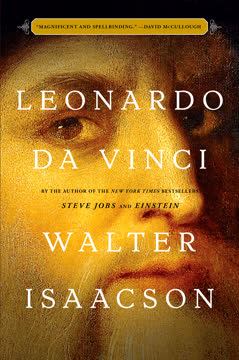
Leonardo da Vinci is praised as a comprehensive, well-researched biography that brings the Renaissance polymath to life. Readers appreciate Isaacson's exploration of Leonardo's boundless curiosity, artistic genius, and scientific pursuits. The book's detailed analysis of Leonardo's paintings and notebooks is commended, though some find it occasionally overwhelming. Many reviewers note the inspiring portrayal of Leonardo's creative process and innovative thinking. While a few critics find the book lengthy or repetitive, most consider it an engaging and informative read that offers valuable insights into one of history's greatest minds.