Key Takeaways
1. "Genocide" Claims Against Europeans are Exaggerated and Misleading.
The facts show that faddish labels such as “genocide” and “stolen land” are not only historically inaccurate—they do far more harm than good, including to the very people they are meant to protect.
Population figures distorted. Claims of millions of Indigenous deaths due to European genocide are often based on wildly inflated pre-contact population estimates, particularly for regions like Hispaniola. While some maximalist estimates suggest eight million people on Hispaniola, archaeological and demographic studies indicate a more realistic figure of around 200,000-300,000. This exaggeration serves a political agenda rather than historical accuracy.
Disease, not massacre. The vast majority of Indigenous population decline, estimated at over 90%, was due to Old World diseases like smallpox, to which Native Americans had no immunity. These epidemics often spread far beyond direct European contact, making intentional spread unlikely and largely uncontrollable. While European cruelty and forced labor did cause thousands of deaths, these numbers are dwarfed by disease and do not constitute a systematic, intentional genocide.
Survival and intermarriage. Genetic evidence and historical records confirm that large populations of Indigenous and mixed-race (mestizo) people survived and thrived in areas of dense pre-Columbian settlement, such as Mexico and Peru. These regions, which accounted for 80% of the New World's population, are overwhelmingly mestizo or Amerindian today, directly refuting claims of widespread extermination. The narrative of total annihilation ignores the resilience and adaptation of Native peoples.
2. Early European-Native Interactions Were Complex, Not Simply Racist.
It is therefore reasonable to suggest that what he meant was nearly the opposite of what Monica (and Howard Zinn) implies.
Nuanced perceptions. Early European explorers, including Columbus, often expressed admiration for Native Americans' physical appearance, intelligence, and customs, viewing them as potential converts and subjects rather than inherently inferior. Columbus's journal, when read in full context, shows a complex view, not a simple desire for enslavement based on racial hatred. The idea of "race" as a biological determinant of inferiority evolved much later.
Absence of modern racism. The concept of biological race, as understood today, did not exist in early modern Europe. Skin color was often attributed to climate, and Christian theology emphasized a common human origin from Adam and Eve. Europeans were not consistently "anti-dark skinned"; for example, black saints were revered, and Ethiopian ambassadors were treated as honored guests.
Intermarriage and social mobility. Intermarriage between Europeans and Native Americans was common, especially in Spanish and French colonies, leading to significant mestizo populations. European nobility often sought to marry into Native "noble" families, viewing it as a social ascent. This fluidity contradicts the notion of pervasive, rigid racial prejudice from the outset of colonization.
3. Native American Societies Were Not Uniformly Peaceful or Utopian.
The political structure of New World societies ensured that they would experience similarly endemic raiding, warfare, slavery, and the extermination of rival tribes.
Endemic warfare. Pre-Columbian Native American societies, particularly tribal chiefdoms and city-states, were characterized by continuous warfare, raiding, and slavery, similar to many Old World societies. Archaeological evidence and oral histories reveal widespread inter-tribal violence, massacres, and the destruction of rival groups, often predating European contact.
Human sacrifice and slavery. Major civilizations like the Aztecs practiced human sacrifice on a massive scale, with tens of thousands of victims annually, often followed by ritual cannibalism. Slavery was also widespread across the New World, with captured individuals, especially women and children, being integrated into conquering tribes or traded. This contradicts the romanticized image of peaceful, egalitarian societies.
Technological disparity. The most advanced New World civilizations, such as the Aztecs and Incas, possessed a technological level comparable to ancient Mesopotamia around 3000 BC. They lacked key Old World innovations like the wheel (for practical use), advanced metallurgy (iron/steel), and sophisticated writing systems, which contributed to their vulnerability upon European contact.
4. "Settler Colonialism" is a Flawed, Ideologically Driven Concept.
Most of the concepts associated with settler colonialism collapse into a rubble of illogic once one identifies and removes the Marxist theory that props them up.
Marxist origins. The theory of "settler colonialism," popularized by academics like Patrick Wolfe, is rooted in Marxist interpretations of history, portraying European expansion as an inherently genocidal, capitalist drive to eliminate Indigenous populations for land and resources. This framework often oversimplifies complex historical realities into a rigid oppressor-oppressed dichotomy.
Limited European reach. For centuries after Columbus, Europeans were largely confined to coastal enclaves in the New World, similar to their trading posts in Asia and Africa. The vast majority of North America remained under Indigenous control until the 19th century, demonstrating that a systematic, continent-wide "elimination" policy was neither feasible nor consistently intended.
Pre-existing European wealth. Europe was already the wealthiest region in the world by 1500, long before significant colonial exploitation of the New World. Economic data shows that colonial ventures, including the transatlantic slave trade, contributed only a modest percentage to Europe's overall GDP, suggesting that European prosperity was not solely built on colonial "theft."
5. Most American Land Was Acquired Through Purchase or Treaty, Not Pure Theft.
The overriding conclusion is that despite all appearances, land in the colonial and early American periods was “not stolen” in the sense that most Left-wing historians and pro-Indigenous activists would have us believe.
Market transactions. The majority of land acquired by Europeans in North America, particularly along the eastern seaboard, was obtained through purchase or treaty from Native Americans. Indigenous leaders, far from being naive, quickly adapted to the land market, often driving hard bargains and accumulating wealth.
Respect for land rights. European governments, including the British and early American administrations, often recognized and sought to protect Native land rights through treaties and boundary lines, such as the Proclamation Line of 1763. While these were sometimes violated, the legal framework for respecting Native sovereignty existed and was often enforced.
Demographic and technological shifts. The dramatic population disparity between rapidly growing European-American settlers and dwindling Native populations (due to disease, inter-tribal warfare, and assimilation) made traditional hunter-gatherer land claims unsustainable. The shift to agriculture and the introduction of firearms fundamentally altered land use and economic viability for Native groups.
6. US Founding Fathers Pursued Complex, Often Humane, Indian Policies.
By any historical standards, the likes of Jefferson, Franklin, Washington, and Lincoln continue to merit their exceptional reputations, and anyone who would question this on the grounds of an anti-Indian prejudice is blinded by ideological animus and impervious to evidence.
Evolving perspectives. Leaders like George Washington and Thomas Jefferson, while initially involved in westward expansion, later dedicated significant effort to establishing fair policies, protecting Native lands, and promoting their welfare. Washington, as president, sought to create a permanent boundary between US and Indian territories and encouraged Native Americans to adopt farming for self-sufficiency.
Jefferson's pragmatism and affection. Jefferson's "unofficial" policy aimed for peaceful coexistence, protection against white encroachment, and gradual assimilation through agriculture, believing it was the "most happy" outcome for Native Americans. He genuinely admired Native culture and sought to ensure their economic independence, even advocating for individual land ownership for Native families.
Lincoln's clemency. Abraham Lincoln's handling of the Dakota War of 1862, where he pardoned 90% of nearly 400 condemned Dakota warriors, demonstrated remarkable clemency and a desire for justice, even in the face of public outrage. His actions were based on distinguishing between combatants and those guilty of atrocities, treating Native warriors with a humanity often denied to them by contemporaries.
7. The Trail of Tears, While Tragic, Was Not a Genocide and Faced Widespread Opposition.
Such a dereliction of all faith and virtue, such a denial of justice, and such deafness to screams for mercy were never heard of in times of peace and in the dealing of a nation with its own allies and wards, since the Earth was made.
Controversial policy. The Indian Removal Act of 1830 and the subsequent Trail of Tears were highly controversial, sparking intense public opposition across the United States, particularly in the North. Figures like Davy Crockett and intellectuals such as Ralph Waldo Emerson vehemently condemned the policy as immoral and unjust.
Legal resistance. The US Supreme Court, in Worcester v. Georgia (1832), declared the forced removal of the Cherokee illegal, upholding their treaty rights. President Andrew Jackson defied this ruling, but the legal system itself provided a check against executive overreach, demonstrating institutional resistance to the policy.
Limited casualties and internal divisions. While tragic, the Trail of Tears resulted in approximately 3,000 deaths out of 60,000 relocated individuals (a 5% mortality rate), primarily from disease and exposure, not intentional slaughter. Furthermore, Native American leadership was deeply divided on the issue, with some factions, like Major Ridge's, advocating for negotiated removal as the most pragmatic path.
8. Claims of Intentional Starvation or Disease Spread are Largely Unfounded.
It is probable that the federal Indian vaccination program of the nineteenth century saved tens of thousands of lives—a significant proportion of all Indians who remained in the United States by 1900.
Disease spread was unintentional. The spread of Old World diseases like smallpox was largely uncontrollable and often affected Native populations far from direct European contact. There is only one inconclusive documented instance (Fort Pitt, 1763) of Europeans potentially attempting biological warfare, which was an isolated suggestion, not a widespread policy.
Active vaccination efforts. The US government, under presidents like Thomas Jefferson and Andrew Jackson, actively pursued policies to vaccinate Native Americans against smallpox as soon as vaccines became available. These programs, often preceding widespread vaccination among white settlers, saved tens of thousands of Native lives, directly contradicting claims of intentional disease dissemination.
Buffalo slaughter context. The near-extinction of the buffalo in the 1870s was primarily driven by the advent of new firearms technology (repeating rifles) and market demand for buffalo hides, not a deliberate US government policy of starvation. While some officials expressed a desire to eliminate buffalo to subdue Native tribes, Congress passed legislation to protect buffalo herds, demonstrating a divided public and political will.
9. The California Gold Rush Violence Was Horrific, But Not a Systematic Genocide.
The fact is, many Indian groups knowingly and willingly went to war rather than submit to some type of sedentary existence.
Anarchic context. The California Gold Rush (1849 onwards) led to a massive, unregulated influx of settlers into Native territories, creating an anarchic environment ripe for violence. While horrific massacres of Native Americans occurred, often by vigilante groups and militias, these were not part of a systematic, state-sponsored genocide.
Exaggerated death tolls. Benjamin Madley's influential work, while detailing atrocities, is criticized for exaggerating the scale of intentional killings by Americans. While thousands of Native Americans died in conflicts and massacres, the figure of 100,000 killed is a significant overstatement; most population decline was due to disease, displacement, and assimilation.
Pre-existing abuses. A substantial portion of California's Native population decline (from 300,000 in 1760 to 100,000-150,000 in 1848) occurred under Spanish mission and Mexican rule, which involved forced labor, disease, and social disruption. The Mexican government's system of indentured servitude, often leading to de facto slavery, was a significant factor in Native suffering before American annexation.
10. "Cultural Genocide" Through Education is a Mischaracterization of Complex Intentions.
To accuse these educators of cultural genocide is not only wrong, it’s desperately ignorant.
Assimilation, not extermination. Residential schools in Canada and similar institutions in the US, while often harsh, underfunded, and culturally insensitive, were primarily intended to provide Native children with a Western education and vocational skills, aiming for assimilation into mainstream society, not the physical or cultural extermination of Native peoples.
Historical context of education. European efforts to educate Native Americans date back centuries, with schools like Harvard Indian College (1656) and Ursuline schools in Quebec (1639) teaching Native languages alongside European subjects. Many Native leaders, like Caleb Cheeshahteaumuck (Harvard graduate) and Sequoia (Cherokee alphabet inventor), benefited from Western education.
Voluntary participation and hybridity. Many Native parents voluntarily sent their children to these schools, recognizing the practical benefits of literacy and Western skills. Native cultures were already dynamic and hybridized through centuries of interaction, making the concept of a "pure" culture being "genocided" an oversimplification.
11. "Cultural Appropriation" is an Overblown Concept Leading to Erasure, Not Respect.
The American Indian once beloved and revered the world over is rapidly becoming invisible in mainstream culture—the result of the too-liberal application of the questionable doctrine of cultural appropriation.
Ideological origins. The concept of "cultural appropriation" emerged from critical theory in the late 1970s, framing any adoption of minority cultural elements by a dominant group as inherently exploitative or disrespectful. This framework often reifies culture as static and exclusive, ignoring its fluid and adaptive nature.
Positive representation. Historically, Native American names and imagery have been widely adopted in American culture, often with intentions of honor, respect, and admiration for Native strength, dignity, and connection to nature. Examples include the Indian Head penny, the Boy Scouts' incorporation of Native lore, and military unit names.
Risk of erasure. The aggressive application of "cultural appropriation" by activists, often non-Native, leads to the removal of Native symbolism from mainstream culture (e.g., sports team names, Halloween costumes). This ironically risks erasing Native Americans from public consciousness, diminishing their visibility and influence, rather than promoting respect.
12. Calls for Further Native Reparations Overlook Extensive Historical and Ongoing Support.
In other words, all that money has so far done nothing—except perhaps to cause more problems.
Long history of support. Native Americans have been the recipients of extensive federal, state, and private charitable support throughout US history, far longer and more comprehensively than any other minority group. This includes land grants, annuities, health services, education funds, and welfare programs dating back to the 17th century.
Substantial financial benefits. Today, federally recognized Native Americans receive significant per capita benefits, including over $20 billion annually in federal allocations, substantial payouts from historical lawsuits (e.g., $3.3 billion under Obama), and revenue from tribal enterprises like casinos and mineral rights. Many tribes hold land valued at hundreds of billions of dollars.
Ineffectiveness of monetary solutions. Despite this unparalleled financial support, many reservation communities continue to face severe social problems, including high rates of poverty, unemployment, alcoholism, drug abuse, and violence. This suggests that simply funneling more money, often mismanaged due to corruption and lack of individual accountability, is not an effective solution and may even exacerbate dependency.
Last updated:
Review Summary
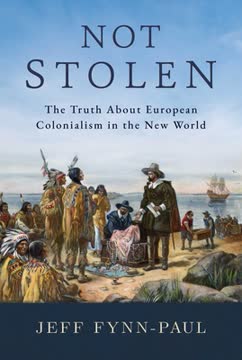
Not Stolen by Jeff Fynn-Paul receives polarized reviews with a 4.11/5 rating. Critics accuse it of being "whitewashing," poorly sourced (relying on Wikipedia), and promoting white supremacist revisionism. Supporters praise it as a fact-based corrective to "woke" history, arguing it debunks myths about genocide, land theft, and European colonialism. The book challenges claims about Native American population sizes, disease spread, and the "stolen land" narrative. Detractors call it polemical propaganda, while defenders view it as essential counterbalance to Marxist interpretations of American history.