Key Takeaways
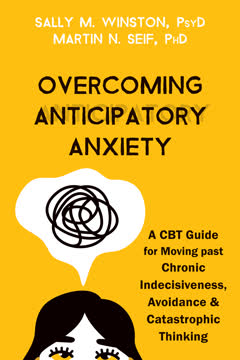
1. Anticipatory Anxiety (AA) and Chronic Indecisiveness (CI) are Avoidance-Driven Patterns
"Anticipatory anxiety" is the anxiety you experience in anticipation of events or situations that you expect will make you anxious or uncomfortable.
Defining the problem. Anticipatory anxiety (AA) is the dread and worry experienced before a feared event, often driven by imagination or past negative experiences. It's the "third layer of fear"—being afraid of being afraid of being afraid—and it's the primary engine behind avoidance. This pervasive phenomenon isn't a formal diagnosis but underlies almost all anxiety states, diminishing flexibility, freedom, and pleasure in daily life.
Indecision's role. Chronic indecisiveness (CI) is the paralyzing inability to make decisions, both small and large, often fueled by AA. It's a habit of avoiding choices, whether consciously or unconsciously, leading to being stuck. AA and CI are intertwined: indecision exacerbates AA, and AA drives the urge to avoid making choices, creating a vicious cycle that limits life opportunities and personal growth.
Common manifestations. AA can appear as phobic avoidance, performance anxiety, insomnia, or even physical symptoms like chronic hyperventilation or gastrointestinal issues. CI manifests as procrastination, active evasion, convenient forgetting, or making decisions with endless escape clauses. Recognizing these patterns in your own life is the crucial first step toward understanding how they operate and how to break free from their grip.
2. Your Brain's Alarm System (Amygdala) Creates False Dangers
Your amygdala operates on the principle that it is less important to find lunch right now than it is to make sure you do not become lunch right now.
The amygdala's role. Our brains are wired for survival, with the amygdala acting as the alarm center, triggering a rapid "whoosh" of emotion—the fight-flight-freeze response—at the merest hint of danger. This primitive part of the brain learns through paired associations, not logic, meaning you cannot simply "talk yourself out" of this initial, automatic arousal. It's a binary system: alarm on or off, with no subtlety.
Two paths to the amygdala. A direct, fast route from the thalamus to the amygdala bypasses higher brain functions, ensuring immediate reaction (first fear). A second, slower path involves the prefrontal cortex, which evaluates the threat. While the prefrontal cortex can confirm a false alarm, it can also generate anxiety by imagining dangers, re-triggering the amygdala even when no external threat exists.
Thoughts as triggers. Crucially, your own thoughts, memories, and imagination can act as triggers, setting off the amygdala's alarm system. This is the essence of anxiety: feeling like you're in danger when you're actually safe. The physical sensations of arousal are your body's natural emergency response, not dangerous in themselves. Misinterpreting these sensations as harmful is a core component of anxiety sensitivity, a genetic predisposition to fear fear itself.
3. Anxious Thinking Hijacks Your Imagination and Common Sense
Anxious thinking views the world as hostile and threatening.
Altered state of awareness. When anxiety is triggered, your consciousness shifts into "anxious thinking," an altered state where your brain assumes danger until proven otherwise. This narrows your attention, making it difficult to access and trust your usual common sense. This state makes you vulnerable to believing your overactive imagination is presenting facts, not fears.
Distorted perceptions. Anxious thinking distorts reality in several ways:
- Catastrophizing: Selectively predicting disastrous outcomes and worst-case scenarios, ignoring probabilities.
- Intensified risk: Focusing solely on the stakes of a situation, not the odds of it happening, making low-probability events feel highly dangerous.
- Selective memory: Vividly recalling past mistakes or negative experiences (Zeigarnik effect) while minimizing successes, convincing you that future events will be equally distressing.
- Fallacy of thoughts as warnings: Believing thoughts can predict or cause events (thought-action fusion), making intrusive thoughts seem important or dangerous.
Self-fulfilling prophecies and urgency. Anxious thinking can lead to self-fulfilling prophecies by making you too frightened to try new things, thus guaranteeing failure. It also creates a false sense of urgency, making worries feel demanding and impossible to set aside. This "paradoxical effort"—where trying harder to control or banish anxiety only makes it stronger—is a key reason why traditional coping mechanisms often fail.
4. Avoidance (Behavioral & Experiential) Fuels and Reinforces Anxiety
Avoidance makes it impossible to check out your what-if thoughts and imagined catastrophes.
The engine of anxiety. Avoidance is the primary mechanism that maintains and reinforces anticipatory anxiety and chronic indecisiveness. It offers immediate, temporary relief from anxious feelings, which acts as a powerful negative reinforcer. This means that every time you avoid, your brain learns that avoidance works, strengthening the likelihood of future avoidance and intensifying the anxiety it seeks to escape.
Forms of avoidance. Avoidance can be:
- Behavioral: Observable actions or inactions, from canceling plans and taking detours to subtle "safety behaviors" like bringing a friend or having an escape plan.
- Experiential: Internal efforts to escape unwanted thoughts, feelings, or sensations. This includes distraction, shutting down, or substituting thinking for feeling (rumination), where endless analysis temporarily reduces anxiety but ultimately fuels the cycle.
Blocking new learning. The most detrimental effect of avoidance is that it prevents new learning. By avoiding feared situations, you lose the opportunity to:
- Disconfirm your catastrophic predictions.
- Discover you can handle discomfort.
- Build confidence and mastery.
- Learn that your anticipatory anxiety was an inaccurate predictor.
Instead, you attribute your temporary relief or "survival" to the avoidance itself, reinforcing the belief that you needed to avoid. Breaking this cycle requires confronting avoidance head-on, understanding that true growth comes from facing, not fleeing, discomfort.
5. Perfectionism, Desire for Certainty, and Fear of Regret Paralyze Action
The mean taskmaster of perfectionism makes necessary uncertainties intolerable, takes the pleasure out of learning, and paralyzes you in the face of choices and decisions.
The pursuit of flawlessness. Perfectionism, the intense desire to be or appear flawless, traps individuals in an all-or-nothing mindset. It sets impossibly high standards, focuses on flaws, and leaves no room for mistakes, leading directly to paralysis in decision-making. This drive, often mistakenly seen as a source of success, actually stifles creativity and makes necessary uncertainties intolerable, turning every choice into a potential disaster.
The illusion of certainty. Life is inherently uncertain, yet chronic indecisiveness is fueled by an intense desire to "know for sure." This isn't about lacking facts, but an uncomfortable awareness of not knowing, often generated by imagination. No amount of research or reassurance can resolve these doubts because they are not fact-based. Waiting for "the right choice" or "the right time" is an attempt to eliminate uncertainty, but it only leads to inaction, as action actually precedes confidence and motivation.
The burden of regret. The fear of regret—anxiety about making a choice you might later wish you hadn't—is a powerful immobilizer. It involves imagining unbearable future consequences or the loss of alternative options (FOMO). This fear is amplified by the belief that one cannot cope with regret. Ironically, this desperate effort to avoid regret often leads to overlooking the significant costs of inaction, such as missed opportunities and prolonged unsatisfying circumstances.
6. Shift Your Perspective: Adopt a Metacognitive, Non-Judgmental Stance
A metacognitive perspective disentangles you from the content of your thoughts and feelings.
Thinking about thinking. Recovery begins with a fundamental shift in perspective: adopting a metacognitive stance. This means becoming aware of your own thoughts, feelings, and sensations as separate from your core self. It's "thinking about thinking" or "awareness of awareness," allowing you to observe your internal experiences without getting entangled in their content. This disentanglement, similar to mindfulness, helps you see that thoughts are just thoughts, and feelings are just feelings—neither are facts.
Beyond content to process. Instead of treating each anxious thought or indecisive moment as a unique problem, a metacognitive perspective reveals them as repetitions of a common, self-perpetuating process. This shift from focusing on what you're thinking to how your mind is operating empowers you to interrupt maladaptive patterns. It allows you to recognize when your imagination is hijacking your common sense or when you're mistaking a false alarm for real danger.
Challenging false beliefs. This perspective also helps challenge common false metacognitive beliefs about worry, such as:
- "Worry means I care."
- "Worry prevents mistakes."
- "Worry can banish doubts."
- "Worry helps solve problems."
- "Worry protects me."
- "Worries that pop up are warnings."
By recognizing these as myths, you can stop giving your worries undue power and begin to relate to them differently, paving the way for genuine change.
7. Embrace the Therapeutic Attitude: Expect, Accept, Allow, and Surrender
The key to recovery lies in changing your attitude toward your thoughts, feelings, memories, sensations, and imagination.
The core attitude shift. The therapeutic attitude is a profound change in your relationship with anxiety, not a technique to eliminate it. It's embodied by three words: "expect," "accept," and "allow."
- Expect: Understand that your biology and history make you susceptible to anxiety; don't hope it won't happen.
- Accept: Acknowledge anxious feelings without judgment, regret, or recrimination; be willing to experience them.
- Allow: Practice non-action and therapeutic surrender, leaving the anxiety alone and staying in the present moment.
The Wise Mind's role. This attitude is guided by your "Wise Mind," the voice of common sense that observes without judgment. It stands apart from the unproductive dialogue between "Worried Voice" (anticipatory anxiety, doubts, what-ifs) and "False Comfort" (avoidance, reassurance, coping). Wise Mind recognizes that struggling against anxiety only intensifies it (paradoxical effort) and that true liberation comes from abandoning the fight.
Therapeutic surrender. Surrender means abandoning the struggle for control, trusting that you can handle whatever thoughts, sensations, and feelings arise, and allowing your mind and body to naturally rebalance over time. It's a refusal to play anxiety's game, like dropping the rope in a tug-of-war. This leap of faith—committing to action without guarantees—removes the fuel that powers anxiety, enabling you to move forward despite discomfort.
8. DANCE: The Five Steps to Overcome Anxiety and Indecision
Just like learning to dance, learning DANCE takes practicing the steps.
A fluid framework for action. DANCE is a practical, flexible framework for applying the therapeutic attitude and metacognitive perspective in daily life. It's not a rigid sequence but a fluid approach to gently navigate anxiety and indecision.
- D: Discern your anticipatory anxiety as imagination, memory, sensitization, or mood, and disentangle yourself. Recognize the familiar "whoosh" of arousal as a pattern, not a unique emergency. Observe your anxious thoughts and feelings from a metacognitive distance, noting the pull to avoid without engaging with the content.
- A: Accept doubts and discomfort willingly. Embrace the unwelcome uncertainty and physical sensations without judgment. Remind yourself that these are not warnings or predictions, but familiar experiences that you can allow to be present.
- N: No struggling, avoiding, reassuring, or overthinking. Resist the urge to fight discomfort, seek reassurance, or ruminate. Understand that these efforts are counterproductive, fueling anxiety through paradoxical effort and negative reinforcement.
- C: Commit to proceed with action or choice. Move forward with your planned action or decision, regardless of how anxious you feel. Don't wait for confidence or certainty. A firm commitment, made despite doubts, is incredibly empowering.
- E: Embrace the present as it is and let time pass. Shift your attention from future-oriented worries to your current sensory reality. Allow anxiety to diminish naturally in the background as you focus on what is happening in the here and now, without trying to banish or fix your feelings.
Practice makes progress. DANCE is learned through consistent practice, both in incidental daily situations and through planned exposures. Each opportunity to lean into discomfort and commit to action, even when anxious, rewires your brain and builds new, healthier pathways.
9. Recovery Means Changing Your Relationship with Anxiety, Not Eliminating It
Recovery does not mean “no anticipatory anxiety anymore.”
Symptoms no longer matter. True recovery, as pioneering therapist Claire Weekes noted, means "when symptoms no longer matter." It's not about eradicating anticipatory anxiety or indecisiveness entirely, but transforming your relationship with them. Anxious thoughts, sensations, or doubts may still arise, especially during stress, but they will lose their power to dictate your choices or cause prolonged suffering.
Reclaiming excitement. As anticipatory anxiety fades, the capacity for excitement reemerges. The physiological arousal that once signaled dread can transform into pleasurable anticipation—the "rush" of new experiences, challenges, and joys. This shift signifies a return to a life unencumbered by anxious limitations, where you can embrace novelty and growth.
Embracing the "hump" and building confidence. During recovery, "false warnings" or lingering blips of anxiety (like Weekes' "hump") are common. These are not setbacks but evidence of your brain rewiring, best met with acceptance and a return to DANCE. Confidence isn't built by avoiding anxiety, but by observing yourself bravely moving forward through discomfort. Like an eagle knowing it can fly, you learn to trust your ability to handle whatever arises, giving no power to anxiety's attempts to bully you.
Last updated: