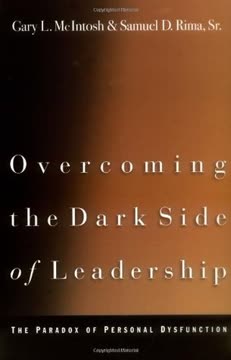
Key Takeaways
1. The Dark Side is a Universal, Hidden Force in Leadership
The dark side, though sounding quite sinister, is actually a natural result of human development.
Inner urges. The "dark side" refers to the inner urges, compulsions, and dysfunctions of our personality that often remain unexamined or unknown until an emotional explosion or significant problem forces us to confront them. It lurks in the shadows of our personality, developing slowly over a lifetime of experiences, examples, emotions, and expectations.
Not exclusively negative. Despite its foreboding name, the dark side is not exclusively a negative force. Paradoxically, the very factors that eventually undermine us are often shadows of the strengths that contribute to our success. It's a part of being human, not a sign of being inherently "sick" or "bad," and can be redeemed with supernatural assistance.
Sudden explosions. While its development is gradual, the assault by these powerful emotions can feel sudden and overwhelming, leading to breakdowns or bizarre behaviors. This denial and repression are particularly common among religious leaders who feel a constant need for control and a shining public persona, often until it's too late.
2. Childhood Experiences Shape Your Unique Dark Side
With rare exception the experiences of our childhood determine the degree to which we are controlled by the dark side of our personality and how it manifests itself when it comes to the exercise of leadership.
Family affair. Our family and developmental years provide the catalyst for the raw materials of pride, selfishness, self-deceit, and wrong motives, determining the final shape of our dark side. Leaders like John F. Kennedy, driven by a need for paternal approval and a culture of winning at all costs, exemplify how early influences can foster a powerful dark side.
Unmet needs. The dark side often develops from "missing blocks" in our Maslow's hierarchy of needs, such as safety, approval, or esteem, which we subconsciously try to satisfy as adults. Traumatic events or deprivations in childhood can leave us feeling permanently threatened, leading to compensatory behaviors.
- Abandonment by a parent can lead to an endless search for safe environments.
- Withholding of love by a perfectionistic parent can create a lifelong quest for approval.
Existential debts. Traumatic childhood events can create "existential debts"—a belief that our unmet need is our fault and we must somehow repay it. Mohandas Gandhi, for instance, felt a lifelong guilt over his father's death, which he attributed to his own lust, influencing his obsession with nonviolent reform.
3. The Paradox: Your Dark Side Fuels Both Success and Failure
In the life and ministry of Jim Bakker we can see a very clear example of both the potential and problems, what we might call the paradox, of the dark side as it relates to the exercise of leadership.
Ache to achieve. The dark side can provide the fuel for extraordinary achievement, silently coaching us to triumph in the very areas that helped create it. Jim Bakker's feelings of inferiority and low self-worth, stemming from a perceived underprivileged childhood and academic failures, fueled his drive to build the PTL empire.
Driven to fail. However, if unacknowledged, the dark side can lead to self-deception and personal weakness, ultimately causing tragic failure. Bakker's need to achieve greatness led him to accept exorbitant bonuses while the ministry was in debt, and to engage in fraud and immoral acts to protect his fragile self-image.
Power for good. Conversely, leaders like Billy Graham, motivated by the traumatic rejection of a teenage love, channeled their drive into a powerful, integrity-filled ministry. Graham's self-awareness and proactive steps to prevent his dark side from sabotaging his leadership allowed God to use his weaknesses for good.
4. Recognize the Five Common Dark Side Leadership Styles
But whenever the dark side is encountered it is a frightening and sobering experience.
Compulsive leaders. These leaders need absolute order, pursue perfection, and are often workaholics, driven by repressed anger and a need for control. Moses, for example, felt he alone could mediate disputes, leading to inefficiency until his father-in-law intervened.
Narcissistic leaders. Obsessed with their image, they exhibit intense ambition, grandiose fantasies, and an overdependence on external admiration, often exploiting others. King Solomon's self-indulgent projects, driven by a need to outshine his father David, exemplify this type.
Paranoid leaders. Characterized by suspicion, hostility, and a fear of being undermined, they are hypersensitive to criticism and create rigid control structures. King Saul's jealousy and attempts to kill David illustrate the destructive path of paranoia.
Codependent leaders. They have a deep need to please others, avoid confrontation, take responsibility for others' actions, and often repress their own emotions. Samson's self-destructive relationships with Philistine women, driven by a need to please, highlight this pattern.
Passive-aggressive leaders. These leaders resist demands through procrastination, stubbornness, and intentional inefficiency, often harboring anger and bitterness. Jonah's reluctance to preach to Nineveh and subsequent anger at their repentance is a classic example.
5. Acknowledge Your Dark Side to Begin Transformation
My sense of reality was just altered. I started out being excited about working for the President. Then I became arrogant, then I became grandiose, and then I became self-destructive.
First step. The journey to overcome the dark side begins with acknowledging its existence and understanding the specific shape it has taken in your life. Dick Morris, President Clinton's political strategist, publicly admitted his arrogance and self-destructive behavior after his fall, recognizing his denial.
Danger of denial. Denial is a deadly disease that prevents leaders from taking responsibility for their actions, often blaming external factors like the "devil" or "bad breaks." King David's year-long denial of his adultery and murder, until confronted by Nathan, illustrates how even divinely chosen leaders can fall victim to this.
Redemption through Christ. For Christians, acknowledging the dark side also means recognizing our fallen human nature and seeking forgiveness and redemption through Jesus Christ. This spiritual step empowers us to overcome our dark side, though the temptation to deny its reemergence remains a constant battle.
6. Examine Your Past to Understand Its Roots
If you want to understand yourself and others, look into the areas of pain, sorrow, and rage.
Self-understanding, not blame. Serious reflection on our past, particularly childhood experiences, is essential for understanding how our dark side developed. The goal is not to assign blame but to gain self-understanding, separating fact from fiction in our memories.
Probing memories. We must recall events that left an indelible mark, no matter how seemingly innocent, and the feelings they generated. These could include:
- Parental divorce or death
- Peer rejection or teasing
- Academic failures or humble family circumstances
- Cruel statements that still sting
Deal with the past. Identifying these formative experiences and the emotions they evoked helps us understand the unmet needs still driving our adult behavior. This process may involve:
- Communicating feelings to influential people (e.g., parents) without blame.
- Writing letters to process emotions, whether sent or not.
- Extending forgiveness to others and ourselves for past hurts and mistakes, as unforgiveness can cripple present leadership.
7. Resist Unrealistic Expectations with God's Grace
For the law of the Spirit of life in Christ Jesus has set you free.
Poison of expectations. Leaders face a confusing and expansive menu of expectations, both self-imposed and from others, which can be a two-edged sword. While healthy expectations can motivate, unrealistic or selfishly motivated ones can become destructive, leading to pain and failure.
Destructive pressure. The cumulative effect of numerous, often contradictory, expectations can create an unbearable burden. Todd Marinovich, a football prodigy, buckled under the immense expectations of his father, leading to rebellion and a derailed career. Similarly, spiritual leaders can burn out or engage in self-destructive behaviors when trying to meet impossible standards.
Oil of grace. A proper understanding and application of God's grace is the liberating "oil" that reduces the friction and pressure of unrealistic expectations. Jesus, who shattered the legalistic expectations of the Pharisees, offers rest and an "easy yoke" to those burdened by human-made rules. Embracing grace means living in freedom, accountable to God, and not allowing others to dictate our behavior through legalism.
8. Cultivate Self-Knowledge Through Spiritual Disciplines
But one who looks intently at the perfect law, the law of liberty, and abides by it, not having become a forgetful hearer but an effectual doer, this man will be blessed in what he does.
Scripture as a mirror. Consistent exposure to the "mirror of Scripture" provides the most accurate self-knowledge, forcing us to confront our depravity and dark side. Neglecting this discipline allows us to live in denial of our true nature, hindering our ability to lead successfully.
Personal retreats. Regularly scheduled retreats (at least 24 hours) offer vital time away from ministry busyness to reflect on our spiritual condition, relationships, and God's direction. Jesus himself prioritized solitude with his Father, underscoring its importance for leaders.
Devotional practices. Daily devotional reading from spiritual leaders, journaling to clarify inner thoughts and emotions, and extended periods of prayer and fasting are crucial. Journaling, in particular, forces honesty, allowing us to identify and define our inner rumblings, reducing their power over us.
9. Seek External Support for Deeper Understanding
Accountability sometimes can be perfunctory and shallow. Submission goes a step further and says, ‘I’m willing to turn loose the control of the vision.’
Personality profiles. Tools like the Gallup Strengths Finder, TJTA, Myers-Briggs, or DiSC can provide invaluable self-knowledge by revealing personality weaknesses and strengths. While they don't explain why we struggle, awareness is half the battle, helping us understand our leadership style and potential pitfalls.
Professional counseling. When personal reflection and spiritual disciplines aren't enough, objective outside help from a professional counselor or therapist may be necessary. Leaders often resist this due to pride or fear of appearing weak, but it can provide crucial insights and help in addressing deeply ingrained issues.
Accountability groups. Submitting to ongoing, transparent accountability relationships with trusted, spiritually mature individuals is critical. This involves:
- Meeting regularly to discuss values and goals.
- Allowing probing questions about all areas of life and ministry.
- Granting permission to challenge inconsistencies.
- Considering a formal covenant to define roles and expectations.
Formal evaluations. Leaders should actively seek formal performance evaluations from those over them. This provides an opportunity to address problem areas early, as others often see our dark side's effects before we do. If not provided, leaders should initiate the process, offering guidelines to their board.
10. Anchor Your Worth in Your Identity in Christ
Our worth as God’s people is what results from our position in Christ rather than our condition on earth.
Beyond performance. All efforts to overcome the dark side will ultimately feel frustrating and empty if our value is tied to performance, position, titles, or achievements. True worth exists independently of anything we do, found only in the grace of God through Jesus Christ.
Position vs. condition. We have both an earthly "condition" (sinful, imperfect, prone to struggle) and a heavenly "position" (new creature, holy, blameless, forgiven, heir with Christ). Christian growth means appropriating our position in Christ by faith, rather than deriving our worth from our fluctuating earthly condition.
God's unwavering love. Scriptures repeatedly affirm our identity in Christ: chosen, redeemed, sealed by the Holy Spirit, children of God, righteous, sanctified. Even while we were still sinners, Christ died for us, demonstrating God's unconditional love. This truth liberates us from the need to prove our worth through leadership achievements.
11. Overcoming the Dark Side is a Lifelong Spiritual Process
Overcoming our dark side is not an event, it is a lifelong process that every leader must be continually working through.
Continuous vigilance. The dark side can never be completely eradicated; it is always with us, like a shadow. Therefore, overcoming it requires continuous vigilance, discipline, and a commitment to ongoing self-examination and spiritual growth.
Redeeming for God's purposes. Our dark side is not intrinsically evil, and God can use it to propel us into leadership. However, it must be redeemed and transformed to serve God's purposes rather than merely satisfying our own neurotic needs. This involves progressively giving our unhealthy motivations and fears over to God.
Balanced leadership. As we gain deeper understanding and consistently practice the steps of acknowledgment, examination, resistance, self-knowledge, and identity in Christ, we protect ourselves and others from destructive failures. This process allows God to exercise more control, leading to balanced, joyful, and God-glorifying leadership.
Last updated: