Key Takeaways
1. Communication Research's Covert Genesis
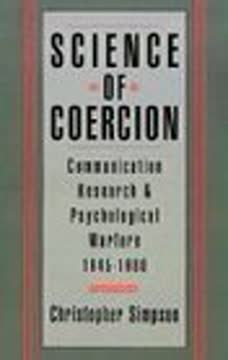
Science of Coercion documents how US military, intelligence, and propaganda agencies spent tens of millions of dollars to underwrite, influence, and apply the work of dozens of leading US social scientists during the first decades of the Cold War.
Foundational funding. The academic discipline of communication research, which crystallized between 1950 and 1955, owes its very existence and early development to substantial financial backing from US national security agencies. These agencies, including the Department of Defense, CIA, and US Information Agency (USIA), poured millions into studies of persuasion, opinion measurement, and propaganda. This funding was far beyond what the private sector could provide, often exploiting military recruits as a unique pool of test subjects.
Key institutions emerged. At least six of the most important US centers for postwar communication studies functioned as de facto extensions of government psychological warfare programs. Their budgets were heavily reliant on national security contracts, sometimes exceeding 75% of annual funding.
- Paul Lazarsfeld’s Bureau of Applied Social Research (BASR) at Columbia University
- Hadley Cantril’s Institute for International Social Research (IISR) at Princeton
- Ithiel de Sola Pool’s Center for International Studies (CENIS) at MIT
- National Opinion Research Center (NORC)
- Bureau of Social Science Research (BSSR)
- Survey Research Center (SRC) at the University of Michigan
Shaping the field. This extensive sponsorship not only ensured the survival of these nascent academic centers but also profoundly influenced the selection of leaders, theories, and research methodologies that would come to define the field. The government's priorities for social management and ideological control became embedded in the academic understanding of communication itself.
2. The Instrumental "Paradigm of Domination"
The dominant paradigm of the field, so to speak, has long been a paradigm of domination.
Communication as control. The core understanding of communication that emerged from this era was not one of mutual exchange or sharing, but rather an instrumentalist view: communication as a tool for persuading or dominating targeted groups. This perspective reduced the complex social process of human communication to a simple model of transmission, where messages could be "plugged in" to achieve specific ideological, political, or military objectives.
Elite management. Much of the scientific output in communication studies since the 1950s has focused on devising means for elites to manage the ideology and public opinion of masses, who were largely disenfranchised from democratic decision-making. This approach emphasized:
- Cradle-to-grave seductions of consumerism
- Public rituals reproducing self-blinding ideologies
- Transferable ideologies across generations
Suppression of alternatives. This narrow, instrumentalist conception of communication often overshadowed and actively suppressed alternative approaches. Concepts like ritual communication, social learning, counterpropaganda, and critical analyses of digital media were largely unexamined or marginalized. The prevailing view presented domination and consumption as acceptable, inevitable, or even "human nature" within academic training and mass media.
3. Psychological Warfare's Expansive Scope
Psychological warfare employs all moral and physical means, other than orthodox military operations, which tend to: a. destroy the will and the ability of the enemy to fight. b. deprive him of the support of his allies and neutrals. c. increase in our own troops and allies the will to victory.
Beyond propaganda. The US military's definition of "psychological warfare" (or "psychological operations") was far broader than simple propaganda. It encompassed a wide array of tactics, explicitly linking mass communication with selective application of violence to achieve political or military goals. This included:
- Overt (white) propaganda: Stressing simplicity, clarity, repetition, and truthfulness (e.g., Voice of America).
- Covert (black) propaganda: Stressing trouble, confusion, and terror, often involving forged documents and deniable sources.
- Gray propaganda: Planting false information in ostensibly independent news outlets.
Integrated violence. The definition explicitly included violent actions, such as:
- Subversion
- Sabotage
- Special operations (assassination, target capture, rescue)
- Guerrilla warfare
- Espionage
- Political, cultural, economic, and racial pressures
Domestic targets. Crucially, the targets of US psychological warfare were not limited to foreign adversaries but also included the people of the United States and its allies. This comprehensive approach aimed to extend US influence far beyond direct military control, at a relatively modest cost, while maintaining plausible deniability for controversial actions.
4. Deep Academic-Government Interlocks
The substantial overlap of key personnel, funding priorities, and data sources strongly suggests that the two programs [Carnegie and Department of Defense] were in reality coordinated and complementary to one another, at least insofar as the two organizations shared similar conceptions concerning the role of the social sciences in national security research.
Interlocking networks. A remarkably tight circle of academics, foundation executives, and government officials formed informal yet powerful networks that coordinated social science funding and research. These "old-boy networks," often rooted in shared World War II psychological warfare experiences, provided crucial professional contacts and funding opportunities for favored scholars. This meant that the same individuals often sat on both government advisory committees and foundation boards, overseeing projects from which they or their institutions directly benefited.
Foundation as conduits. Major philanthropic organizations like the Rockefeller Foundation, Ford Foundation, and Carnegie Corporation played a significant role, often operating in close coordination with government intelligence and propaganda programs. For instance:
- The Rockefeller Foundation reportedly laundered CIA funds for Hadley Cantril's research.
- The Ford Foundation underwrote CIA propaganda projects aimed at intellectuals.
- Carnegie executives controlled funds for influential projects like the American Soldier studies, which depended on military cooperation.
Closed systems. These networks were largely closed to outsiders, with records and decision-making processes often classified. This created a system where a small group of men, enthusiastic about psychological operations, exercised substantial influence over both public and private funds for academic mass communication studies, shaping the field's direction and accepted "knowledge."
5. Euphemism and Strategic Concealment
This seemingly self-contradictory, multilayer approach helped construct a euphemistic, bureaucratic sublanguage of terms that permitted those who had been initiated into the arcana of national security to discuss psychological operations and clandestine warfare in varying degrees of specificity depending upon the audience, while simultaneously denying the very existence of these projects when it was politically convenient to do so.
Layers of deception. From its inception, US psychological warfare was built on multiple, overlapping layers of cover stories and euphemistic explanations, even within secret government councils. This allowed for the pursuit of covert political operations and medium-scale wars while evading oversight and accountability. For example, the National Security Council (NSC) simultaneously issued:
- NSC 4 (Confidential): Authorized overt foreign information measures, publicly framing them as "truth is our weapon."
- NSC 4-A (Top Secret): Directed that these overt programs "must be supplemented by covert psychological operations," explicitly authorizing the CIA to conduct deniable programs.
"Psychological warfare" as euphemism. The very phrase "psychological warfare" itself became a euphemism to conceal covert activities that most governments would consider acts of war. The Office of Policy Coordination (OPC), the CIA's clandestine warfare agency, was officially termed the "United States' Psychological Warfare Organization," despite its charter including sabotage, demolition, subversion, and assassination.
Insulating academics. This linguistic strategy extended to academic discourse, where the social context of government sponsorship and violent applications was often stripped away. Research initially conceived for psychological warfare was later presented as neutral "communication research," adding a gloss of academic recognition and further obscuring its origins and implications for the average reader.
6. Academic Journals as Propaganda Platforms
Public Opinion Quarterly—and perhaps other contemporary academic journals as well—exhibited at least three important characteristics that linked the publication with the U.S. government’s psychological warfare effort during the first decade after World War II.
Advocacy and promotion. Public Opinion Quarterly (POQ), a prestigious academic journal, served as a significant platform for advocating and promoting US propaganda and psychological warfare projects. It frequently published case studies, research reports, and polemics in favor of expanded psychological operations, often without clear definitions of what "propaganda" or "psychological warfare" truly entailed.
Reinforcing foreign policy. More subtly, many POQ articles articulated and reinforced US propaganda themes on broader foreign policy issues, such as:
- The necessity of the Cold War and Soviet culpability.
- The importance of defeating communist parties in European elections (e.g., Italy in 1948).
- The dangers of "neutralism" in the global struggle.
The journal consistently presented a single, government-aligned point of view on these controversial matters, rarely airing contrary perspectives.
Close editorial ties. A substantial number of POQ's editors and contributors maintained unusually close relationships with clandestine psychological warfare efforts at the CIA, State Department, and armed services. Many were financially dependent on these contracts, blurring the lines between independent scholarship and government advocacy. This influence extended to other journals like the American Journal of Sociology, where articles on mass communication were often rooted in psychological warfare contracts.
7. "Scientific" Justification for Coercion
The symbols of science often became as convenient for government clienteles of applied science as they were for social scientists who either sought government favor or justification for asserting their views concerning public policy.
Objectivity as cover. The political-military crises of World War II and the Cold War fostered a strong convergence of interests between elites seeking social engineering tools and social scientists. This allowed academics to transform morally or politically suspect research topics into "purely instrumental" and "objective" studies. For example, research on:
- The effects of bombing on civilian morale
- The "democratization" appropriate for armed forces
- The functions of true and false atrocity accounts in propaganda
These became acceptable academic inquiries, often presented as neutral scientific advances.
Quantitative appeal. Quantitative social science, with its emphasis on statistics and "hard" data, was particularly attractive to government funders. It conveyed an impression of scientific rigor and allowed reform-minded social scientists to navigate political roadblocks, such as congressional suspicion or nativist lobbies. This preference for quantifiable "effects" research shaped the methodologies adopted by the emerging field.
Insulation from consequences. Many social scientists adopted the rationale that their work in psychological warfare (e.g., troop morale, political communication) was fundamentally nonviolent and distinct from the development of weapons. This "insulation" allowed them to avoid confronting the ethical implications of their research, even as government definitions of psychological warfare explicitly included violence, sabotage, and assassination.
8. From Propaganda to "Development Theory"
The CENIS approach, it will be recalled, held that technological innovations in mass communication had helped create an explosive situation in developing countries by implicitly encouraging political participation by millions of people who remained economically and socially disenfranchised.
Evolving focus. As the 1950s progressed, the "old style" of psychological warfare, with its direct emphasis on Soviet and Eastern European targets, began to wane in favor of a broader, integrated strategy for "developing" entire nations. This shift was spearheaded by institutions like MIT's Center for International Studies (CENIS), which became a central hub for this new approach.
"Modernization" as management. CENIS studies viewed social change in developing countries primarily as a management problem for the United States. Daniel Lerner, a key figure, argued that "urbanization, industrialization, secularization [and] communications" were measurable elements of modernization that could be shaped to achieve outcomes desirable to the US government. This led to:
- Studies of "agitators" in Indonesia and student radicals in Chile.
- Analysis of "change-prone" individuals in Puerto Rico.
- Research on the social impact of economic development in the Middle East.
Integrated intervention. This "development theory" combined various tools:
- "White" and "black" propaganda
- Economic development aid
- US-trained and financed counterinsurgency operations
It became known as "limited warfare" among military planners and was rapidly integrated into US psychological warfare practice worldwide, particularly in Southeast Asia (e.g., Cambodia, Laos, Vietnam) and Latin America.
9. Wilbur Schramm: Architect of the Dominant Paradigm
Schramm’s biographer, Steven Chaffee, has written that Schramm “towers above our field” and that communication studies between 1933 and 1973 might best be described as the “Age of Schramm.”
Defining the field. Wilbur Schramm is widely recognized as the single most influential figure in defining and establishing mass communication research and education in the United States. His writings, particularly The Process and Effects of Mass Communication, became foundational texts for generations of scholars, shaping the field's curriculum, theories, and accepted "knowledge."
Government-sponsored theories. Schramm's most pervasive theoretical contributions were often developed directly from his work for US government psychological operations. For instance, his widely accepted distinction between "authoritarian" and "Soviet totalitarian" media systems was developed under a USIA contract, based on sources themselves derived from US psychological warfare programs. This schema, while lacking scientific rigor, provided a politically useful rationale for supporting corrupt anti-communist regimes.
Extensive government ties. Schramm's career was deeply intertwined with US psychological warfare campaigns, with significant portions of his income and professional prestige derived from these activities. His roles included:
- Studies for the US Air Force on Korean War psychological operations.
- Evaluations and consulting for the USIA.
- Analysis for the National Security Council on CIA-directed Radio Free Europe.
- Chair of the Secretary of Defense's Advisory Panel on Special Operations.
- USIA sponsorship for his influential textbooks.
This established a "positive feedback" loop where government funding reinforced his authority and the acceptance of his government-aligned theories.
10. A Legacy of Violence and Misery
The problem with such claims, however, is that the supposed beneficiaries of U.S.-sponsored psychological warfare in a long list of countries are worse off today than ever before.
Failed promises. Advocates of psychological warfare claimed it would be cheaper, more flexible, less brutal than conventional war, and conducive to humanitarian and democratic values. However, the historical record reveals a starkly different outcome. In many of the principal battlegrounds where these tactics were deployed, the majority of people are now poorer, less democratic, less free, and often living in worse health and greater terror.
Increased suffering. The interventions, often cloaked in the rhetoric of "development" or "security," generally increased prevailing levels of violence and misery. Countries like Guatemala, Nicaragua, El Salvador, the Philippines, Turkey, and Indonesia, which were major targets of US psychological operations, bear witness to this destructive legacy. Even conservative leaders, such as Pope John Paul II, have acknowledged the profound devastation left by decades of superpower competition in the Third World.
Rethinking the role of social science. The re-examination of psychological warfare's record forces a critical reconsideration of the role of the United States in world affairs and the complicity of social scientists in propagating ideologies that served powerful interests. It challenges the notion of "neutral" or "objective" communication studies, revealing how the field became entwined with institutions of power, often at the expense of genuine human understanding and well-being.
Last updated:
Review Summary
Science of Coercion examines how U.S. military and intelligence agencies funded and shaped communication studies during the early Cold War (1945-1960). Reviewers praise Simpson's well-documented analysis showing how academics developed a "communication-as-dominance" paradigm, prioritizing propaganda and psychological warfare research over understanding communication as human interaction. The book reveals how funding created an incestuous research environment lacking ethical oversight. While some found it academic and generalized, most consider it essential reading for understanding how government interests influenced social science research, with implications lasting into today's algorithmic persuasion culture.