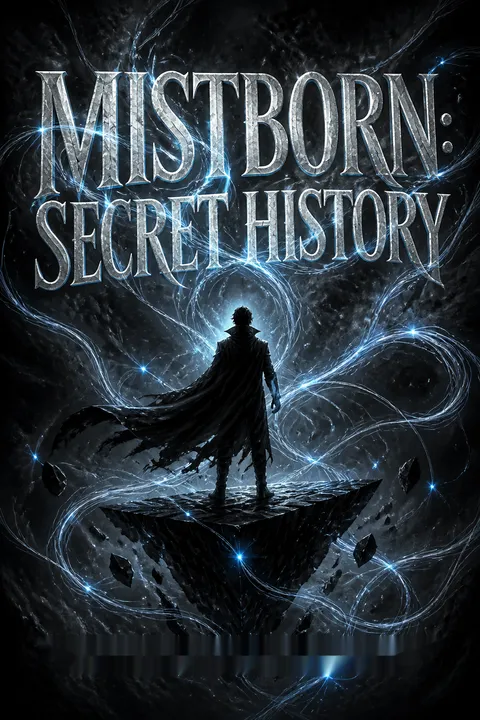


Plot Summary
The Survivor Refuses the Beyond
After killing an Inquisitor, Kelsier faces the Lord Ruler in Luthadel and dies under his blow. In the misted realm between life and whatever follows, he sees souls drawn toward an unknowable Beyond and refuses to join them. The Eleventh Metal has shown him a vision of the Well of Ascension, and he realizes the Lord Ruler may have hidden that source of power inside his palace.
As his spirit begins to unravel, Kelsier runs for the Well and begs Preservation, whom he nicknames Fuzz, to help him endure. Preservation pushes him into the glowing pool. Kelsier survives as a spirit bound to the Well, though the power also confines him there.
Kelsier's refusal is not simple courage. He treats death as another confinement to outwit, because surrender would mean accepting an ending he cannot control. The impulse that made him a revolutionary now becomes metaphysical defiance. Yet the scene also introduces a limit: his survival depends on Preservation's power, so his escape from one form of dependence creates another. The Well is both refuge and prison, an apt material form for Kelsier's habit of turning every apparent defeat into a new scheme.
A Prison With a Pulse
Bound to the pool, Kelsier learns that its light lets him sense events in the living world. Its pulses carry glimpses of Vin, Elend, Terris lore, and a destructive presence working to alter books and prophecy. He follows one pulse outward and feels Ruin, the force opposed to Preservation, watching him.
Meanwhile, Preservation grows erratic and visibly unravels, admitting that the Well will soon fill again and that its power can release Ruin. Kelsier also watches the Lord Ruler arrive as a spirit and pass onward without remaining.
When Vin and Elend finally enter the cavern, Preservation cannot convince Vin to keep the power. Kelsier wounds Elend through the god's hand to make Vin seize it, but she releases it instead, freeing Ruin and emptying Kelsier's prison.
The prison turns observation into a cruel form of participation. Kelsier can see danger approaching, but cannot make himself heard or act directly; his attempt to injure Elend exposes the moral cost of treating people as pieces in a plan. Vin's self-sacrifice defeats his calculation, even as it enables Ruin's escape. The episode contrasts two styles of agency: Kelsier manipulates circumstances to force a choice, while Vin accepts the consequences of her own judgment. Neither is wholly safe, but only one respects the person making the choice.
Freedom Finds a Funeral
Kelsier leaves the empty cavern and reaches a funeral at Keep Venture, where Vin mourns and the survivors bury the dead from Luthadel's siege. He discovers that Dockson and Clubs were killed by koloss while he remained trapped, and Preservation reveals that Dockson blamed Kelsier for the disaster.
Grief hardens into a new purpose: Kelsier embraces the failing god and agrees to seek help beyond Preservation's reach. A thread of Preservation's power leads him to Khriss, a scholar from another world, and her wary companion Nazh.
They explain that Ruin and Preservation are fragments of a shattered deity, and that sixteen such powers exist across a vast inhabited cosmos. Khriss refuses to intervene, but Nazh directs Kelsier toward the Ire, an ancient group near the ocean.
Freedom arrives with a reckoning rather than a welcome. Kelsier had imagined the crew continuing his work, but the funeral makes his absence tangible and forces him to face the human cost of plans made from a distance. Preservation's grief, experienced through their contact, enlarges Kelsier's sympathy beyond his personal losses. Khriss's explanation also changes the scale of responsibility: Kelsier's local rebellion sits inside a cosmic structure he barely understands. His decision to keep moving is therefore partly hope and partly a familiar refusal to admit helplessness.
The Road Remembers Mare
Kelsier crosses the misted version of the Final Empire toward the ocean, learning to travel by the impressions left by people and objects. At Longsfollow, he revisits the place where he and Mare once hid after he killed a noble family in retaliation for a child's murder. Mare had warned him that one act of vengeance could invite many more; Kelsier now sees the chain of reprisals that followed.
He also learns that abandoned objects can be gathered as spirits, and coaxes a discarded cookfire into a portable flame. Ruin appears at the edge of the world and tries to frighten him with threats against Vin. Kelsier recognizes the provocation and continues west, carrying the fire and the guilt with him.
The journey makes memory physical. Kelsier can touch the old room, but cannot restore the life he and Mare shared there; the place answers with impressions rather than comfort. His recollection challenges the heroic story he tells about himself. Vengeance helped shape his opposition to tyranny, but it also multiplied danger for people who had little power over the conflict. The cookfire offers a smaller, more ethical kind of mastery: rather than taking a life or commanding a crowd, he preserves a modest source of warmth and carries it onward.
The Ire Lose Their Prize
Beyond the ocean's edge, Kelsier finds the Ire's fortress, built from stone spirits sustained by a glowing conduit. He discovers that the group plans to use a device filled with liquid light to Connect one of its members to Preservation and claim the Shard. Rather than attack the guarded vault, Kelsier follows their expedition and undermines it with whispered threats, staged apparitions, and a planted robe that makes Alonoe appear to vanish.
The frightened company breaks apart in a jungle. Kelsier isolates Alonoe, takes her orb, and lets her leave alive. The theft gives him a possible means to reach Preservation's power, but it also brings him back to a world already collapsing under Ruin's influence.
Kelsier's heist shows how thoroughly his identity depends on reading other people's expectations. He does not overpower the Ire's guards; he makes their own suspicion and ambition do the work. That ingenuity is impressive, but the episode also sharpens a question about his methods. He treats fear as a tool because it has served him before, and spares Alonoe partly because she is no longer useful to punish. The orb represents power stripped of its context: Kelsier steals the object before he fully understands what it can demand of him.
Metal Opens the Mind
Returning to Fadrex, Kelsier finds Vin near the white-haired Drifter, but Ruin blocks his attempts to reach her and reveals that Kelsier's rebellion served its plans. During an attack on the koloss, Kelsier sees the creatures' human souls emerge and learns from a dying obligator that spikes transformed them.
Preservation's visions confirm that metal lodged in people lets Ruin influence them, including Vin, Marsh, and Spook. Kelsier concludes that Vin's earring is a spike and that she needs a warning. Direct contact with her remains impossible, so he turns toward Spook in Urteau, where Ruin is driving the young man toward murder and a citywide fire.
The discovery of the spikes gives Kelsier a concrete answer to a problem that had seemed supernatural and limitless. Ruin's influence works through vulnerabilities that have been made material, so resistance becomes possible, though never simple. Kelsier's dawning recognition that Vin is compromised unsettles his old confidence in personal judgment: a trusted person may be acting under pressure she cannot see. The revelation also turns his attention from grand confrontations toward communication. Knowledge matters only if it can cross the barriers Ruin has placed around the people he wants to save.
Kelsier Takes the Shard
Preservation finally begins to die, and Kelsier breaks the Ire's orb to draw its light into himself. The power expands him across the world, making him a godlike presence, but it will not obey his attempt to attack Ruin. Ruin explains that Kelsier's soul remains tied to it and that the power resists his murderous intent.
Kelsier tries instead to reach Vin, but their clash shakes Fadrex and exposes the spike in her ear without making her understand the warning. He withdraws before Ruin can overwhelm him. Kelsier recognizes that force will not solve this. Ruin's attention is concentrated around Vin, leaving other places less guarded, and Kelsier searches for a way to act through them.
Ascension enlarges Kelsier without making him sovereign. The gulf between possessing power and being able to use it exposes the limits of his familiar model of agency, in which determination and cleverness can bend a situation. Ruin's claim on him also complicates the distinction between enemy and self: Kelsier's actions have helped create the crisis, but that does not make him merely Ruin's instrument. His retreat is a rare tactical acceptance of weakness. Instead of equating persistence with direct confrontation, he begins to treat attention itself as a scarce resource.
Spook Rejects Ruin
In Urteau, Ruin pushes Spook toward murder by promising him greater Allomantic power. Kelsier gets through to the young man's battered mind and helps him recognize the metal spike in his chest as the source of Ruin's leverage. Spook tears it out, then follows Kelsier's urging to lead the townspeople away from the fires Ruin has set.
Their brief connection allows Kelsier to tell him that Vin's earring is also a spike and that warnings must be written in metal, where Ruin cannot alter them. Spook orders a message engraved on a plate and entrusts it to Goradel, who carries it toward Luthadel. Ruin's control of Marsh makes that delivery perilous.
Spook's resistance matters because it does not begin with strength. Ruin has targeted his need for recognition, offering magical ability as compensation for years of feeling overlooked. Kelsier reaches him by connecting power to responsibility rather than status: Spook must act not to become impressive, but to protect the people in danger. Their bond gives Kelsier influence, yet it also exposes his own absence from the life of someone who trusted him. The message carved in metal turns memory into a safeguard, a fragile human method designed for a world where even written truth can be corrupted.
The Earring Comes Free
Goradel reaches Marsh with Spook's metal message, but Marsh kills him under Ruin's control and reads the plate aloud. Its warning still reaches the right hands: when Marsh is sent to break Vin, he tears the spike from her ear. Kelsier draws Ruin's attention away long enough for Vin to take up Preservation's power.
She uses it to destroy Ruin, though Elend dies in the battle, and Sazed then takes both powers to remake the world. Kelsier watches the outcome he could not force: Vin's judgment and sacrifice accomplish what his schemes could not. The victory ends Ruin's immediate threat, but it cannot restore everyone who has already died.
The climax depends on a message surviving its failed delivery. Goradel dies, Marsh is still under Ruin's influence, and yet the information passes through the very agent meant to suppress it. Kelsier's crucial act is not simply fighting Ruin; he draws attention and gives up power so Vin can choose for herself. The contrast with his earlier attempt to manipulate her through Elend marks a hard-won ethical shift. Victory remains costly, especially in Elend's death, preventing the resolution from becoming a clean reward for cleverness.
Kelsier Lets Vin Go
After Sazed remakes the planet, Kelsier meets Vin and Elend in the Cognitive Realm. Vin thanks him, then leaves with Elend for the Beyond despite Kelsier's plea that she stay. Before departing, she asks him to examine whether his struggle came from love or from a need to prove that no one could defeat him. Kelsier cannot answer.
Sazed remains to shape the new world and tells Kelsier he cannot return to physical life, though Kelsier suspects the god is withholding hope. Alone on a green plateau, Kelsier remembers Mare through the flowers growing there. His victory has saved a future he cannot inhabit, leaving him with both a new world and the unresolved desire to find a way back into it.
Vin's departure is the emotional answer to Kelsier's original refusal to accept an ending. He can save people without possessing them, but he has not yet learned to accept their choices when those choices take them beyond his reach. Her question separates love from the wish to repair an injured self-image, without denying that both motives can coexist. The flowers recall Mare not as proof that Kelsier has earned reunion, but as evidence that the world can carry beauty forward without returning the dead. His remaining ambition is therefore both a promise and a warning.
Epilogue
Weeks later, Spook finds a small spike shaped like an earring on his desk and puts it through his ear, following a half-remembered instruction. Kelsier appears to him from the Cognitive Realm, explaining that Spook's damaged mind and the spike let them communicate.
He wants Spook's help investigating the wider cosmos and finding a way to restore his connection to physical life. Spook hesitates, unsure whether this visitor is truly Kelsier, while Kelsier treats the uncertainty as the start of another crew's work.
The epilogue converts survival from a solitary obsession into a proposed partnership. Kelsier has not solved his separation from physical life, but Spook's altered perception gives him a possible collaborator and makes the next scheme depend on trust. The spike is deliberately double-edged: the same metal that allowed Ruin to intrude now opens a channel between two people. Spook's doubt is important. Unlike the young apprentice who once wanted to imitate Kelsier, he now has reason to question the authority of the man before him. Their renewed relationship can only proceed if Kelsier accepts that being followed is not the same as being believed.
Analysis
Secret History revises the meaning of survival by placing Kelsier's most familiar trait under pressure. He has always treated limits as problems to outthink, whether the limit is an oppressive emperor, a prison, or death itself. The novella grants him extraordinary persistence, but it refuses to equate persistence with wisdom. He can enter the divine conflict and even hold a Shard, yet he cannot simply impose his will on Ruin or make Vin choose as he wants. His power grows while his certainty is challenged.
The story's central ethical tension lies between protection and control. Kelsier loves his crew and wants to save the people who trust him, but he repeatedly turns that care into strategy, treating fear, injury, and faith as levers. Vin's choices expose the difference between helping someone act and arranging circumstances so they have only one choice. Kelsier does learn to give power away at the decisive moment, but the victory does not erase the earlier cost of his manipulation. Vin's final question leaves that moral accounting open rather than granting him easy absolution.
The spiritual system also externalizes psychological states. Metal can mark a breach in the self; the Cognitive Realm gives objects and places the emotional weight people have invested in them; Connection makes private loyalties part of a larger structure. Kelsier's journey through remembered rooms and abandoned landscapes therefore parallels his growing recognition that no action belongs to its author alone. Other people carry its consequences.
Finally, the book frames knowledge as a survival skill. Ruin wins leverage by changing records and exploiting ignorance, while the warning survives because it is deliberately written in metal. Yet knowledge does not become mastery: Kelsier learns more about the cosmos and still cannot control every outcome. The ending leaves him facing the harder task of living with uncertainty, dependence, and love without converting each one into another scheme.
Review Summary
People Also Read





Characters
Kelsier
The defiant crewleaderA charismatic thief turned revolutionary, Kelsier reads people quickly and prefers a plan he can shape to a risk he must simply endure. His confidence protects a deep fear of helplessness, sharpened by imprisonment, loss, and the violence of the Final Empire. He loves Mare and feels a fierce, partly paternal attachment to Vin, yet his care can become entangled with control. Kelsier's talent is not only Allomancy or deception; it is the ability to make others imagine that change is possible. His blind spot is believing that a worthy end can excuse the methods he uses to secure it.
Vin
The reluctant successorVin begins from the instincts of a street survivor: trust cautiously, notice every exit, and rely on herself before anyone else. Kelsier's crew gives her belonging and training, while her relationship with Elend tests whether intimacy can coexist with independence. She is observant, stubborn, and more compassionate than her defensive habits suggest. Unlike Kelsier, Vin is less interested in proving that she can master every situation. Her moral seriousness makes her willing to carry burdens that others would evade, though that willingness can leave her vulnerable to people who present self-sacrifice as the only honorable choice.
Preservation
The fading god of orderPreservation is a divine power invested in endurance, stability, and the continuation of life. The humanlike figure Kelsier meets is fragmented and forgetful, but moments of clarity reveal a mind struggling to protect a world it helped create. Its caution can resemble passivity, especially to Kelsier, who interprets delay as failure to act. Yet Preservation's restraint is not merely weakness: the god's nature limits what it can do, even when it recognizes the danger. Its relationship with Kelsier becomes an uneasy partnership between immense power and a mortal temperament that keeps demanding practical plans.
Ruin
The patient destroyerRuin is the divine force associated with decay, endings, and change. It presents destruction as necessary rather than malicious, arguing that all living things must eventually alter or perish. Its intelligence is most dangerous when it works indirectly: it changes records, inhabits familiar appearances, and exploits people whose choices are already strained by fear or ambition. Ruin's confidence rests on the belief that resistance only postpones an inevitable conclusion. Kelsier's refusal to accept that premise makes him an irritant, but it also gives Ruin a way to manipulate his pride.
Spook
The overlooked apprenticeSpook is a young member of Kelsier's crew whose awkwardness and reserve leave him hungry to be taken seriously. He admires Kelsier and wants the strength to matter in moments when others seem more capable. That desire makes him susceptible to promises of power, but it is not his deepest quality. Spook is attentive to the suffering around him and capable of choosing responsibility even when doing so costs him the identity he hoped to gain. His growth depends on distinguishing courage from imitation and usefulness from applause.
Sazed
The keeper of faithsSazed is a Terrisman scholar who preserves religions, histories, and ways of thinking that others dismiss. His learning is not cold accumulation: he studies belief because he wants to understand what gives people meaning, and he often serves as a patient guide to Kelsier's impulsive crew. Sazed's steadiness can conceal grief and uncertainty, particularly when inherited knowledge no longer provides an adequate answer. He embodies the possibility that study and faith can coexist without either becoming a simple instrument of power.
Elend Venture
The idealist kingElend is a nobleman shaped by books, political argument, and an unusually sincere desire to govern justly. His reforming ideals set him apart from the aristocratic culture that raised him, but good intentions do not automatically make him effective. Vin's love brings him into close contact with dangers he once approached as questions of theory. He is thoughtful and self-questioning, traits that can look like weakness beside Kelsier's certainty but also keep him open to revision. His challenge is to turn moral principle into decisions that protect people in an unstable world.
Marsh
The guarded brotherMarsh is Kelsier's older brother, a reserved and disciplined man whose caution grew from the shared danger of their mixed heritage. Their relationship contains love, rivalry, and an old fear that either brother's mistake could expose the other. Marsh's seriousness contrasts with Kelsier's showmanship, but it does not mean he lacks conviction. He is shaped by duty and by a habit of keeping emotion private, making it difficult for others to know what he is carrying.
Mare
The absent moral compassMare is Kelsier's wife, remembered through her flower, her skepticism, and the arguments that once challenged his appetite for vengeance. She could recognize injustice without believing every act of retaliation would repair it. Her influence remains part of Kelsier's inner life, especially when he revisits choices that harmed people beyond their intended targets. Mare's absence gives his victories a personal measure that fame and political change cannot replace.
The Drifter
The cosmic wayfarerThe white-haired Drifter is an experienced traveler between realms who approaches danger with humor, misdirection, and a guarded sense of purpose. He arrives at the Well seeking something for his own reasons and proves far more capable than Kelsier expects. Their encounter is adversarial, but it also reveals how little Kelsier understands about the worlds beyond his own. The Drifter's teasing manner keeps his motives difficult to read.
Khriss
The scholar from TaldainKhriss is a traveling scholar who gathers knowledge about the powers and peoples of the wider cosmos. She is curious without being reckless, and her refusal to promise help reflects a careful assessment of her own limits rather than indifference. Kelsier's urgency interests her, but she does not mistake his confidence for expertise. Her explanations give him a larger framework while leaving the practical crisis for him to face.
Nazh
The wary field agentNazh works alongside Khriss as a capable, suspicious companion, ready to defend their mission and skeptical of Kelsier's intentions. His caution often sounds blunt, but beneath it lies a grudging respect for people who continue acting when success is uncertain. By pointing Kelsier toward the Ire, Nazh gives him a lead without pretending the journey will be safe or easy.
Dockson
The crew's stern strategistDockson is Kelsier's close friend and the practical mind behind much of the crew's work. He has less patience for improvisation than Kelsier and understands that political change depends on supply, timing, and people who must live with its aftermath. His loyalty is serious rather than sentimental, which makes his judgments carry particular weight with Kelsier.
Clubs
The practical metalworkerClubs is the crew's craftsman, a skilled worker whose gruff manner conceals a lasting commitment to the people he has chosen as family. He contributes practical expertise rather than grand speeches, making him one of the crew's essential anchors. His skepticism keeps Kelsier's plans connected to the material world.
Ham
The questioning soldierHam is a powerful fighter with a reflective streak, often willing to test the assumptions behind a plan even while carrying it out. His physical strength does not crowd out curiosity. As one of Kelsier's trusted companions, he helps make the crew feel like a group of distinct minds rather than followers gathered around a single leader.
Breeze
The polished persuaderBreeze is an elegant social manipulator who uses charm and emotional insight to steer people. His polished manners can hide self-interest, but he is more perceptive and loyal than his cultivated detachment first suggests. He understands that people often respond less to arguments than to the feelings beneath them.
Demoux
The quiet believerDemoux is a former soldier among Kelsier's followers. His faith in the cause gives him a role in the community that survives Kelsier's absence, even as the upheaval tests what that faith can hold.
Goradel
The former imperial guardGoradel once served the Lord Ruler's regime, but he is capable of reconsidering the loyalties that shaped his life. His guarded temperament reflects a man who has spent years serving power and is still learning what responsibility means.
Gemmel
The strange Allomancy tutorGemmel trained Kelsier in Allomancy after his escape from the Pits. His erratic behavior and cryptic lessons left a deep impression on Kelsier, though not every aspect of the old man's mind was easy to understand.
The Lord Ruler
The empire's brutal rulerThe Lord Ruler is the immortal emperor whose authority has defined the Final Empire for a thousand years. Kelsier regards him as the embodiment of a political order built on terror and inherited privilege. His composure and apparent invulnerability make him a formidable opponent, while his history remains tied to the world's buried religious mysteries.
Alonoe
The Ire's ambitious leaderAlonoe is an elder of the Ire who treats the prospect of gaining Preservation's power as a prize worth considerable risk. Her command of the expedition is firm, and she trusts planning and authority more readily than compromise. Kelsier exploits that confidence by making her own companions doubt the mission.
Plot Devices
The Cognitive Realm
The world between worldsThe Cognitive Realm is where Kelsier's spirit persists after death. It reflects the living world through the way people perceive places and objects: metal shines with unusual force, while abandoned things can retain impressions of use and purpose. Kelsier moves through walls, follows souls, and learns to gather the spirits of objects, but he cannot simply return to ordinary life. The realm makes emotion and memory part of the landscape, turning his journey into a physical encounter with the meanings people leave behind.
The Well of Ascension
A prison and reservoirThe Well gathers Preservation's power and holds it in a physical pool mirrored in the Cognitive Realm. Kelsier's spirit is sustained there, but its boundaries keep him from leaving until Vin empties the power. The Well also links the trilogy's political struggle to the divine conflict between Preservation and Ruin. Its cycles create a limited opportunity for someone to take up power, while the danger of releasing that power makes every choice there consequential.
Hemalurgic spikes
Metal that opens soulsMetal spikes can pierce a person's soul and alter their abilities, but they also create openings Ruin can exploit. Kelsier recognizes the danger through the Inquisitors, the koloss, and finally the spikes affecting Vin and Spook. A small piece of metal can therefore function as both a source of power and a channel for outside influence. Spook's insistence that a warning be engraved in metal turns the weakness of Ruin's ability to alter metal into a practical safeguard.
The Ire's orb
A vessel for ConnectionThe Ire's orb contains concentrated power that can Connect a person to Preservation. The group intends to use it as a route to Ascension, and Kelsier steals it before they can reach the Well. Breaking the orb allows him to draw in the power, though possession does not grant effortless control. The device makes Connection tangible: a constructed object can create a bond between a person and a divine power, but the person's nature and existing ties still shape what that bond permits.
Mists and atium
Power divided into formsPreservation's power appears in the Well as liquid light and in the world as mists, while Ruin's body is associated with atium. These forms are not decorative magic. They provide the means by which power can be gathered, held, and transferred, and they explain why Vin's earlier experience at the Well matters later. The contrast between the Shards also sets up the possibility that their powers can be brought together rather than treated as permanently separate forces.
Download PDF
Download EPUB
.epub digital book format is ideal for reading ebooks on phones, tablets, and e-readers.








