Key Takeaways
1. The 80/20 Principle: A Universal Law of Imbalance
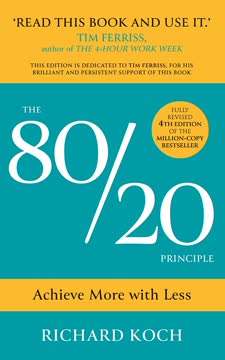
The 80/20 Principle asserts that a minority of causes, inputs, or effort usually lead to a majority of the results, outputs, or rewards.
Counterintuitive truth. The 80/20 Principle, also known as the Pareto Principle, reveals a fundamental imbalance in the world: a small percentage of inputs or causes are responsible for a disproportionately large percentage of outputs or results. This pattern, discovered by Vilfredo Pareto in 1897 while observing wealth distribution, is consistently repeated across diverse fields, from economics to quality control and daily life. It challenges our natural expectation that causes and results are generally equally balanced, a "50/50 fallacy" that often leads to misdirected effort.
Ubiquitous application. This principle manifests everywhere, often with surprising precision. In business, 20% of products or customers typically generate 80% of sales or profits. In society, 20% of criminals account for 80% of crime value, and 20% of motorists cause 80% of accidents. Even in the home, 20% of your clothes are worn 80% of the time. The exact numbers may vary (e.g., 70/30, 90/10), but the underlying pattern of predictable imbalance remains.
Beyond statistics. The 80/20 Principle is more than a statistical observation; it's a profound insight into how the world works, often explained by chaos theory's concepts of nonlinearity and feedback loops. Small initial advantages can compound into massive disparities over time, leading to "winner take all" scenarios. Understanding this principle provides a powerful lens to identify the "vital few" forces that truly matter, allowing us to focus our energy where it will yield the greatest impact.
2. Strategic Business Focus: Simplify for Profit
Unless your firm is very small and simple, it is almost certainly true that you make at least 80 percent of your profits and cash in 20 percent of your activity, and in 20 percent of your revenues.
Unveiling true profitability. Most businesses operate with a flawed understanding of where their profits truly originate. Conventional accounting systems often obscure the fact that a small fraction of products, customers, or market segments generate the vast majority of profits, while the rest contribute marginally or even incur losses. A detailed 80/20 analysis, breaking down profitability by various categories, is crucial to reveal these hidden truths and inform effective strategy.
Targeting the "vital few." By identifying the 20% of products, customers, or segments that yield 80% of profits, businesses can dramatically improve their financial performance. This involves:
- Reallocating sales and marketing efforts to high-profit areas.
- Increasing investment in successful products or customer types.
- Selectively raising prices or cutting costs in less profitable areas.
- Considering radical retrenchment or exit from loss-making segments.
Beyond the snapshot. While 80/20 profit analysis provides a powerful snapshot, it's not the sole determinant of strategy. It must be combined with an assessment of market attractiveness and the firm's competitive position within each segment. For instance, a loss-making segment might be worth investing in if it's a growing market where the firm has potential for future dominance, as seen in the Electronic Instruments Inc. example. This holistic view prevents simplistic conclusions and drives truly transformative action.
3. The Cost of Complexity: Why Less is More
Simple is beautiful explains a large part of why the 80/20 Principle works.
Complexity's hidden toll. The seemingly outrageous claims of the 80/20 Principle in corporate profits—where 20% of revenues can yield 80% of profits—are largely explained by the "cost of complexity." As businesses grow and diversify, they often add marginal products, customers, and processes, which introduce disproportionately high overheads and management costs. These hidden costs erode profitability, making larger, more complex operations less efficient than their simpler counterparts.
Simplicity as a competitive edge. Successful firms, often unknowingly, thrive by maintaining simplicity. This means:
- Focusing on a narrower range of products and customers.
- Ruthlessly outsourcing non-core activities to cut complexity and costs.
- Streamlining organizational structures, potentially even abolishing central functions.
- Prioritizing customer needs over internal managerial hierarchies.
The German study of 39 companies highlighted that simplicity was the sole differentiator between winners and less successful firms, proving that a simple organization excels at selling even complicated products.
Overcoming managerial bias. Managers often inadvertently foster complexity because it creates interesting, challenging jobs and expands their influence. However, this "organized conspiracy to misallocate rewards" ultimately harms the business. The "50/5 Principle" (50% of items add less than 5% to revenues/profits) offers a powerful tool to identify and eliminate low-value activities, restoring focus and profitability. Reducing complexity is not just about cutting costs; it's about unleashing the inherent productivity of a focused, streamlined operation.
4. Cultivate Core Customers and High-Impact Sales
Eighty percent of the value of your allies comes from fewer than 20 percent of their number.
Targeting profitable marketing. The 80/20 Principle is indispensable for effective marketing and sales, shifting focus from a broad, often unprofitable, approach to a targeted, high-impact one. Instead of trying to satisfy all customers or promote all products, firms should concentrate on the "right" ones: the 20% of customers who generate 80% of sales and profits, and the 20% of products that yield 80% of fully costed profits. This selective approach maximizes return on marketing investment.
Locking in core customers. For the vital 20% of customers, the goal is not just satisfaction, but "outrageous" service and lifelong loyalty. This involves:
- Identifying who these key customers are, whether individuals or distribution channels.
- Providing exceptional, surprising service that goes beyond industry norms.
- Developing new products and services specifically for and with this core group.
- Making extraordinary efforts to retain them, as customer loyalty is the fundamental driver of long-term profitability.
Optimizing sales performance. The 80/20 Principle also applies to salesforces, where typically 20% of salespeople generate 70-80% of sales. To leverage this, organizations should:
- Retain and reward high performers, and hire more like them.
- Focus salespeople's efforts on the 20% of products and customers that yield the most sales and profits.
- Organize high-volume accounts under dedicated teams, regardless of geography.
- Utilize cost-effective methods like telephone sales for less important accounts.
- Revisit old, satisfied customers, a surprisingly neglected but highly successful sales technique.
5. Mastering Decisions and Projects with 80/20 Thinking
The most important decisions are often those made only by default, because turning points have come and gone without being recognized.
Selective decision-making. The 80/20 Principle reframes decision-making by asserting that only a minority of decisions truly matter, but those few matter immensely. Instead of agonizing over every choice, categorize decisions into "important" and "unimportant," delegating or quickly resolving the latter. Crucially, recognize that the most impactful decisions are often those missed by default, where critical turning points are overlooked due to a lack of intuition and insight, rather than insufficient data.
The 80/20/100/100 rule. For important decisions, adopt a focused approach: gather 80% of the data and perform 80% of the analysis in the first 20% of the available time. Then, make a decision with 100% confidence and act decisively. This rule emphasizes speed and conviction over exhaustive, often paralyzing, analysis. If a decision isn't working, change course early; if it is, double down on the success, as "luck" often hides highly effective, repeatable mechanisms.
Efficient project management. Projects, notorious for complexity and delays, also benefit from 80/20 Thinking. The key is to:
- Simplify the objective: Strip projects down to one simple aim, as 80% of value comes from 20% of activities.
- Impose impossible timescales: This forces teams to identify and focus on the 20% of requirements that deliver 80% of the benefit.
- Plan and design before acting: Address 80% of potential problems in the design phase, where they are cheapest to correct.
This approach transforms project management from a linear, exhaustive process into a selective, high-impact endeavor.
6. Time Revolution: Work Less, Achieve More
80 percent of achievement is attained in 20 percent of the time taken; conversely, 80 percent of time spent leads to only 20 percent of output value.
Challenging time management. Our conventional approach to time, often driven by "time management" philosophies, is fundamentally flawed. It assumes time is scarce and must be efficiently managed, leading to busyness and guilt. The 80/20 Principle, however, reveals that most of what we do is of low value, and we are "awash with time," making good use of only 20% of it. A "time revolution" is needed, not just marginal efficiency gains.
Unlocking productive laziness. The core of a time revolution involves a radical shift in mindset:
- Dissociate effort and reward: Recognize that hard work often leads to low returns, while insight and self-directed action yield high returns. Embrace "productive inertia" by learning from figures like Ronald Reagan or Warren Buffett.
- Give up guilt: Prioritize activities you enjoy, as enthusiasm drives extraordinary value creation.
- Free yourself from obligations: Selectively choose commitments and allies, avoiding those that drain time without significant return.
- Be unconventional: Question norms and seek eccentric ways to spend time that multiply effectiveness.
Identifying and multiplying high-value time. The key is to identify the 20% of your time that generates 80% of your achievement or happiness—your "happiness and achievement islands." Then, consciously increase the time spent on these activities, even if it means eliminating 80% of low-value tasks. This radical reallocation can multiply your "productivity" and happiness, potentially leading to a two-day work week or a complete career and lifestyle change.
7. Design Your Life: Happiness Through Selective Action
Happiness, like the mind, will atrophy if not exercised.
Holistic life design. True fulfillment comes from a rounded view of everything we want, not just isolated achievements or financial gains. Most people lead "lopsided lives" because they fail to consciously design their lifestyle, work, relationships, and pursuit of happiness. The 80/20 Principle serves as a diagnostic, highlighting wasted effort and pointing towards a path where we can work less, earn more, enjoy more, and achieve more by being selective.
Choosing your career context. Your career choice profoundly impacts your overall happiness. It's crucial to align your ambition and preferred working style with the right context:
- Organization Man/Woman: High ambition, prefers structured environment.
- Sole Trader: High ambition, seeks independence, avoids managing others.
- Entrepreneur: High ambition, enjoys building and leading teams.
- Collaborator: Low ambition, enjoys working with others.
- Freelancer: Low ambition, seeks autonomy in project-based work.
- Developer: Low ambition, enjoys organizing and developing others.
Many experience alienation because they are in the wrong "box," failing to recognize their true professional inclinations.
Cultivating happiness habits. Happiness is not predestined; it's a skill that can be learned and cultivated. This involves:
- Eliminating unhappiness: Systematically avoid situations and people that make you miserable.
- Daily happiness habits: Incorporate activities like exercise, mental/spiritual stimulation, acts of kindness, pleasure breaks with friends, self-treats, and self-congratulation.
- Medium-term strategies: Maximize control over your life, set attainable goals, be flexible, choose a happy partner, cultivate a few happy friends, build strong professional alliances, and evolve your ideal lifestyle.
By consciously engineering your life to maximize positive experiences and minimize negative ones, you can significantly enhance your overall well-being.
8. Nurture Vital Relationships and Strategic Alliances
Eighty percent of the value of our relationships comes from 20 percent of the relationships.
Quality over quantity in personal connections. The 80/20 Principle applies profoundly to relationships: a small minority of our connections provide the vast majority of their value. We often misallocate our time and emotional energy, spreading ourselves too thin across many acquaintances rather than deepening the few truly important bonds. This "village theory" suggests a limited capacity for deep relationships, emphasizing the need for careful selection and cultivation.
Prioritizing key relationships. To maximize relational value, consciously identify your "Top 20" friends and loved ones, then allocate your time and emotional energy to reinforce and deepen the most important 20% (typically 4-5 people). This focused effort ensures that your most significant relationships receive the attention they deserve, leading to greater mutual support and happiness. Avoid superficial connections that drain your energy without offering substantial return.
Building professional alliances. In the professional sphere, a few key allies are indispensable for success. History shows that individuals achieve greatness not in isolation, but through effective alliances. These alliances are built on five attributes:
- Mutual enjoyment: Genuine liking for each other's company.
- Respect: Professional admiration for each other's abilities.
- Shared experience: Bonding through common challenges or projects.
- Reciprocity: Consistent, proactive support for each other's interests.
- Trust: Total honesty and reliability at all times.
Cultivate a small, carefully chosen network of mentors, peers, and mentees, focusing on these attributes to create powerful, mutually beneficial partnerships.
9. Career Success: Be Intelligently Lazy and Specialized
Finally, there are the intelligent lazy ones. They are suited for the highest office.
The "Intelligent Lazy" advantage. General Von Manstein's matrix highlights that "intelligent lazy" individuals are best suited for the highest office. This isn't about actual laziness, but about extreme efficiency: achieving maximum results with minimum effort by focusing only on what truly matters. In today's "winner take all" world, where a small elite of professionals command disproportionate rewards, adopting this mindset is crucial for career success.
10 Golden Rules for Career Success:
- Specialize in a small niche: Become an acknowledged leader in one thing you do exceptionally well and enjoy.
- Choose a niche you enjoy and excel in: Enthusiasm drives achievement and marketability.
- Realize knowledge is power: Become the foremost expert in your chosen niche.
- Identify your market and core customers: Serve those who value your unique expertise most.
- Identify where 20% effort gives 80% returns: Focus on high-impact activities, eliminating low-value tasks.
- Learn from the best: Observe, imitate, and adapt the practices of top performers in your field.
- Become self-employed early: Capture the full value of your superior productivity.
- Employ net value creators: Leverage others' talent by hiring those who add more value than they cost.
- Outsource everything but your core skill: Keep your operations simple and focused on your unique advantage.
- Exploit capital leverage: Use money to multiply proven ideas and expand your influence.
Beyond hard work. Success is not merely about working hard; it's about working smart and selectively. The 80/20 Principle reveals that most people dilute their effectiveness by doing too many things where their comparative skill is not exceptional. By focusing on your unique strengths and applying "lazy intelligence," you can achieve extraordinary results and secure a highly rewarding career.
10. Multiply Wealth: Invest Smart, Not Hard
To every one who has will more be given, and he will have abundance; but from him who has not, even what he has will be taken away.
Money's unequal distribution. Money, like other resources, adheres to the 80/20 Principle, tending towards unequal distribution. A minority of individuals accumulate the majority of wealth, largely due to investment returns rather than employment income. The power of compounding means that even small differences in annual returns lead to vastly skewed wealth accumulation over time, making strategic investment a critical path to financial abundance.
Koch's 10 Commandments of Investment:
- Match philosophy to personality: Choose an investment strategy that aligns with your temperament and skills.
- Be proactive and unbalanced: Take charge of your investments and concentrate on a few high-return opportunities.
- Invest mainly in the stock market: Historically, stocks offer significantly higher long-term returns than other assets.
- Invest for the long term: Avoid frequent trading; hold quality investments for many years to benefit from compounding.
- Invest most when the market is low: Buy when others are pessimistic, using metrics like low Price/Earnings (P/E) ratios as buy signals.
- If you can't beat the market, track it: Use index funds if your active strategy doesn't consistently outperform the market.
- Build on your expertise: Specialize in industries or areas you know well to make informed investment decisions.
- Consider emerging markets: Invest a small, diversified portion in high-growth economies for potentially higher returns, with awareness of increased risk.
- Cull your loss makers: Rigorously sell any stock that falls 15% from your purchase price to prevent significant losses.
- Run your gains: Let winning investments continue to grow; resist the temptation to take profits too early, as superstars drive portfolio returns.
Leveraging the 80/20 in portfolios. A few investments (20%) typically generate the majority of gains (80%) in a portfolio. The key is to identify these "superstar" shares and allow their profits to ride, setting "lock-gain" prices (e.g., 15% below recent highs) to protect against reversals. While money can buy lifestyle and opportunity, it's crucial not to let its pursuit become an end in itself, risking personal happiness and values.
11. The Two Dimensions: Efficiency and Life Enhancement
Efficiency requires the 20 percent approach. But what is life-enhancing deserves a 200, 2,000, or 2,000,000 percent approach.
Beyond mere efficiency. The 80/20 Principle operates on two distinct, yet complementary, dimensions: efficiency and life enhancement. The efficiency dimension applies to tasks that are not inherently significant to us, serving merely as a means to an end. Here, the goal is to achieve maximum results with minimum effort, using the 20% approach to quickly complete chores, routine work, or unwanted obligations, thereby freeing up time and energy.
Devotion to life-enhancing pursuits. The life-enhancing dimension encompasses everything truly important to our well-being: deep personal relationships, meaningful work, cherished hobbies, self-expression, and personal achievement. For these, the 80/20 Principle helps us identify the few things that truly matter, but then demands a "200, 2,000, or 2,000,000 percent approach"—unlimited time, effort, and soul. This is where we invest deeply, without stinting, to build a rich and fulfilling life.
Achieving balance and sustainability. Critics argue that cutting out the "80%" can lead to corner-cutting, unsustainability, or a soulless existence. However, the principle, when applied intelligently, addresses these concerns:
- Corner-cutting: Only applies to efficiency tasks; life-enhancing pursuits demand depth.
- Sustainability: Requires a long-term view, recognizing that today's "vital few" may need nurturing or that new opportunities might emerge from the "trivial many."
- Balance: Achieved by being "unbalanced" in efficiency (doing less) to create space for a balanced, deeply invested approach to life-enhancing activities.
The 80/20 Principle is not just about doing less; it's about doing less of the unimportant to do more of the truly important, allowing us to find our "yin and yang" within a life centered on what truly counts.
Last updated:
Similar Books