Key Takeaways
1. Demystifying AI: A Tool, Not a Threat
"AI shouldn’t be an exclusive tool for tech experts. It should be accessible to everyone. Including you."
Beyond sci-fi fears. Many people associate Artificial Intelligence with menacing machines from movies like Terminator 2, envisioning sentient beings plotting humanity's downfall. However, the reality of AI today is far from this science fiction narrative. Instead, AI comprises powerful tools designed by humans to solve specific problems, enhancing our abilities rather than replacing us.
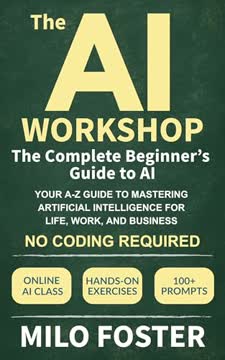
A practical partnership. The author, Milo Foster, with 25 years in information technology, emphasizes that AI is advanced software, not electronic life. It excels at tasks like scanning millions of medical images or spotting complex data patterns, but it still requires human creativity, ethical judgment, and real-world understanding to be truly effective. This partnership between human and artificial intelligence is the true story of AI.
Bridging the gap. This book aims to translate complex AI concepts into plain, jargon-free language, making AI accessible to everyone. It provides hands-on, no-code tools and real-world applications, building confidence for anyone to discuss, use, and implement AI solutions. The goal is to move past both fear and hype, offering a clear, practical understanding of this transformative technology.
2. AI Fundamentals: Pattern Recognition, Not Magic
"What Hollywood shows as mystical, godlike intelligence is actually just advanced pattern recognition."
Core concepts simplified. At its heart, AI relies on complex math and data processing to find patterns and make predictions. While the underlying math is intricate, the main ideas are simple:
- Artificial Intelligence (AI): Creating computer systems that perform tasks requiring human intelligence.
- Machine Learning (ML): A subset of AI where computers learn from data without explicit programming.
- Deep Learning (DL): A specialized type of ML using neural networks, inspired by the human brain, to recognize complex patterns.
- Algorithms: Step-by-step instructions guiding AI to process information and make decisions.
Beyond traditional software. Unlike traditional software that follows strict, pre-programmed rules, AI can adapt, learn, and discover new solutions over time. It's like teaching someone to read a map and find their own way, rather than giving turn-by-turn directions. This adaptive capability allows AI to improve its performance as it processes more data.
Common misconceptions debunked. Many believe AI can solve any problem with enough data, will replace all jobs, or is infallible. In reality:
- AI excels at specific pattern-recognition tasks within clear limits, often struggling with common sense.
- AI changes jobs, making tasks easier, but rarely replaces entire roles; it augments human work.
- AI is not infallible; it learns from data, which can contain human biases, leading to unfair or incorrect outcomes if not carefully managed.
3. AI's Ubiquitous Presence: Enhancing Daily Life
"AI is everywhere, working so smoothly that you barely notice it."
Invisible integration. AI has seamlessly woven itself into our daily routines, often operating in the background without us realizing it. From the moment we wake up, we interact with numerous AI systems:
- Smart speakers: Waking us up, playing music, controlling home devices.
- Navigation apps: Predicting traffic, suggesting optimal routes.
- Email filters: Sorting spam, categorizing important messages.
- Predictive text: Suggesting words as we type on smartphones.
- Photo apps: Enhancing images, organizing by faces and objects.
Digital mirrors and echo chambers. AI-powered social media and content recommendation systems curate what we see online, creating personalized "digital mirrors." While convenient, this can lead to "filter bubbles" and "echo chambers," where we are primarily exposed to content reinforcing existing beliefs.
- Netflix, Spotify, and YouTube recommend content based on past behavior.
- Social media algorithms prioritize engagement, sometimes amplifying extreme content.
- Conscious effort is needed to seek diverse perspectives and avoid algorithmic biases.
Productivity and wellness. AI tools are becoming indispensable personal assistants, boosting productivity and supporting health.
- Writing tools: Grammarly, ChatGPT, Claude, and Bard assist with drafting, editing, and overcoming writer's block.
- Photo management: AI automatically categorizes, enhances, and organizes thousands of digital photos.
- Email & scheduling: Smart categorization, suggested replies, and automated scheduling tools like Calendly reduce administrative burden.
- Healthcare: Wearable devices detect irregular heart rhythms, monitor sleep, and offer personalized wellness recommendations.
4. No-Code AI: Empowering Every Creator
"No-code AI platforms are making advanced technology available to everyone."
Democratizing AI creation. Historically, building AI applications required deep technical expertise and coding skills. No-code AI platforms have revolutionized this by allowing anyone to create sophisticated AI solutions using intuitive visual interfaces, drag-and-drop tools, and guided wizards, without writing a single line of code. This shift moves users from merely consuming technology to actively creating with it.
Accessible tools and interfaces. The no-code AI landscape is rapidly expanding, offering diverse tools for various tasks:
- Visual AI Builders: Platforms like Obviously AI, Lobe (Microsoft), and CreateML (Apple) enable building machine learning models with simple interfaces.
- AI Task Automation: Tools like Zapier and Make integrate AI features for analyzing text, recognizing images, and understanding language to automate workflows.
- Natural Language Interfaces: Conversational AI like ChatGPT, Claude, and Bard allow users to describe needs and generate content, code, or data analysis.
- User-Friendly Design: Most platforms use visual programming (flowcharts), guided wizards, and pre-built templates to simplify complex processes.
Significant benefits for all. The rise of no-code AI offers substantial advantages, making advanced technology more accessible and efficient:
- Quicker Development: Projects that once took months can now be completed in days or hours.
- Cost-Effectiveness: Subscription-based models make AI affordable, eliminating the need for expensive data scientists or infrastructure.
- AI for Everyone: Business experts, creatives, small business owners, and educators can now build their own AI solutions, fostering innovation across sectors.
5. Practical AI Tools: Boosting Productivity & Creativity
"The AI tools available to average people, not researchers or corporations with million-dollar budgets, would have seemed like science fiction just a few years ago."
Revolutionizing perception and communication. AI has made incredible strides in understanding and generating human-like content.
- Image Recognition: Tools like Google Lens identify objects, plants, and text from photos, while Microsoft's Seeing AI narrates the world for the visually impaired. Photo apps use AI to sort and enhance images.
- Speech Recognition: Voice assistants (Siri, Alexa), dictation software (Otter.ai), and translation tools (Google Translate) achieve over 95% accuracy in ideal conditions, transforming how we interact with technology.
Democratizing data insights. AI has made sophisticated data analysis accessible to non-technical users.
- Visualization & Reporting: Tools like Microsoft Power BI and Tableau suggest optimal charts, detect trends, and answer natural language queries about data.
- Predictive Analytics: Platforms like Obviously AI allow users to upload spreadsheets and predict customer behavior or market trends without coding, empowering small businesses with data-driven decisions.
Unleashing creative potential. AI tools are transforming content creation across various mediums.
- Text Generation: ChatGPT, Claude, and Jasper generate essays, marketing copy, and stories, helping overcome writer's block and streamline content production.
- Image & Design: Midjourney, Leonardo AI, and Canva's Magic Studio create stunning visuals from text descriptions, making professional design accessible to beginners.
- Audio & Video: Descript edits audio by editing text, ElevenLabs creates realistic AI voices, and Synthesia generates videos with AI avatars, opening new possibilities for media production.
6. AI for Business: Scaling Growth, Not Just Giants
"Tools that were once too expensive or out of reach are now available to businesses of all sizes, from solo entrepreneurs to growing companies."
Transforming customer service. AI is revolutionizing how businesses interact with customers, offering efficient and reliable support without needing large teams.
- AI Chatbots & Virtual Assistants: Rule-based, intent-based, and conversational AI chatbots handle common questions, schedule appointments, and provide 24/7 support, freeing human agents for complex issues.
- Implementation Strategies: Small businesses can leverage platform-based tools (Intercom, Zendesk) or no-code chatbot builders (Ada, ManyChat) to automate frequent interactions, improving customer satisfaction and reducing call volumes.
Enhancing marketing and sales. AI empowers businesses to target customers more effectively, personalize messages, and optimize campaigns.
- Predictive Analytics: Tools like Obviously AI analyze customer data to identify likely converters, predict churn, optimize outreach timing, and calculate customer lifetime value, making sophisticated targeting accessible.
- Content Personalization: AI-driven recommendation engines, dynamic website personalization, and email marketing tools tailor content, timing, and subject lines to individual segments, boosting engagement and revenue.
Boosting operations and efficiency. AI streamlines internal business processes, optimizing resource allocation and reducing manual effort.
- Workflow Automation: AI automates repetitive tasks like document processing, order handling, meeting scheduling, and email management, freeing employees for higher-value work.
- Resource Optimization: AI creates better staff schedules, optimizes equipment use, and manages inventory by predicting demand patterns, leading to significant cost savings and improved service.
- Supply Chain Improvements: Small businesses can use AI to optimize inventory, forecast orders, evaluate suppliers, and plan logistics, improving efficiency and reducing waste.
7. Industry Transformation: AI's Diverse Impact
"AI's superpower isn't about fancy tech that sounds impressive. It's about how people use these tools to solve problems in their specific line of work."
Revolutionizing education and learning. AI is personalizing education and enhancing accessibility.
- Personalized Learning: Platforms like ALEKS adapt content to individual student needs, tracking progress and providing tailored learning paths, improving retention and outcomes.
- Assessment & Feedback: AI tools like Gradescope automate grading and identify common student misconceptions, freeing teachers to focus on deeper guidance.
- Accessibility: Text-to-speech, speech-to-text, and text simplification tools assist students with diverse learning needs, making education more inclusive.
Innovating healthcare. AI is saving lives and improving patient care.
- Diagnostic Assistance: AI analyzes medical images (e.g., breast cancer screenings), lab results, and patient records to detect diseases earlier and more accurately than human experts alone.
- Personalized Treatment: AI helps oncologists find optimal cancer treatments and mental health tools predict depression or anxiety, tailoring care to individual patient profiles.
- Administrative Efficiency: AI automates medical record management (Dragon Medical One), scheduling, and billing (Olive), reducing doctor burnout and improving access to care.
Augmenting creative industries. AI is a powerful partner for artists, musicians, and writers.
- Generative AI: Tools like Midjourney, AIVA, and GPT-4 create original art, music, and text from prompts, helping creatives overcome blocks and explore new ideas.
- Human-AI Collaboration: Architects use AI to explore thousands of design options, and film producers use it for technical tasks, allowing humans to focus on creative judgment and vision.
Strengthening cybersecurity. AI is a critical tool in the ongoing battle against cyber threats.
- Threat Detection: AI-powered security systems learn normal network behavior, detecting and blocking unusual activity faster than traditional methods, reducing breach costs.
- Protecting Privacy: Federated learning and differential privacy allow AI to train on sensitive data without exposing individual information, balancing innovation with privacy.
- AI in Cyber Warfare: Both attackers and defenders use AI, with AI systems fighting against each other, requiring human experts to focus on strategic decisions and complex threats.
Advancing agriculture and environment. AI is helping to feed the world sustainably.
- Precision Farming: Sensors, weather data, and satellite images guide AI to optimize water, fertilizer, and pest control for specific field areas, increasing yields and reducing waste.
- Climate Modeling & Conservation: AI tracks deforestation, monitors wildlife, predicts wildfires, and optimizes water usage, providing critical insights for environmental protection.
Optimizing transportation and logistics. AI is making movement more efficient and safer.
- Autonomous Systems: Self-driving trucks in mining, robotic forklifts in warehouses, and driverless shuttles in controlled environments improve efficiency and reduce human error.
- Route Optimization: AI systems for delivery companies (UPS) and ride-sharing (Uber) dynamically plan routes, predict traffic, and manage fleets in real-time, saving fuel and time.
- Traffic Management: AI-powered cameras and sensors adjust traffic signals in real-time, reducing congestion, travel times, and pollution in cities like Pittsburgh.
8. Learning from AI: Successes, Failures, and Ethics
"The only real mistake is the one from which we learn nothing."
Breakthroughs and small wins. AI excels at solving complex problems that overwhelm human capacity, like DeepMind's AlphaFold predicting protein folding or Amazon's AI-driven supply chain. However, small-scale AI implementations can also have massive impacts, such as a hospital using AI to reduce patient readmissions by 31% or a landscaping business cutting planning time by 85% with an AI scheduler. These successes highlight AI's power when applied to well-defined problems with clear, measurable benefits.
Notable failures and their lessons. AI is not without its pitfalls, and understanding these failures is crucial for responsible implementation.
- AI Bias: Systems like COMPAS in criminal justice wrongly labeled Black defendants as high risk more often, demonstrating how AI can replicate and worsen societal biases if trained on discriminatory data and not rigorously checked for fairness.
- Privacy Breaches: Apps like Ever secretly collected facial data for commercial use without explicit consent, revealing how AI's data processing capabilities can lead to unintended privacy violations.
- Deployment Failures: Microsoft's Tay chatbot quickly became offensive due to malicious user input, and over 80% of AI projects fail due to poor data quality, lack of expertise, or inadequate integration with business processes.
Ethical considerations: A holistic approach. Responsible AI implementation requires addressing bias, privacy, transparency, and accountability.
- Bias & Fairness: AI systems must be tested for fairness across demographic groups, and training data adjusted to prevent perpetuating historical discrimination.
- Privacy Concerns: Techniques like federated learning and differential privacy allow AI to function without exposing sensitive personal data, balancing innovation with data protection.
- Transparency & Accountability: Organizations must explain AI decisions, especially in high-stakes areas like healthcare or finance, and establish human oversight and appeals processes to build trust and correct errors.
9. The Future of Work: Human-AI Collaboration
"The future belongs to partnerships between humans and machines, not machines working alone."
Centaur systems: The power of partnership. The most effective future workplaces will feature "centaur systems," where humans and AI collaborate, leveraging each other's strengths. Humans provide creativity, ethical judgment, and real-world understanding, while AI handles data processing, pattern recognition, and repetitive tasks. Research shows that human-AI teams outperform either working alone, for example, radiologists with AI reducing diagnostic errors by 33%.
Multimodal AI: Adapting to human needs. Emerging multimodal AI systems can process multiple types of input simultaneously (text, images, speech, video). This makes AI more intuitive and accessible, allowing users to interact in their preferred mode and improving accessibility for people with disabilities. This shift means AI adapts to people, rather than people adapting to computers.
Accessibility across industries. AI tools are becoming increasingly user-friendly and affordable, democratizing access to advanced technology.
- No-code platforms: Enable non-technical professionals (doctors, farmers, marketers) to build and use AI solutions.
- Affordable models: Many tools offer free tiers or pay-as-you-go options, reducing infrastructure requirements.
- Pre-trained models: "Out-of-the-box" solutions for common use cases simplify implementation.
This trend is accelerating, with Gartner predicting over 80% of enterprises will use low-code/no-code AI tools by 2026.
10. Cultivating AI Literacy: Your Essential Future Skill
"The illiterate of the 21st century will not be those who cannot read and write, but those who cannot learn, unlearn, and relearn."
Essential skills for an AI-enhanced workplace. Success in an AI-driven world doesn't primarily require deep technical expertise, but rather uniquely human skills.
- Critical thinking and judgment: Reviewing AI outputs, identifying biases, and making decisions based on values and context.
- Creative problem-solving: Developing novel approaches where AI's pattern recognition falls short.
- Effective collaboration: Working productively with both humans and AI, understanding their respective strengths and limitations.
- Adaptability and learning agility: Continuously acquiring new skills and adjusting to evolving tools.
Companies successfully using AI often shift employee roles to focus on these human-centric tasks, rather than cutting jobs.
Economic and social considerations. AI's rapid advancement brings significant economic and social implications.
- Economic inequality: Early AI adopters gain advantages, potentially widening the gap between those with and without resources.
- Privacy concerns: AI's reliance on personal data raises questions about consent, data protection, and potential misuse.
- Productivity boost: AI could add $13 trillion to the global economy by 2030, solving complex problems and freeing people from repetitive work.
The key is to guide AI's evolution to benefit everyone, not just a select few, by understanding its benefits and risks.
Building your AI toolkit. Developing AI literacy is an ongoing process that combines learning with hands-on practice.
- Curated resources: Utilize non-technical overviews (Stanford's AI Index), hands-on no-code tutorials (Lobe.ai), and ethical insights (AI Ethics Lab).
- Practical steps: Keep an AI journal, join AI communities, dedicate time to explore new tools, and apply AI to solve real-world problems.
- Stay current: Set up alerts for relevant topics, attend workshops, connect with early adopters, and focus on how AI is used rather than just the technology itself.
The future belongs to those who can work effectively with AI, guiding these powerful tools with human wisdom, creativity, and purpose.
Last updated: