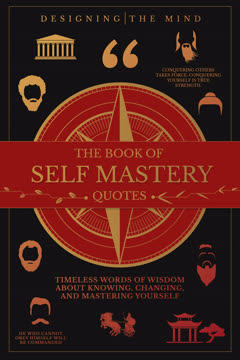
Key Takeaways
1. Self-Mastery is the Ultimate Pursuit
Our great and glorious masterpiece is to live appropriately.
Beyond conventional success. Conventional wisdom often steers us toward external markers of success like lucrative careers, social media presence, and material possessions. However, many who achieve these goals find themselves just as unhappy as when they started, having failed to become who they truly wanted to be. The wisest thinkers throughout history, and modern researchers, suggest an alternative: mastering oneself.
Fortify your inner vehicle. Instead of striving to build a perfect life to inhabit, the true path to lasting well-being lies in fortifying and mastering the vehicle through which you traverse life – your inner self. This resilient, powerful kind of mastery allows you to navigate life's challenges with strength and tranquility, making self-mastery your ultimate occupation.
A North Star. This pursuit serves as a guiding principle, a "North Star," reminding you of your priorities, weakening the hold of others' opinions, and helping you laugh at inevitable setbacks. It defends your goals and decisions from distractions, allowing you to compose your character and win order and tranquility in your conduct.
2. Your Mind is Your Masterpiece
All experiences are preceded by mind, having mind as their master, created by mind.
The mind's power. The Buddha, centuries ahead of his time, taught that our thoughts, feelings, and the stories we tell ourselves are merely reflexes of our minds, coloring our reality. By cultivating awareness of these mental phenomena, we can gradually free ourselves from their constant harassment and find peace.
A superb instrument. The mind, when used rightly, is a superb instrument; used wrongly, it becomes destructive. Often, we don't use our minds at all; they use us, leading to the delusion that we are our minds. Recognizing this allows us to reverse the relationship, taking control by embracing the present moment and freeing ourselves from the constant nagging of past regrets and future worries.
Guard your mind. The mind is the only thing that can truly hurt you. Lacking mindfulness turns your thoughts into your greatest enemy, attacking you when you're down and destroying your ability to enjoy life. By becoming aware of your thoughts and their effects, you can strip them of their power, becoming their master instead of their slave.
3. Character is Forged Through Habit
We are what we repeatedly do. Excellence, then, is not an act, but a habit.
Sum of your habits. Aristotle viewed a person as the sum of their habits, extending beyond routines to encompass an individual's entire being. Words and actions flow from habits, which are then reinforced or broken by those actions, allowing one's disposition to be cultivated and perfected. The aggregate of all habits forms one's character.
Sculpting your identity. Our habits serve as evidence of the type of person we are, creating a powerful feedback loop that shapes our identity. If you consistently act as your ideal self would, you build the evidence needed to reinforce that identity. This process of building habits is, in essence, the process of becoming yourself.
Beyond self-blame. Instead of beating yourself up for mistakes, identify the habits that led to them and devise ways to change them. This involves putting systems in place to decrease bad habits incrementally or replacing them with healthier ones, slowly nearing your ideal lifestyle.
4. Live by Purpose, Not Prescription
The goals that you have set for yourself may be ones sold to you by the larger culture - ‘Make money! Own your own home! Look great!’ - and while there may be nothing wrong with striving for those things, they mask the pursuits more likely to deliver true and lasting happiness.
Beyond cultural decoys. Many goals prescribed by culture—wealth, possessions, prestige—are often decoys to true happiness. These "means goals" make us vulnerable to disappointment when situations don't go as hoped. True and lasting happiness comes from discerning and following "end goals" like being surrounded by love, personal growth, or contributing to community.
Authentic self-direction. We often believe we have coherent reasons for our goals, but upon closer examination, aspirations are frequently determined by imitation rather than conscious self-direction. Seneca urges us to wake up and ask if we are truly living an authentic life or merely being swept along by external currents.
Will one thing. The first condition for more than mediocre achievement in any field, including the art of living, is to "will one thing." This means committing oneself to a single goal, gearing all energies in that direction, and avoiding the weakening effects of split energies and constant conflicts.
5. Embrace Adversity as Growth
The most intelligent men, like the strongest, find their happiness where others would find only disaster: in the labyrinth... their delight is in self-mastery… They regard a difficult task as a privilege; it is to them a recreation to play with burdens that would crush all others.
Strength training for the mind. Most people avoid unpleasant tasks, pain, or confronting weaknesses. However, rare individuals seek out these experiences because they foster growth. Viewing challenges as "strength training for your mind" transforms unfortunate circumstances into opportunities for self-mastery.
Amor Fati. Cultivating wisdom and emotion regulation leads to a new relationship with life, one of "Amor Fati," or the love of fate. This attitude embraces everything that happens, daring the world to throw curveballs because they make life more interesting. It's about loving all experiences, even those that seem bad at the time.
The path to depth. Prolonged illness or suffering, while not inherently good, can make one deeper, forcing philosophers to descend into their nethermost depths and let go of complacency. Such protracted and dangerous exercises in self-mastery transform a person, leading to a higher kind of health that grows stronger under everything that doesn't kill it.
6. Cultivate Equanimity and Non-Attachment
By pleasure we mean the absence of pain in the body and of trouble in the soul.
Inner tranquility. Equanimity, known as upekkha in Buddhism, apatheia in Stoicism, and ataraxia in Epicureanism, is a state of undisturbed tranquility and psychological stability. It is an unshakeable freedom of mind, immune to gain and loss, honor and dishonor, praise and blame, pleasure and pain.
Beyond illusion. The pain of loss often results from illusion—a narrow view of nature's workings. Spinoza believed we suffer because we fail to comprehend and love the infinite and eternal universe in its entirety. The more we learn to love nature as a whole, the less we are affected by its temporary permutations and the less we fear death, which is not an experience but an absence of feeling.
Rejecting total control. Non-attachment isn't about indifference to everything, but a mental orientation that rejects fantasies of total control and permanence. It allows you to turn circumstances into a playground, opting out of the competitive game others play, and finding joyfully indifferent freedom amidst life's waves.
7. Action Tames Anxiety and Drives Growth
Any action is often better than no action, especially if you have been stuck in an unhappy situation for a long time.
Breaking the cycle. Anxiety often makes us want to avoid the very things we must seek out. Neuroscience shows that the amygdala, our brain's threat detector, is trained through gradual exposure to fear-inducing stimuli. Taking action, even a small one, breaks the vicious cycle of anxiety and expands your comfort zone.
Decide and move. When anxious, making a decision—even a wrong one—is often better than making no decision at all. Taking action allows for quick learning and course correction, quieting the amygdala and easing anxiety. The worst response to anxiety is remaining static, stewing in stress and fear.
Nature loves courage. Plunging into the unknown with confidence, whether starting a new job or moving to a new city, often reveals that the perceived risks are exaggerated. The worst-case scenario is rarely death or despair, but rather starting over with more knowledge. Overwhelmingly, letting go of comfort and embracing the unknown is met with generous reward.
8. Question Everything, Especially Yourself
Before you can question your intuitions, you have to realize that what your mind's eye is looking at is an intuition—some cognitive algorithm, as seen from the inside—rather than a direct perception of the Way Things Really Are.
Unreliable intuitions. We are wired to be confident in our beliefs, even without solid evidence, and our intuitions about what will make us happy can be deceiving. Getting what we want often satisfies us only briefly, yet we repeatedly chase short-term rewards, forgetting how unreliable our intuitions are.
Confronting biases. Even the most rational people are full of cognitive biases that systematically cause us to misperceive reality and make the same mistakes. Eliezer Yudkowsky urges us not to be so trusting of our own minds, shifting our aim from being right to removing bias and overcoming our limited perspectives.
The danger of dogmatism. Dogmatism, or believing without question, damages our flourishing by building happiness on false foundations. When reality inevitably clashes with shoddy models, pain and confusion result. Anything that contradicts cherished beliefs becomes a threat to identity, damaging mental balance.
9. You Are the Sculptor of Your Brain
Any man could, if he were so inclined, be the sculptor of his own brain.
Neuroplasticity's promise. Neuroplasticity, the brain's ability to change and adapt, means that our psychological makeup is not fixed. Neural pathways are constantly being built, destroyed, and rerouted. This makes it harder to excuse inadequacies, as change is possible through consistent and sustained effort.
Beyond consumption. Creativity is a core human drive to exert control over your environment and express what is within. It's not just for artists; it's about making something, not merely consuming. When engaged in the creative process, we feel more alive, becoming masters of the small reality we create, and in doing so, creating ourselves.
Optimize your software. Tim Urban suggests that a key factor in success is the ongoing endeavor to optimize one's own mind. Most people strive to preserve their beliefs, but for a few, all beliefs are temporary experiments. Every day is a mental beta test—an opportunity to iterate, expand, and upgrade cognitive software, questioning assumptions and discarding obsolete models.
10. Integrity and Authenticity Define True Power
The man who lies to the world, is the world’s slave from then on…There are no white lies, there is only the blackest of destruction, and a white lie is the blackest of all.
The cost of dishonesty. Ayn Rand argues that a lie is an act of self-abdication, surrendering one's reality to the person lied to, making them one's master. Dishonesty, even "white lies," rarely helps in the long run and forces one to maintain a fabricated reality, which is rarely in one's true best interest.
Coherence and consistency. No one likes a hypocrite, yet we are all hypocrites by default. Building a mind that is coherent and consistent, where deed and word are in accord, is a great and difficult achievement. Recognizing this accomplishment in oneself and others is crucial for genuine self-mastery.
Obey yourself. Lacking self-control not only prevents achieving what you care about but also signals to others that you can be manipulated for their goals. Cultivating strengths like differentiating truth from fiction, regulating emotions, and exercising restraint makes you resistant to external manipulation.
11. Compassion and Connection Ripple Outward
If we could change ourselves, the tendencies in the world would also change. As a man changes his own nature, so does the attitude of the world change towards him.
The ripple effect. Gandhi's profound insight is that changing ourselves impacts those around us, contributing to a better world. This two-way relationship between self and world means that as we shape our environments, we must also be conscious of how they shape us, choosing wisely.
Start with yourself. Marie Curie, a pioneer in radioactivity, argued that progress isn't possible without individual improvement. While we cannot improve the world as isolated islands, the ripple effect of positive change must begin with the smallest possible unit: yourself. Work on yourself before you can effectively improve your family, community, or the world.
Benevolence as joy. Confucius believed that cultivating reciprocity and regard for others builds better individuals, families, and harmonious societies. He claimed that benevolence, doing the right thing for its own sake, not only positively impacts others but is the prime cause of joy for the individual practicing it.
Last updated:
Similar Books