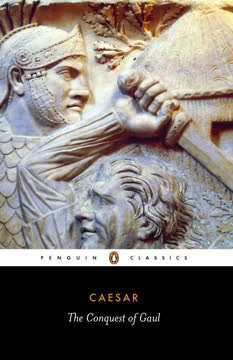
Key Takeaways
1. Caesar's Political Imperatives Drove the Conquest of Gaul
Political necessity, rather than military or than his personal irreplaceability in command, required that he continue in post.
Personal ambition. Gaius Julius Caesar's nine-year campaign in Gaul was deeply intertwined with his political survival and advancement in Rome. Facing powerful rivals like Pompey and Crassus, and a hostile senatorial oligarchy, Caesar needed continuous military success and the wealth it brought to maintain his influence. His command was extended not just for military reasons, but to prevent his return to private status, which would have meant political suicide and inevitable prosecution.
Exploiting instability. Roman politics in the late Republic was characterized by personal factions and power struggles, where military commands offered opportunities for wealth, patronage, and armed power. Caesar skillfully leveraged the perceived threats from Gallic tribes, such as the Helvetii and Ariovistus, to justify his campaigns beyond the Roman Province. These actions, while presented as defensive, served to expand his military glory and secure his political standing back home.
Circumventing opposition. Caesar often bypassed senatorial opposition through popular assemblies and even intimidation, as seen during his consulship. His victories in Gaul, awarded public thanksgivings of unprecedented length, were crucial for his image. The constant need to maintain his dignitas—his status and prestige—meant he could not afford to relinquish his command without immediately securing another, such as the consulship, to avoid legal challenges.
2. Gaul: A Diverse Land Ripe for Roman Intervention
The Gaul which Caesar conquered included France, except the southern part which was already a Roman province, southern Holland, Belgium, Germany west of the Rhine and most of Switzerland.
Tribal divisions. Caesar divided Gaul into three main groups: the Belgae, Aquitani, and Celts (Gauls), each with distinct languages, customs, and laws. This inherent fragmentation, coupled with a history of migrations and internal conflicts, made Gaul susceptible to external manipulation. The Celts, particularly the Aedui and Arverni, were often at odds, creating opportunities for Roman intervention by siding with one faction against another.
Cultural contrasts. Contact with Mediterranean civilizations had influenced Gallic culture, leading to urban development, skilled metalwork, and settled agriculture in many areas. However, political stability varied, with some tribes evolving primitive states while others retained kingship. Caesar frequently characterized the Gauls as impulsive, emotional, and easily swayed, contrasting them with the more disciplined Germans, a perception that served to justify Roman conquest and control.
Germanic pressure. The movements of Germanic tribes, like the Suebi, Cimbri, and Teutoni, into Gaul created significant unrest and provided Caesar with convenient pretexts for military action. The Helvetii's migration, for instance, was framed as a threat to the Roman Province, even if geographically implausible. This external pressure exacerbated existing Gallic rivalries, allowing Caesar to present himself as a protector while systematically extending Roman dominion.
3. Roman Military Superiority and Adaptability in Warfare
Caesar’s great gift – apart from the invaluable ability to get the best out of his men – was his swiftness to react to and extricate himself from the consequence of his own errors.
Discipline and training. The Roman army, composed of highly disciplined legionaries, consistently demonstrated superior organization and training compared to the Gallic forces. Even when outnumbered, Roman soldiers' ability to maintain formation, execute complex maneuvers, and adapt to changing battlefield conditions often proved decisive. Caesar's legions were professional, serving for pay, and fiercely loyal to their commander, a system that ensured high morale and effectiveness.
Engineering prowess. Roman engineering capabilities were a critical advantage, particularly in siege warfare and river crossings. The rapid construction of bridges, like the one over the Rhine, and elaborate siege works, such as those at Alesia and Avaricum, showcased their technical superiority. These feats often demoralized the Gauls, who lacked comparable infrastructure and tools, and allowed the Romans to overcome natural barriers and fortified positions.
Tactical flexibility. Caesar's leadership was marked by his tactical brilliance and ability to adapt. He employed various strategies, from swift forced marches and surprise attacks to patient sieges and feigned retreats, always seeking to exploit enemy weaknesses. His willingness to learn from mistakes and extricate his forces from difficult situations, combined with his men's unwavering loyalty, ensured that even setbacks were often quickly overcome or avenged.
4. Strategic Invasions Beyond Gaul: Germany and Britain
His strongest motive was to make the Germans less inclined to come over into Gaul by giving them reason to be alarmed on their own account, and showing them that Roman armies could and would advance across the river.
Deterring incursions. Caesar's expeditions across the Rhine into Germany were primarily punitive and deterrent. He aimed to demonstrate Roman military reach and power, discouraging Germanic tribes like the Suebi and Sugambri from aiding Gallic rebels or migrating into Gaul. These incursions, though often brief and without lasting territorial gains, served to secure Rome's newly established frontier along the Rhine.
Seeking glory and intelligence. The invasions of Britain, while yielding little immediate strategic value for Rome, were immensely important for Caesar's personal glory and political standing. He sought to:
- Punish Britons for aiding Gauls.
- Gather intelligence on the island's inhabitants, geography, and resources.
- Achieve the prestige of conquering a distant, unknown land.
These expeditions, though costly and challenging due to unfamiliar terrain and weather, cemented his reputation as a daring and successful commander.
Justifying expansion. Caesar often presented multiple, sometimes conflicting, justifications for campaigning outside his designated provinces. These included protecting Roman allies, avenging past wrongs, and preventing future threats. Such justifications were crucial for countering potential accusations of overreach and ensuring continued support from Rome, even as his actions pushed the boundaries of Roman influence.
5. The Great Rebellion: Vercingetorix Unites Gaul Against Rome
The whole of Gaul will then be united, and when we are all of one mind the entire world cannot stand against us.
A charismatic leader. Vercingetorix, a young Arvernian nobleman, emerged as the unifying figure for the Gallic resistance. Capitalizing on widespread resentment against Roman rule and the execution of Acco, he rallied numerous tribes, including the Senones, Parisii, and Aedui, under a common banner of national liberty. His leadership marked a significant shift from fragmented tribal conflicts to a coordinated pan-Gallic uprising.
Strategic scorched earth. Vercingetorix implemented a "scorched earth" policy, burning towns and crops to deny the Romans supplies and force them into starvation. This drastic measure, though painful for the Gauls, aimed to exploit the Roman army's logistical vulnerabilities. His strategy, initially met with resistance from some tribes, demonstrated a keen understanding of Roman military dependence on local resources.
A desperate struggle. The rebellion culminated in the epic siege of Alesia, where Vercingetorix and his forces were trapped by Caesar's elaborate circumvallation and contravallation lines. Despite a massive relief army attempting to break the siege, the Gauls ultimately failed. Vercingetorix's surrender, a poignant moment of sacrifice for his people, symbolized the end of organized Gallic resistance and the triumph of Roman military might.
6. Roman Siegecraft and Brutal Pacification Tactics
Caesar resolved to make an example of them in order to teach the natives to be more careful in future about respecting the rights of ambassadors; he had all their councillors executed and the rest of the population sold as slaves.
Advanced siege techniques. The Romans employed sophisticated siegecraft, including massive terraces, towers, mantlets, and intricate trench systems, to overcome fortified Gallic strongholds. At Alesia, Caesar constructed a double line of fortifications—one facing inward to contain Vercingetorix's army, and another facing outward to repel the Gallic relief force. These engineering marvels allowed the Romans to sustain prolonged sieges and defeat numerically superior forces.
Ruthless pacification. While Caesar was known for his clemency in the Civil War, his treatment of rebellious Gauls was often brutal, serving as a stark warning against further resistance. Examples include:
- The massacre of the Usipetes and Tenctheri, despite their envoys seeking a truce.
- The execution of Venetic councillors and the sale of their entire population into slavery for detaining Roman officers.
- The mutilation (cutting off hands) of all armed defenders at Uxellodunum to deter future revolts.
These actions, though harsh, were effective in breaking the will of the Gallic tribes and establishing Roman authority.
Psychological warfare. Beyond direct military force, Caesar employed psychological tactics to demoralize the enemy and secure submission. Feigning fear to draw out opponents, spreading rumors, and making public examples of rebels were common. The sheer speed and unexpectedness of Roman movements, such as Caesar's winter marches, often caught the Gauls off guard, preventing them from consolidating their forces and fostering a sense of Roman invincibility.
7. The Human Element: Loyalty, Treachery, and Courage in Conflict
Thus Fortune played with them in their struggle for preeminence: bitter rivals though they were, each helped and saved the other, so that it could not be decided which was the more deserving of the prize of valour.
Divided loyalties. The Gallic War was not a monolithic struggle but a complex tapestry of shifting alliances and internal conflicts. Many Gallic tribes, like the Aedui and Remi, initially allied with Rome, often due to long-standing rivalries with other tribes such as the Arverni and Sequani. These alliances, however, were often fragile, swayed by promises, threats, or perceived Roman weakness, leading to frequent defections and betrayations.
Individual acts of heroism and betrayal. The narrative is rich with examples of individual courage and treachery on both sides.
- Gallic figures: Orgetorix's ambition, Dumnorix's revolutionary zeal, Ambiorix's cunning, and Vercingetorix's patriotic leadership.
- Roman figures: Centurions like Pullo and Vorenus, whose rivalry spurred them to mutual acts of bravery, and officers like Sabinus, whose rashness led to disaster.
These personal stories highlight the human drama amidst the grand military campaigns.
The cost of war. The conflict exacted a heavy toll on the Gallic population, with countless lives lost, towns burned, and entire tribes enslaved. Even Roman soldiers endured immense hardships, including starvation, harsh weather, and constant danger. The narrative underscores the brutal realities of conquest, where personal ambition and political necessity often overshadowed humanitarian concerns.
8. Caesar's Masterful Propaganda and Leadership Style
They were published to provide writers with information about such important events, but they have received such general approbation that future writers appear to have been forestalled, rather than provided with an opportunity.
Crafting his narrative. Caesar's "Commentaries" were not merely objective reports but masterful works of propaganda, designed to justify his actions, enhance his reputation, and influence public opinion in Rome. He presented himself as a decisive, benevolent, and divinely favored commander, always acting in Rome's best interest, even when exceeding his authority. The elegant and lucid style of his writing, praised by Cicero, made his accounts compelling and widely accepted.
Inspiring loyalty. Caesar possessed an extraordinary ability to inspire loyalty and dedication in his troops. He shared their hardships, addressed them personally, and rewarded their bravery, fostering a deep bond that transcended mere military duty. His presence on the battlefield, often in the thick of the fighting, galvanized his men and instilled confidence, even in the most desperate situations.
Controlling information. Caesar carefully controlled the flow of information, both to his troops and to Rome. He downplayed Roman losses, exaggerated enemy numbers and ferocity to magnify his victories, and selectively presented events to suit his political agenda. The "Commentaries" themselves served as a primary source, shaping how his campaigns were understood by his contemporaries and by history.
9. The End of Gaul's Freedom and the Impending Roman Civil War
Though this action made it perfectly plain what was planned against Caesar, he nevertheless thought that he should put up with everything, so long as some hope remained of reaching a settlement by constitutional means rather than resorting to war.
Gaul subdued. By 51 B.C., after years of relentless campaigning and the crushing of Vercingetorix's rebellion, Gaul was largely pacified. Caesar's strategy of combining military force with conciliatory gestures—such as granting tax immunity to loyal tribes and bestowing gifts—helped stabilize the region. The widespread revolts ceased, and Gaul, though conquered, began its integration into the Roman Empire, marking a significant expansion of Roman territory and influence.
Political machinations in Rome. Even as Gaul was being secured, the political climate in Rome grew increasingly hostile towards Caesar. His rivals, particularly Pompey and the conservative senators, sought to strip him of his command and prosecute him upon his return. They manipulated senatorial decrees, such as demanding legions for a Parthian campaign, to weaken his military strength and undermine his political standing.
The brink of civil war. The final book, written by Hirtius, highlights the escalating tensions that would soon erupt into civil war. Pompey's appointment as sole consul and his actions to disadvantage Caesar, coupled with Caesar's determination to protect his dignitas and avoid prosecution, pushed the Republic to its breaking point. The conquest of Gaul, while a monumental achievement, ultimately served as a prelude to the internal conflict that would transform the Roman world.
Last updated:
Review Summary
The Conquest of Gaul receives widespread praise for Caesar's clear, engaging prose and vivid battle descriptions, with readers appreciating the detailed military tactics, ethnographic observations of Gauls, Germans, and Britons, and firsthand historical perspective from 58-50 BCE. Many note the work's propagandistic nature, written in third person to appear objective while promoting Caesar's achievements. Reviewers highlight the brutality and massive scale of violence, comparing it to propaganda by modern dictators. The straightforward Latin style makes it a common teaching text. Readers find value in Caesar's leadership insights, engineering feats, and logistical challenges, though some criticize the self-serving narrative and war crimes depicted.