Key Takeaways
1. The Cosmos Forged: From Chaos to Olympian Order
In the beginning, there was … nothing.
Primordial origins. The Greek myths begin not with a creator god, but with a void of swirling movement, from which Gaia (Earth) and Tartarus (the underworld) spontaneously emerged. Love, as the fundamental creative force, then governed subsequent stages, leading to the birth of Uranus (Heaven) from Gaia, and their union producing the elder gods, the Titans. This initial cosmic order was primitive and marked by the fear of succession.
Titanomachy and Zeus's rise. Uranus, fearing his children, imprisoned them within Gaia, leading to her agony and the eventual castration of Uranus by his son Cronus. Cronus, in turn, swallowed his own children to prevent a similar fate, until Rhea, with Gaia's help, saved Zeus. Zeus, after being nurtured in secret, forced Cronus to regurgitate his siblings, initiating the ten-year war against the Titans.
- Zeus's allies: His siblings (Hera, Poseidon, Hades, Demeter, Hestia), the Hundred-handers, and the Cyclopes (who forged his thunderbolt).
- Cronus's allies: Most other Titans.
- Outcome: Titans defeated and imprisoned in Tartarus, Atlas condemned to hold the heavens.
Establishing divine order. Even after the Titans' defeat, Zeus faced challenges from the monstrous Giants (born from Uranus's blood) and the terrifying Typhoeus (Earth's final monstrous offspring). These battles, often requiring mortal aid (Heracles), solidified Zeus's rule and established the stable, ordered world known to humans. The major domains were divided among Zeus and his brothers:
- Zeus: Heavens and Olympus
- Poseidon: Seas and the surface of the earth
- Hades: Underworld
2. The Olympian Pantheon: Flawed Immortals Governing All
The gods are, then, finally incomprehensible to mortal minds, just as a monkey cannot understand a man, and that is why we speak of them in parables.
Human-like flaws. The Olympian gods, though immortal and immensely powerful, are portrayed with distinctly human emotions and vices. They are prone to jealousy, anger, lust, and pride, often interfering in mortal affairs for personal amusement or to settle grudges. This makes them relatable yet terrifying, as their whims can bring immense suffering or unexpected blessings.
Diverse domains and powers. Each Olympian deity governs a specific aspect of the cosmos, ensuring a balance of power and influence. Their individual strengths and weaknesses prevent any single god from completely dominating, except for Zeus, whose wisdom and strength surpass all others combined.
- Zeus: King, sky, weather, justice
- Hera: Queen, marriage, childbirth
- Poseidon: Sea, earthquakes, horses
- Hades: Underworld, wealth
- Aphrodite: Love, beauty, sex
- Ares: War (frenzy, rage)
- Hephaestus: Fire, craftsmanship
- Athena: Wisdom, strategic war, crafts
- Apollo: Music, prophecy, healing, archery, plague
- Artemis: Hunt, wilderness, chastity, childbirth
- Hermes: Messengers, thieves, trade, luck, borders
- Dionysus: Wine, ecstasy, liberation, theater
Incomprehensible nature. Despite their human-like traits, the gods remain fundamentally alien to mortals. Their immortality and carefree existence set them apart, making their motivations and actions ultimately beyond human comprehension. Mortals are mere playthings, their lives brief and filled with toil, while the gods endure eternally, their stories serving as parables to shed light on their immense power and unpredictable nature.
3. Prometheus' Gift: Humanity's Hope and Enduring Suffering
It was called intelligence, and with intelligence came speech.
The great experiment. Bored with their endless monotony, the gods decided to populate the earth, molding creatures from clay. Prometheus, a cunning Titan, was tasked with equipping each species. His brother Epimetheus, however, forgot to give humans any natural defenses, leaving them naked and vulnerable. Prometheus, feeling a strange kinship, invested them with his own essence: intelligence and speech, laying the foundation for human advancement.
The theft of fire. The gods, amused by humanity's intelligence, invented sacrifice to demand worship. Prometheus, seeing fire as the key to civilization and survival, stole it from Hephaestus' workshop and brought it to mankind. This act, while granting humanity the means to cook, make pottery, forge metals, and build society, enraged Zeus, who had intended to deny them fire as punishment for Prometheus' earlier trick regarding sacrifices.
- Prometheus' tricks:
- Equipping humans with intelligence.
- Deceiving Zeus in the division of sacrificial meat.
- Stealing fire for humanity.
Eternal punishment and hope. For his defiance, Prometheus was chained to the Caucasian mountains, his liver eternally devoured by an eagle, only to regenerate each night. This torment lasted thirty thousand years until Heracles freed him. Zeus also punished humanity for the theft of fire, but not by immediate destruction. Instead, he introduced Pandora, whose box released all evils into the world, leaving only hope behind. This marked the beginning of humanity's enduring toil and suffering, a constant reminder of their divine origins and their place in the cosmic order.
4. Fate's Unyielding Grip: Prophecy and the Inevitable Doom
If the length of a life is already determined, men must act with courage, for they will die anyway when it is their time.
The Fates' decree. Even the gods cannot always turn aside Fate, as exemplified by the three Fates—Clotho, Lachesis, and Atropos—who spin, measure, and cut the thread of every life. Prophecies, often delivered by oracles like Delphi, reveal these predetermined destinies, but mortals and even gods frequently try to avert them, only to inadvertently fulfill them. This highlights the futility of resisting what is destined.
Examples of inescapable fate:
- Cronus: Swallowed his children to avoid being overthrown, but Zeus still rose to power.
- Laius and Oedipus: Laius tried to abandon his son to avoid being killed by him, but Oedipus survived, unknowingly killed his father at a crossroads, and married his mother, fulfilling the oracle.
- Achilles: Knew his choice was a short, glorious life or a long, inglorious one, and chose glory, accepting his fated death at Troy.
- Thetis: Knew her son would be greater than his father, leading Zeus to marry her to a mortal (Peleus) to avoid being overthrown.
Hubris and divine punishment. Attempts to defy fate or disrespect the gods often lead to severe, ironic punishments. Tantalus, Sisyphus, Ixion, and Lycaon all suffered eternal torments for their hubris. Even well-intentioned actions, like Agamemnon's boast to Artemis, could trigger divine wrath and demand terrible sacrifices, such as Iphigeneia's life. This reinforces the idea that mortals must act with piety and humility, for their lives are ultimately subject to forces beyond their control.
5. The Age of Heroes: Taming the Wild and Battling Curses
Humankind had at last fulfilled the potential bestowed on it by Prometheus.
A new race of men. After the destructive flood sent by Zeus, Deucalion and Pyrrha repopulated the earth by throwing stones, giving rise to the Age of Heroes. These men, descendants of Prometheus and Epimetheus, possessed great strength, cunning, and courage, embodying humanity's potential. Their purpose was often to tame the wild, lawless world left over from earlier ages, making it safe for civilization.
Defining heroism through trials. Heroes like Heracles, Theseus, and Bellerophon undertook monumental tasks, often involving monstrous beasts or treacherous individuals. These "labors" were not just physical challenges but tests of character, wit, and resilience.
- Heracles: Completed twelve impossible labors (Nemean Lion, Lernaean Hydra, Erymanthian Boar, Cerberus, etc.), clearing the world of many evils and eventually achieving godhood.
- Theseus: Cleared the Saronic Gulf road of brigands (Periphetes, Sinis, Sciron, Cercyron, Procrustes), captured the Marathonian Bull, and defeated the Minotaur in the labyrinth.
- Bellerophon: Tamed Pegasus and slew the Chimera, but his hubris led to his downfall.
The weight of curses. Despite their greatness, heroes and their families were often plagued by ancient curses, passed down through generations. The houses of Thebes (Oedipus) and Mycenae (Atreus) are prime examples, where incest, murder, and betrayal were recurring themes, leading to cycles of violence and suffering. These curses highlight the long-lasting consequences of impious acts and the interconnectedness of family destinies.
6. The Trojan War: Divine Intrigue and Mortal Sacrifice
The oath that triggered the Trojan War.
A divine catalyst. The Trojan War, a ten-year conflict, was ignited by a series of divine interventions and mortal choices. It began with the uninvited goddess Strife tossing a golden apple "For the Fairest" at the wedding of Peleus and Thetis. Zeus, to avoid choosing, sent the goddesses Hera, Athena, and Aphrodite to Paris, a Trojan prince, for judgment. Aphrodite's bribe—the love of the most beautiful woman, Helen—led Paris to choose her, incurring the wrath of Hera and Athena.
The abduction of Helen. Paris, aided by Aphrodite, abducted Helen from Sparta, violating the sacred laws of hospitality and marriage. This act triggered the oath sworn by Helen's many suitors to defend her marriage, uniting the Greek forces under Agamemnon, king of Mycenae. The Greeks, including legendary heroes like Achilles, Odysseus, and Ajax, sailed to Troy to reclaim Helen and restore Menelaus's honor.
Sacrifice and prophecy. The war was fraught with prophecies and sacrifices. Agamemnon was forced to sacrifice his daughter Iphigeneia to appease Artemis and gain favorable winds for the fleet. The prophecy that the first Greek to touch Trojan soil would die was fulfilled by Protesilaus. The war's outcome was often swayed by divine intervention, with gods openly supporting their favored mortals, leading to a prolonged and bloody conflict that devastated both sides.
7. Achilles' Wrath and Hector's Fall: The Price of Glory
It’s better to burn out than to fade away.
Achilles' withdrawal. The war's turning point came when Agamemnon, commander of the Greek forces, insulted Achilles by taking his war-prize, Briseis. Enraged, Achilles withdrew his Myrmidons from battle, praying to his mother Thetis for Zeus to turn the tide against the Greeks. Zeus granted this, allowing Hector, Troy's greatest warrior, to drive the Greeks back to their ships, nearly burning their fleet.
Patroclus's sacrifice. Seeing the Greeks in dire straits, Achilles' beloved companion, Patroclus, begged to wear Achilles' armor and lead the Myrmidons. Achilles agreed, but warned him not to pursue the Trojans to the city walls. Patroclus, carried away by success, ignored the warning and was ultimately killed by Hector, aided by Apollo. This act sealed Hector's doom and reignited Achilles' fury.
Vengeance and its cost. Patroclus's death plunged Achilles into inconsolable grief and a thirst for vengeance. He reconciled with Agamemnon, received new armor from Hephaestus, and returned to battle, a force of nature. He relentlessly pursued and killed Hector, then dishonored his body by dragging it behind his chariot. Achilles' rage, though fulfilling his prophecy of glory, also hastened his own fated death, struck by an arrow from Paris (guided by Apollo) in his vulnerable heel, on the threshold of Troy.
8. Odysseus' Odyssey: Resilience, Cunning, and the Long Road Home
Home for me is sea-girt Ithaca, though I have not set eyes upon her welcome shores for many years.
A perilous journey. Odysseus, the cunning king of Ithaca, faced a twenty-year journey home after the fall of Troy, plagued by divine wrath, particularly from Poseidon, whose son Polyphemus he had blinded. His journey was a test of endurance, wit, and leadership, as he navigated monstrous dangers and the loss of all his men.
- Calypso: Held him captive for seven years on Ogygia, offering immortality.
- Phaeacians: Rescued him after a shipwreck and provided safe passage home.
- Cyclops Polyphemus: Blinded by Odysseus, incurring Poseidon's lasting enmity.
- Circe: Transformed his men into pigs, but Odysseus, with Hermes' help, overcame her magic.
- Sirens: Odysseus heard their deadly song while tied to the mast.
- Scylla and Charybdis: Navigated the treacherous strait, losing six men to Scylla.
- Cattle of Helios: His men, despite warnings, ate the sacred cattle, leading to their destruction by Zeus.
The underworld and prophecy. Guided by Circe, Odysseus descended to the underworld to consult the prophet Teiresias. He learned of his future trials, including the suitors at home and the need to appease Poseidon by carrying an oar far inland until it was mistaken for a winnowing shovel. He also spoke with shades of fallen heroes and his mother, gaining crucial insights and warnings.
Reckoning and reunion. Upon returning to Ithaca, disguised as a beggar by Athena, Odysseus found his palace overrun by arrogant suitors vying for Penelope's hand and consuming his wealth. With the help of his loyal swineherd Eumaeus, cowherd Philoetius, and his now-grown son Telemachus, Odysseus orchestrated a brutal vengeance. He revealed himself, strung his mighty bow (a feat only he could accomplish), and, with divine aid, slaughtered all the suitors. His reunion with Penelope, initially cautious, was sealed by his knowledge of their immovable bed, a secret only they shared, bringing a long-awaited peace to his troubled household.
Last updated:
Review Summary
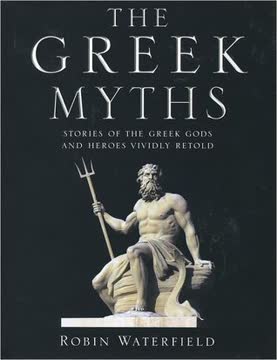
The Greek Myths by Robin Waterfield receives mixed reviews, averaging 3.73 stars. Readers appreciate the comprehensive coverage of myths from creation through the Trojan War, beautiful illustrations, and clear organization. However, many criticize the dry, biblical writing style with phrases like "Come all ye muses," finding it pretentious and oddly paced. Common complaints include excessive character names without context, confusing structure, and inconsistent detail that made reading tedious. Some readers found it boring despite fascinating source material. Positive reviews praise its accessibility, vivid descriptions, and value as an introduction to Greek mythology, though several note Stephen Fry's versions are more engaging.