Key Takeaways
1. The Primacy of Attention
A human being’s attention is the most precious treasure he possesses.
Attention is vital. Our attention is the most valuable asset we possess, yet we often take it for granted. It is constantly claimed by life's demands—survival, desires, and distractions—and its direction determines what aspects of our being are nourished and grow. Without conscious direction, it drifts aimlessly, feeding unproductive thoughts and negative emotions.
Directing energy. Attention acts as a link between our higher and lower selves, serving as fuel for whichever state it gravitates towards. When we allow our attention to be absorbed by useless daydreams or negative emotions, we inadvertently strengthen and crystallize these lower tendencies. Conversely, directing it towards noble thoughts and higher aspirations fortifies our spiritual endeavors.
Conscious vigilance. Understanding this paramount role of attention awakens a profound desire to withdraw it from worthless states. By consciously nurturing positive sentiments and starving negative ones, we gain control over our inner landscape. This deliberate redirection of attention is crucial for spiritual transformation, allowing us to achieve prodigious feats, whether in art, science, or mysticism.
2. Overcoming Self-Forgetfulness
It can in all truth be said that the fall of the human being took place when he began to forget himself.
The spiritual fall. Humanity's fundamental problem is self-forgetfulness—losing connection with our Supreme Being, the mysterious Source from which we originated. Each birth begins with a pure state of consciousness, but discordant external conditions and unfavorable influences cause us to forget our True Identity, reenacting the spiritual fall.
The price of return. Our spiritual struggles, particularly efforts of inner presence, are the price we must pay to return to our primordial state. This involves sustained effort to maintain an "out-of-the-ordinary presence" that gradually replaces our habitual state of being. This presence, initially fleeting, reveals a vast, impartial consciousness.
Active passivity. Once this higher state appears, our efforts shift from striving to surrender and self-abandonment. This is not passive torpor but an "actively passive" state, vigilantly present to the Sacred within. This conscious and intense inner presence allows the Impersonal to manifest, revealing a state of unity beyond duality.
3. Moral Integrity as the Foundation
Everything in the Universe is subject to an invisible cosmic law of attraction and gravitation to a corresponding level of being, according to its weight and density.
Integrity is essential. True spiritual benefit and understanding of mysticism are impossible without developing moral integrity. Wrong conduct, even minor, if repeated, takes root and impedes spiritual endeavors, rendering them sterile. Our aspirations can be unknowingly influenced by lower motives like desire for prestige or biased feelings.
Cosmic law of being. Just as physical objects gravitate according to their weight, our inner state—forged by our thoughts and actions—determines the level of consciousness to which we gravitate. This applies both in life and after death. Therefore, constant vigilance over thoughts, speech, and actions is crucial.
Fidelity to self and others. Integrity means fidelity to oneself and others. We must be honorable, sincere, and compassionate, recognizing that all beings suffer. Any harm done to one part of the universal whole inevitably affects the whole. This understanding fosters a deep commitment to moral values, ensuring that spiritual efforts lead to genuine transformation rather than crystallizing undesirable tendencies.
4. The Body as a Tool for Awareness
The body—the very thing that, knowingly or unknowingly, is an inner hindrance to the human being, and partly the cause of his spiritual fall, ever distracting his attention from where it should be centered—can become the precise means for him to be aware of himself in a new way, and help him in his efforts to rise to the higher realms of his being.
Transforming hindrance into aid. Our physical body, often a source of distraction and spiritual impediment, can be transformed into a powerful instrument for self-awareness. By consciously cultivating awareness of our physical movements and postures, we can use the body to ascend to higher states of being.
Cultivating self-awareness. This involves patiently observing our physical actions—walking, speaking, eating—through our mind's eye, creating distance from identification. This practice reveals:
- Physical restlessness and unnecessary gestures
- Muscular tensions that drain energy
- Emotional and mental agitations linked to physical states
Inner union. Each moment of returning to self-awareness is linked to a subtle feeling of the body, a re-membering of mind, body, and feelings. This global awareness, though fleeting, is a reunion of these three aspects. Developing this sensation also paradoxically helps us realize that we are not merely our body, fostering a dignified and refined approach to life's later stages.
5. Nada Yoga: The Inner Sound as a Guide
When the aspirant has become aware of the mysterious presence in him of this sound, he may at first be struck with surprise and awe, but no matter how weak or distant it may appear, it will be very obvious that this is no ordinary sound but a mystical one of a higher cosmic order.
The primordial sound. Nada Yoga, the Yoga of the Inner Sound, is a powerful meditation technique. By quieting the mind and listening internally with sustained attention, one can become aware of a feeble, unusual sound deep within the ears and head—a mystical, primordial sound with an uninterrupted, crystal-like vibration.
Support for concentration. This inner sound, or Nada, becomes a priceless support for concentration, especially for those struggling to retain focus. As one rises to higher consciousness, the sound becomes louder, more shrill, and acquires a celestial sparkle, oscillating continuously. It helps purify and calm the mind and feelings.
Divine signpost. The Nada acts as a divine signpost, indicating the right direction and helping the seeker rise to more luminous planes. Its presence protects against self-forgetfulness; its fading signals a weakening of attention. The seeker must always follow the most subtle and "ultra" aspect of the sound, relentlessly seeking its finer spheres, even in daily life.
6. Yoga of the Void: Mastering the Mind
If the seeker can now, in as tranquil and simple a manner as possible, plunge deeper into himself while continuing to watch his thoughts, they will quiet to such a great extent that the gap between each succeeding thought will become much wider and more evident.
Watching thoughts. The mind's incessant flow of thoughts can be a torment. Instead of forcefully repressing them, the Yoga of the Void involves vigilantly watching each thought and image without identification or entanglement. This patient observation reveals that each thought has a beginning, climax, and end.
Discovering the gap. As thoughts quiet down, a crucial discovery emerges: a gap, or void, between each thought. By fixing attention on this void and increasing its duration, one realizes it's not emptiness but an infinite expanse of subtle, impersonal consciousness—a silent, witnessing Spectator.
Beyond the mind. This state brings extraordinary inner silence and sublime peace, revealing our True Identity, a translucent sky untouched by passing thoughts. This practice strengthens the will, offers control over thoughts, and provides a refuge during life's inevitable harassments, preparing us for the ultimate transition beyond the mind.
7. Suffering as a Catalyst for Awakening
For most people, suffering is perhaps the only means that can make them yearn to seek a way out of the inner slavery to their ordinary selves and eventually find the road to their emancipation.
Suffering's purpose. Earthly existence is inherently fraught with suffering, which, for many, is the primary catalyst for seeking spiritual emancipation. When faced with tribulations, if one can avoid despair, suffering can be consciously transformed into an instrument to accelerate spiritual evolution, driving one inward to discover the ultimate citadel of peace.
Life's imperfections. Life's imperfections—strife, pain, uncertainty—are paradoxically perfect. Without them, humanity would not seek liberation from its merciless grip, remaining lost in oblivion. These challenges compel us to turn inward, seeking solace and salvation beyond duality.
The river of struggle. The path of yoga is like a deep, turbulent river. The seeker, having glimpsed the sublime shore, endures immense difficulties and risks. Family and external circumstances may add to the hardships, but the taste of spiritual sweetness, received by Divine Grace, fuels an unyielding aspiration to reach the Sublime.
8. Renunciation and Inner Transformation
Just as a cherry seed loses its identity when planted in the soil but is later transmuted into a beautiful cherry tree adorned with exquisite fruit, so it is with a person’s ordinary self: it has to be sacrificed and transformed into something finer and greater so that the person can start to serve a higher purpose in the Cosmos.
Sacrifice of the ordinary. Renunciation is not merely giving up external things, but "dying" to one's customary state of being and feeling. This difficult act is essential to allow something higher to come to the foreground. Our ordinary self, with its incessant desires and attachments, constantly blocks the path to emancipation.
The inner battle. We carry numerous hidden tendencies and impulses that enslave us. Developing greater self-awareness allows us to identify these, realizing the extent of our bondage. Renunciation involves intelligently struggling with these traits, replacing negative ones with their opposites, and nurturing noble sentiments.
The void and Grace. True renunciation creates an indispensable inner void, allowing the Divine to fill it. This "emptying" of self, though painful, is the only way for Grace to descend and purify our lower nature. It's a lifelong process, where the strength to be sincere comes from both the grief of seeing insincerity and the longing for truth.
9. Living in Two Worlds: Duality and Unity
The aspirant who, through ardent and sincere spiritual efforts, has come to know the true condition of being beyond duality, will also know and understand better the state of duality itself, even though he has now begun to live in another world in himself that is not subject to it.
Beyond duality. As spiritual efforts deepen, the seeker transcends the world of duality—desire and aversion, happiness and distress—to experience the sacred Unity behind all things. This doesn't mean escaping the physical world, but living in two worlds simultaneously: the physical realm of duality and an inner universe free from it.
Impartial witness. From the heights of True Being, events are viewed with impartiality, through the uninvolved, silent Witness within. This stronghold allows one to withstand external onslaughts without being diminished. Duality, with its suffering and uncertainty, is paradoxically a grace, compelling us to seek the unity beyond.
New perspective. Once the true condition beyond duality is known, feelings and interests shift inward, drawing force and inspiration from this sublime Source. This new perspective allows for a profound understanding of both duality and unity, transforming one's experience of life and preparing for the ultimate liberation from the physical prison.
10. Preparation for the After-Death State
If he has not come to recognize the Sacred in himself while still carrying his mortal body, if he has not arrived at a state of knowing this luminous consciousness and vast cosmic silence during his lifetime—be it only a little—then it will not be possible for him to understand it after he leaves this form of existence.
The great transition. Just as water transmutes into a finer state when heated, our ordinary self undergoes transformation through divine alchemy. Death is not a loss but a return to our original state of being. However, without recognizing the Sacred within during life, the after-death state appears as an incomprehensible void, causing panic and anguish.
Meditation as preparation. Deep meditation offers a foretaste of the after-death state, revealing our origin and the conditions we will encounter. This familiarity helps overcome the fear of physical death, allowing us to consent to this change as a natural return to our primordial state.
The choice of destiny. At death, we stand naked with what we have made of ourselves. Our thoughts, feelings, and interests in life determine the state of consciousness to which we gravitate. The opportunity to learn, transform, and pay karmic debts exists only in this earthly existence; after death, it is irrevocably too late to change.
11. The Interconnectedness of All Things
Whatever a human being thinks and does, even without his being aware of it, forges him into what he is—and it will ultimately determine the state of consciousness to which he will inescapably gravitate when he leaves this form of existence.
Invisible influences. Our thoughts, words, and deeds leave an indelible trace, not only on ourselves but on others and the environment. We are constantly receiving and transmitting subtle influences, shaping our being and the world around us. This interconnectedness means every action has far-reaching consequences.
Personal responsibility. The way we vibrate—our temperament, inclinations, and inner state—creates an atmosphere that affects everything we touch. From driving a car to interacting with family, our conduct leaves an imprint, contributing to either beneficence or sorrow. This demands self-study and vigilance over what we transmit.
Cosmic ripples. Just as a stone dropped in a pond creates ripples, our actions unleash chains of events. This applies to individual lives, societal dynamics, and even the cosmos. Understanding this karmic law compels us to cultivate compassion, use our faculties constructively, and strive for inner awakening to positively influence the universal whole.
Last updated:
Review Summary
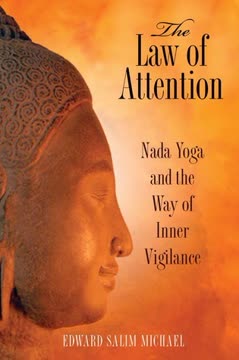
The Law of Attention receives an impressive overall rating of 4.57 out of 5 stars from 42 reviews on Goodreads. One enthusiastic reader awarded the book a perfect 5-star rating, expressing that the value of such a work transcends verbal description. The glowing review suggests this is a deeply impactful book whose worth cannot be adequately captured through conventional assessment, indicating it offers profound insights or transformative content for its readers.





