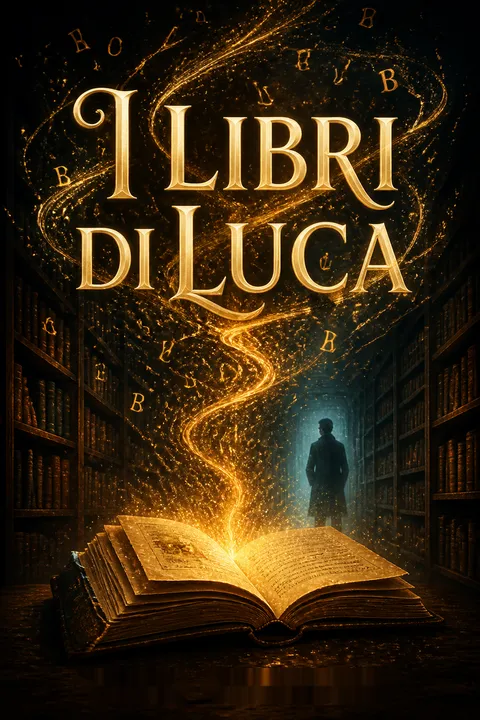


Plot Summary
Luca’s Last Reading
After a week away, Luca Campelli returns to his Copenhagen antiquarian bookshop and finds an unfamiliar first edition of an Italian work displayed among its rarest books. Its fine paper and engraved illustrations delight him, but the moment he reads aloud, his body begins to convulse. Luca cannot lift his eyes from the pages or stop the torrent of words pouring from him.
His shaking tears apart the balcony railing, and he falls among the shelves below. The death is reported as heart failure, yet the strange book, its missing price label, and the violent scene leave more questions than the official explanation can answer. Luca dies surrounded by the books he loved, and his estranged son is drawn back into the shop’s orbit.
The Barrister’s Bad News
Jon Campelli, a thirty-three-year-old barrister, begins the day preparing a meticulous closing argument for his client Mehmet Azlan, who has repeatedly been accused of fencing stolen goods. Jon wins the case, but before he can enjoy the victory, his firm’s partner Frank Halbech assigns him the notoriously difficult Remer corporate-raiding case.
A police call then tells Jon that his father, Luca, has died. The news unsettles him more than he admits. His parents’ separation and his father’s long absence have left their relationship unresolved, while Jon has built a career around controlling every detail. He now has to confront a loss he had kept at a distance, even as a formidable new client begins to complicate his professional life.
An Inheritance of Questions
At Luca’s funeral, Jon finds a congregation far larger and more varied than the handful of customers he remembers from childhood. Luca’s longtime assistant, Svend Iversen, explains that the mourners are friends of the bookshop. William Kortmann, a wheelchair-using regular, hints that Jon may have work to do with them, while Iversen later reveals that Jon alone inherits Libri di Luca.
Jon offers the shop to Iversen, who refuses and insists that Luca’s estate involves more than books. That afternoon, a shabby stranger in a pub warns Jon that reading can be dangerous and claims Luca understood why. The stranger leaves Jon with a warning instead of an explanation, sharpening Jon’s sense that his father’s life contained a hidden world.
The Locked Library
When Jon returns to Libri di Luca, Iversen takes him into a locked basement room filled with the Campelli family’s rare collection. He explains that a small number of people, called Lectors, can influence listeners through reading. Transmitters charge a text with emotion and emphasis; receivers sense or intensify what readers experience.
Luca belonged to the transmitter line, and Iversen believes Jon may have inherited the gift. Jon rejects the claim as unprovable until Iversen introduces Katherina, a dyslexic receiver who works in the shop. Her presence connects the secret to the bookshop’s everyday life, but Jon remains cautious: he is a lawyer accustomed to evidence, not invisible channels of influence.
Fahrenheit Comes Alive
Katherina’s ability becomes undeniable when Jon reads Fahrenheit 451 silently in the basement. The girl in the story appears so vividly that he feels affection and loss as she leaves, while his eyes refuse to break from the page until the passage ends.
Katherina confirms that she can follow what he reads and influence his experience. Her own history explains the cost: after a childhood car crash, she began hearing the inner voices of readers, an experience adults mistook for illness.
Luca taught her to manage the flood, and she later learned to perceive images in readers’ minds. Jon has now felt both the wonder and the violation of Lector power. Alone among the books afterward, he is overwhelmed by voices and images, then flees with the demonstration’s paperback still in his pocket.
Fire at Libri di Luca
Jon and Katherina are discussing the bookshop’s future when bottles of burning fuel smash through its windows. They fight the flames together, but Iversen is badly cut and burned while trying to protect the shop. Jon learns that the police suspect a racist attack, yet neither he nor Katherina believes that explains the timing.
At Kortmann’s heavily guarded home, Jon hears the more disturbing possibility: Luca may have been murdered by a receiver, and other bookshops and Lector contacts have recently been attacked. Kortmann asks Jon to investigate because he is not yet aligned with either faction. Jon accepts and chooses Katherina as his guide, despite the distrust many transmitters feel toward receivers.
Kafka’s Last Reader
At a meeting of the transmitters, Jon sees a community already divided by suspicion. Lee, a software engineer searching online for connections between the attacks, soon appears to have taken his own life with an insulin overdose.
Jon and Katherina inspect Lee’s flat, where his orderly shelves of literature and neglected computer offer few immediate answers. Mehmet uses his technical skills to search the computer remotely and finds Lee’s browsing history, including research into books, libraries, and distant travel.
Iversen later points out that reading Kafka could have deepened Lee’s despair if a receiver had quietly reinforced its bleakness. The group cannot tell whether Lee chose suicide freely or was pushed toward it, but his death makes the threat feel deliberate rather than coincidental.
Iversen’s Hospital Attack
While recovering in hospital, Iversen begins reading a book brought by Pau and suddenly loses control of his body. Jon stops the attack by covering the pages, and Iversen survives, though the episode confirms that someone can use reading to harm a listener.
When Iversen regains his strength, he recalls Tom Nørreskov, a receiver expelled from the Society more than twenty years earlier. Luca had banished Tom after allegations of sexual misconduct, and the man disappeared from their lives.
The timing makes Tom a possible link between the old division and the new violence. Before they visit him, Katherina tells Jon about accidentally overloading a childhood teacher during a reading, an event that has left her carrying guilt alongside her gift.
The Farm’s Hidden History
Jon and Katherina find Tom living under another name on an isolated farm, where warning signs let him detect people reading as they approach. Tom says he and Luca once suspected a secret faction of Lectors was using its powers for private ends. To draw it out, they arranged Tom’s expulsion as a cover, but the plan brought no clear answer. Instead, accusations split the Society.
Then Jon’s mother, Marianne, died, and Luca withdrew from his family and the Society, sending Jon away because he feared the faction would target him next. Tom had carried this explanation for years, but warns Jon to leave the investigation alone. As they depart, unknown readers approach the farm, confirming that someone may still be watching.
Jon Loses His Old Life
Remer turns Jon’s absences and unanswered case questions against him, reading selected correspondence to Halbech and persuading the partner to fire him. Jon recognizes the tactic as possible Lector influence, but the professional life he has relied on is suddenly gone.
Rather than retreat, he asks Iversen to activate his dormant ability. During the reading of Don Quixote, Jon discovers he can shape the scenes with extraordinary force. His uncontrolled power sends electrical discharges through the basement, starts fires, and leaves Katherina and Iversen injured by the effort of containing him.
Jon sleeps for thirty-six hours, then finds that ordinary signs and pages now press on his attention. His new ability has opened a door, but he does not yet know how to close it safely.
Kortmann’s Name in the Files
Jon and Katherina train with charged books before slipping into Jon’s former law office to examine Remer’s files. Katherina distracts Jon’s colleague Anders Hellstrøm by strengthening his concentration, while Jon gathers documents on Remer’s companies.
One list names Kortmann as a board member alongside Remer’s associates. Jon, Katherina, and Iversen confront Kortmann with the connection, but he dismisses their theory and orders Jon and Katherina off his property. Iversen chooses to leave with them rather than keep his place in the Society.
Jon then practices alone at Luca’s grave and discovers that intense reading can bend the iron fence around the family plot. The evidence against Kortmann is troubling, but the strange physical effects show that Jon’s power exceeds anything they understand.
The Chauffeur’s Trail
The divided Lectors begin pooling information, though many transmitters remain loyal to Kortmann and Pau initially stays with them. Jon lures Remer to a pub so the others can follow him. The trail leads to the Demetrius School, where Katherina hears several focused readings inside. Jon’s group also learns that Kortmann’s chauffeur has entered the same building.
Before they can investigate, Katherina and Henning visit Kortmann’s home and find him hanged inside the lift tower. Henning carries the body into Kortmann’s library, unwilling to leave his mentor in the shaft. The murder turns their suspicion into a more urgent hunt: the chauffeur and Remer may be coordinating, and the school may house the machinery behind their influence.
The School Belowground
Jon, Katherina, and Pau enter the school after dark and find an underground facility hidden beneath its classrooms. A testing room contains wired helmets, while records measure children’s Lector potential before activation.
The discovery suggests the organization is identifying and cultivating young recruits. In another room, Remer waits with his staff. Pau reveals that he has been working for them, then hits Jon with a crowbar as Katherina is restrained.
Remer takes Jon to a testing chamber and demands a display of his abilities; when Jon’s power erupts, the blast tears through the facility. Katherina escapes into the night, but Jon is recaptured. Soon after, the school burns, and Remer’s people erase the evidence while the police accept an accidental electrical fire.
A Postcard from Alexandria
Mehmet traces Jon’s flight to Egypt, and Tom arrives at Libri di Luca with a postcard Luca had sent from Alexandria. Its photograph identifies the rebuilt Bibliotheca Alexandrina as the likely destination. Katherina travels there with Mehmet and Henning, then spots Jon in a marketplace, walking beside Remer but regarding her as an enemy.
Henning recognizes that a transmitter has altered Jon’s feelings by giving him a false explanation for their relationship. Mehmet locates Pau at a hotel, and the group captures him long enough to learn that the Order plans to reactivate its members using Jon and the library’s accumulated energy.
Katherina enters the ceremony wearing Pau’s robe and amulet, while Mehmet and Henning search for another way inside. Jon, meanwhile, believes he has finally found his place in the Order.
The Black Robe Rises
The Order fills the library’s vast reading room under the cover of a public event. Remer reads an old Latin statement of the group’s purpose, then gives the podium to Jon, dressed in black among hundreds of white-robed members.
Jon starts a carefully staged activation, using a charged book and the library’s immense store of Lector energy. Katherina recognizes his distinctive rhythm and tries to reach him through images of their life together. The reading begins to return his memories, but Remer and his allies are also gaining power.
Jon’s electrical discharges strike the building, panic spreads through the crowd, and the ceremony becomes physically dangerous. Henning is reactivated on the upper level, then collapses and dies. Katherina and Mehmet remain inside, knowing that stopping the ritual may mean losing Jon.
Pinocchio Breaks the Spell
Jon recovers enough of himself to resist Remer, but the ceremony has made Remer and several followers powerful enough to reshape the story Jon is reading. Jon falls from the podium and injures his ankle.
When Katherina throws him a book, he recognizes Pinocchio, the Italian story Luca read to him throughout childhood. Its familiar scenes restore the images his father gave him and let him read without exhausting himself. Jon’s power knocks Patrick Vedel, the receiver who killed Luca, away from him.
Then Katherina signals Jon to stop. The accumulated energy loses its focus; Remer and the remaining readers collapse amid a blinding discharge. Jon and Katherina leave the library with Mehmet, but Henning is dead and the Order’s surviving members remain an uncertain threat.
The Way Back to Books
After hiding in Alexandria for several days, Jon, Katherina, and Mehmet decide the violence has gone far enough. Jon’s ankle is sprained rather than broken, and the newspapers disguise the deaths and destruction as a lightning strike and small fire at the library.
Mehmet stays in Egypt, while Jon and Katherina fly home. Jon knows he cannot return to his legal career: his life has been redirected by the powers he once dismissed and the family history he never understood.
What he longs for is the sound of Libri di Luca’s doorbells and the feel of its books. As he reads an in-flight magazine, he senses Katherina listening beside him. This time, the awareness does not make him feel exposed. He has found someone who can share the world his reading opens.
Analysis
The novel makes reading a literal form of influence, then asks what ethical boundaries can survive once interpretation becomes power. A transmitter does not simply persuade an audience; a receiver can perceive the listener’s shifting attention, and Jon’s growing ability pushes this mechanism into physical space. That fantasy gives form to an ordinary truth about books: a story can alter what feels possible, but here the alteration can be imposed without consent. The danger is not just manipulation by a villain. Jon’s first uncontrolled activation nearly destroys the people trying to help him, so talent itself requires discipline, context, and accountability.
The factions’ conflict is sustained by a problem familiar to both institutions and families: secrecy presented as protection can preserve life in the short term while poisoning trust over time. Luca hides the truth from Jon to keep him safe, yet that silence leaves his son unprepared for the forces around him. Kortmann’s faction and Clara’s receivers interpret history through accumulated grievance, allowing suspicion to substitute for evidence. Their divisions make the Order’s infiltration easier because the Society has already weakened its own capacity to compare accounts.
Books also function as material memory. The charged volumes preserve accumulated readings, while Pinocchio carries the most intimate inheritance of all: the images Luca gave his son before estrangement broke their relationship. Jon’s victory therefore does not come from raw strength alone. A childhood story restores a self the Order’s reading had displaced. The ending’s modest image of Katherina listening beside him as he reads offers a countermodel to coercive influence. Reading remains powerful, but it becomes shared rather than imposed, and Jon no longer has to experience that power alone.
Review Summary
The Library of Shadows received mixed reviews. Many readers found the premise of people with special reading abilities intriguing, but some felt the execution was lacking. Positive reviews praised the unique concept, engaging plot, and exploration of the power of books. Critical reviews cited flat characters, predictable storylines, and pacing issues. Some enjoyed the blend of mystery, fantasy, and thriller elements, while others found it confusing. Overall, the book's innovative idea about the magical potential of reading resonated with many bibliophiles.
Characters
Jon Campelli
The skeptical barristerJon is a gifted Copenhagen barrister whose careful preparation and command of an audience have earned him professional renown. He prefers evidence, procedure, and control, traits that protect him from the unresolved pain of his family history but also keep him emotionally guarded. Luca’s death draws him back to the bookshop and into a community whose abilities challenge his assumptions about agency and persuasion. His legal mind makes him attentive to contradictions and motives; his private self is less practiced at grief, trust, and dependence. Jon’s central tension is not simply whether he believes in the Lectors, but whether he can accept that his most effective skill may carry ethical responsibilities he never chose.
Katherina
The perceptive receiverKatherina is a receiver whose dyslexia makes written language difficult to decode, while the emotional and visual currents behind reading arrive with overwhelming clarity. A childhood accident began her experience of other people’s reading as voices and images, and years of practice have taught her to mute, focus, and interpret that flood. She is guarded around strangers, partly because her ability makes ordinary privacy fragile, but her loyalty to Luca and the bookshop gives her a strong sense of belonging. Katherina’s compassion does not make her passive: she can act decisively when someone is endangered. Her connection with Jon grows through shared investigation, yet she remains alert to the risks of knowing more about another person than they have chosen to reveal.
Luca Campelli
The absent bookshop patriarchLuca is an Italian antiquarian bookseller whose life is shaped by intimacy with books, family inheritance, and a rare talent for reading aloud. Customers trust his knowledge because he treats every volume as a crafted object with a history, not merely merchandise. His warmth and ability to bring stories to life make him a gathering point for people who otherwise have little in common. He is also a private man, capable of keeping painful decisions and important truths from those closest to him. To Jon, Luca is both a lost father and a puzzle; to Katherina and Iversen, he is a mentor whose generosity made an otherwise frightening ability manageable.
Svend Iversen
Luca’s steadfast assistantIversen has worked beside Luca for decades and regards Libri di Luca as a shared calling rather than a workplace. A skilled transmitter, he understands the practical disciplines of reading and the ethical limits imposed by the Bibliophile Society. His manner is warm, patient, and often humorous, especially with Jon, whom he remembers as a child. Iversen tries to protect the community without controlling it, a difficult balance when the old divisions become dangerous. His loyalty is personal as well as institutional: he cares for Luca’s legacy, Katherina’s wellbeing, and the possibility that Jon can find a place in the family history he has been denied.
Otto Remer
The ambitious clientRemer is a wealthy businessman accused of exploiting and bankrupting companies, and he treats legal trouble as another arena for strategic bargaining. He is personable when it serves him, but his easy manner conceals a calculating view of people and institutions. Remer believes exceptional ability should be optimized and put to practical use, a conviction that shapes how he thinks about Lector powers and the people who possess them. His interest in Jon begins amid business questions about Libri di Luca, then grows as he recognizes Jon’s unusual potential. Remer’s language of opportunity and efficiency can make coercion sound like mentorship, which is precisely what makes him dangerous.
William Kortmann
The Society’s cautious leaderKortmann leads the transmitter side of the Bibliophile Society and lives in a heavily secured house designed around his wheelchair. He is formal, politically astute, and protective of the group’s secrecy. His history with Luca and his role in the separation between transmitters and receivers make him an important authority, but also a figure whose decisions are viewed differently by each faction. Kortmann values order and containment, especially when the Society faces threats, and he expects others to respect institutional discipline. Jon’s arrival forces him to deal with a Campelli heir whose independence and lack of prior involvement make him difficult to direct.
Pau
The volatile young LectorPau is a young transmitter whom Luca took in after finding him reading poems for money in the street. Impulsive, proud, and quick to take offense, he wants recognition and a meaningful place in the bookshop community. His limited experience makes him impatient with the Society’s rules, which he sees as stale restrictions rather than safeguards. Pau is especially sensitive to being treated as a child or as someone whose abilities are inadequate. He alternates between bravado and insecurity, and his restless energy often exposes tensions that older members prefer to smooth over.
Mehmet Azlan
Jon’s resourceful friendMehmet is Jon’s client and friend, a trained programmer who makes a living entering online contests and reselling what he wins. His flat doubles as a crowded warehouse, a comic contrast to Jon’s polished home and professional habits. Mehmet uses humor to needle stereotypes and refuses to let other people define his capabilities by his background. His technical expertise makes him useful when an investigation requires digital access, but his deeper value is personal: he is generous without demanding immediate explanations and tends to act when friends are in danger.
Tom Nørreskov
The isolated former memberTom, who later lives under the name Klausen, is a receiver who has spent years apart from the Copenhagen Lector community. He is intensely wary of visitors and has built a life around watching for signs of intrusion. His friendship with Luca links him to the Campelli family and to an earlier period of conflict within the Society. Tom’s isolation has sharpened his suspicion, but he also carries a complicated loyalty to the people and plans he left behind. He is a source of historical knowledge, though his recollections come from a life spent waiting for a danger he cannot fully prove.
Clara
The receivers’ organizerClara heads the Centre for Dyslexia Studies and organizes the receiver community. Practical and direct, she provides a place where people overwhelmed by the voices of readers can compare experiences and learn to manage them. She views the receivers as a close-knit group because their abilities expose them to distress that outsiders often misread as illness. Clara respects Luca’s work toward reconciliation but is willing to challenge the transmitter leadership when she believes receivers are being blamed unfairly. Her confidence can harden into certainty, especially when the group’s safety is at stake.
Lee
The searching software engineerLee is a software engineer and member of the transmitter group who tries to trace the recent attacks through online research. Socially isolated and intensely curious, he moves between technical forums, literature, and questions about Lector activity. His methodical habits make him an early investigator, though his work is difficult for the older leadership to monitor. Lee represents a younger generation that wants the Society to use modern tools rather than rely entirely on old loyalties and private meetings.
Henning Petersen
The anxious booksellerHenning works in a Copenhagen bookshop and serves as treasurer for the transmitter group. Nervous in manner and blinkingly attentive, he is less comfortable with confrontation than with the familiar routines of books and accounting. He is nevertheless observant and willing to question assumptions, particularly when the group’s explanations do not fit the evidence. Henning’s caution is not cowardice; it reflects the burden of a community that has lived for years with mistrust and the possibility of exposure.
Patrick Vedel
A receiver in Remer’s circlePatrick is a receiver associated with Remer’s professional network. He is composed and watchful, and he understands how a receiver’s ability can shape the work of a transmitter. His presence shows that Lector talents can be paired strategically, beyond the informal reading community Jon first encounters.
Marianne Campelli
Jon’s remembered motherMarianne is Jon’s Danish mother and Luca’s wife. Though absent from much of Jon’s adult life, her memory remains closely tied to his sense of family, childhood, and the painful break between father and son. Jon remembers her through the emotional fragments of a life that was never fully explained to him.
Plot Devices
Lector reading
Stories that alter perceptionA small number of people can affect how others experience written text. Transmitters shape a listener’s emotional response through emphasis and cadence; receivers sense the images and currents of attention produced by reading, sometimes strengthening or muting them. The ability depends on concentration, the text, the reader, and the surrounding circumstances. It can create an unusually vivid shared reading experience, but the same mechanism can also distort judgment or physically endanger a listener. Jon’s legal skill at holding an audience foreshadows his latent talent, though persuasion through a story proves far less controllable than an argument in court.
Charged books
Memory stored in the pageBooks repeatedly read by Lectors can accumulate a force that makes them more effective than new or mass-produced copies. Their physical age, paper, binding, and history matter within the story, giving the bookshop’s collection both cultural and practical significance. Luca’s rare volumes provide a training ground, while the Campelli family’s treasured books carry emotional associations that ordinary editions cannot reproduce. The device also gives the novel a material account of literary influence: stories do not merely survive in memory, they leave traces in objects and places.
Receiver and transmitter split
A divided secret societyTransmitters and receivers possess complementary abilities but have lived in separate factions for decades. Their division grew from mutual suspicion after a series of attacks, and it shapes who trusts whom, which rooms they may enter, and whose account of events seems credible. Luca’s efforts to keep the groups connected make his death destabilizing beyond the loss of one leader. The split functions as both a practical obstacle to investigation and a psychological one: each faction interprets uncertainty through old grievances, making cooperation difficult precisely when coordinated knowledge is most needed.
The Demetrius School
A recruitment and testing siteThe school’s underground rooms contain wired helmets, measurement equipment, and records estimating children’s Lector potential. Its ordinary public identity conceals a system for identifying and developing recruits. This discovery changes the conflict from a feud between established Society members into a struggle over how the next generation will be found and used. The school also introduces the Order’s scientific language and its ambition to measure abilities that the Bibliophile Society has treated as personal, difficult to quantify, and ethically sensitive.
The Bibliotheca Alexandrina
A vast energy amplifierThe modern library in Alexandria stands near the site of the ancient center of learning and holds an immense accumulated charge, according to Luca’s theory. Its scale and design concentrate the power of books and Lector activity, making it far more than a dramatic setting for the final gathering. Remer’s Order seeks to exploit that force through Jon, whose abilities are unusually strong. The library turns reading from an intimate exchange into a mass event, increasing the reach of the Lectors while also magnifying the danger of losing control.
Download PDF
Download EPUB
.epub digital book format is ideal for reading ebooks on phones, tablets, and e-readers.








