Key Takeaways
1. The Ultimate Question: Is There an Intelligence Beyond the Universe?
Both spent a significant portion of their lives addressing this question, realizing its profound implications for understanding our identity, our purpose, and our destiny.
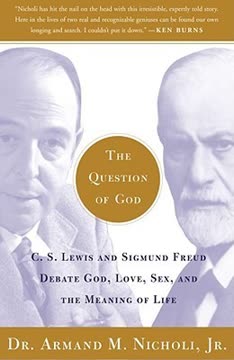
A fundamental divide. Sigmund Freud, the founder of psychoanalysis, and C. S. Lewis, the celebrated Oxford don, stood on opposite sides of life's most crucial question: the existence of an Intelligence beyond the universe. Freud, an ardent atheist, championed a "scientific Weltanschauung," dismissing religious faith as "patently infantile" and a "mass delusion." He predicted that education would lead humanity away from such "fairy tales."
Lewis's counter-argument. Lewis, initially an atheist who used Freud's reasoning, later embraced a spiritual worldview, asserting that the universe's vastness, precision, and complexity unmistakably point to a Creator. He urged people to "wake up" and discern the "signposts" of this Intelligence. Their contrasting answers, "No!" from Freud and "Yes!" from Lewis, were bold, clear, and mutually exclusive, shaping their entire philosophies of life.
Beyond mere philosophy. For both men, this wasn't a detached academic debate but a deeply personal inquiry with far-reaching consequences. Their differing conclusions informed every aspect of their personal, social, and political lives, influencing their perceptions of self, relationships, adversity, and purpose. The author's Harvard course, comparing their views, revealed how profoundly this question ignites discussion and shapes individual existence.
2. Wish Fulfillment vs. Innate Longing for the Creator
Freud therefore concludes that belief in God is merely a projection of powerful wishes and inner needs.
God as an exalted father. Freud's psychological argument against God's existence centered on wish fulfillment, asserting that religious ideas are illusions stemming from deep-seated human needs. He specifically identified the "small human child’s long-drawn-out helplessness and need of help," which, in adulthood, projects onto a "personal God" resembling an "exalted father." This concept, he argued, explained why people cling to belief, especially when their father's authority wanes.
Lewis's nuanced critique. Lewis countered that if belief were merely wish fulfillment, the inherent ambivalence in human wishes (both positive and negative) would mean the wish for God not to exist would be equally strong. He noted his own fervent wish as an atheist was precisely that God not interfere with his life. Furthermore, Lewis proposed that a deep-seated desire for something often indicates its actual existence, much like hunger points to food.
The "Joy" of longing. Lewis described a lifelong, intense longing he called "Joy," an "unsatisfied desire which is itself more desirable than any other satisfaction." He eventually concluded this yearning was not for a place but for a "Person"—the Creator. This innate desire, he argued, is a "signpost" to God, suggesting humans are "made for another world," and that earthly pleasures only serve to "arouse it, to suggest the real thing."
3. Conscience and the Universal Moral Law
All the human beings that history has heard of acknowledge some kind of morality; that is, they feel towards certain proposed actions the experiences expressed by the words ‘I ought’ or ‘I ought not.’
Morality as a human construct. Freud believed that ethics and morals are not divinely ordained but arise from "inescapable exigencies of human cohabitation." He saw them as a "highway code for traffic among mankind," changing with time and culture. Conscience, for Freud, was the internalized voice of parental prohibitions and demands, forming the superego, which judges and threatens with punishment.
Lewis's argument for objective truth. Lewis strongly disagreed, arguing that the moral law is discovered, not invented, much like the laws of mathematics. He observed that despite cultural differences, a fundamental moral code—the "Tao" or Natural Law—is universally recognized. He pointed out that when we judge one culture's morality as "better" than another's, we implicitly appeal to a "Real Morality" independent of human opinion.
The flaw in Freud's origin story. Freud's theory of conscience's origin in a prehistoric parricide, where sons felt "remorse" for killing the primal father, was critiqued by Lewis. Lewis noted that if the parricide produced guilt, it presupposed an existing moral sense that men "ought not to have committed it." Freud's own admission of "no answer" for his "impulsion toward the ideal" and his "thoroughly decent" behavior further highlighted the limitations of a purely human-derived morality.
4. Lewis's Conversion: An Intellectual and Emotional Awakening
You must picture me alone in that room in Magdalen, night after night, feeling, whenever my mind lifted even for a second from my work, the steady, unrelenting approach of Him whom I so earnestly desired not to meet.
The reluctant convert. Lewis's transition from militant atheism to profound faith was a gradual, intellectual, and deeply personal journey. Initially, he found the idea of a "transcendental Interferer" repugnant, cherishing his autonomy. However, a confluence of factors began to erode his atheism:
- His lifelong "Joy" experiences, which he realized were pointers to a Creator.
- The conversion of admired friends like J. R. R. Tolkien and H. V. V. Dyson.
- Reading authors like G. K. Chesterton, whose arguments profoundly impressed him.
- A fellow atheist's admission of the Gospels' historical authenticity.
The moment of surrender. Feeling "hounded" and with "no escape," Lewis made a conscious decision to "open the door" to the possibility of God. This led to a reluctant surrender to Theism, followed by a deeper acceptance of Jesus Christ as the Son of God. He recognized the Gospels as "true myth"—historical fact embodying universal mythical themes—and Jesus's claims as unique, leaving only the options of "lunatic, liar, or Lord."
A transformed life. This conversion, though intellectual, profoundly impacted Lewis's emotional life, replacing pessimism with "buoyant cheerfulness" and transforming him from a wary introvert to a personable extrovert. Research on similar conversion experiences among Harvard students revealed "marked improvement in ego functioning," including enhanced self-image, impulse control, and capacity for relationships, suggesting such transitions are adaptive, not pathological.
5. Happiness: Fleeting Pleasure vs. Lasting Joy in Relationship
God cannot give us happiness and peace apart from Himself, because it is not there. There is no such thing.
Happiness as instinctual satisfaction. Freud equated happiness primarily with pleasure, especially the "preferably sudden" satisfaction of "damned up" instinctual needs, with "sexual (genital) love" serving as its "prototype." He argued that happiness is inherently fleeting due to its episodic nature and the constant threats of pain from our bodies, nature, and other people. Civilization's necessary restrictions on instincts further diminish our capacity for happiness, leading to "discontents."
Lewis's divine design for joy. Lewis countered that true, lasting happiness stems from a relationship with the Creator, for whom humans were designed. He believed that God's plan for His creatures is "the happiness of being freely, voluntarily united to Him and to each other in an ecstasy of love and delight." Earthly pleasures, while good, are merely "Inns" on a journey, not our ultimate "home," and pursuing them as life's primary purpose leads to frustration and unhappiness.
The danger of ambition and pride. Both Freud and Lewis, before Lewis's conversion, struggled with pessimism and the desire for fame. Freud openly sought recognition, linking it to childhood experiences and his father's disapproval. Lewis, too, battled "a zoo of lusts, a bedlam of ambitions," recognizing pride as "the essential vice, the utmost evil." After his conversion, Lewis found that prioritizing his relationship with God and others led to genuine contentment, demonstrating that "when first things are put first, second things are not suppressed but increased."
6. Sexuality: Instinctual Drive vs. Integrated Love
Lewis agreed with Freud that there is nothing forbidden or sinful about sexuality and that we ought to have complete freedom to speak about it.
Freud's expansive view of sex. Freud revolutionized understanding of sexuality by asserting it begins at birth, not puberty, and encompasses a broader range of pleasure-seeking activities beyond the genital. He identified "oral," "anal," and "phallic" stages, and the Oedipus complex, arguing that "sexual impulses are regarded as including all of those merely affectionate and friendly impulses to which usage applies the exceedingly ambiguous word ‘love.’" He believed excessive repression of these impulses led to neuroses.
Lewis's moral framework for sexuality. Lewis agreed on the importance of open discussion about sex, noting that the biblical worldview "thoroughly approves of the body" and "glorifies marriage." However, he sharply distinguished between "repression" (unconscious, unhealthy) and "suppression" (conscious control, healthy), arguing that "for any happiness, even in this world, quite a lot of restraint is going to be necessary." He believed the sexual instinct had "gone wrong," leading to its "ludicrous and preposterous excess."
Eros, Venus, and the "mess." Lewis differentiated between Eros (being in love, a delighted preoccupation with the Beloved) and Venus (the physical sexual act). He argued that "being in love" is a noble but temporary feeling, meant to mature into a deeper, willed love. He criticized the cultural tendency to make sex too serious or to use "being in love" to justify immoral acts, suggesting that the "mess" of modern sexuality stems from ignoring clear moral boundaries like "Either marriage, with complete faithfulness to your partner or else total abstinence."
7. The Complexities and Dangers of Human Love
Every human love, at its height, has a tendency to claim for itself a divine authority.
Love as sublimated libido. Freud contended that all forms of human love—from familial affection to friendship and universal love for humanity—are ultimately expressions of "aim-inhibited" sexual impulses, or libido, diverted from their direct sexual aim. He also highlighted the "narcissism of minor differences" and an underlying "readiness for hatred" that pervades human relationships, often leading to conflict even among intimates.
Lewis's four loves. Lewis, drawing on Greek tradition, categorized love into four distinct forms:
- Storge (Affection): Comfortable familiarity, modest, least discriminating, "responsible for nine-tenths of whatever solid and durable happiness there is in our natural lives."
- Philia (Friendship): Least necessary, least instinctive, based on shared interests, "side by side absorbed in some common interest," often disparaged by collective-minded societies.
- Eros (Being in Love): Romantic passion, a "glorious state" that "opens our eyes," but is a feeling that "does not last" in its initial intensity.
- Agape (Charity/Divine Love): The highest form, based on the will, desiring the best for others, even enemies, and acting accordingly, regardless of feeling.
The perils of idolatry and the "Inner Ring." Both recognized the destructive potential of love. Lewis warned that "love, having become a god, becomes a demon," leading to unloving acts in its name. He also identified the "Inner Ring"—the desire to be part of an exclusive group—as a powerful, pride-driven passion that can lead individuals to compromise their integrity and commit "very bad things."
8. Pain: Resignation to Fate vs. God's Redemptive Megaphone
God whispers to us in our pleasures, speaks in our conscience, but shouts in our pains: it is His megaphone to rouse a deaf world.
Suffering as an unanswerable argument. For Freud, the problem of pain was a primary obstacle to faith. He argued that if a benevolent, omnipotent God existed, He would not permit the vast suffering in the world. Personal experiences of anti-Semitism, the loss of loved ones, and his own battle with cancer fueled his conviction that "obscure, unfeeling and unloving powers determine men’s fate," leading him to a philosophy of "resignation."
Lewis's journey through grief. Lewis, too, experienced profound suffering: his mother's death, war trauma, and the devastating loss of his wife, Joy. He wrestled with God's apparent absence in his deepest need, questioning if God was "The Cosmic Sadist." However, he ultimately reconciled suffering with faith by redefining "omnipotence" (power to do what's intrinsically possible, not nonsense) and "love" (stern, demanding perfection, not mere kindness).
Pain's purpose and the "enemy-occupied territory." Lewis argued that free will, though enabling evil, is essential for love and joy. He saw pain not as God's creation, but as a consequence of a "Fallen Universe" and "enemy-occupied territory." God, he believed, uses pain as a "megaphone" to awaken humanity to its need for Him, though it can also lead to "unrepented rebellion." Lewis's faith was strengthened, not shattered, by his suffering, leading him to understand that God uses evil for "His redemptive purpose."
9. Death: Terrors of Annihilation vs. Hope of Transition
The horror of the Christian universe was that it had no door marked Exit.
Freud's obsession with annihilation. Freud's awareness of death began in childhood with his brother's passing, leading to a lifelong obsession and "dread of death." He observed that the unconscious "does not believe in its own death; it behaves as if it were immortal," yet consciously, he was tormented by "the terrors of eternal nothingness." He was superstitious about the age of his death and, in his final moments, chose euthanasia, having found no spiritual consolation.
Lewis's "penal obscenity" and "Grand Miracle." Before his conversion, Lewis, like Freud, saw death as the ultimate end, even considering suicide as an "Exit" from unbearable life. After his conversion, he viewed death as "Satan's great weapon and also God's great weapon," a "penal obscenity" resulting from the Fall, yet also the means of redemption. He saw pagan myths of dying gods as "signposts" pointing to the "Grand Miracle" of Christ's Resurrection.
Prepared for the journey's end. Lewis, despite his initial terror of loss, found peace in his later years, even anticipating death. He saw it not as annihilation but as a transition, a "friend and deliverer," a "stripping off that body which is tormenting you." His final days were marked by cheerfulness, calmness, and a deep sense of having completed his earthly purpose, believing "there are better things ahead than any we leave behind."
10. Worldview's Profound Impact on Life and Relationships
Their lives, however, offer sharp commentary on the truth, believability, and utility of their views.
Freud's fractured connections. Freud's materialist worldview, coupled with his "distrust of and low evaluation of people," contributed to a pattern of establishing intense relationships with colleagues, only to break them amid bitter recrimination. He often felt betrayed, believing "all my life I have been looking for friends who would not exploit and then betray me." His pessimism about human nature meant he expected little improvement, even from psychoanalysis.
Lewis's relational transformation. Before his conversion, Lewis was an introspective, critical, and arrogant individual, wary of close relationships due to early trauma. His diary revealed a "zoo of lusts" and a "bedlam of ambitions." After his conversion, his worldview dramatically shifted:
- He became an extrovert, forming deep friendships (e.g., the Inklings).
- He valued every human being as an "immortal," transcending earthly significance.
- He diligently corresponded with countless individuals, offering help and encouragement.
- He cultivated "Agape," a willed love for others, which transformed his feelings and interactions.
The ultimate test. The contrasting relational patterns of Freud and Lewis, particularly Lewis's profound transformation, serve as a powerful testament to the "utility" of their respective worldviews. Lewis's life demonstrated that a spiritual perspective could foster deep connection, compassion, and a profound sense of purpose, even in the face of immense suffering, while Freud's life, despite his intellectual brilliance, remained marked by isolation and a pervasive sense of human unworthiness.
11. The Peril of Distorting the Image of God
My idea of God is not a divine idea. It has to be shattered time after time. He shatters it Himself. He is the great iconoclast.
Transference and the distorted divine. Freud's theory of transference, where individuals unconsciously displace feelings from childhood authority figures onto present ones, offers a crucial insight into how we might distort our concept of an Ultimate Authority. If we project unresolved conflicts with our earthly fathers onto God, we risk creating a deity based on our neuroses rather than on reality. This distortion, Freud implied, fuels the "fairy tales" of religion.
God as the "great iconoclast." Lewis, after his conversion, became acutely aware of this human tendency to create God in our own image. He recognized that his initial concept of God, influenced by his difficult relationship with his father, needed to be continually "shattered" by the true nature of the Creator. He emphasized that "all reality is iconoclastic," meaning that true encounters with God often challenge and break down our preconceived notions.
The first commandment's wisdom. The tendency to distort God's image explains why "people have committed, and continue to commit, ungodly acts—even acts of terrorism—in the name of God." This human inclination to fashion a deity that serves our own desires or justifies our prejudices underscores the profound wisdom of the first commandment: "You shall have no other gods before me." Both Freud and Lewis, in their own ways, highlighted the critical importance of confronting our assumptions about the divine, whether in rejection or acceptance.
Last updated: