Key Takeaways
1. Earth's Gifts: A Foundation of Abundance, Not Scarcity
This abundance of berries feels like a pure gift from the land. I have not earned, paid for, nor labored for them.
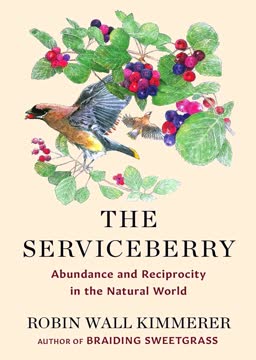
Embrace the unexpected. The sheer delight of finding Serviceberries, ripe for the picking, feels like an unearned gift from the land. This immediate sense of joy highlights a fundamental truth: much of what sustains us—the sun, the air, the rain—is freely given, not a commodity to be bought or sold. It challenges the notion that worthiness or labor must precede every benefit.
Gifts, not resources. While conventional economics labels these as "natural resources" or "ecosystem services," the author and the birds know them as gifts. This shift in perspective from transactional to gratuitous transforms our relationship with the natural world, fostering a deep sense of kinship and appreciation. It reminds us that life's essentials are inherently abundant, not inherently scarce.
Neighborly generosity. The particular bounty of Saskatoons, a western species, was an unexpected gift, planted by farmer neighbors, Paulie and Ed. Their first bearing year produced berries with an enthusiasm that mirrored the author's own, demonstrating how human intention can amplify nature's generosity and create shared abundance. This act of planting for future harvest, even if initially for profit, ultimately contributes to a wider web of gifts.
2. Indigenous Wisdom: The "Gift" in Every Berry
In naming the plants who shower us with goodness, we recognize that these are gifts from our plant relatives, manifestations of their generosity, care, and creativity.
Cultural significance. The Serviceberry, known by many names like Juneberry, Shadbush, and Saskatoon, holds deep cultural importance across various traditions. Its early spring bloom signals thawed ground for circuit preachers and the running of shad, making it a vital "calendar plant" for synchronizing seasonal rounds, especially for Indigenous Peoples who move with the rhythms of the land. This practice honors abundance by meeting it where and when it naturally arrives, contrasting with modern demands to force food to us.
The root of "gift." In Potawatomi, the Serviceberry is called Bozakmin, meaning "the best of the berries." Crucially, the root word "min" appears in many other berry names (Minaan for Blueberry, Odemin for Strawberry) and even for staples like Maize (Mandamin) and Wild Rice (Manomin). This linguistic connection reveals a profound worldview: these plants are not mere "things" but "gifts" from plant relatives, embodying unconditional love and generosity.
Sustaining life. This understanding extends beyond fresh berries to traditional foodways, such as pemmican, where dried Serviceberries were a critical ingredient. Combined with venison or bison, pemmican served as a highly concentrated, transportable, and preserved food, providing nutritional sustenance through seasons of hunger. This ancient practice highlights how Indigenous economies were built on recognizing and sharing these vital gifts, fostering sophisticated trade networks and community well-being.
3. The Market Economy's Flaw: Manufacturing Scarcity
In order for capitalist market economies to function, there must be scarcity, and the system is designed to create scarcity where it does not actually exist.
Scarcity as a principle. Conventional economics, as taught in schools, often begins with the premise of scarcity—how people use limited resources and respond to incentives. This foundational belief shapes a mindset where everything is implicitly defined as scarce, leading to the commodification of goods and services and prioritizing individual accumulation. This "Rational Economic Man" model assumes self-interest as the primary driver.
A different definition. Ecological economics, however, offers an alternative: "how we organize ourselves to sustain life and enhance its quality." This perspective integrates Earth's natural systems and human values, moving beyond purely monetary metrics. It recognizes that the Greek root oikos (home/household) for both "ecology" and "economy" implies systems of relationship and care, not just transactions.
The Windigo mindset. The market economy's need for scarcity often leads to the privatization of abundant natural gifts, like pure water, which was once unthinkable to buy. This conversion of common gifts into commodities for profit creates artificial scarcity, making essentials unaffordable for many. This behavior mirrors the Potawatomi "Windigo," a monster whose insatiable hunger for taking too much and sharing too little jeopardizes the entire community, a stark metaphor for unchecked capitalist accumulation.
4. All Flourishing Is Mutual: The Core of Reciprocity
All flourishing is mutual.
Gratitude and reciprocity. If gratitude is the intuitive first response to receiving gifts, then reciprocity is the second: the impulse to give a gift in return. This isn't a bilateral exchange of obligation, but a diffuse, open flow that keeps the gift in motion, preventing accumulation and stagnation. This "currency" of gratitude and reciprocity multiplies with every exchange, becoming a truly renewable resource that strengthens community bonds.
Storing wealth in relationships. The profound wisdom of the hunter who, when asked why he didn't store excess meat, replied, "I store my meat in the belly of my brother," encapsulates the essence of a gift economy. Wealth is redefined not by individual accumulation, but by having enough to share. This practice ensures that everyone in the community has what they need, fostering interdependence and mutual well-being, where the economic unit is "we" rather than "I."
Nature's example. The Serviceberry itself embodies this principle. It doesn't hoard the abundance of sugar it produces; instead, it invites birds to a feast. By sharing its berries, the tree ensures seed dispersal, and the birds, in turn, scarify the seeds for germination. This intricate web of relationships—between trees, insects, birds, and microbes—demonstrates how gifts are multiplied through giving, leading to a thriving ecosystem where abundance is shared, and all flourishing is indeed mutual.
5. Nature's Blueprint: Circular Materials, Flowing Energy
Materials move through ecosystems in a circular economy and are constantly transformed. Abundance is created by recycling, by reciprocity.
The circular economy of materials. Ecosystems offer a powerful model for sustainable economics, distinguishing between the flow of energy and the cycling of materials. Essential elements like carbon, nitrogen, and phosphorus endlessly cycle through an ecosystem, constantly changing form. For instance, carbon from the atmosphere becomes sugar in a berry, then part of a bird's feather, eventually returning to the soil to nourish a new seedling. This continuous transformation and recycling create abundance, demonstrating that in nature, there is no waste, only starting materials.
The one-way flow of energy. In contrast to materials, energy flows in one inevitable direction, governed by the laws of thermodynamics. The sun's energy, stored in a Serviceberry, fuels a bird's song but eventually dissipates as heat. Energy cannot be completely recycled; it must be constantly replenished. This fundamental difference highlights the importance of renewable energy sources, like the sun, which has always been revered as the ultimate source of life, powering all ecological and, by extension, human economies.
Biomimicry for human systems. The study of how natural systems operate provides a blueprint for reimagining human economies. Biomimicry, a growing field, seeks to design social institutions and economic systems that align with natural principles rather than working against them. By understanding how Serviceberries and other ecosystems manage resources—through interdependence, recycling, and efficient energy use—we can develop economic models that are inherently sustainable, meeting human needs while ensuring the long-term health of the planet.
6. Beyond the "Tragedy": Collective Care for Common Gifts
Defying the long-held theory, her work showed that collective action, trust, and cooperation can lead to the mutual well-being of land and people without degrading commonly held resources.
Challenging a flawed narrative. The "Tragedy of the Commons," articulated by Garrett Hardin, posits that shared resources will inevitably be destroyed by competing self-interests, leading to calls for privatization. This powerful idea has justified commodifying what was once communal. However, Nobel laureate Elinor Ostrom's groundbreaking work directly refutes this, demonstrating that communities can successfully manage common resources through collective action, trust, and cooperation, ensuring mutual well-being without degradation.
Indigenous models of common wealth. For much of human history, land was viewed as a common source of abundance, managed through mutual obligations rather than private ownership. Examples include:
- Dish with One Spoon Treaty: Haudenosaunee and Anishinaabe nations agreed to share hunting grounds and provisions as "One Dish," emphasizing joint responsibility for care.
- Bears Ears National Monument: Five tribes nurtured relationships with the U.S. government to protect sacred lands as a common gift, a transformative step towards healing colonial taking, though later contested.
The contest of worldviews. These historical and contemporary examples highlight an ongoing economic contest between colonial values of individual accumulation and Indigenous values of sharing the commons. The dispossession of original peoples aimed to replace the notion of land as belonging with land as a source of belongings, narrowing well-being from common wealth to individual wealth. Ostrom's work, and Indigenous practices, offer a powerful counter-narrative, proving that shared resources can thrive under collective stewardship.
7. The Honorable Harvest: Guidelines for Conscious Consumption
We are called to harvest honorably, with restraint, respect, reverence, and reciprocity.
A moral dilemma. When land is viewed as a gift from "someones" rather than mere "somethings" or commodities, consumers face a moral dilemma. While humans must consume to live, our patterns of gross overconsumption have led to ecological and spiritual depletion. The property mindset, which claims privilege to exploit what is "owned," removes moral constraints on consumption, leading to disastrous outcomes.
Ancient ethics for living. Indigenous cultures worldwide have long practiced the "Honorable Harvest," a set of unwritten guidelines for taking from the land. These ethics are seen as timeless treaties between humans and more-than-human relatives (Deer, Bear, Fish, Plant people), where other beings agree to share their lives to sustain humans, in return for human restraint, respect, and reciprocity. These guidelines likely arose from learning through ecological consequences of past mistakes.
Practical principles for honorable taking:
- Know the ways of those who care for you.
- Introduce yourself and ask permission.
- Never take the first or the last.
- Take only what you need and what is given.
- Never take more than half; leave some for others.
- Harvest with minimal harm.
- Use respectfully; never waste.
- Share what you have taken.
- Give thanks and a gift in reciprocity.
- Sustain those who sustain you.
These principles offer a profound framework for consuming with humility and awareness, ensuring the Earth's gifts endure for future generations.
8. Grassroots Gift Economies: Building Community Through Sharing
We know how to do this—and what’s more, we crave doing it, feeling more alive with every gift exchange.
Everyday acts of generosity. Gift economies are not just ancient concepts; they thrive in our daily lives, often unnoticed. Simple acts like sharing excess lasagna with an elderly neighbor, passing on outgrown baby strollers, or giving a finished book to a friend are atoms of a gift economy. These exchanges build bonds, prevent waste, and foster connection without monetary transaction, demonstrating that giving begets giving and keeps the gift in motion.
Community-scale initiatives. Beyond individual acts, gift economies manifest in organized community efforts. Examples include:
- Little Free Libraries: Small, publicly accessible boxes where books are freely exchanged, fostering a love of reading and community connection.
- Free Farm Stands: Neighbors sharing surplus vegetables and flowers, creating joy and access to fresh food.
- Mutual Aid Networks: Spontaneously arising during crises like earthquakes or hurricanes, where people pool resources (food, labor, blankets) in solidarity, overriding market economies and demonstrating our inherent capacity for compassion.
- Freecycling and Repair Cafés: Movements focused on sharing goods and skills to reduce waste and foster community resilience.
Digital commons. The digital world also hosts vibrant gift economies. Open-source software, Wikipedia, and countless educational videos on platforms like TikTok and YouTube exemplify how knowledge, time, and experience are freely shared, creating an information commons. These digital spaces demonstrate a collective longing to create alternatives to systems that prioritize profit over shared well-being, proving that we can cultivate generosity without the catalyst of catastrophe.
9. Ecological Succession: Nature's Model for System Change
The extractive practices of the colonists must be replaced with reciprocity and replenishment if anyone is to survive.
Nature's dynamic change. Plant communities are not static but constantly in flux, undergoing ecological succession—a dynamic mosaic of replacement and renewal. After a major disturbance (fire, flood, human activity) creates a "gap," fast-growing pioneer species colonize the area. These opportunists prioritize exponential growth and resource consumption, investing only in their own rapid expansion, much like early colonizing human societies.
From exploitation to maturity. However, these pioneer species eventually deplete resources, face disease, and limit their own growth, facilitating their replacement. The next wave of inhabitants grows more slowly, investing in persistence and nurturing cooperative relationships alongside competition. These "mature" communities are sustainable, demonstrating a transition from exploitation to reciprocity, from individual good to common good. This natural process offers a parallel for human societies to move from hoarding to circulation, from independence to interdependence, and from wounding to healing.
Tools for transformation. Ecological succession highlights two mechanisms for systemic change:
- Incremental change: The slow, steady replacement of unsustainable practices with those that serve ecological flourishing.
- Creative disruption: Disturbances, when calibrated correctly, create openings and "gap edges" (ecotones) where new species and systems can emerge and thrive.
We can use both incremental shifts and strategic disruptions to nurture emerging gift economies within the dominant market system, becoming the "storm that topples the senescent, destructive economies" to allow new, regenerative ones to flourish.
10. Cultivating Gratitude: The Currency of a Regenerative Future
I want to live in a society where the currency of exchange is gratitude and the infinitely renewable resource of kindness, which multiplies every time it is shared rather than depreciating with use.
Beyond profit: the value of relationship. Farmers like Paulie and Ed, while part of the market economy, also embody the gift economy. By inviting neighbors to pick Serviceberries for free, they forgo immediate profit but invest in community, building goodwill and social capital. This "good marketing" cultivates relationships, fostering a sense of connection to the land and each other that transcends commodity transactions. People return not just for produce, but for the experience, the laughter, and the feeling of being valued—qualities that cannot be commodified.
Redefining wealth and well-being. A regenerative future requires shifting our understanding of wealth from individual accumulation to having enough to share, and from material possessions to the richness of relationships. Thinkers like Kate Raworth, with "Doughnut Economics," propose an economy bounded by ecological limits and founded on social justice, valuing community, mutual support, and the "productivity" of unpaid labor like family care and gardening. This holistic view recognizes that true well-being encompasses far more than GDP measures.
The power of personal offerings. The author's father's daily ritual of pouring coffee onto the ground, saying "Here's to the gods of Tahawus," exemplifies a deeply personal act of gratitude and reciprocity. This "secondhand ceremony," born from a history of cultural loss, nonetheless connected his family to the land and its ancient wisdom. It taught that the land knows you, even when you are lost, and that ceremonies, large or small, awaken us to the gifts around us. This profound connection, rooted in gratitude, is the medicine needed to inspire a legion of land protectors and guide us toward an economy where kindness multiplies and all life flourishes mutually.
Last updated:
Review Summary
The Serviceberry by Robin Wall Kimmerer explores gift economies versus market economies through the metaphor of the serviceberry tree, which abundantly provides fruit to birds, animals, and humans. Reviews are polarized: admirers praise Kimmerer's blending of Indigenous wisdom with ecological knowledge, appreciating her message about reciprocity, gratitude, and community sharing. Critics find it repetitive, simplistic, overly political, or idealistic, questioning the practicality of gift economies in modern society. Some readers felt misled expecting nature writing rather than economic critique. The book's brevity (under 130 pages) drew mixed reactions—some found it perfectly concise while others thought it stretched a short essay unnecessarily.