Key Takeaways
1. The Universe is a Symphony of Rhythmic Waves
At the root of all power and motion, at the burning center of existence itself, there is music and rhythm, the play of patterned frequencies against the matrix of time.
Fundamental rhythm. The universe, at its most basic level, is not composed of static matter but of dynamic, vibrating energy. Ancient philosophers like Pythagoras intuited this, calling a stone "frozen music," a concept now validated by modern science. Every particle, radiation, and force derives its characteristics from the pitch, pattern, and overtones of its particular frequencies.
Musical structure. This rhythmic nature is evident across various scientific domains. The electromagnetic spectrum, for instance, spans over seventy octaves, with visible light being just one. Similarly, the Periodic Table of Elements organizes chemical elements into seven octaves, where properties tend to repeat, much like musical octaves. This deep structural resonance suggests that music is not merely an art form but a reflection of the world's inherent order.
Cosmic dance. From the infinitesimal vibrations within an atom's nucleus (10^22 times a second) to the slow, majestic orbits of galaxies, everything is in motion, a grand, intricate dance. Our senses act as rhythm transformers, translating these vast frequency ranges into perceivable experiences, connecting us intimately to the cosmic symphony.
2. Human Connection is a Synchronized Dance
Communication is thus like a dance, with everyone engaged in intricate and shared movements across many subtle dimensions, yet all strangely oblivious that they are doing so.
Universal entrainment. Just as two pendulum clocks on a wall synchronize their swings, living systems, including humans, exhibit "entrainment"—a tendency for oscillators in the same field to lock into a shared rhythm. This phenomenon is driven by nature's quest for efficient energy states, making cooperation less energy-intensive than opposition.
Micro-level synchrony. Dr. William S. Condon's microanalysis reveals that human conversation is a precise, largely unconscious dance. Speakers' micro-movements are synchronized with the micro-units of their speech, and astonishingly, listeners move in precise shared synchrony with the speaker's voice, with no discernible lag. This suggests that at a fundamental level, the listener is not merely reacting but is "one with the speaker."
Rhythm of culture. This rhythmic connection extends beyond individual interactions to cultural identity. Different ethnic groups possess distinct rhythmic patterns in their nonverbal communication, which can lead to communication challenges even when speaking the same language. The ability to entrain with these rhythms is crucial for deep understanding and connection, transforming interactions from mere verbal exchanges into shared experiences.
3. Our Bodies are Empty Rhythm, Not Solid Flesh
At the ultimate heart of the body, at the heart of the world, there is no solidity.
Beyond superficiality. Our conventional perception of the body as solid, chunky flesh is challenged by deeper scientific inquiry. Through electron-scanning microscopes, the body reveals itself as a dynamic, fluid, and elegant landscape of cells and fibers, resembling an undersea world teeming with rhythmic life.
Dissolving into waves. As magnification increases further, muscle fibers dissolve into long, spiral molecules swaying in the wind, held by invisible waves pulsing trillions of times a second. Atoms, too, are tiny shadowy balls dancing around fixed locations, their electrons forming a cloud. Penetrating the atom's nucleus, we find not a solid object but an oscillating field, waves of rhythm.
Pure rhythm. Even subatomic particles like quarks, the supposed basic building blocks, ultimately dissolve into pure rhythm. This profound realization means that the body, at its most fundamental level, is made of emptiness and rhythm. This perspective dissolves the traditional mind-body dualism, suggesting that both are manifestations of underlying wave patterns.
4. Personal Identity is a Unique Inner Pulse
At the heart of each of us, whatever our imperfections, there exists a silent pulse of perfect rhythm, a complex of waveforms and resonances, which is absolutely individual and unique, and yet which connects us to everything in the universe.
Irreversible uniqueness. Personal identity is an essential, unique, and irreversible quality of human existence, expressed in countless ways. From fingerprints and voiceprints to brainwave patterns and even newborn breathing rhythms, each individual possesses distinctive, identifiable patterns. This uniqueness is encoded in our very being, down to the DNA in every cell.
Artist's signature. The presence of an artist in their work, like Thomas Wolfe's cadence in his writing or Beethoven's signature in his music, transcends time and physical absence. Dr. Manfred Clynes's research on "essentic forms" shows that basic emotions have characteristic, universal gestures, and that composers possess a unique "inner musical pulse" that is remarkably stable and distinctive, regardless of the piece or performer.
Wave function of self. This "inner pulse" is proposed as the most fundamental quality of individuality—an overall wave function that subsumes body, mind, and spirit. It is the unitary identity that expresses itself in a multiplicity of identifying characteristics. This perspective dissolves mind-body dualism, seeing both as manifestations of this unique rhythmic pulse, which persists even beyond physical death.
5. Each Being is a Hologram of the Universe
Each part of the hologram, no matter how small, can reproduce the whole image when illuminated by laser light.
All-in-oneness. The concept of holography, where every fragment of a photographic hologram contains the entire image, offers a powerful metaphor for understanding our connection to the universe. This resonates with ancient mystical traditions, like the Hindu "Net of Jewels," where every piece of the universe contains every other piece, and the idea that God is immanent in all creation.
Holonomic structure. Modern quantum theory suggests that "no theory of reality compatible with quantum theory can require spatially separated events to be independent," implying a deep interconnectedness. Physicists like Karl Pribram propose that the brain itself operates holographically, storing memories not in specific locations but distributed throughout, allowing the whole to be reconstructed from any part.
Universal information. If the universe is a probability-wave hologram, then information about the whole is available at every point. This means each subatomic particle within us, and indeed our entire being, is a "holoid"—an entity that is holonomic—containing essential and complete information about the entire universe. This structural connection, rather than merely sensory perception, implies that all possible knowledge is potentially available to us.
6. Reality is a Playground of Interacting Identity and Holonomy
In the playground of reality, where the relationship between identity and holonomy is directly experienced, each of us is in the business of creating all of existence, effortlessly, on the wink of an instant.
Two essential qualities. Human existence, and indeed the universe, is defined by two complementary qualities: identity (our unique, discrete rhythmic pulse) and holonomy (our nature as a hologram of the entire universe). Without identity, there would be no differences, no relationships, and thus no objects or events. Without holonomy, there would be no overarching unity or meaning.
The "I-ness" experience. The profound, often overwhelming sense of "I-ness"—the feeling of being the unique center around which the world revolves—arises from the interplay between these two qualities. This is not mere subjective consciousness but the ego's wonder at a deeper truth: that the individual "I" is, in essence, the universe itself.
Ego's role and transcendence. The ego, a social construct, often constrains our experience of both holonomy (oneness with the world) and identity (our true, unique rhythm). However, through practices that reduce ego, such as intense martial arts training or moments of profound surrender, individuals can transcend these constraints. In this state, intentions align with universal flow, and reality seems to respond, as seen in the story of the biplane appearing precisely as desired.
7. Perfect Rhythm is Always Present, Awaiting Our Awareness
Could it be that we miss the experience not because it is so distant but because it is so close?
Beyond goals and ego. We are often taught to prioritize goals and distrust our natural rhythms, leading us to believe that moments of perfect synchrony with the cosmos are rare and reserved for saints. Yet, the silent pulse of perfect rhythm, the interplay between holonomy and identity, is always present at the heart of every life, available to our awareness.
Moments of grace. These moments, often described as feeling "exactly right" or "effortless," are more prevalent than we imagine. They can be triggered by extraordinary circumstances like danger, passion, intense concentration, or the apprehension of death, as experienced by individuals like Julia facing a cancer scare or Richard in a state of athletic exhaustion.
The crystalline state. In these episodes, the ordinary becomes wondrous, and judgment dissolves. The world is perceived with intense clarity, and time itself can shift from linear measurement to a measure of intensity. The challenge lies not in finding this perfection, but in becoming aware of what is already there, perhaps by stripping away the barriers of ego, custom, language, and judgment.
8. Intentionality Shapes Our Reality, Body, and World
The healer simply authorizes the patient to do what he or she is already easily capable of: that is, to control even the most esoteric bodily functions, to grow or destroy tissue, to produce sickness or health.
The placebo effect. The "placebo effect" dramatically demonstrates the power of intentionality, proving that "mind" can exert specific and profound control over matter. Placebos, whether sugar pills or ceremonial acts, authorize individuals to activate their innate transformative powers, influencing everything from pain relief and arthritis symptoms to blood cell counts and even producing drug-like side effects.
Beyond conscious will. Effective intentionality springs not from ego or conscious will, which can be judgmental and ineffective, but from identity. It operates in the "here-and-now," at the dimension-less point where space-time unfolds and reality continually creates itself. This is where phenomena like stigmata, where intense contemplation of the crucifixion manifests physical wounds, become possible.
Positive transformation. Intentionality is not limited to pathology; it can also drive positive bodily transformations. Examples include breast enlargement through suggestion and the astounding improvements in sports performance over the last century, where athletes like Arnold Schwarzenegger emphasize "mind over matter" and visualization. This "focused surrender"—intense effort combined with total relinquishment of ego—allows intentionality to alter structure, influencing both our bodies and the world around us.
9. The Universe's Intention is Continuous Evolution and Novelty
The present moment always contains an element of genuine novelty, and the future is never wholly predictable.
Evolutionary imperative. The universe is not a static, deterministic system but an evolving one, constantly generating increasing complexity, order, and beauty. This evolutionary tendency is not limited to biological forms but extends to culture, society, and consciousness itself. Harvard astronomer David Layzer notes that the universe is "unfolding in time but not unraveling; on the contrary, it is becoming constantly more complex and richer in information."
Unpredictable future. Because new information is continuously being generated, the future is never wholly predictable. Even the most sophisticated computer models fail to accurately project future states beyond a few years, as novel and unexpected developments constantly emerge. This inherent novelty means that adventure is not just possible but inevitable, and each of us is involved in this grand enterprise of evolution.
Plenitude, not scarcity. This evolving universe operates from a position of plenitude, not scarcity. While physical scarcity may appear, information—the true currency of evolution—is constantly increasing and essentially unlimited. Our conscious intentionality, when aligned with this universal intention, allows us to participate fully in shaping the future, generating new information and options that can lead to profound personal and social transformations, such as the global effort to end hunger.
10. We Possess Infinite Knowledge and God-like Transformative Power
Life cannot be fooled.
Beyond conscious awareness. We are composed of waves, and objects are precipitates of their relationships. Each of us has a unique identity (wave function) and is a holoid of the universe, containing universal information—past, present, and some of the future. This means we implicitly know everything, even if our conscious awareness is but a tiny fraction of this vast knowledge.
The power of truth. Just as a wife knows her husband's deepest deceptions without words, and a dying patient is not fooled by reassurances, "life cannot be fooled." Concealment and willful ignorance create painful reverberations. This implicit knowledge extends to cosmic patterns and even the darkest aspects of human history, suggesting that we are not innocent observers but participants in all of existence.
God-like potential. The silent pulse of perfect rhythm, the paradoxical interplay between identity and holonomy, is always present within us. Through intentionality, the vector of identity, we can influence our universe in extraordinary ways. This realization, supported by modern physics, urges us to transform our values from separation and competition to connectedness, responsibility, and participation. We are not helpless; we are like gods, capable of transforming our bodies, our societies, and all of existence, moment by moment, with the ever-surprising music of the universe.
Last updated:
Review Summary
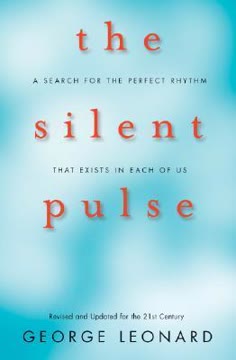
The Silent Pulse receives mixed reviews with a 4.17 rating. Readers appreciate Leonard's exploration of personal and universal rhythms, connecting humans to electromagnetic fields and cosmic patterns. Some find the book enlightening with valuable meditations and perspectives on consciousness, particularly resonating with musicians. Critics note the dense, textbook-like beginning and question claims about mind-over-matter abilities. Many praise its blend of science and metaphysics, calling it a timeless classic still relevant decades after publication. The aikido-centered philosophy particularly appeals to spiritually-minded readers.