Plot Summary
Return to the Machine
After his first journey to the far future, the Time Traveler is plagued by guilt over Weena's death and doubts about the reality of his adventure. Driven by a need for proof and redemption, he resolves to return to the future, meticulously preparing for the journey with supplies and determination. His friend, the Writer, visits, expressing skepticism but also hope. The Traveler, feeling both the weight of his past and the urgency of his mission, sets the Time Machine in motion once more, leaving behind the comfort of his era and plunging into the unknown, intent on finding evidence and perhaps atoning for his failures.
Divergent Futures Unveiled
As the Traveler speeds through time, he witnesses a world that is not as he remembers. The landscape and the sun's behavior are different—seasons vanish, the earth's rotation halts, and the sun is shrouded. He realizes, with mounting horror, that history itself has changed since his first journey. The future is not fixed; his actions have altered the course of events. This revelation shakes his scientific certainty, leaving him adrift in a mutable universe where the very fabric of reality is subject to the choices and interventions of time travelers.
The Dark Night Descends
The Traveler is cast into a world of perpetual night, where the sun is hidden and the land is a cold desert. He encounters Morlocks, now more numerous and emboldened, and is forced to fight for survival. The familiar landmarks are twisted echoes of his previous journey, and the White Sphinx stands as a lonely sentinel. The Traveler's sense of isolation deepens as he realizes he is in a history where the Eloi's world never came to be. The darkness is both literal and existential, as he grapples with the consequences of his interference in time.
Morlocks and Memory
In a desperate struggle, the Traveler battles Morlocks, only to discover that those he harms are not the monsters he remembers but children. He is captured and brought to a strange, illuminated prison. Here, he meets Nebogipfel, a Morlock unlike any other—intelligent, articulate, and curious. Through Nebogipfel, the Traveler is confronted with the moral weight of his actions and the complexity of the Morlocks' society. The encounter forces him to reconsider his prejudices and the simplistic narratives of good and evil that once guided him.
The Cage of Light
The Traveler is held in a featureless, illuminated cell, provided with food and water but denied freedom. Nebogipfel visits, initiating a process of communication and understanding. Through painstaking language lessons, the Traveler and Nebogipfel bridge the gap between their species. The Morlock reveals the existence of the Sphere, a vast artificial world built around the sun, and hints at the advanced civilization that has emerged. The Traveler's captivity becomes a crucible for self-reflection, as he is forced to confront his own limitations and the vastness of the future.
Nebogipfel's Revelation
Nebogipfel explains the true nature of the Sphere and the society it sustains. The Morlocks are no longer the degenerate creatures of the Traveler's first journey but a rational, post-human species dedicated to knowledge and peace. The Traveler learns that his previous violence was against Morlock children, and he is overcome with guilt. Nebogipfel reveals that the Traveler's own account of his first journey altered history, preventing the Eloi-Morlock dystopia and enabling the rise of the Sphere. The Traveler is forced to accept that he is a destroyer and creator of worlds, his actions echoing across the Multiplicity of Histories.
The Sphere and Its People
Nebogipfel leads the Traveler through the Sphere, a world of endless chambers, intelligent machines, and Morlocks who have mastered their biology and society. The Sphere is a utopia of reason, democracy, and technological marvels, where war and want are unknown. The Morlocks reproduce asexually, educate for adaptability, and govern through collective intelligence. The Traveler is both awed and unsettled by their alien perfection, struggling to find his place in a world where the old human passions and divisions have been transcended.
The Multiplicity of Histories
The Traveler and Nebogipfel discuss the Many Worlds Interpretation of quantum mechanics, realizing that every action, every time journey, creates new branches of history. The paradoxes of time travel—causal loops, contradictions—are resolved by the existence of infinite, parallel realities. The Traveler's guilt is tempered by the knowledge that no history is truly erased; all possibilities exist somewhere in the Multiplicity. Yet this realization brings its own existential weight, as the Traveler grapples with the meaning of choice and responsibility in an infinite cosmos.
War Across Time
The Traveler is swept into a future where time travel has become a tool of war. Juggernaut machines, powered by Plattnerite, traverse the centuries, and rival powers seek to rewrite history to their advantage. The Traveler witnesses the devastation of London, the collapse of civilization, and the futility of endless conflict. He is joined by figures from his past—Moses, Filby, and others—each altered by the shifting tides of history. The war across time is both literal and metaphorical, a struggle for meaning in a world where the past is no longer secure.
The Palaeocene Exile
Fleeing the chaos of the time war, the Traveler and Nebogipfel are cast back to the Palaeocene, fifty million years in the past. They are joined by a handful of survivors from the future, and together they struggle to build a new life. The challenges of survival—hunting, shelter, illness—are compounded by the need to forge a community from disparate backgrounds. The Traveler finds purpose in teaching, building, and nurturing hope. The colony becomes a seed for a new humanity, its fate uncertain but its spirit resilient.
The Colony of Survivors
The survivors establish First London, a settlement on the ancient Thames. They adapt to the land, form new relationships, and raise children. The Traveler reflects on the fragility and tenacity of life, the cycles of birth and death, and the possibility of redemption. Nebogipfel continues his experiments, seeking a way to return to the future or to communicate across histories. The community is tested by illness, loss, and the lingering trauma of war, but it endures, embodying the hope that even in the darkest times, humanity can begin again.
White Earth and the Constructors
The Traveler and Nebogipfel are eventually rescued by the Universal Constructors, machine descendants of humanity who have inherited the earth after its final glaciation. The Constructors are immortal, collective intelligences, dedicated to the accumulation and preservation of knowledge. They have transformed the planet, built vast towers, and prepared for journeys beyond the limits of time and space. The Traveler is both guest and specimen, studied and cared for, but also isolated in a world where biological life is a memory.
The Time Ships' Departure
The Constructors invite the Traveler and Nebogipfel to join them on a voyage to the Boundary at the Beginning of Time. Their consciousnesses are transferred into Plattnerite-based forms, and they become part of a fleet of Time Ships, immense vessels capable of traversing the Multiplicity of Histories. As they travel back through cosmic epochs, they witness the birth and death of stars, the formation of galaxies, and the unraveling of space and time. The journey is both physical and metaphysical, a passage through the deepest mysteries of existence.
The Boundary of Creation
The Time Ships reach the Nucleation, the singularity at the origin of space and time. Here, the Constructors unleash their Nonlinearity Engines, traversing not just time but the Multiplicity itself. They seek a universe without boundaries, infinite and eternal, where Mind can flourish without limit. The Traveler experiences the collapse and rebirth of reality, the convergence of all histories, and the emergence of a new cosmos. It is a moment of awe and terror, as the limits of knowledge and being are transcended.
The Infinite Multiplicity
In the new, optimal universe, the Traveler witnesses the fulfillment of the Constructors' quest: a cosmos without beginning or end, filled with infinite stars and infinite possibilities. Mind permeates all matter, consciousness is distributed across the fabric of reality, and the old conflicts of biology and fate are overcome. The Traveler is both infinitesimal and infinite, a mote of awareness in a sea of meaning. The Watchers, beings who traverse the Multiplicity, guide him through this final vision, revealing the ultimate destiny of intelligence.
The Circle Closes
The Traveler is returned to his own time, his body and mind restored. He delivers the Plattnerite to his younger self, ensuring the invention of the Time Machine and the unfolding of all that follows. The circle of causality is closed, but the Multiplicity remains open, with infinite histories branching from every choice. Nebogipfel chooses to journey with the Watchers to higher orders of reality, while the Traveler, changed by his experiences, decides not to return to his old life but to seek redemption in the future he once abandoned.
Redemption in the Vale
The Traveler returns to the world of the Eloi and Morlocks, determined to make amends for his past failures. He rescues Weena, establishes a new community, and works to bridge the divide between the post-human species. Through teaching, farming, and diplomacy, he plants the seeds of a better future, hoping to rekindle the light of reason and compassion. The journey is not without peril, but the Traveler finds meaning in service and connection, embracing the possibility of hope even in a world shaped by loss.
Epilogue: Seeds of Hope
In his final days, the Traveler records his story, sealing it in a Plattnerite container in the hope that it will one day be found. He reflects on the lessons of his journey: the power and peril of knowledge, the necessity of humility, and the enduring value of kindness. The future remains uncertain, but the Traveler's actions have sown the possibility of renewal. The circle of time is both closed and ever-expanding, and the seeds of hope he has planted may yet blossom in worlds and histories beyond imagining.
Characters
The Time Traveler
The protagonist is a brilliant, restless Victorian scientist whose invention of the Time Machine sets in motion a cascade of unintended consequences. Driven by curiosity, guilt, and a longing for redemption, he is both a witness to and an agent of history's transformation. His relationships—with Weena, Nebogipfel, Moses, and others—reveal his capacity for empathy and self-doubt. Over the course of his journeys, he evolves from a detached observer to a man deeply invested in the fate of others, ultimately seeking atonement for the worlds he has altered and destroyed. His arc is one of humility, growth, and the search for meaning in an infinite cosmos.
Nebogipfel
Nebogipfel is a Morlock unlike any other: intelligent, articulate, and deeply curious about both the past and the future. He serves as the Traveler's guide, interlocutor, and sometimes conscience, challenging the protagonist's assumptions and prejudices. Nebogipfel's perspective is shaped by his post-human society, which has transcended many of the limitations and conflicts of biological humanity. He is both compassionate and analytical, capable of great patience but also driven by a relentless quest for understanding. His journey mirrors the Traveler's, as he too seeks purpose and belonging in a universe of endless possibilities.
Weena
Weena is a gentle, childlike member of the Eloi, the future's frail and passive surface dwellers. She represents both the vulnerability and the potential of post-humanity. Her relationship with the Traveler is marked by affection, trust, and ultimately tragedy. Weena's fate is a catalyst for the Traveler's guilt and his determination to make amends. In the revised history, she becomes a symbol of hope and the possibility of renewal, as the Traveler's efforts to save her and her people become central to his redemption.
Moses
Moses is the Traveler's younger incarnation, encountered during a journey to the past. He embodies the protagonist's early ambition, skepticism, and naivety. Their interactions are fraught with tension, as Moses resists the warnings and wisdom of his future self. Through Moses, the narrative explores themes of identity, causality, and the difficulty of self-transformation. He is both a source of frustration and a reminder of the Traveler's own journey from arrogance to humility.
Hilary Bond
Captain Hilary Bond is a soldier from a war-torn future, marked by courage, resilience, and a deep sense of responsibility. She becomes a key figure in the Palaeocene colony, guiding the survivors through hardship and loss. Her relationship with the Traveler is one of mutual respect and, eventually, intimacy. Hilary's scars—both physical and emotional—reflect the trauma of her era, but her leadership and compassion help to forge a new beginning for humanity. She represents the enduring strength of the human spirit in the face of catastrophe.
Filby
Filby is a recurring figure from the Traveler's original circle, reappearing in various histories as a companion, critic, and sometimes comic relief. He embodies the practical, questioning side of human nature, often challenging the Traveler's theories and decisions. Filby's presence grounds the narrative, providing a touchstone to the protagonist's origins and a reminder of the ordinary lives affected by extraordinary events.
The Writer
The Writer is the Traveler's confidant and the first to believe in his account of time travel. He serves as both audience and advocate, recording the story for posterity. In later histories, he becomes a public intellectual, shaping the discourse on the future and the meaning of progress. The Writer's faith in the Traveler and his willingness to imagine new possibilities are crucial to the unfolding of the Multiplicity.
Stubbins
Stubbins is a soldier and former footballer who becomes a pillar of the Palaeocene community. His practicality, kindness, and resilience make him indispensable in the struggle for survival. Stubbins's journey from war to peace, from loss to hope, mirrors the larger arc of the narrative. He represents the best of ordinary humanity: loyalty, adaptability, and the capacity for joy even in adversity.
The Universal Constructors
The Constructors are post-human intelligences, collective minds composed of countless modular parts. They have inherited the earth after the extinction of biological life, dedicating themselves to the accumulation and preservation of knowledge. Their goals are both alien and familiar: to transcend the limitations of matter, to explore the Multiplicity, and to ensure the survival of Mind. The Constructors are both caretakers and experimenters, inviting the Traveler and Nebogipfel to join them in their ultimate quest.
The Watchers
The Watchers are enigmatic entities who traverse the infinite branches of history, observing and sometimes intervening in the affairs of lesser beings. They embody the ultimate potential of intelligence: the ability to move not just through time and space, but across realities. The Watchers serve as both witnesses and catalysts, guiding the Traveler toward understanding and, ultimately, toward the closure of the circle of causality.
Plot Devices
Multiplicity of Histories
The central plot device is the concept of the Multiplicity: every action, every journey through time, creates new branches of history. This resolves the paradoxes of time travel—causal loops, contradictions, and the grandfather paradox—by positing that all possible outcomes exist somewhere in the infinite sheaf of realities. The narrative structure is thus non-linear, with histories diverging and converging, and characters encountering alternate versions of themselves and their worlds. This device allows for both the exploration of consequence and the affirmation of hope: no history is ever truly lost, and redemption is always possible.
Time Travel as Catalyst
The Time Machine is not merely a vehicle but a force that disrupts and reshapes reality. Its use unleashes unintended consequences, from the alteration of the Eloi-Morlock future to the outbreak of time wars and the rise of machine intelligences. The machine's operation is tied to Plattnerite, a mysterious substance that enables the twisting of space and time. The Traveler's journeys become both literal and metaphorical, forcing him to confront the ethical and existential implications of his invention.
Quantum Mechanics and Nonlinearity
The narrative weaves in the Many Worlds Interpretation of quantum mechanics, using it as both explanation and metaphor for the proliferation of histories. The billiards table, the Nonlinearity Engines, and the Watchers' traversal of Imaginary Time all serve to illustrate the fluidity of reality and the interconnectedness of all things. Science is not just a backdrop but a living force, shaping the characters' understanding of themselves and their place in the cosmos.
Foreshadowing and Closure
The story is rich in foreshadowing, with early events and choices reverberating across centuries and realities. The motif of the closed circle—causal loops, the return to origin, the delivery of Plattnerite to the younger self—serves to unify the sprawling narrative. The closure of the circle is both a resolution of paradox and a symbol of redemption, as the Traveler finds meaning not in escape but in return, atonement, and the planting of seeds for the future.
Analysis
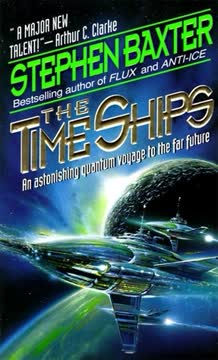
Stephen Baxter's The Time Ships is a profound meditation on the nature of time, causality, and human responsibility. By expanding H.G. Wells's original vision into a multiverse of infinite possibilities, Baxter explores the ethical and existential consequences of technological power. The novel interrogates the myth of progress, showing how every attempt to control or perfect the future unleashes new complexities and dangers. Yet it is also a story of hope: the capacity for change, the possibility of redemption, and the enduring value of compassion. The characters' journeys—from guilt to understanding, from isolation to community—mirror the larger arc of humanity's struggle to find meaning in a universe that is both indifferent and infinitely rich. The use of quantum mechanics and the Multiplicity of Histories is not just a clever plot device but a metaphor for the moral weight of choice: every action matters, every life is significant, and the future is always open. In the end, The Time Ships is a celebration of humility, curiosity, and the courage to face the unknown—a reminder that, even in the face of infinity, the smallest act of kindness can echo across worlds.
Last updated:
Review Summary
The Time Ships is Stephen Baxter's authorized sequel to H.G. Wells's classic, published on its centennial. Readers praise Baxter's successful emulation of Wells's Victorian prose style and voice, though some find it occasionally overblown with exclamation marks. The novel incorporates modern science concepts like quantum mechanics, parallel universes, and Dyson spheres while maintaining the original's feel. Many appreciate the character development, particularly the Time Traveller's relationship with the Morlock scientist Nebogipfel. However, opinions divide on pacing—some find it overlong with excessive scientific exposition, while others enjoy its grand scope and ideas, rating it among Baxter's best works.





