Key Takeaways
1. WWI's Profound Disillusionment
By the end of the war, the emotional and spiritual lives of millions of ordinary Europeans were caught up in a no-man’s-land of doubt and disillusionment.
Shattered illusions. The Great War (1914-1918) profoundly traumatized Europe, dismantling settled beliefs about God, morality, and the existence of good and evil. Soldiers like Tolkien and Lewis emerged physically intact but emotionally scarred, facing a world that seemed to have lost its moral compass. This widespread disillusionment created a fertile ground for new, often destructive, ideologies.
Catalytic moment. The year 1919, when both Tolkien and Lewis returned to Oxford, marked a pivotal point in world history. The harsh terms of the Treaty of Versailles, while often blamed, were less significant than the war itself in unleashing forces that would lead to another global conflict. The psychological damage inflicted by military leaders' fictional narratives of victory, particularly in Germany, fueled a sense of betrayal and resentment.
Lingering anxieties. The post-war period was characterized by a deep emotional vertigo, especially among veterans. The "mirage of a better world" that had sustained men through the monstrous offensives of the trenches proved to be an illusion. This pervasive sense of loss, grief, and the "theft of youth" left millions feeling that a state of emergency had become a permanent condition, making a return to the world of 1914 impossible.
2. The Rise of Totalitarian "Political Religions"
Communism, fascism, Nazism: all produced political systems that drew their strength from their hatreds.
Filling the void. The spiritual and moral vacuum left by the Great War was swiftly filled by militant, secular ideologies that functioned as "political religions." In 1919, the German Workers’ Party (precursor to the Nazis) and Mussolini’s Fascist Party were founded, while Marxism-Leninism gained ground in Russia. These movements offered utopian visions and a sense of belonging, appealing to populations disoriented by war and economic hardship.
Contempt for the West. Despite their differences, these totalitarian states shared a fundamental disdain for the democratic and religious ideals of the West. Their ambitions made another global conflict almost inevitable, driven by a "Will to Power" that sought to dominate and control. Lewis observed that many intellectuals, journalists, and others "needed to believe; they wanted to be duped" by the crudest propaganda, as traditional religious faith evaporated.
Idolization of the state. These new creeds demanded absolute loyalty, often deifying their leaders and justifying extreme violence in pursuit of their goals. Stalin's forced collectivization, Mussolini's empire-building, and Hitler's racial purity laws all exemplified this idolization, leading to mass murder and the systematic dehumanization of individuals. The "acids of modernity" had dissolved traditional bonds, leaving societies vulnerable to these menacing new faiths.
3. Modernism's Assault on Traditional Values
The modern man has ceased to believe in it, but he has not ceased to be credulous, and the need to believe haunts him.
Erosion of meaning. The post-WWI era saw the rise of Modernism in arts and literature, which, alongside new disciplines like Freudian psychoanalysis, rejected traditional understandings of human personality, morality, and religious belief. Freud categorized religion as an "irrational and neurotic desire," while Modernist art emphasized "the absurd, the nonsensical, the illogical and the irrational," reflecting a world where "reality has broken down."
Intellectual despair. This intellectual climate fostered a "cult of despair," where concepts like faith, courage, and virtue were deemed obsolete. Authors like T. S. Eliot, in The Waste Land, lamented the decay of Western civilization, presenting a vision of fragmentation and meaninglessness. Walter Lippmann observed that the "universal element in the soul of man burnt so dimly," as artists struggled to find substitutes for lost religious organizing principles.
Scientism's dominance. Darwinian evolution, social Darwinism, and new discoveries in physics seemed to strip human life of transcendent purpose, reducing it to a random product of biology. This "scientific" account of the world, often presented as the only path to reality, left little room for spiritual or moral truth. Lewis, initially influenced by this view, later recognized its "gigantic assumptions and irreconcilable differences," realizing that it led to a profound sense of emptiness.
4. Tolkien and Lewis: Guardians of Western Heritage
They acquired something that our modern era has mostly abandoned: perspective.
Counter-cultural stance. Tolkien and Lewis, both deeply rooted in classical and medieval literary traditions, actively resisted the prevailing Modernist cynicism and despair. They saw the "feverish experimentation" of contemporary art and literature as a symptom of a deeper cultural sickness, a rejection of the "eternal and universal values" found in older texts. Their commitment was to preserve and revitalize these ideals.
Nourished by antiquity. Their intellectual lives were shaped by ancient myths, epic poetry, and medieval stories of honor, chivalry, sacrifice, and war. Tolkien's love for Beowulf and Norse sagas, and Lewis's devotion to Virgil's Aeneid and medieval romances like Sir Gawain and the Green Knight, provided them with a "clean sea breeze of the centuries" to counter the "great cataract of nonsense" of their own age.
Moral purpose of literature. They believed that literature, especially "deep-rooted tales" and "good fairy-stories," served as a powerful medium for moral teaching. Tolkien insisted that language "filled with the memory of good and evil, is an achievement," while Lewis sought to recover a "long-lost state of mind" that valued romantic love and chivalry. Their scholarship was not merely academic but a deliberate effort to transmit wisdom, virtue, courage, and faith to a generation that had largely abandoned them.
5. Myth and Fantasy as Truth-Bearers
The great instrument of moral good is the imagination.
Imagination's power. Tolkien and Lewis championed myth and fantasy not as escapism, but as profound tools for understanding reality and conveying universal truths. Tolkien's "On Fairy-Stories" argued that fantasy offers Recovery, Escape (from the ugliness of the modern world, not reality), and Consolation (eucatastrophe), pointing to "joy beyond the walls of the world."
Sub-creators. Tolkien believed that humans, as "sub-creators" made in the image of a Maker, naturally engage in myth-making. This imaginative faculty allows us to glimpse deeper truths about God's redemptive purpose, even in pre-Christian myths. Lewis, initially skeptical, came to see myths as "splintered fragments of the true light," preparing the heart for the "true myth" of Christianity.
Re-enchanting the world. In an age of "disenchantment" driven by materialism and scientism, they used fantasy to re-enchant the world, inviting readers to see nature and human experience with fresh eyes. Their stories, filled with wonder, adventure, and peril, addressed fundamental human desires for meaning, beauty, and love, challenging the notion that the imaginative mind had nothing to say to the "real" world of facts and rationality.
6. The Inklings: A Fellowship of Resistance
The little knots of Friends who turn their backs on the ‘World’ are those who really transform it.
Community of purpose. The Inklings, a literary group founded by Tolkien and Lewis, became a vital "beachhead of resistance" against the prevailing intellectual and moral currents of their time. Meeting weekly, they shared and critiqued their works-in-progress, fostering a unique environment of "unbiased judgment" and mutual encouragement.
Wartime camaraderie. Composed largely of WWI veterans, the Inklings provided a haven of sanity and intellectual vigor amidst the anxieties and terrors of WWII. Their discussions, often ranging from literature and theology to "the state of the nation," fortified them against the "great fog of nonsense" and the "moral cowardice" they observed in wider society.
Subversive intent. Far from being an ivory tower club, the Inklings aimed to "redirect the whole current of contemporary art and life." They believed that by creating imaginative literature rooted in Christian values, they could "smuggle" profound truths into people's minds, challenging the materialistic, nihilistic, and totalitarian outlooks that threatened Western civilization. Their friendship, Lewis noted, was "the strongest safeguard against complete servitude."
7. WWII's Shadow on Their Masterpieces
The darkness of the present days has had some effect on it.
War's pervasive influence. The Second World War, with its unprecedented scale of destruction and moral horror, profoundly shaped the imaginative works of Tolkien and Lewis. The "crisis" and "darkness" of the era, including the fear of invasion and the reality of aerial bombings, directly influenced the tone and themes of The Lord of the Rings, The Ransom Trilogy, The Screwtape Letters, and The Chronicles of Narnia.
Themes of radical evil. The rise of totalitarian regimes and their "Will to Power" found echoes in their fictional villains: Sauron, the White Witch, and the N.I.C.E. The corrupting nature of power, the temptation to compromise with evil, and the necessity of unwavering resistance became central motifs. Tolkien's description of Mordor, a "blasted industrial hell," resonated with the devastated landscapes of war-torn Europe.
Personal impact. Both authors, having experienced WWI, understood the "utter, stupid waste of war" and the "animal horror" of combat. These memories, combined with the ongoing anxieties of WWII, imbued their battle scenes and depictions of suffering with a stark realism. Tolkien's Leaf by Niggle reflected his personal fears of death and the unfinished nature of his great work amidst the war's "darkening horizons."
8. Critique of Scientism and Dehumanization
Man’s final conquest has proved to be the abolition of Man.
Science perverted. Lewis, particularly in The Ransom Trilogy and The Abolition of Man, launched a trenchant critique against "scientism"—the belief that science alone provides answers to life's deepest questions. He warned that when unhinged from a traditional moral code, science and technology could be perverted to serve dictatorial aims, leading to the dehumanization of individuals and the creation of totalitarian societies.
Social engineering. That Hideous Strength vividly portrays a scientific elite (N.I.C.E.) using "scientific planning" and "irresistible scientific technique" for social engineering, echoing the eugenics movement and the practices of Nazi Germany and Soviet communism. Lewis argued that such efforts, aimed at "conquering nature" and achieving human perfectibility, ultimately led to the "abolition of Man" by stripping humanity of pity, happiness, and freedom.
Moral vacuum. Lewis contended that modern educational methods, by rejecting a universal Moral Law (the "Tao"), were producing "men without chests"—individuals lacking the moral qualities necessary for a virtuous life. This moral agnosticism, he believed, made people "easier prey to the propagandist" and laid the groundwork for totalitarianism, where "the power of some men to make other men what they please" became a terrifying reality.
9. The Heroism of the Ordinary
There is a seed of courage hidden (often deeply, it is true) in the heart of the fattest and most timid hobbit, waiting for some final and desperate danger to make it grow.
Unlikely heroes. Tolkien, deeply influenced by his WWI experience, celebrated the heroism of "quite small people against impossible odds." His hobbits, modeled on the ordinary British soldiers he fought alongside—shopkeepers, clerks, farmers—embody a courage that is not grand or epic, but rather a stubborn, selfless dedication to duty in the face of overwhelming evil.
Internal battles. Bilbo Baggins's journey in The Hobbit and Frodo and Sam's quest in The Lord of the Rings are not just external adventures but internal struggles against fear, temptation, and despair. Their bravery often unfolds reluctantly, in moments of solitude and moral choice, demonstrating that true heroism lies in choosing the good even when it means personal sacrifice and no hope of glory.
Countering cynicism. This "theory of courage" directly challenged the anti-heroic and cynical sentiments prevalent after WWI. Tolkien's stories offered a powerful counter-narrative, reminding readers that even in the darkest times, ordinary individuals possess the capacity for immense valor and fortitude. This ethos resonated deeply with the British people's resilience during WWII, as civilians and young airmen displayed extraordinary courage.
10. Friendship as a Moral Anchor
Life—natural life—has no better gift to give. Who could have deserved it?
Mutual fortification. The deep friendship between Tolkien and Lewis, and within the wider Inklings group, served as a crucial moral and intellectual anchor during the tumultuous war years. Their bond, forged in shared experiences of loss and a common vision, provided mutual support, intellectual sparring, and a haven of sanity against the era's pervasive cynicism.
School of virtue. Lewis's reflections on friendship in The Four Loves are deeply autobiographical, describing how like-minded friends, drawn together by a common pursuit of truth and beauty, can "bring out all that is best, wisest, or funniest in all the others." This community, he argued, became a "school of virtue and wisdom and love," fortifying each member against the "prejudices, hatreds, and conventional wisdom of the age."
Resistance to totalitarianism. Lewis saw friendship as inherently subversive to authoritarianism, which "frowns upon friendship because it creates a rival to their authority." The Inklings, as a "sort of secession, even a rebellion," offered "the strongest safeguard against complete servitude," demonstrating how a community of freedom-loving friends could transform the world by upholding ideals of bravery, self-sacrifice, and moral clarity.
11. Christianity as the "True Myth"
Legend and History have met and fused.
Reconciling reason and imagination. Tolkien's pivotal conversation with Lewis on Addison's Walk helped Lewis reconcile his intellectual skepticism with his profound imaginative longings. Tolkien explained that ancient myths, with their recurring patterns of a dying and reborn god, were "splintered fragments of the true light," intimations of God's redemptive purpose. Christianity, he argued, was the "true myth"—the myth that became fact in the historical person of Jesus.
The problem of evil explained. Lewis's conversion to Christianity provided a framework for understanding the problem of evil, a central theme in his wartime writings like The Problem of Pain and The Screwtape Letters. He argued that evil stems from man's free will and rebellion against God's Moral Law, and that pain, paradoxically, can serve as a "flag of truth within the fortress of a rebel soul," shattering self-absorption and leading to spiritual awakening.
Redemptive purpose. Both authors imbued their stories with a distinctly Christian sensibility, emphasizing self-denial, humility, and the rejection of worldly power. Tolkien's concept of "eucatastrophe"—the sudden, miraculous reversal of catastrophe—reflects the biblical theme of grace and redemption. Their works offered a powerful counter-narrative to the despair of their age, pointing towards a cosmic struggle where light ultimately triumphs over darkness.
12. Enduring Legacy: Re-enchanting a Disfigured World
There is light and high beauty forever beyond its reach.
Universal appeal. The novels of Tolkien and Lewis, born from the crucible of two world wars and a deep intellectual conviction, transcended their immediate context to become universal works of profound moral and spiritual significance. They demonstrated that fantasy, children's literature, and satire could be powerful vehicles for exploring fundamental questions about the human condition, good and evil, and the search for meaning.
Cultural replenishment. In an era marked by the "near-death of the humanities" and a fading "collective memory" of Western civilization's literary heritage, Tolkien and Lewis actively sought to replenish this cultural capital. Their works, rooted in classical, medieval, and Christian traditions, offered readers a "deeper pondering and insight into central aspects of our actual lives," whetting their sensitivity to honor, courage, aspiration, and beauty.
Hope in darkness. Despite living in a "Land of Shadow" during the darkest hours of the 20th century, their stories radiate a "sublime quality" and "joy beyond the walls of the world." They remind us that even when the world is "dark and disfigured," courage and faith can prevail, offering a "bright glimpse of the far-off country" and the enduring light that lies beyond the reach of any shadow.
Last updated:
Review Summary
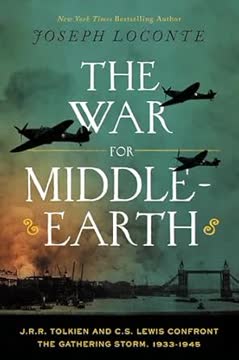
The War for Middle-earth explores how J.R.R. Tolkien and C.S. Lewis's experiences in WWI and their lives during WWII shaped their famous works, The Lord of the Rings and The Chronicles of Narnia. Readers praise Loconte's deep dive into their friendship, the moral and cultural influences on their writing, and how they countered totalitarianism through storytelling. The extensively researched book examines the interwar years and how these authors used fantasy to promote courage, virtue, and hope against nihilism and modernism's failures. Most found it accessible, thought-provoking, and inspiring for fans of both authors.