Key Takeaways
1. Acknowledge the Pervasive Exhaustion and Its Cultural Roots
Every woman I know is tired.
Universal struggle. Exhaustion is not an individual failing but a widespread reality for women across all life stages and roles—mothers, students, professionals, and empty nesters alike. This fatigue manifests in various ways, from quiet tears and deep sighs to wistful social media scrolling and the dread of "Sunday Scaries." It's a pervasive issue that often leads to jokes about sleeping when we're dead, perpetuating a cycle of unaddressed weariness.
Inherited burden. This deep-seated exhaustion is often inherited, passed down through generations, and normalized as an unavoidable part of being a woman. The author shares her personal experience of growing up with a sleepless mother and initially accepting her own insomnia as a "birthright," attempting to "redeem the time" by working or planning. This mindset, however, only led to deeper fatigue, eventually manifesting as anxiety-induced insomnia and panic attacks.
Cultural problem. Research confirms a "gender exhaustion gap," with women nearly 20% more likely to experience fatigue and burnout than men, largely due to assuming responsibility in multiple spheres. This isn't due to weakness but a cultural problem that idolizes busyness, rewards pushing through, and denies God-given boundaries. Recognizing this collective struggle is the first step to shedding shame and fighting for the deeper rest God promises.
2. Identify Your Specific Type of Fatigue for True Healing
The pain of your fatigue, the saturation point where it manifests itself as tension in your life, is telling a bigger truth and is something we need to pay attention to and address.
Beyond surface symptoms. True healing from exhaustion requires understanding its root cause, as fatigue often manifests in one area while originating in another. A one-size-fits-all approach to rest often fails because we are tired in incredibly different ways, leading to continued weariness even after attempts at rest like vacations or naps. The book outlines four distinct types of exhaustion:
- Spiritual Exhaustion: Weariness from striving to earn God's love, spiritual abuse, or a "have-to" mentality about faith.
- Physical Exhaustion: Chronic tiredness from denying the body's basic needs for sleep, movement, and proper nutrition.
- Mental Exhaustion: Overwhelm from constant stimulation, multitasking, and carrying an excessive mental load.
- Emotional Exhaustion: Drained by unprocessed feelings, trauma, or the energy spent suppressing emotions.
Interconnectedness of fatigue. These types of exhaustion are interconnected; for instance, physical tiredness can exacerbate emotional instability, and spiritual striving can manifest as mental overload. The author's own experience with anxiety-induced insomnia revealed a deeper spiritual exhaustion rooted in a misunderstanding of grace. Identifying the primary source of fatigue allows for targeted, effective strategies rather than superficial fixes.
Personalized approach. Understanding your specific fatigue type is crucial because what truly restores one person might not work for another. For example, a physically exhausted person might need more sleep, while an emotionally drained individual might need to process past trauma. The goal is to move beyond generic advice and tailor rest practices to your unique needs, recognizing that your body, mind, and spirit require different forms of renewal.
3. Dismantle the Lies That Keep You From Rest
Jesus Christ did not die on the cross for us to live a life of punitive exhaustion.
Challenging false beliefs. Many women resist rest due to deeply ingrained lies that contradict God's design for their lives. These untruths prevent them from receiving the gift of rest, perpetuating a cycle of weariness. The book identifies five common lies:
- "I can't rest until the work is done." This ignores God's original design where rest (evening) precedes work (morning).
- "Rest will be boring." This often stems from a misunderstanding of rest as passive or lazy, or a preference for striving over receiving worth.
- "No one else around me will rest." Fear of being misunderstood or seen as lazy, even in Christian circles.
- "It's going to cost too much." Believing that rest means sacrificing approval, worldly success, or identity.
- "My circumstances won't allow for it." Feeling trapped by life's demands and doubting God's ability to provide rest in any season.
God's design for rest. From creation, God established rest as foundational, not earned. The Hebrew word rachaph (hovering) in Genesis 1:2 suggests the Holy Spirit was "relaxing" during creation, and God sequenced "evening and then morning," placing rest before work. This divine pattern challenges the notion that rest must be earned after all tasks are complete, affirming it as a gift to be received first.
Rest as a trade, not a cost. While embracing rest may involve perceived "costs" like the approval of others or worldly striving, these are actually trades for far greater gifts. Rest can lead to:
- A deeper sense of being known and loved by God.
- Experience of eternal abundance over worldly striving.
- Wild peace and contentment over being "most counted on."
- A life that embraces boundaries over one pushed to its limits.
By reframing these "costs" as opportunities for profound gain, women can overcome their reluctance and embrace God's invitation to a life of freedom and peace.
4. Embrace Spiritual Rest by Knowing Your Place in God's Kingdom
Rest is not an optional add-on in God’s kingdom; it’s the place where we have always belonged.
Beyond obligation. Spiritual exhaustion arises from trading God's care for obligation, grace for earning love, and abundance for merely "getting through." The antidote is understanding our true place as daughters of God, not just workers or leaders. Daughters don't have to earn their place, strive for relevance, or work for rest; they receive it as an inheritance. This shifts our perspective from "This is for You" (God) to "This is for me" (receiving God's love).
Placed in rest. From the very beginning, humanity was "placed in rest." The Hebrew word yanach in Genesis 2:15, translated as "put," also means "to bestow, lay down, and rest." This signifies that rest is not a consequence of the Fall but an inherent part of God's original design and a gift. Understanding this foundational truth helps us shed the shame associated with needing rest and recognize it as a divine provision.
Practicing in wilderness. The Israelites' forty-year journey through the wilderness, a journey meant to take days, was a space for them to practice rest and trust God's provision amidst hardship. Similarly, our "now-and-not-yet" lives on earth, with their struggles and limitations, are opportunities to build the "muscles of rest." This means:
- Acknowledging our limitations and boundaries.
- Cultivating a sustainable pace rather than a breakneck speed.
- Accepting God's invitation to abundance, not reactive defeat.
- Blessing our current season, even if it's not what we anticipated, as exactly where God intends us to be.
5. Honor Your Physical Body's Limits and Practice the "Ministry of Absence"
Our bodies live in the kingdom, but the default pace of this world is killing us.
Kingdom mindset for the body. Just as our souls exist in God's kingdom, so do our physical bodies. This means applying kingdom truths—God's kindness, nearness, and grace—to our physical well-being. If we believe in eternity, we don't need to squeeze every second out of this life or push past physical boundaries to "make the most of it." Instead, we can align our physical pace with God's will, recognizing that our bodies are home base until eternity.
Rejecting constant consent. We often unconsciously consent to an unsustainable pace, believing we "can't just quit" or stop showing up. This includes:
- Feeling obligated to be reachable 24/7 via technology.
- Saying yes to every invitation out of people-pleasing or fear of missing out (FOMO).
- Insisting on doing everything ourselves, believing we are the only trustworthy ones.
However, we have the authority and autonomy to set physical limits and boundaries. Saying "no" is not selfish; it's an act of stewarding the life God has given us, enabling us to serve, love, and lead well for the long haul.
The ministry of absence. Sometimes, the most impactful thing we can do is to step back and allow God to work. The "ministry of absence" means trusting that God can operate even when we are not physically present or actively "fixing" things. This was exemplified by Jesus, who often withdrew from crowds to pray, and by the author's husband, who encouraged a friend to pray for himself rather than immediately intervening. Practicing absence allows us to:
- Let others step up and take responsibility.
- Avoid over-responsibility and the belief that everything depends on us.
- Deepen our dependence on God's presence and power.
This isn't negligence but a worshipful act of trusting God's sovereignty and honoring our own God-given limitations.
6. Reclaim Mental Peace by Counteracting Overstimulation and Over-Responsibility
Simply put, we are not the problem because we can’t handle constant mental exertion in every setting, all day. None of us are meant to.
Overstimulated brains. Our brains are constantly bombarded with information and stimuli, leading to a default state of overwhelm and mental exhaustion. This isn't a personal failing but a consequence of a culture that has largely robbed us of quiet, undistracted moments. The metaphor of a "jar of dirt and water shaken aggressively" illustrates how our minds need time to settle when we intentionally slow down. This overstimulation drains energy, making it difficult to think clearly or find peace.
Multitasking is a myth. The belief that we can effectively do multiple things at once is a persistent myth. What we actually do is rapidly shift attention, leading to:
- Reduced focus and attention quality.
- Increased mental exertion and "brain damage" over time.
- A constant state of divided attention that leaves us mentally exhausted.
Scripture encourages singular focus, reminding us to "fix your gaze directly before you" (Proverbs 4:25) and "fix your thoughts on Jesus" (Hebrews 3:1). Fighting multitasking requires clarifying our purposes and unleashing passionate focus on what truly matters.
Not mine to carry. Mental exhaustion is often fueled by over-responsibility, the belief that we must solve, fix, and sort out everything around us. This codependent tendency, often rewarded by culture, leads to a crushing mental load. Jesus, despite His mission to save humanity, frequently withdrew from people, demonstrating that it's possible to care deeply without carrying every burden. Practicing "benevolent detachment"—releasing everyone and everything to God—is crucial for mental peace. This involves:
- Discerning what is truly ours to hold versus what belongs to God or others.
- Using prayer as a primary response to worry and concern.
- Setting boundaries on information intake and communication.
7. Process Your Emotions with Compassionate Curiosity to Avoid Burnout
You don’t shoot the messenger.
Emotions as messengers. Many women are emotionally exhausted from ignoring, suppressing, or mindlessly obeying their feelings. The book challenges the harmful half-truth that "feelings are liars," instead proposing that emotions are messengers—electrochemical signals alerting us to our perceptions of the world. Suppressing these messengers, like the "shove them down" mentality, ultimately backfires, leading to more intense feelings and emotional burnout.
The body keeps the score. Unprocessed emotions don't simply disappear; they embed themselves in our souls and bodies, leading to physical and mental fatigue. Chronic stress, grief, sadness, and anger can manifest as inflammation, tension, and various health issues. Our bodies need outlets to complete the stress cycle, such as:
- Crying (releases oxytocin, relieving pain and stress).
- Laughter, movement (running, dancing), or creative expression.
- Physical comfort and safe touch.
Denying these natural releases leaves us exhausted and disconnected from our physical selves, hindering true healing.
Compassionate curiosity. A healthy approach to emotions involves "compassionate curiosity," which means noticing, naming, and discerning how to move forward with God. This is rooted in God's own compassionate and merciful nature, as He is never dismissive of our feelings. The process involves:
- Notice: How does the emotion appear in your body? Where might it be coming from?
- Name: Articulate the feeling as specifically as possible, using metaphors if needed.
- Discern: What is God saying about this feeling? Does it require confession, comfort, action, or release?
This practice allows us to engage with our emotions without judgment, transforming them from burdens into prompts for deeper alignment with God and healthier responses.
8. Reset Your Rhythms of Rest, Starting with Sabbath
Jesus said it best: The Sabbath is for us.
Rhythms over schedules. To fight exhaustion effectively, we need to embrace rhythms of rest rather than rigid schedules. Schedules are time-based and often lead to failure, while rhythms are fluid patterns that provide structure and space to breathe. The author's experience recovering from childbirth taught her the power of patiently adding one healthy rhythm at a time, celebrating small wins, and building routines that genuinely make sense for her well-being.
Sabbath as a gift. The Sabbath, often viewed as an obligation or a test, is fundamentally a gift from God designed to combat spiritual, physical, mental, and emotional fatigue. Jesus Himself affirmed, "The Sabbath was made to serve us; we weren’t made to serve the Sabbath." It's an invitation to trust God by laying aside work and striving, fostering intimacy and reliance on Him. Developing a Sabbath rhythm requires:
- Intentionality: Choosing a day and planning activities (or lack thereof) that genuinely lead to rest and enjoyment of God.
- Flexibility: Recognizing that what works for Sabbath will vary by person and season.
- Communication: Clearly communicating your Sabbath boundaries to family and community.
Tailoring your Sabbath. A truly restorative Sabbath is personalized to address your specific fatigue types:
- Spiritual: Focus on enjoying God through prayer, worship, or simply being in His presence without striving.
- Physical: Prioritize physical rest, naps, light movement, and delegating chores like laundry or dishes.
- Mental: Disengage from planning, strategizing, and digital stimulation; embrace quiet and release mental burdens.
- Emotional: Engage in lighthearted community, creative outlets, or safe processing, avoiding activities that heighten emotional stress.
The journey to a sustainable Sabbath will involve trial and error, but the consistent practice of returning to rest, even after falling out of rhythm, is crucial for long-term healing and freedom from exhaustion.
9. Be a Catalyst to Change the Culture of Exhaustion
One woman fighting fatigue is beautiful, but a whole community shifting the way they talk, move, serve, and live—that will change the world.
Collective impact. While individual efforts to embrace rest are vital, true transformation occurs when entire communities shift their approach to exhaustion. The author encourages readers to be catalysts for change, starting by inviting friends and family into conversations about the book's themes. This collective movement can dismantle the pervasive culture of busyness and normalize God-given rest.
Changing the language. Our words shape our world, and the language we use about capacity, energy, and rest profoundly impacts our communities. To change the culture, we must consciously shift our language:
- No more glorifying busy or tired: Avoid humblebragging about packed schedules or lack of sleep; instead, show compassion for others' fatigue.
- No more self-identifying as people pleasers: Recognize people-pleasing as an idol-worship issue, not a positive trait.
- No more apologizing for rest or boundaries: Set limits without guilt, affirming that needing rest is not a flaw.
- No more glossing over exhaustion: Be honest with trusted friends about your true level of fatigue, fostering genuine connection and support.
This courageous shift in language creates an atmosphere where others feel empowered to explore realistic rest for themselves.
Changing the pace. Beyond language, communities must collectively adjust their pace to foster sustainable living. This involves:
- Allowing organic growth: Resisting the urge to over-program or rush initiatives, giving people and ministries time to develop naturally.
- Prioritizing margin: Building in intentional breaks, "Sabbath Sundays," and periods of rest for staff and volunteers.
- Normalizing "no": Creating an environment where declining opportunities is accepted and understood, rather than met with judgment or pressure.
The author's church, Bright City, exemplifies this by maintaining a slower pace, even if it means saying no to good ideas, to ensure long-term health and prevent burnout within the community. This intentional slowing down allows for deeper connection, genuine participation, and a more sustainable expression of faith and service.
Last updated:
Review Summary
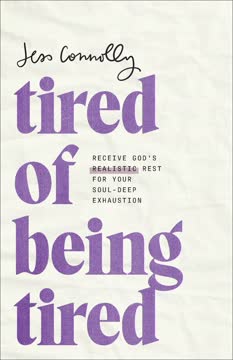
Tired of Being Tired receives overwhelmingly positive reviews (4.46/5 stars), with readers praising its practical, grace-filled approach to addressing physical, spiritual, mental, and emotional exhaustion. Reviewers appreciate that it offers realistic solutions without adding more burdens, includes helpful reflection questions and a fatigue quiz, and resonates across different life stages—including singles, pastors, and non-mothers. Many plan to reread it with journals to implement its actionable insights. The audiobook narrated by the author is highly recommended. A few critics found it overly personal or exhausting to read.
Similar Books