

Key Takeaways
Study ordinary life before borrowing another comedian's material
Look before you invent. Buck Henry argued that writers lose material when they retreat into insulated worlds. Long stretches in limousines, he warned, can make a writer forget what taxis, buses, and ordinary life feel like. Stephen Merchant and Ricky Gervais drew The Office from temporary jobs, where small power struggles and awkward coworkers supplied detail no sitcom formula could invent. Larry Wilmore urged young writers to ask what their families and communities actually did, rather than recycling jokes from other shows.
Experience needs attention. Living through an event is not enough. Writers must notice behavior, language, and contradiction, then choose the telling detail. For Mike Sacks's interviewees, observation is not research kept in notebooks. It is a habit of staying curious about people beyond the entertainment business.
What's striking is how closely this advice resembles ethnographic fieldwork: watch people in their own settings before explaining them. That approach produces specificity, but it also demands humility. A writer's social position shapes what seems ordinary, strange, or funny, so observation is never neutral. The strongest material often comes not from collecting eccentric people as specimens, but from noticing how the observer is implicated in the scene. The book's examples suggest a useful discipline: record concrete behavior first, then decide what it means.
Build jokes from a character's wants, not a quota of punchlines
Character generates comedy. Dan Mazer says jokes cannot carry a story without a convincing person at its center. The Ali G and Borat characters worked because Sacha Baron Cohen and Mazer built detailed histories, habits, and beliefs for them. The interviews were heavily prepared, even when they looked spontaneous. That background let Cohen respond in character when a conversation went somewhere unexpected.
Power can turn. Allison Silverman uses the term status shift for a change in who controls a scene. A confident character who suddenly loses authority can be funnier than a powerless person being mocked. David Brent in The Office is compelling not because he is conventionally likable, but because his hunger for approval collides with his inability to read a room. A character's desires, blind spots, and choices give jokes somewhere to come from.
A character is a causal engine, not merely a container for gags. Social psychology helps explain the appeal of a status reversal: audiences track who has control, then enjoy the moment that expectation breaks. But status alone does not guarantee comedy. A reversal needs recognizable motives, or it becomes arbitrary humiliation. The distinction matters ethically as well as artistically. A fully observed character can expose vanity and self-deception without reducing a person to a single trait.
Let awkward silence carry meaning a punchline would flatten
Silence is playable. The Office grew out of a documentary style that made pauses feel like real time rather than empty space. Merchant and Gervais even wrote extended silences into the scripts, resisting actors' natural urge to fill every gap. When Tim and Dawn speak privately behind glass, the audience sees but cannot hear them. The missing dialogue lets viewers imagine the intimacy for themselves.
Small reactions matter. Buck Henry said a writer must look and listen; sometimes a face or a pause reveals more than another line. Paul Feig used expressions as punchlines in Freaks and Geeks, where awkward teenagers often cannot articulate what they feel. The underlying craft is restraint: give viewers enough information to understand the emotional stakes, then let them complete the moment.
Silence recruits the audience as an interpreter. In ordinary conversation, pauses, glances, and withheld responses carry social information, so a restrained scene can feel more intimate than a polished speech. This is also a form of trust: the work does not explain every emotion on its behalf. The risk is that ambiguity can become mere vagueness. Silence earns its force when the characters' relationship and the situation are clear enough for viewers to make a meaningful inference.
Make the format constrain the joke and involve the audience
Form changes meaning. Al Jaffee's Mad fold-in began as a mischievous alternative to magazine foldouts. A reader folded the page inward, merging two parts of an image into a new picture and punchline. The device made the reader participate rather than simply receive the gag. Jaffee spent weeks designing each one and checked that the images aligned when folded.
Limits can create opportunity. The documentary camera in The Office magnified small gestures because the viewer assumed every filmed moment had been selected for a reason. A comic strip, a live show, an animated short, and a sitcom each offer different tools and restrictions. The lesson is not to decorate a joke with a format, but to let the format shape what can happen and what the audience is asked to do.
This is an instance of an affordance: a feature of a medium that makes certain actions possible and others difficult. The fold-in is memorable because its physical mechanism is also its argument. The reader must complete the transformation. Similar choices can make form feel necessary rather than ornamental. Still, novelty has a short shelf life. A format trick sustains attention only when it clarifies or deepens the idea, not when participation itself is the entire payoff.
Anchor absurdity in a world viewers can understand
Give chaos a counterweight. Harold Ramis described a useful contrast: place an unusual person in an ordinary world, or an ordinary person in an unusual one. The social rules provide something for the absurdity to push against. In Caddyshack, the country club's rigid class order gave the eccentric characters a stable target and context.
Clarity protects complexity. Ramis also regretted that audiences could lose track of character relationships in his Catch-22 adaptation because he knew the novel too well to notice what newcomers might miss. Mitch Hurwitz took the opposite risk with Arrested Development, packing interlocking plots and recurring clues into unusually short episodes. These examples point to the same craft problem: complexity can reward close attention, but the viewer still needs enough orientation to follow the story.
A stable frame reduces the mental work required to understand a comic disruption. Viewers can enjoy an unexpected event more when they know which social rule, relationship, or expectation it breaks. That does not mean every comedy needs a conventional plot. It means the work should distinguish deliberate mystery from accidental confusion. Complexity is most satisfying when it offers a path through the details, rather than demanding that audiences reconstruct basic information the story has not made legible.
Rewrite until readers stop seeing the labor
Drafting and editing differ. Merrill Markoe advised writers to let a first draft be bad, then return with enough distance to recognize what is unnecessary. She repeatedly rewrote her work, sometimes removing sections she liked because they weakened the whole piece. David Sedaris described producing a long first draft, then carving a story out of it through successive revisions.
Use your ears. Sedaris learned to read work aloud, pencil in hand, and mark repetition, strained phrasing, or places where listeners needed room to laugh. Dave Barry also found that jokes stopped feeling funny after days of revision, making it hard to know whether a line had improved. The practical aim is not endless polishing. It is enough distance to hear the work as a reader or audience member might.
Revision is a change in perception as much as a change in wording. Distance interrupts the writer's familiarity with a draft, while reading aloud exposes rhythm and breath that silent reading can conceal. Audience response adds evidence, but it is not a perfect measure: a laugh can reward an easy line while missing a subtler point. The best editing uses several tests, including clarity, sound, and structural necessity, without treating immediate applause as the sole definition of success.
Choose the target before choosing the taboo
Context decides the target. Stephen Merchant distinguished exploring an uncomfortable subject from directing a joke at the people harmed by it. Dan Mazer said Borat's apparent ignorance was designed to reveal the assumptions of interview subjects and the societies they represented. The satire was not simply a license to shock; the target had to be legible.
Pain can have a purpose. Todd Hanson's Onion work often used bleak humor to confront grief, violence, or public crisis. He described the importance of knowing what a joke attacks. Al Jaffee traced humor to the absurd restrictions and anti-Semitism he saw growing up in Lithuania, where ridicule offered a way to respond to powerlessness. These examples treat humor as more than amusement: it can expose hypocrisy, but careless targeting can reproduce it.
A joke's ethical meaning depends on who is made ridiculous, who has power, and what assumptions the audience is asked to share. Satire can make prejudice visible by staging it, but audiences do not always infer the intended target. That uncertainty is not a reason to ban difficult subjects. It is a reason to make the structure of the joke do real work, so the critique is clearer than the harm it risks repeating.
Match the joke to its performer, medium, and audience
The page is not the performance. Harold Ramis said Bill Murray improvised much of his work in Caddyshack, while Rodney Dangerfield relied on precisely worded jokes and timing. The same writing approach would not serve both performers. Ramis also used editing to shape improvised material, keeping the moments that built and discarding those that did not.
Production changes perception. The Office used silence and a close documentary camera; M A S H was altered by the laugh track CBS required, which Larry Gelbart believed changed how viewers perceived its characters. Animation gave writers like Robert Smigel room for images that would be harder to stage with live actors. A joke must survive its full route from page to performer to edit to audience.
Comedy is embodied and situated. A line's effect depends on voice, pace, gesture, framing, and the audience's expectations, so a script cannot be judged only as text. This is why rehearsal and editing are not secondary chores; they are part of composition. Yet adaptation has limits. A performer may improve a line, but improvisation can also blur tone or structure. Matching method to talent means knowing when to invite spontaneity and when exact wording is the joke.
Build a career through practice, community, and persistence, not guarantees
Make work before permission. Todd Hanson spent years contributing to The Onion for little pay before it became a livelihood. Its headline meetings could consider hundreds of ideas for only a handful of selections. His advice was to create an outlet of your own rather than wait for a gatekeeper to validate the ambition. Other contributors built careers through improv groups, sample scripts, magazine submissions, or personal referrals.
Skill meets circumstance. Ken Levine urged aspiring sitcom writers to master writing before pitching. Stephen Merchant's partnership with Ricky Gervais began with a short film made for practical reasons, then developed into The Office. The interviews repeatedly acknowledge timing, collaborators, access, and luck alongside talent. Persistence improves a writer's chances, but the book does not promise that hard work alone will produce a job.
Creative careers combine individual skill with institutions that distribute attention and opportunity. Repeated practice can improve craft, while a community supplies collaborators, feedback, and routes to work. But the stories also resist a simple meritocracy: access, timing, and industry economics shape whose talent is seen. The useful response is neither romantic certainty nor cynicism. Build a body of work, learn the conventions of the market, and create relationships without mistaking rejection for a precise measurement of ability.
Analysis
This collection resists the tidy promise that comedy can be reduced to a dependable formula. Its strongest lesson emerges from disagreement. Some interviewees treat comic instinct as an inborn gift; others describe improv, revision, close observation, story structure, and group critique as teachable disciplines. The disagreement is productive. Talent may affect how easily a writer generates material, but the interviews show that professional work also depends on selection, craft, collaboration, and the ability to revise without protecting every favorite line.
The book's range makes comedy appear less like a genre than a set of decisions. Buck Henry and Stephen Merchant build from observed behavior. Al Jaffee turns a physical fold into a participatory joke. Larry Gelbart uses dramatic seriousness to make comedy about war carry emotional weight. Jack Handey finds surprise in a calm voice and an abrupt turn. These are not interchangeable techniques. Each depends on the medium, performer, audience, and target.
The deeper tension is between spontaneity and control. The reader sees jokes that appear effortless, but the interviews reveal rehearsal, rejected drafts, elaborate character histories, editorial judgment, and production choices. Conversely, excessive control can sterilize a scene, while unfiltered improvisation can lose shape. Good comedy often depends on preparing carefully enough to recognize the moment when a rough edge should remain.
The book is also an industry portrait. Writers describe years of unpaid work, cancellations, executive notes, low acceptance rates, and the unpredictable advantages of a collaborator or a timely idea. Its advice therefore works best as a map of practices, not a promise of success. The practical standard is demanding but clear: observe closely, find a distinctive point of view, make the story understandable, revise for precision, and learn what the chosen medium can do. Humor is neither merely instinct nor merely technique. It is a crafted encounter between a particular mind and an audience capable of recognizing the world from a new angle.
Review Summary
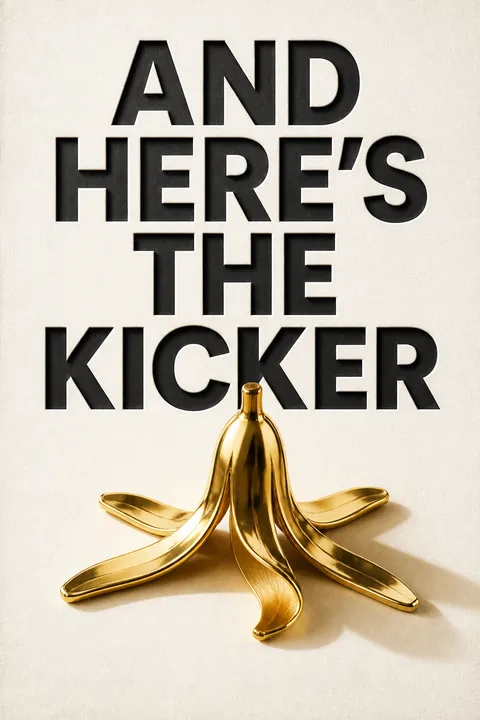
And Here's the Kicker offers insightful interviews with comedy writers, providing a behind-the-scenes look at the craft. Readers appreciate the diverse range of comedic voices and valuable advice for aspiring writers. The book explores the creative process, career paths, and personal experiences of renowned humorists. While some found certain interviews more engaging than others, many praised the book's depth and its ability to illuminate the often-mysterious world of comedy writing. Criticisms include a lack of diversity among interviewees and occasional repetitiveness in content.
People Also Read

Glossary
status shift
A change in scene powerA reversal in who controls a comic scene. A person who appeared dominant may lose authority, while someone previously dependent gains leverage. Allison Silverman uses the term to describe a source of comic movement, such as a host claiming expertise and then being challenged by someone who exposes the limits of that claim.
fold-in
A fold-revealed visual jokeA Mad magazine feature created by Al Jaffee in which a printed image and its wording change when the page is folded inward. Separate visual elements combine to reveal a new picture or punchline. Readers must physically manipulate the page, making the joke a small puzzle as well as a satire.
Deep Thoughts
Faux wisdom with an absurd turnJack Handey's short comic observations, first published in print and later featured on Saturday Night Live. They often begin in a calm, reflective tone that suggests a sentimental lesson, then veer into an unexpected, unsettling, or illogical conclusion. Their humor depends on the mismatch between soothing presentation and strange content.
hot laugh
A fresh joke reactionA term Buck Henry recalled from The Steve Allen Show for the band laughing at a punchline they had not heard during rehearsal. The reaction signaled that a joke still had the freshness of discovery. Rehearsals sometimes used nonsense in place of punchlines so the band would not know what was coming.
anti-humor
Comedy that rejects standard punchlinesA comic approach that disrupts the expected shape of a joke rather than delivering a conventional setup and payoff. Todd Hanson associated it with work that could lack a familiar punchline or refuse a standard cartoon gag. The term describes a method, not a guarantee: oddness must still produce an effect.
call forwards
Hints at future eventsMitch Hurwitz's term for planting clues to events that have not yet occurred in a series. Unlike a callback, which recalls something viewers already saw, a call forward rewards viewers who notice a hint before its later payoff. Arrested Development used such clues within its dense, interlocking storylines.
sweetened
Audio reactions added or adjustedA production term for adding, replacing, or modifying audience laughter and applause during postproduction or broadcast. The interviews discuss how this practice can alter a comedy's tone and its characters' perceived motives. Larry Gelbart argued that MAS*H played differently without the laugh track imposed by the network.
black humor
Comedy amid dark subject matterA label Bruce Jay Friedman popularized through a 1965 anthology of writers whose work found comedy in darker territory than conventional satire. Friedman later regarded the label as limiting, and described the work more as tense comedy, where humor sits alongside pain or anxiety rather than erasing it.
Download PDF
Download EPUB
.epub digital book format is ideal for reading ebooks on phones, tablets, and e-readers.








