

Plot Summary
Nox Trapped Inside
After a marsh ritual, Nolan Gauntt7 appears in the body of his young grandson,11 Nolan Junior.11 The Skullbreakers, a gang of resurrected men led by Nox,2 have disrupted the transfer, but Nolan7 leaves a mark on Nox2 that seals him inside his own mind. Lily,1 whose water magic has helped expose the Gauntts, cannot break the spell.
Her other partners, Kai,3 Jett,4 and the recovering Ruin,5 fear that even killing Nox2 might not free his spirit. Lily1 also realizes that Marie Gauntt7 intends to take over her own granddaughter.12 The Gauntts have used children as future bodies, and stopping them now means protecting Marisol, Lily’s younger sister,6 along with countless other victims.
The opening turns a personal crisis into an ethical emergency: Nox is not simply unconscious, but imprisoned in the body the Gauntts mean to keep useful. Lily’s inability to help him makes her powers feel limited precisely when her responsibilities expand. The revelation about the children gives the conflict a sharper moral scale, while Nox’s condition makes that scale intimate. Lily’s resolve grows from fear for her chosen family into a refusal to let the Gauntts treat any life as replaceable.
Thrivewell’s Repeating Names
Kai3 returns to Thrivewell Enterprises, where he has been working undercover, and quietly questions colleagues before locating the company archives. Old records show the same names, Nolan,7 Marie,7 Thomas,8 and Olivia,8 recurring across generations, with the family’s public history carefully limited to one generation at a time.
Kai3 suspects that the Gauntts’ body transfers began long before the marsh confrontation. When Marie7 summons him to her office, he recognizes the danger and slips out through a delivery exit, escaping the Skeleton Corps members waiting outside. His research gives Lily’s1 group a historical lead, but it also tells the Gauntts that someone inside their company is investigating them.
Kai’s discovery makes corporate respectability part of the supernatural machinery. Thrivewell’s stable succession is not merely a business achievement; it conceals a family that has made identity itself repeatable. Kai’s escape also shows the cost of knowledge in this story. Information gives the group leverage, but the moment it becomes useful, it exposes the investigator. His cool competence protects the others, though it cannot make their new enemy less powerful.
The Marsh Keeps Score
After Skeleton Corps gunmen attack Lily’s1 apartment, the group flees with Nox’s2 motionless body and Ruin5 still recovering from a gunshot. In temporary shelter, Lily1 and Ruin5 search public records. They learn that the first Marie Gauntt7 hosted séances and that the family bought the spit of land where the ritual took place.
Lily1 returns to the marsh and calls up four child-shaped figures from its water. The spirits cannot explain how to wake Nox,2 but they show her fragments of their lives: the Gauntts controlling, abusing, and finally drowning them before taking their bodies. Lily1 feels the marsh’s revulsion at the rituals, though she leaves without a cure or proof she can present publicly.
The marsh becomes an archive that official records cannot provide. Its testimony is bodily and partial, arriving through sensation rather than orderly explanation, which mirrors the victims’ stolen memories. Lily’s encounter gives the dead children presence without pretending their suffering can be converted neatly into evidence. She also learns that sympathy is not the same as a solution: the spirits can reveal what happened, but they cannot yet tell her how to undo it.
Enemies Bring Their Marks
A Skeleton Corps member named Parker9 comes to the group because a Gauntt mark has hidden memories from him. Ruin5 touches the mark, and Lily1 breaks its spell, restoring memories that turn Parker9 against the people controlling his gang. Lily1 then seeks out Peyton,10 a former college bully who bears the same kind of mark.
Ruin’s5 magic alters Peyton’s10 resistance before Lily1 removes it, a choice that helps her learn the truth but also complicates the group’s claim to be restoring others’ control. After Peyton10 sees what was done to her, she agrees to help. The group begins turning former victims into allies, though trust remains tentative and their motives differ.
The marks make complicity difficult to judge because the Gauntts have interfered with memory and behavior. Parker’s anger and Peyton’s shock are not identical forms of consent, and Ruin’s coercive intervention exposes a real tension: the group opposes control while sometimes overriding resistance for what it believes is someone’s own good. The story does not erase that contradiction. Instead, it makes alliance something negotiated through imperfect choices, shared injury, and the possibility of acting freely once the spell is broken.
A Child Takes the Megaphone
Lily1 and Ruin5 use Ansel’s father’s computer to email his business and personal contacts about the Gauntts’ abuse of children. The group then stages a street demonstration outside Thrivewell with a giant child-shaped float. Marisol, Lily’s sixteen-year-old sister,6 publicly describes Nolan and Marie’s abuse of her when she was nine, while Kai3 urges witnesses to pay attention and demand accountability.
Reporters arrive, and the group leaves recordings from other victims behind for them to find. Jett adds painted accusations to Thrivewell advertisements across town. The allegations spread beyond the group’s immediate circle, but the spectacle also makes the Skullbreakers and their allies easier for the Gauntts to identify and target.
Marisol’s public testimony shifts the conflict from private recovery to collective credibility. Her decision is not a simple victory over fear: she speaks while carrying the knowledge that exposure can make her more vulnerable. The publicity campaign also works through competing forms of evidence, testimony, recordings, and images, because the Gauntts’ power depends partly on controlling what others can believe. Jett’s alterations make the city itself a message board, refusing the family the quiet, polished setting in which it usually exercises authority.
The Men Join Hands
The Gauntts send Skeleton Corps attackers to the group’s temporary hideout. Lily floods the stairwell, while Kai3 turns one attacker against his companions and the others fight their way out. Later, when the surviving group gathers at a motel, Lily1 wonders whether their different powers could work together against Nox’s2 spell.
She passes some of her energy through Kai, Ruin, and Jett, forming a lasting supernatural connection among them. Lily1 breaks the barrier around Nox’s2 mind while Ruin5 stirs his desire to return, Kai3 commands him to fight, and Jett4 reshapes the magical structure holding him. Nox2 wakes. His return restores the gang’s leader2 and makes Lily’s1 bond with all four men a conscious choice rather than an assumption.
The rescue succeeds through coordination, not a sudden increase in Lily’s individual strength. Each partner contributes a distinct capacity, and the shared energy makes their emotional ties materially consequential. Their connection also carries risk, since Lily may not be able to separate her power from theirs afterward. She accepts that possibility as a form of chosen belonging. Nox’s awakening therefore resolves the immediate bodily crisis while deepening the story’s central question: whether intimacy can bind people without making them prisoners.
Marked Cops Give Chase
Lily1 returns to the marsh hoping its spirits can identify physical evidence, but they reveal only that the Gauntts removed the old bodies and continued poisoning the water with ritual magic. On the way back, police officers try to arrest the group without being able to name a crime. When the officers attack, the Skullbreakers recognize matching marks on them and escape rather than hurt people being controlled.
More marked civilians join the chase through Mayfield, and Nox’s2 car is repeatedly pursued. Lily1 realizes that the group cannot keep evading every person the Gauntts manipulate. They head for a cottage Peyton10 can access, where Lily1 hopes to persuade former victims and gang members to help them strike back.
The failed marsh search offers no conventional evidence, but it reveals the breadth of the Gauntts’ reach. Even law enforcement can be turned into a weapon, blurring the line between attacker and victim. Lily’s refusal to treat marked officers as ordinary enemies preserves her moral distinction from the Gauntts, yet it also costs time and safety. Her move toward allies reflects a change in strategy: survival now depends on replacing evasion with organized resistance.
The Cottage Camera
At Peyton’s10 lakeside cottage, Lily1 and Nox2 persuade two reluctant Skeleton Corps members to consider breaking their marks, while Ruin5 reassures Peyton10 that she can help without exposing her history publicly.
The group then disguises one ally as the Gauntts’ usual driver and attaches a camera to Marie Junior’s schoolbag. From the footage, Lily1 and Kai3 watch Thomas8 take the girl home, order her upstairs, and leave her sitting motionless in her bedroom until dinner. Marie7 later returns to make sure the child remains quiet and compliant.
Kai sends the recording to news organizations, which report that the girl appears emotionally broken. The footage makes the Gauntts’ treatment visible, but Marie7 answers with a threat against Lily1 and the children already in hospitals.
The camera converts an invisible pattern of domination into observable behavior: a child’s silence, isolation, and dependence on permission. Its power lies in what it does not need to show. No supernatural explanation is required to recognize that something is wrong. At the same time, the recording cannot prove every allegation or reveal the full history behind the girl’s passivity. The Gauntts exploit that gap, answering evidence with a more immediate threat against children whose vulnerability makes the group’s campaign morally costly.
Poisoned Children, Painted Walls
Soon after the recording reaches the news, children across the county develop a mysterious illness, and authorities publicly identify Lily1 and the Skullbreakers as suspects. Lily1 cannot get past security at a hospital to reach the children, so she returns to the marsh and asks its power for help.
Kai3 and Ruin5 reassure her that using force to protect others does not make her like the Gauntts, and Kai3 reveals a tenderness he usually hides behind strategy. Meanwhile, Jett paints a huge image on Thrivewell’s headquarters, linking the Gauntts to the sick children and urging families to look for marks. The image draws public attention, but it cannot cure anyone. The Gauntts summon Lily1 for a negotiation.
The poisoning tactic weaponizes Lily’s compassion: the Gauntts make her appear responsible for the very suffering she is trying to stop. Her inability to reach the hospitalized children dramatizes the limits of individual rescue when access itself is controlled. Kai’s reassurance matters because Lily is beginning to fear that necessary violence has made her morally indistinguishable from her enemies. Jett’s mural answers a political problem with public visibility, but the image can expose suspicion only; it cannot substitute for the cure Lily still needs.
Fergus Gives Them Away
In a field near her childhood home, Lily1 meets a Gauntt representative and rejects Marie7 and Nolan’s7 offer of safety and employment in exchange for abandoning her allies. The Gauntts refuse to admit responsibility for the sick children.
Soon afterward, Fergus13 calls Lily1 claiming he is under threat, and she gives him the cottage’s location. Peyton10 then warns that Fergus13 had earlier asked where the group was hiding, suggesting he has been pressured into betrayal. Three cars arrive before the group can escape.
The attackers shatter the cottage windows, force everyone outside with gunfire and gas, and are met by Lily’s water magic and the others’ improvised weapons. Kai3 is shot, Marisol’s6 wrist is broken, and Peyton10 arrives to help repel the assault.
The negotiation offers Lily a version of safety purchased through complicity, which clarifies that the Gauntts want more than her silence. Fergus’s apparent betrayal shows how coercion fragments solidarity; the group cannot know whether a frightened ally is still acting freely. At the cottage, the bodily costs land unevenly: Kai is wounded, Marisol is injured, and Lily’s protective instincts cannot prevent either harm. Her growing leadership must now include trusting others to choose risk, rather than equating love with keeping them untouched.
The Bakery Revolt
With Kai3 wounded and the group running out of safe places, Lily1 calls Parker9 and asks him to organize the marked Skeleton Corps members against their own leaders. Parker9 arranges a meeting at Castle Top Bakery, where his allies attack the bosses from inside as the Skullbreakers enter from outside. Lily1 persuades several underlings to abandon the leadership, which had repeatedly sold them out to the Gauntts.
Marisol6 shoots a man who tries to attack Nox,2 acting on memories of his earlier abuse. The two remaining bosses are killed, but a Gauntt car arrives as the bakery begins to shake and crack. Lily1 leads the group through the back as the building collapses, then decides to lure the Gauntts toward the marsh.
Lily’s appeal to Parker transfers operational authority to someone who understands the gang from within. The revolt succeeds because she does not ask the Skullbreakers to dominate the Corps; she asks the Corps’ members to stop obeying leaders who have betrayed them. Marisol’s shot marks a painful change in her relationship to self-defense, but it is her own action rather than Lily’s intervention. The bakery’s collapse ends the gang leadership’s immediate power while forcing the allies to face the enemy that stood behind it.
The Marsh Strikes Back
Lily1 tells Peyton10 to pass a false message to the Gauntts, claiming the group has found a way to destroy their power source. She then returns to the marsh with Nox,2 Jett,4 Ruin,5 Kai’s3 absence, and Marisol,6 asking the water and the drowned children’s spirits to use the magic the Gauntts forced into them.
When the four Gauntts arrive, their power knocks the men back and leaves Lily1 exposed in the water. She raises the marsh into towering human shapes, giving the spirits enough force to break through the Gauntts’ defenses. The water smashes their car, drags them out, and drowns Nolan,7 Marie,7 Thomas,8 and Olivia.8 With the four bodies dead, the family’s cycle of taking new hosts ends.
Lily’s decisive move differs from the Gauntts’ use of the marsh because she asks the water and its dead to act with her rather than treating them as fuel. The distinction does not make the violence gentle: the spirits’ revenge is lethal, and Lily risks losing herself in the power she channels. The climax turns the family’s chosen ritual ground against them. Their attempt to make a landscape serve private immortality is undone by the accumulated memory and anger they buried there.
A Boy Gets His Life
As Lily1 sinks beneath the water, Jett4 pulls her toward shore while Nox2 spots Nolan Junior’s11 abandoned body. He orders one remaining marsh spirit into the boy and performs CPR until the child’s heart starts beating. Nolan Junior11 wakes frightened but alive, and Marisol6 comforts him while Nox2 reunites with Lily.1
The group learns that children hospitalized with the Gauntts’ magical illness are beginning to recover, suggesting their power has ended with them. The surviving boy wants to return to his sister,12 Marie Junior,12 and Lily1 agrees to help him get home. She also decides the Gauntts’ bodies should remain for investigators to find. Their defeat leaves survivors with memories, choices, and the difficult work of rebuilding.
Nox’s decision to save the child prevents victory from becoming another act of dispossession. The boy is not a vessel to be claimed, but a person who can reclaim his body and choose what comes next. The children’s recovery gives the group evidence that defeating the Gauntts has ended their immediate harm, while restored memories will bring new pain as well as truth. Lily’s final decisions favor accountability and the survivors’ agency over concealment or easy closure.
Epilogue
One year later, Lily1 is recording her debut album, while Kai3 pursues investments, Ruin5 sells his experimental hot sauce, and Jett4 prepares his first gallery show. Nox2 has built a substantial memorial for his grandmother, and Marisol6 is back in school, making plans with a boy she likes.
Several former victims have spoken publicly, while others seek help more privately; Lily1 directs some of the Skullbreakers' profits toward local mental-health services. Peyton10 and Parker9 have grown closer, and the rescued Gauntt children11 are building lives of their own. The group remains entangled in supernatural and criminal trouble, but their home now holds room for ambition, recovery, and ordinary pleasure.
The time jump measures victory through the lives the characters can now pursue, not simply through the villains’ defeat. Lily’s music, Jett’s art, and Ruin’s food business make creative work a counterpoint to the Gauntts’ instrumental use of other people. Nox’s memorial gives grief a public form, while support for mental-health care acknowledges that supernatural liberation cannot erase trauma. The ending preserves the group’s unruly identity, but their future is no longer organized solely around survival.
Analysis
The novel’s central conflict is not simply between supernatural power and human vulnerability. It is between two ways of understanding other people. The Gauntts treat bodies, memories, childhood, and even public reputation as resources to be managed for their own survival. Lily1 and the Skullbreakers also use force, deception, and influence, but the story repeatedly tests whether their choices protect another person’s capacity to live freely or reproduce the same coercion under a better banner. Ruin’s5 alteration of Peyton’s10 resistance, the gang’s violent retaliation, and Lily’s1 use of the marsh all keep that distinction unsettled rather than automatic.
Memory is the hinge between private pain and collective action. The marks do more than conceal abuse: they leave victims unable to interpret their own histories, which makes resistance difficult and accountability easy to evade. Breaking a mark is therefore liberating, but it does not deliver instant healing. Marisol’s6 public testimony, Peyton’s10 reluctance, and Fergus’s13 fear show that restored knowledge leads to different choices. The group’s task is not to demand identical forms of courage, but to make solidarity possible without requiring every victim to become a public symbol.
The marsh gives this ethical argument a physical landscape. The Gauntts invest it with ritual power and treat it as property; Lily1 discovers that it also carries the memory of the children they killed. Its eventual violence is revenge, but it is also a reversal of the family’s assumption that power belongs to whoever can exploit a resource most efficiently. Lily’s1 appeal succeeds because she offers the marsh’s power a different purpose, though the cost and danger of that act remain visible.
The ending measures justice through restored agency rather than a clean return to innocence. Nolan Junior11 gets a chance to choose a life, hospitalized children recover, and former victims can speak or seek care on their own terms. Lily’s1 music, Jett’s4 art, and Ruin’s5 hot sauce matter because the characters can finally create for reasons beyond survival. Their love does not erase violence or trauma; it gives them a structure in which a future can be imagined and pursued.
Review Summary
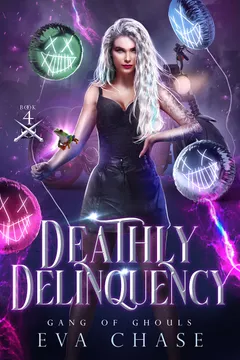
Deathly Delinquency receives mixed but generally positive feedback as the final installment of the Gang of Ghouls series, averaging 3.88 stars. Readers praise the action-packed plot, well-developed characters, and satisfying HEA ending. Many appreciate the balance between romance and story, along with Lily's relatable character arc. Common criticisms include an anticlimactic final battle, unanswered questions about the Gauntt family's motives, repetitive plot structure, and a rushed conclusion. The audiobook narration, particularly Joe Arden's performance, receives notable praise.
Characters
Lily
Water witch and singerLily is a young woman rebuilding her life after years lost to a psychiatric institution and the Gauntts’ manipulation. Her water magic gives her unusual force, but her instinct is to use it protectively, especially for her younger sister, Marisol6. She is practical under pressure and compassionate enough to question whether her methods are becoming too harsh. Lily’s relationships with Nox2, Kai3, Jett4, and Ruin5 give her several kinds of intimacy and support, while her own developing confidence makes her more than the person they guard. Music remains a private source of identity and an increasingly public ambition.
Nox
The gang’s fierce leaderNox leads the Skullbreakers with physical confidence, blunt protectiveness, and a talent for making loyalty feel like a concrete obligation. His gang is not merely a source of power; it is the family he built after a childhood marked by neglect and instability. With Lily1, he is demanding and affectionate, but he also respects her capacity to make decisions. Nox tends to solve danger through direct action, which can make him impatient with uncertainty. Beneath that force is a man who wants to keep his people safe and give the next generation the care he did not receive.
Kai
The gang’s strategistKai is an observant planner who reads people and situations quickly, then turns small pieces of information into practical advantage. His intelligence has often left him isolated, and he learned to treat emotional insight as a tool before learning how to express his own feelings openly. He works undercover at Thrivewell and is willing to take calculated risks when they protect the group. With Lily1, Kai’s precision gradually makes room for tenderness. He remains skeptical of easy answers, but his care for others is not abstract: he studies what they need and helps make it possible.
Jett
The transforming artistJett is a reserved artist whose supernatural ability lets him reshape materials, objects, and even his own creations. He often says more through what he makes than through what he tells people, and his work can be beautiful, unsettling, or deliberately blunt. His guardedness comes from a habit of keeping anger and vulnerability contained until he trusts someone. With Lily1, he becomes more openly affectionate and allows his creativity to serve both pleasure and protection. Jett’s loyalty is expressed through attention: he notices what can be repaired, changed, or turned into a weapon.
Ruin
The gang’s bright sparkRuin meets hardship with exuberance, humor, and a readiness to find some useful or pleasurable thing in the middle of disaster. His magic can influence emotion, giving his optimism practical force as well as personal warmth. He values belonging and thrives when he can support the people he loves, though his cheerful certainty can sometimes blur the difference between helping someone and deciding for them. With Lily1, he is openly tender and playful. His bond with the Skullbreakers gives his energy direction, while his own history explains why he works so hard to make other people feel welcomed.
Marisol
Lily’s stubborn sisterMarisol is Lily’s1 sixteen-year-old sister, a sharp, determined teenager who has survived abuse and periods of separation from the person she trusts most. She refuses to be treated only as someone who needs protection; she wants information, purpose, and a voice in decisions that affect her. Her humor and youthful bluntness coexist with a hard-won seriousness. Marisol’s courage is not the absence of fear, and she is still learning what kind of help she wants. Her relationship with Lily1 is loving but complicated by the older sister’s1 impulse to shield her from every possible danger.
Nolan and Marie Gauntt
Thrivewell’s hidden rulersNolan and Marie Gauntt present themselves as composed leaders of a prosperous family and corporation. Their public manner depends on discretion, inherited status, and the assumption that wealth can make scrutiny disappear. They are calculating and intensely protective of their legacy, treating other people’s privacy and independence as obstacles to manage. Their influence extends beyond the office through favors, social networks, and supernatural means. The contrast between their polished authority and their private conduct makes them difficult to challenge: they have trained their community to mistake silence for proof that nothing is wrong.
Thomas and Olivia Gauntt
The family’s polished facesThomas and Olivia are prominent members of the Gauntt family and public representatives of its respectability. They help maintain the impression that Thrivewell’s influence is simply the result of generations of careful management. Their composed presentation conceals a willingness to enforce the family’s interests behind closed doors. They are part of the wider network through which Nolan and Marie7 preserve power, making their roles important even when they are not the most visible decision-makers.
Parker
The gang’s uneasy defectorParker is a Skeleton Corps member whose discovery of a hidden mark forces him to reconsider the gang’s relationship with the Gauntts. He is cautious because he knows the risks of defying his own leaders, but anger at being manipulated gives him a reason to act. Parker understands the Corps from the inside and can reach people the Skullbreakers cannot. His growing willingness to take responsibility makes him a bridge between rival groups, though he must earn trust on both sides.
Peyton
A wary former bullyPeyton was one of Lily’s1 college bullies, proud, defensive, and accustomed to deciding who deserved her kindness. Learning that the Gauntts interfered with her memories complicates her sense of responsibility without erasing the harm she caused. She does not become instantly comfortable with Lily1 or the group, and she is wary of public exposure. Still, Peyton can act decisively when she believes a cause matters. Her gradual movement from hostility to practical cooperation grows from wanting control over her own story.
Nolan Junior
A child heirNolan Junior is a young boy caught inside the Gauntt family’s plans for its future. He is quiet and closely managed by the adults around him, with little opportunity to make ordinary choices. His situation highlights how the family’s polished structure can conceal a child’s isolation. Beneath the obedient surface is a person with his own attachments and wishes, including concern for his sister12.
Marie Junior
A watched granddaughterMarie Junior is Nolan Junior’s11 younger sister and the focus of the family’s rigid expectations. She spends long stretches alone, responding to adult instructions rather than being encouraged to explore or play. The camera footage of her daily routine makes the emotional cost of this control visible. She is a child, not merely a symbol of the Gauntts’ plans, and her quietness should be understood as a condition imposed on her rather than a lack of personality.
Fergus
A frightened college victimFergus is a former college bully whose restored memories leave him overwhelmed and uncertain. He is easily frightened by the consequences of open resistance, making him a vulnerable and unreliable ally. His struggle reflects how different people respond to recovered trauma and pressure.
Dr. Morton
The gang’s discreet doctorDr. Morton is a veterinarian with enough practical medical skill to help the Skullbreakers after severe injuries. He is accustomed to working outside conventional circumstances and treats their supernatural complications with wary professionalism.
Plot Devices
The Gauntt marks
Locks away stolen memoriesThe Gauntts place supernatural marks on people, hiding memories of abuse and allowing the family to influence some marked victims. Lily1 can break the spells, which restores what victims were made to forget and gives them a chance to choose how to respond. The marks connect private trauma to public resistance, since each recovered memory can create another ally. They also complicate trust: an apparent betrayal may be freely chosen, magically influenced, or driven by fear.
Soul transfers
Keeps the family in powerThe Gauntts preserve their lives by moving their spirits into younger bodies through rituals tied to the marsh. The process turns children into future vessels and lets the family extend its influence across generations. Its discovery explains the repeated family names in Thrivewell’s history and clarifies why the Gauntts protect their secrecy so fiercely. The ritual’s reliance on the marsh also creates the weakness Lily1 eventually recognizes: the place and the spirits harmed there can resist being used.
Lily’s water magic
Turns water into forceLily can sense and control water, draw on nearby supplies, and direct it against people or barriers. Her power first appears useful in immediate fights, but the marsh expands its meaning: water holds traces of the Gauntts’ rituals and offers a channel to the spirits of their victims. Lily’s capacity depends on her energy and concentration, so it is never a limitless solution. The power becomes most consequential when she treats the marsh as an ally rather than merely a weapon.
Shared supernatural energy
Makes their powers cooperateLily passes some of her supernatural energy through Kai3, Jett4, and Ruin5, creating a lasting connection among them. Each man can then contribute a different ability toward a shared goal, helping them break the spell imprisoning Nox2. The connection also gives them faint access to one another’s physical and emotional states. It is both a practical tool and a relationship choice, binding Lily1 more deeply to the people she trusts.
Public evidence campaign
Makes secrecy harder to maintainThe group combines mass emails, Marisol’s6 testimony, recordings, a staged float, altered advertisements, and hidden camera footage to force attention onto the Gauntts. Each tactic reaches a different audience, while the repeated accusations make it harder for Thrivewell to dismiss the story as a single grievance. The campaign does not immediately prove every supernatural claim or protect its participants from retaliation. Its function is to break the Gauntts’ control of the public narrative and encourage victims to act together.
About the Author





Download PDF
Download EPUB
.epub digital book format is ideal for reading ebooks on phones, tablets, and e-readers.








