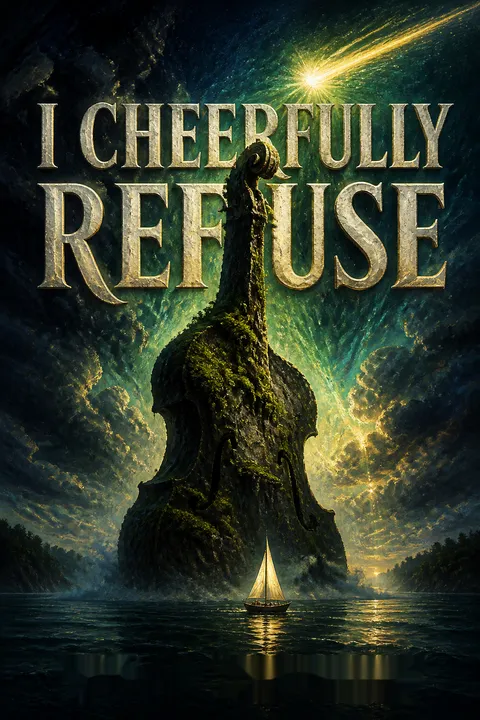


Plot Summary
The Comet Over Superior
In a battered future beside Lake Superior, Rainier, usually called Rainy, plays bass in local bars and shares a house with Lark, his book-loving wife. Their friend Jack Labrino arrives worried that the approaching Tashi Comet signals disaster. Rainy plays for him, and Lark’s warmth briefly lifts the tavern owner out of his gloom.
The couple’s small acts of care matter in a region where storms, failing infrastructure, and scarce supplies have become ordinary. Soon Lark returns from her bookshop with news that a traveler has brought a rare book she has sought since childhood. The visitor will rent their attic room, opening their home to a stranger whose arrival will pull their quiet life into danger.
The comet gives private anxieties a public shape. Labrino reads catastrophe into the sky because his life has trained him to expect loss; Rainy answers with music, a practical kindness that cannot disprove disaster but can change the next hour. Lark’s brief intervention shows how care circulates through this community, not as grand rescue but as hospitality, food, and attention. The coming story begins in this tension: people know the world is failing, yet continue to make room for one another.
The Book in the Bag
The boarder, Kellan, arrives in a battered Ford Ranchero with a child’s suitcase, a ruined claw of a hand, and a bundle of drawings he guards closely. The book he carries is an advance copy of I Cheerfully Refuse, the nearly mythical final work of poet Molly Thorn. Lark is delighted but too apprehensive to open it.
Rainy sees Kellan’s hunger and feeds him breakfast, then agrees to help repair the car. Kellan is cautious around Rainy’s size but gradually shares stories about his odd relatives and his failed hopes of working for the wealthy families called astronauts. His drawings reveal a keen eye for people, while his constant watchfulness hints that the road has taught him to expect pursuit.
The rare galley is both an object of desire and a test of how people treat what they cannot yet understand. Lark welcomes the book’s mystery; Rainy first notices Kellan’s hunger and vulnerability. The contrast defines their household’s ethics: curiosity is not separate from care. Kellan’s guardedness, meanwhile, is not mere eccentricity. In a society where labor contracts can become captivity, caution is a survival skill, though it also makes trust difficult.
The Fair and the Fugitive
At Greenstone’s sprawling pier market, Kellan finds no ball joints at first, while Rainy watches police officer Apeknuckle break a vendor’s knee during a dispute. The commotion lets Kellan slip several heavy parts into his coat. He later admits he fled a six-year labor contract rather than die in captivity, and Rainy decides not to report him.
Kellan pays Rainy to settle the stolen parts with the vendor and asks for help installing them before he continues toward Ontario. On the drive home, Rainy reads of teenagers in Green Bay who used Willow, a supposed therapeutic that promises escape from a ruined world. Kellan’s confession earns him shelter, but his theft and the newspaper’s account leave Rainy uneasy about the price of helping him.
Rainy’s choice is compassionate but not innocent. He recognizes Kellan’s desperation and quietly absorbs the consequences of the theft, beginning a pattern in which loyalty outruns judgment. The Green Bay deaths give Willow its emotional context: people do not seek it only for pleasure, but because the future has become difficult to imagine. The scene also introduces the novel’s central moral pressure. When systems are cruel, survival may require breaking their rules, yet the harm that follows does not disappear.
A Library, Then the Slates
Rainy remembers meeting Lark while she worked at a library desk. He first fell for her voice, then began reading the books she recommended, moving from reluctant curiosity to an overwhelming education in stories.
Years later, their shared sailing trip carries them beyond the permitted route toward the Slate Islands. A violent storm nearly overwhelms them, but Lark’s skill and Rainy’s work at the bilge pump bring them safely into a sheltered harbor.
There they meet a white-haired sailor whom Lark believes may be Molly Thorn, though Rainy doubts the identification. Lark also reveals that Rainy had pursued her by listening to her recommendations and reading for her sake. The memory explains why the Slates become his destination after her death.
This recollection gives Rainy’s later voyage its emotional map. Reading is not simply a hobby he adopts to impress Lark; it becomes a way to enter other lives and notice hidden possibility. Their first storm at sea punctures his self-image as a natural sailor, while Lark’s competence makes dependence an intimate form of trust. The possible Molly encounter leaves uncertainty unresolved. For Lark, wonder enlarges reality; for Rainy, love makes that enlargement attractive even when he cannot quite believe it.
Werryck in the Attic
While Rainy and Kellan fail to repair the Ranchero, the car slips from its jack and nearly crushes Rainy. Kellan retreats upstairs and inhales gas from a canister, revealing a panic that turns into elaborate warnings about Werryck, a powerful tracker tied to a medical ship. Kellan insists that if Werryck appears, escape matters more than belongings.
Rainy’s memories of a pandemic hospital ship make the warning feel less fantastic than it sounds. Around this time, Rainy also confronts his limits as protector when the children he teaches music turn on Tonio, a vulnerable boy. Rainy scares them off, but cannot promise Tonio lasting safety. He has inherited Erik’s unfinished sailboat, Flower, another fragile thing he hopes to make useful.
The canister offers Kellan temporary relief while loosening the boundary between confession and delusion. His warning proves difficult to dismiss because Rainy knows that medicine and corporate power have already been joined in the past. The Tonio episode makes the same problem personal: Rainy can interrupt cruelty, but cannot guarantee protection. These paired moments expose the gap between good intentions and control. Flower becomes a counter-image to that helplessness, a repairable craft that gives Rainy work even when human danger resists repair.
Labrino Chooses Willow
While Lark and Kellan travel to Duluth to buy a large book collection, Rainy stops at Labrino’s tidy home and finds him unusually peaceful. Labrino has taken Willow and expects to die, having already spoken with his son about the decision and arranged to leave the Lantern to drummer Harry.
He spends his remaining time telling Rainy stories about his younger life, including the playful bear that once convinced him to stay in Icebridge. Rainy steps outside to fetch his bass, then returns to find Labrino dead. He plays the song Labrino loved before calling for help. When Lark and Kellan come home buoyant with books, Rainy cannot keep the death from Lark, and she shares his grief.
Labrino’s decision is neither treated as a simple act of despair nor neatly corrected by Rainy’s presence. The story lets his final hour contain pleasure, memory, and chosen solitude alongside irreversible loss. Rainy’s brief departure becomes a source of guilt, though Labrino himself asked for music rather than rescue. The episode also sharpens the danger of Willow: its promise of clarity can make death feel orderly and even beautiful. That emotional seduction will haunt Rainy when grief later leaves him unable to imagine a life without Lark.
Lark’s Birthday Ends
At the bookshop, an old visitor asks to see the rare Molly Thorn galley and leaves impressed by Lark’s refusal to sell it. For her birthday, Rainy fills the yard with neighbors, musicians, food, and lanterns.
The old visitor attends and gives a thoughtful toast, but Kellan is missing from the gathering. The next day Kellan has vanished with his car and equipment. A sudden windburst sends Rainy and Lark searching for Maudie’s dog Vixen. Returning home, Rainy discovers the rooms ransacked and finds Lark dead upstairs, killed with a heavy tool.
Police initially suspect him, while he points them toward Kellan and the name Werryck. The violence transforms a home built around books and hospitality into the crime scene from which Rainy must flee.
The birthday gathering briefly realizes Lark’s ideal of community: strangers and neighbors share food, music, and attention without needing to agree about everything. The visitor’s toast makes the scene feel unusually whole, which intensifies the shock of its aftermath. Kellan’s absence creates suspicion, but the attack has a wider reach than Rainy can yet understand. His discovery of Lark’s body breaks the everyday logic of care. The house, once an open refuge, becomes a place where protection has failed in its most intimate form.
Flower Becomes an Escape
After Lark’s funeral, Rainy drifts through grief, stops playing with his band, and begins using Kellan’s gas. A memory of Lark’s imagined future reminds him of Flower, and he starts repairing the boat rather than remain trapped in their damaged house. When he returns to the Lantern for a gig, Werryck appears with two men.
Rainy recognizes the visitor from Lark’s birthday and understands that he is in danger, so he uses a disruptive bass line to escape through the back. He reaches Flower as a severe storm bears down, starts the outboard, and leaves Icebridge under pursuit. In the waves, he uses the anchor to steady the boat, raises a storm sail, and survives the night at sea.
Rainy does not heal before he leaves; he leaves because staying still has become intolerable. The boat offers an alternative to both numbness and self-destruction, but it is no clean escape. His musical improvisation buys a few seconds, while seamanship and luck preserve his life. The storm strips away the romance he once attached to sailing, replacing it with bodily fear and repetitive labor. Grief remains aboard with him, yet Flower gives it a direction.
Willow’s Hidden Cargo
After a brief stop in Lightner, where local children debate whether Willow deaths are suicides or journeys toward something better, officer Apeknuckle warns Rainy that powerful outsiders are looking for him. Rainy puts back to sea. In Thunder Bay he finds Kellan’s missing-person poster and calls the number, only to reach Werryck.
Werryck claims Kellan stole nearly ten thousand Willow doses from the medicine ship and sold them to people including the Lightner victims and Labrino. He offers Rainy legal protection and repairs to his house in exchange for Kellan’s location. Rainy refuses and throws the cheap phone into the lake. The revelation stains his loyalty to Kellan, but Werryck’s offer and account of Lark’s death remain untrusted.
Rainy’s loyalty now has to survive evidence that Kellan’s flight has harmed others. Werryck frames truth as a tool of recruitment: he offers details that may be accurate, then uses them to invite Rainy back under his authority. Rainy refuses, not because Kellan is blameless, but because Werryck’s version of justice is inseparable from coercion. Willow’s market thrives on despair, while its distributor can be both a frightened fugitive and an agent of further harm.
Jolie Offers Shelter
A storm drives Rainy toward Jolie, where Doctor Girard treats an infected cut on his chin and his wife Evelyn feeds him from her garden. Rainy joins a local band for a benefit supporting Nils, a dying father, and the performance restores some pleasure in making music with others. Stevie the welder fashions replacement chainplates for Flower in exchange for Rainy’s help at the benefit.
Afterward, Rainy tells Girard and Evelyn that he intends to sail to the Slate Islands, hoping Lark may somehow be there. They do not ridicule his hope. Evelyn gives him clothes for the journey, and Girard shares a photograph of his dead daughter, Tinker, as a way of entrusting Rainy with a memory. Repaired and provisioned, Rainy leaves Jolie.
Jolie offers a model of care that does not require certainty. Girard treats Rainy’s wound, Evelyn shares food, and Stevie exchanges skilled labor for music. Their community is not free of grief, but grief has not been converted into a reason to abandon the living. The photograph of Tinker recognizes the risk in Rainy’s hope without trying to cure it. He can leave for the Slates because someone has first helped him survive the present.
Sol Boards Flower
After storms and a near-fatal chase from armed strangers, Rainy reaches Winton with his damaged boat. A nine-year-old girl named Sol approaches, carrying a fishing spear and an alert distrust of adults. She leads him to King Richard, the man holding her as a supposed guardian. When Sol secretly stows away aboard Flower, Rainy turns back rather than abandon her.
He learns that Richard has abused and controlled other girls as well. To secure Sol’s freedom, Rainy gives Richard his cherished Fender bass. Sol says she has a grandfather, Papa Griff, who may protect her, and Rainy agrees to help find him. They leave Winton together, carrying little certainty but a clear obligation to keep her safe.
Sol enters the story already practiced at reading danger and negotiating for herself. Rainy’s first instinct is to return her to the adult who claims authority, but her account forces him to distinguish guardianship from possession. Giving up his bass is a concrete sacrifice, not a symbolic gesture alone: music has been his way of regulating grief and reaching others. The decision binds him to Sol while exposing how little confidence he has in his ability to protect her.
The Bridge Demands Blood
On the way through a canal toward Redfield, Rainy and Sol bury a drowned man whom Sol treats as a possible relative. The route divides a comfortable mainland from a neglected island where painted portraits memorialize the dead. At the Huffin Lift Bridge, operator Alistair demands an exorbitant fee and then refuses to honor the pass Rainy bought.
Essie, an island bait seller, offers another way through: strip Flower’s mast and hardware, hide the boat in reeds, and tow it with her small dinghy. While they wait, mainland vigilantes cross the bridge, set fires, and hang three islanders, including the painter of the memorials. Rainy and Sol sink Flower temporarily to squeeze beneath the span, then escape with the dinghy returned to Essie.
The canal turns inequality into geography: one shore maintains houses and institutions, while the other is left to decay and then blamed for its own abandonment. The vigilantes’ religious language does not soften the execution; it helps make violence seem authorized. Alistair’s toll is a smaller expression of the same power, extracting payment while denying passage. Rainy and Sol survive by ingenuity and cooperation, but their escape does not undo the cruelty they witness.
Papa Griff Appears
After Rainy returns Essie’s dinghy, Sol swims back to Flower and reveals she has taken Richard’s hidden money. The pair eventually reach Port Mineral, where Papa Griff appears on the dock. Sol is overjoyed to find the grandfather she has described, and Rainy accepts him aboard despite doubts about his stories and his lack of sailing skill.
On the passage toward Jolie, Griff cannot follow basic steering directions and panics during worsening weather. He opens a seawater intake while trying to reach the bilge, flooding the boat; the wind then tears Flower’s mainsail. The storm carries them to Michipicoten Island, where a medicine ship and Werryck’s black cruiser are waiting. Armed men seize Rainy, Sol, and Griff.
Griff’s arrival seems to validate the refuge Sol has imagined, but the reunion quickly exposes the difference between a comforting story and dependable action. Rainy accepts Griff partly because he wants Sol to have family, and partly because the voyage feels manageable. His judgment fails under pressure. The damaged boat and capture return the group to Werryck’s system, making the ship a material version of the power Rainy has been fleeing.
A Cell Above the Bilge
Aboard the medicine ship Posterity, Rainy is locked in a damp cell while he worries about Sol and Griff. Werryck visits, declares him convicted under an expedited process, and explains that Kellan’s stolen Willow was found aboard Flower. Instead of treating Rainy as an ordinary prisoner, Werryck returns his bass and requires him to play.
Rainy joins a paint crew, where he meets Marcel, a resourceful janitor who carries pastries, kindness, and knowledge through the ship. The crew’s stories reveal the ship’s testing program and its prison deck, the Shambles. Rainy also learns that the escapees called the Twelve are still at large. Music gives him a limited place in the ship’s hierarchy, but does not free him or reassure him about Sol.
Werryck’s gift of the bass complicates the usual pattern of domination. He allows Rainy a valued instrument, but the privilege is conditional and designed to serve Werryck’s needs. Music becomes both a form of survival and a measure of control: Rainy can play, yet cannot choose whom he sees or where he goes. Marcel’s small acts of generosity create a counter-network inside Posterity, one based on relationships rather than official permission.
The Twelve in the Cage
Marcel tells Rainy that Sol is aboard and that Griff has consented to place her in trials for a compliance treatment aimed at difficult children. Before Rainy can intervene, Werryck summons him to watch the captured Twelve return, including Kellan. Werryck then locks them in a small cage on a raft beside Posterity as a public punishment.
Rainy asks him to bring them in before a storm, but Werryck refuses. All twelve survive the night, and their return to the ship changes the mood among inmates and workers. Rainy also discovers that Sol has learned to write her own name and sent him the message through Ivar. The brief note gives him proof that she remains herself, even as the ship plans to alter her.
The raft turns punishment into spectacle, making the Twelve’s exposure a warning to everyone aboard. Rainy cannot stop the ordeal through argument, but he continues to ask for mercy, and the inmates’ attention becomes a form of witness. Sol’s handwritten name answers the ship’s effort to classify and rename children: she claims a small piece of selfhood with the letters Rainy taught her. Her note also changes Rainy’s isolation into a relationship that can still act across locked doors.
Posterity Breaks Open
Marcel leads a revolt when workers begin moving supplies onto the black cruiser. The guards hesitate, then surrender their weapons after Marcel persuades them that leaving is a choice, not an assault. Tom Skint fires, killing one guard and wounding Marcel.
Rainy throws Skint from an upper platform, and the freed inmates take control of the ship. Sol escapes the children’s quarters; most prisoners and many staff board the overloaded cruiser. Rainy chooses to take Flower instead, bringing Sol and the guard Burke with him.
Kellan stays with the Twelve, while Griff elects to remain beside Werryck. Rainy retrieves his bass and Molly Thorn’s book, then sails away as Posterity’s pumps fail. The ship sinks with Werryck, Griff, Skint, and the remaining guards aboard.
The revolt is not a clean transfer of power. It begins with a choice to leave, becomes violent when Skint shoots, and forces everyone aboard to decide what risks they can bear. Rainy’s act against Skint is not framed as a triumph over evil so much as a breaking point after prolonged helplessness. The departures are equally revealing: Kellan chooses the people who shared his captivity, while Rainy chooses Sol and a smaller, uncertain future. Posterity’s sinking follows the system’s dependence on the labor it abused.
The Comet Finds Jolie
Rainy, Sol, and Burke reach Jolie, where Evelyn welcomes them with food, soap, and rest. Burke later leaves for another life, while Rainy finds work and a small place of his own. Sol studies with Girard and begins to read, though she remains wary of school and uncertain about writing.
She secretly scatters seeds through abandoned parts of town, and gardens begin appearing in ruined places. News from Harriet reports that the Twelve dispersed with help from townspeople, Marcel survived, and a network of strangers sheltered the escapees.
Posterity’s loss is confirmed. When the Tashi Comet finally appears, Rainy sails to the Slates alone. He feels Lark’s presence in a half-sleeping vision of future friends and returns to Jolie as Rachel’s bass playing carries across the night.
The ending answers the comet’s opening threat without pretending the world has become safe. Rainy returns to music, Sol begins to claim language, and the community makes practical room for people displaced by Posterity. Her scattered seeds echo Lark’s belief that better futures need not be fully planned to be worth tending. Rainy’s visit to the Slates does not prove what happens after death; it lets him hold grief and attachment without making either a verdict. The comet becomes a shared spectacle rather than a prophecy of doom.
Analysis
I Cheerfully Refuse sets its people inside a collapsing civic world where public institutions have either failed or been captured. Roads break, medicine becomes an instrument of obedience, law serves the powerful, and people are encouraged to interpret despair as a private defect or a route to an afterlife. Yet the novel does not counter this landscape with a heroic restoration of government. Its alternative is smaller and more demanding: neighbors feed one another, welders repair a boat, musicians play for a dying man, and strangers make room for people fleeing captivity.
Rainy’s growth is measured less by mastery than by his changing relationship to responsibility. He begins as a genial man who thinks protection can be promised if he is large enough and willing enough. Tonio, Kellan, Lark, and Sol teach him that care cannot control outcomes. This knowledge does not excuse passivity. Rainy keeps acting, but learns to distinguish a promise of safety from a commitment to stay present. His bass playing makes that ethic audible: a steady line supports others without pretending to lead every melody.
The novel also asks how stories shape the boundary between hope and delusion. Lark’s faith in literature does not make her naïve; it lets her recognize unrealized capacities in people and in the future. Rainy’s voyage toward the Slates is partly grief-driven magical thinking, yet that hope carries him through a period when ordinary reasoning offers no life worth inhabiting. Sol’s first steps toward reading transform that inheritance. Writing her own name is a modest act of resistance against a ship that intends to replace it. Her seeds scattered through Jolie extend the same principle into the physical world: the future is not guaranteed, but it can be cultivated.
The comet finally gathers the book’s competing responses to catastrophe. It can be read as omen, spectacle, or simply an ancient body following its path. The novel’s answer is not to deny disaster, but to refuse the claim that disaster is the only story left. Its cheerfulness is therefore not optimism as prediction. It is a practice: keep feeding people, making music, repairing what can be repaired, and leaving room for lives not yet imagined.
Review Summary
"I Cheerfully Refuse" receives largely positive reviews, averaging 3.98/5. Readers praise Enger's lyrical, beautiful prose and compelling characters, particularly the gentle protagonist Rainy and his wife Lark. Set in a near-future dystopian world shaped by climate change, corporate oligarchy, and suppressed literacy, the novel follows Rainy's sailing journey across Lake Superior after personal tragedy. While many celebrate its emotional depth, hopefulness, and rich imagery, some critics find the pacing slow, the plot meandering, and the world-building insufficiently explained.
People Also Read









Characters
Rainier, called Rainy
The bass-playing caretakerRainy is a large, good-natured musician whose practical skills often arrive before his judgment. He plays bass by instinct, prefers steady rhythms, and initially knows little about books until Lark draws him into reading. His instinct is to feed, shelter, carry, and defend people who seem vulnerable, but he gradually learns that protection cannot be promised absolutely. His narration is observant and self-deprecating, with occasional blind spots: he trusts people because he wants to see their goodness. Music, repair work, and sailing give him ways to act when words fail. His central struggle is not becoming fearless, but continuing to care after loss has shown him the limits of care.
Lark
The bookseller of possibilityLark is Rainy’s wife, a bookseller whose quiet voice and quick understanding make people feel seen. She loves rare and neglected writing, especially Molly Thorn, and treats reading as a form of practical help: she recommends books according to what a person needs. Her imagination is generous but not merely fanciful. She notices overlooked people, builds a thriving shop from a bakery shelf, and sustains friendships through attention and humor. Lark welcomes uncertainty where Rainy tends to seek proof, especially in stories of ghosts, futures, and human change. Her influence remains a compass for Rainy, though the novel does not reduce her to a source of his grief; her independent commitments shape the community around them.
Kellan
The fugitive portraitistKellan is a gaunt, guarded young microbiologist with a badly burned hand, a failing car, and a gift for drawing faces. He has escaped a coercive labor contract and carries the habits of someone who expects pursuit. His charm appears in nervous stories and precise sketches, while his thefts and decisions reveal that vulnerability does not make him harmless. He wants freedom but also makes choices that expose others to danger. Rainy sees him as a younger brother and often interprets his fear generously. Kellan’s relationship with Rainy tests the difference between compassion and absolution, while his artistic eye suggests a capacity to notice other people even when he struggles to trust them.
Sol
The spear-carrying survivorSol is a nine-year-old girl with a fishing spear, a quick temper, and an unusually direct way of assessing adults. She has survived neglect and exploitation by learning to watch, lie when necessary, steal when useful, and keep moving. Her courage can look like fearlessness, but it also conceals how little reliable care she has known. She loves stories even before she can read, and books give her a language for imagining herself beyond her immediate circumstances. Rainy does not tame her; he gradually offers dependable company while she retains her stubborn independence. Her need for safety exists alongside a fierce resistance to being treated as property or as a problem to be corrected.
Werryck
The sleepless ship authorityWerryck is a powerful official associated with Posterity, the medicine ship and floating prison. He is difficult to read: at times he behaves like a cultivated book lover who appreciates music, at others like an administrator who treats people as possessions. His authority rests not only on force but on the capacity to make others doubt their own standing. He has surrendered sleep in exchange for revenge and influence, a bargain that illuminates how thoroughly he has organized himself around control. Rainy’s bass playing reaches a private vulnerability in him, but that intimacy never erases the imbalance between jailer and prisoner. Werryck embodies the danger of humane gestures used without relinquishing power.
Jack Labrino
The worried tavern keeperLabrino owns the Lantern, hires local musicians, and often brings his worries to Rainy and Lark. His loneliness and accumulated family grief coexist with generosity and a deep attachment to music. He fears the comet and the world’s decline, yet he can still be calmed by a simple bass line or made happy by a shared meal. His friendship gives Rainy an early example of how listening can matter even when it cannot change someone’s final choice.
Marcel
The shipboard connectorMarcel works as a janitor aboard Posterity and moves easily between people and parts of the ship that authority keeps separate. He brings food, notices who needs help, and earns trust through small, unshowy acts. His warmth does not make him passive: he can organize people and take decisive risks. Kellan’s drawings capture his observant, knowing expression, while Rainy encounters him as a person whose presence briefly makes even a prison feel more open.
Papa Griff
Sol’s elusive grandfatherGriff is the grandfather Sol describes as a resourceful protector, a traveling mechanic and performer with a talent for finding his way into stories. He arrives with charm and a seemingly affectionate history with Sol, but his boasts and evasions make Rainy wary. Griff wants to avoid conflict and secure his own future, even when others depend on him. His presence tests Rainy’s willingness to accept imperfect family ties and Sol’s hope that someone from her past can offer lasting safety.
Girard
The recovering doctorGirard is a physician in Jolie whose illness has altered his speech and energy but not his concern for patients. He treats Rainy’s infected wound and offers care without demanding payment. His grief over his daughter, Tinker, sits beside a disciplined effort to remain useful to his community. Girard’s mixture of scientific practice and emotional reserve gives Rainy a model of kindness that does not depend on certainty or eloquence.
Evelyn
The garden-hearted hostEvelyn is Girard’s wife, an urban farmer who grows food and quietly shares it with neighbors. She welcomes Rainy, tends to his needs, and prepares him for his voyage with clothing and provisions. Her generosity is practical rather than ceremonial. Having known family loss herself, she can respect Rainy’s grief without trying to argue him out of it.
Essie
The island boatmakerEssie is an islander who sells leeches and knows how to navigate the canal’s hostile politics. Her son’s experience with a medical ship has given her a personal reason to distrust systems that promise treatment in exchange for obedience. She lends Rainy and Sol a small dinghy despite the danger to her, asking only that it be returned. Her dry humor and careful judgment make her a guide who understands both the risks and the costs of resistance.
King Richard
The self-made guardianRichard runs a small shop and surrounds himself with weapons, religious symbols, and the authority of a man who expects obedience. He calls Sol his ward, but his conduct reveals a possessive and exploitative view of children in his care. Rainy encounters him as both a local power and a direct threat. Richard’s self-justifying manner shows how abuse can hide behind claims of provision and protection.
Burke
The questioning guardBurke is a strong guard aboard Posterity who can be gentle, curious, and capable of following orders that harm prisoners. His health and ordinary affability make his role unsettling rather than reassuring. He asks about the lives of those in his custody, suggesting a conscience that has not entirely disappeared, but sympathy does not immediately make him resist the system he serves.
Tom Skint
Werryck’s brutal enforcerSkint is a hard, violent operative who carries out Werryck’s orders and bears an intensely personal hostility toward Rainy. His missing fingers and physical aggression mark him as a man shaped by violence, though the story does not treat that history as an excuse for what he does. He helps make Werryck’s authority tangible at street level and aboard the ship.
Alistair
The bridge tollkeeperAlistair operates the Huffin Lift Bridge and uses its passage rules to extract money from travelers and islanders. His formal manner and failing eyesight complicate his appearance of command, but he remains part of a system that restricts movement. Rainy and Sol meet him at the point where bureaucratic obstruction gives way to open violence.
Harriet
The principled paint leaderHarriet leads Rainy’s paint crew aboard Posterity with blunt discipline and a strong belief that actions carry lasting consequences. She is protective of younger or more vulnerable crew members and speaks plainly when authority expects silence. Her practical courage helps create solidarity among people who have learned to distrust promises.
Maudie Antoinette
The baker and neighborMaudie owns the bakery where Lark’s bookshop grows and gives Rainy blunt, physical help when grief leaves him unable to care for himself. She is sturdy, generous, and unsentimental about the obligations friendship creates. Her bread and her home make ordinary sustenance part of the community’s response to crisis.
Tonio
The music-loving studentTonio is a vulnerable child in Rainy’s music class who responds to songs while remaining mostly silent. Other children target him, and Rainy tries to intervene. Tonio represents the people Rainy wants to protect and the painful limits of a promise made in anger.
Apeknuckle
The injured local officerApeknuckle is a large police officer whom Rainy first sees bullying a Greenstone vendor. Later, he warns Rainy to leave when outsiders begin hunting him. His changed conduct suggests that even a feared authority figure can recognize when greater power has made the local law irrelevant.
Stevie
The welder with a bandStevie is a welder in Jolie who makes replacement chainplates for Rainy and arranges his appearance at a benefit concert. She values practical work and community obligations, connecting repair to music without treating either as charity.
Tove
The ship’s sharp-eyed cookTove works in Posterity’s kitchen and shares a close connection with Marcel. Her quickness and willingness to act make her one of the people helping others survive inside the ship’s rigid hierarchy.
Ivar
The cautious stewardIvar is Posterity’s steward, responsible for moving Rainy through the ship and enforcing its routines. He remains guarded, but his quiet delivery of Sol’s handwritten message shows that small acts of trust can pass through even tightly controlled spaces.
Plot Devices
The Tashi Comet
A recurring skyward measureThe comet frames the story’s movement from anticipation to catastrophe and then to a more cautious form of hope. Labrino interprets it as a warning, while Rainy initially sees it as a rare beauty worth watching. Its eventual appearance does not solve the characters’ material problems, but it gives them a shared event beyond the reach of local authorities and corporate power. The comet’s cycle encourages the distinction between predicting disaster and choosing how to live while it approaches.
Willow
A false promise of elsewhereWillow is a dissolving pharmaceutical sold as a therapeutic, but it leads people to choose death while imagining they are traveling toward a better world. The drug connects Labrino’s private decision to a growing public crisis among children, families, and the poor. Kellan’s theft of thousands of doses makes him both a fugitive from Posterity and a source of harm. The product exposes how despair can be commercialized, especially when people have little reason to believe that their lives will improve.
Flower
A fragile vehicle of agencyErik’s unfinished sailboat gives Rainy a practical way to leave Icebridge and a sustained task through grief. Its failing pump, corroded chainplates, damaged sails, and slow outboard make every passage dependent on maintenance and judgment. Flower carries books, food, the bass, and eventually Sol, so it becomes a shared living space rather than a simple escape vehicle. Its vulnerability prevents the voyage from becoming a fantasy of mastery; Rainy survives through learned skills, help from others, improvisation, and luck.
Molly Thorn’s Galley
A book that carries futuresThe rare advance copy of I Cheerfully Refuse begins as the treasured object Lark has sought since childhood. It later connects Lark’s literary life to Rainy’s grief, Sol’s hunger for stories, and Werryck’s own private attachment to books. Molly Thorn’s writing repeatedly offers a language for refusing apocalyptic certainty without denying suffering. The book does not provide a map out of danger; it helps characters imagine that the future can remain open and that a person’s words can leave evidence of a life.
The Bass Guitar
A line of human connectionRainy’s Fender bass is the instrument through which he comforts Labrino, bonds with Lark, and steadies himself during upheaval. Its low, repetitive lines suit his belief that good accompaniment supports others without demanding attention. The instrument also becomes a source of leverage: Rainy gives it up to free Sol, and Werryck later returns it to keep Rainy playing. Music can calm and connect people, but it cannot guarantee safety or erase unequal power.
Download PDF
Download EPUB
.epub digital book format is ideal for reading ebooks on phones, tablets, and e-readers.








