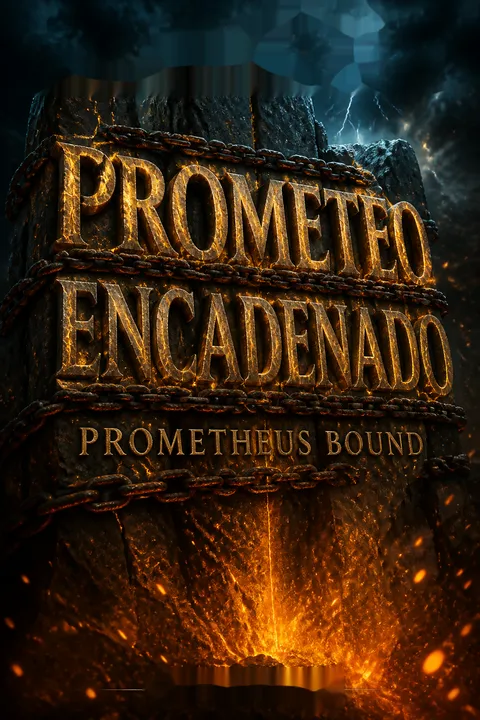


Plot Summary
Chains Above Skythia
At the world's barren edge, Power and Force bring Prometheus to a sheer cliff while Hephaistos prepares the chains. Zeus has ordered the blacksmith to fasten his kinsman there for stealing fire and giving it to mortals, a crime that challenged the gods' privilege and the new ruler's authority.
Hephaistos objects to binding a fellow god, but fear of Zeus overcomes his reluctance. Under Power's commands, he pins Prometheus to the rock and locks his limbs in place. The three enforcers leave him alone, unable to see or hear another person. Only then does Prometheus break his silence, calling on the sky, sea, earth, and sun to witness the punishment that has begun.
The opening makes power physical before it makes it political: Zeus's authority reaches the audience through metal, tools, and the reluctant hands of Hephaistos. His hesitation establishes that obedience is not the same as conviction, while Power treats cruelty as routine enforcement. Prometheus's isolation is both punishment and a theatrical problem: he has no human audience, so he appeals to the natural world instead. His first act of resistance is not escape but testimony. The scene asks who gets to define a crime when the ruler writes the law, and makes the body of the dissenter the first evidence.
The Human Race Spared
The daughters of Oceanus arrive after hearing the hammering and ask what brought Prometheus to the cliff. He recounts the struggle that put Zeus on the throne: his mother Themis, whom he identifies with Earth, warned that clever counsel would defeat force, but the Titans ignored him. Prometheus then joined Zeus, helping overthrow Kronos and his allies.
Once in power, however, Zeus planned to wipe out the existing human race and create another. Prometheus opposed him and kept mortals from destruction. He admits that his aid to them has cost him, while the Oceanids recognize that Zeus's rule rests on power imposed by his own laws. Their sympathy gives the solitary prisoner his first witnesses.
Prometheus's story complicates the simple image of rebel against ruler. He helped Zeus win, so his punishment follows not from loyalty to the defeated Titans but from refusing to remain useful on Zeus's terms. Political alliance becomes dangerous when the victor expects permanent obedience. The revelation about humanity raises the stakes beyond Prometheus's pride: he claims that mortal existence itself depended on his intervention. The Oceanids' arrival matters because they turn private pain into publicly witnessed injustice. Yet they are not neutral judges; their family ties and fear of Zeus shape what they can safely say. The play makes testimony a fragile form of resistance.
Oceanus Turns Back
Oceanus, Prometheus's relative and father of the chorus, arrives on a winged mount, offering to approach Zeus on the prisoner's behalf. He urges Prometheus to moderate his anger and adapt to the new ruler, warning that open defiance may bring worse pain. Prometheus rejects the advice and reminds Oceanus that he once helped Zeus establish his rule.
He then points to Atlas, condemned to bear the sky, and Typhon, crushed beneath Mount Etna, as examples of what Zeus does to challengers. Oceanus still proposes mediation, but Prometheus tells him to leave before his sympathy earns him punishment. Recognizing that intervention could endanger himself without freeing his friend, Oceanus flies home.
Oceanus offers a familiar survival strategy: translate injustice into a problem of tone, then advise the injured person to become easier to govern. His concern may be genuine, but it also protects his own position. Prometheus answers by making the cost of accommodation visible through Atlas and Typhon, whose punishments turn Zeus's supremacy into landscape. His reminder that he helped establish Zeus's rule exposes the weakness of Oceanus's proposed mediation: the ruler has already repaid past service with violence. Oceanus's departure is not a betrayal in the same sense, but it shows how fear drains solidarity of practical force.
Fire Becomes Civilization
With Oceanus gone, Prometheus explains to the Oceanids what his aid to mortals included. Before his intervention, humans could not interpret what they saw, build proper shelter, or recognize the seasons. He taught them to read the stars, count, and use written signs; he yoked animals for labor, made horses useful, and enabled ships to cross the sea.
He also gave them medicines and systems of divination, including ways to read dreams, birds, and sacrificial signs, and showed them how to work metals. The chorus questions whether he has helped mortals at excessive cost to himself. Prometheus answers that necessity still binds him, and insists that neither skill nor cleverness can overrule fate.
The catalogue makes fire more than a stolen object: it is the condition for accumulated knowledge, labor-saving tools, navigation, healing, and interpretation. Civilization appears as a chain of learned practices rather than a sudden gift of perfection. Prometheus presents himself as teacher and inventor, but the chorus's question exposes the psychological danger of that identity: devotion to others can become inseparable from self-sacrifice and self-importance. His claim that fate outranks craft is especially pointed after so many examples of human ingenuity. Knowledge can enlarge the field of action without abolishing the limits imposed by power, mortality, or cosmic necessity.
Io Arrives Unmoored
Io, daughter of the river god Inachus, rushes onto the scene in a human form marked by her transformation into a cow. She recognizes Prometheus as another sufferer and asks why the gods have punished him. In turn, he identifies her as the young woman Zeus desired. Io explains that repeated dreams urged her toward Zeus, but her father consulted oracles and was ordered to drive her from home.
Zeus changed her shape, Hera set the many-eyed herdsman Argos to watch her, and the relentless guard pursued her until Hermes killed him. Hera then sent the gadfly that still drives Io across the world. Io describes her present torment and demands to know what further suffering awaits.
Io's arrival shifts the play from a prisoner's account of injustice to the lived consequences of divine desire. Her body bears the change Zeus imposed, while the gadfly makes punishment mobile: unlike Prometheus, she cannot remain in one place long enough to turn pain into composed defiance. Her father's obedience to an oracle shows how divine power reaches into family life, compelling a parent to expel his child. The story also refuses to treat Zeus's erotic interest as harmless privilege. Io's confusion and agitation give the audience an embodied counterpoint to Prometheus's controlled, often proud narration.
The Prophecy's Price
Prometheus maps Io's past and future journey, naming distant peoples, dangerous lands, and the Nile delta where Zeus will finally calm her and she will bear Epaphos.
Her descendants will return to Argos; among them, one woman will spare her husband when her sisters kill theirs, beginning a line that eventually produces Prometheus's liberator, Herakles. Io's future therefore carries both an end to her wandering and a distant promise for her fellow sufferer.
Prometheus also reveals the secret Zeus needs: a marriage he is pursuing could produce a son stronger than his father and bring Zeus down. He refuses to identify the marriage's details until Zeus releases him. Prophecy becomes leverage, and Prometheus guards it as his only bargaining power.
The long itinerary can feel like a widening map, but its dramatic work is intimate: it links Io's immediate suffering to a future family line and makes ancestry a political force. Her descendants will matter not because blood guarantees virtue, but because one choice within that line changes what becomes possible. Prometheus's second prophecy gives him leverage over Zeus, yet it also exposes his dependence on knowledge he cannot safely disclose. He is both prophetic authority and captive negotiator. The secret's withholding turns foresight into a resource, one that can alter the balance of power only if its holder survives long enough to use it.
Hermes Demands the Secret
Hermes arrives as Zeus's messenger and demands the identity of the marriage that threatens the throne. Prometheus refuses, mocking the young gods' belief that present power will last. Hermes warns that Zeus can split the cliff with thunder, bury Prometheus in rock, and later send an eagle to tear at his liver each day.
He insists that only another god willing to take Prometheus's place in the underworld could end that torment. The Oceanids urge Prometheus to accept wise counsel, but when Hermes orders them away, they refuse to abandon him. They choose to share his danger rather than preserve their safety by leaving. Prometheus holds his secret, and Hermes departs without the answer Zeus sought.
Hermes converts the abstract threat of tyranny into a detailed future of bodily torture, attempting to make surrender seem rational. His argument is not merely that Zeus can hurt Prometheus, but that pain will outlast any principled resistance. Prometheus's refusal may be courage, pride, or both; the play does not make these motives cleanly separable. The Oceanids' decision to remain marks a change in their role. Earlier they witnessed and advised; now they accept a share of the risk. Their solidarity cannot free Prometheus, but it prevents Zeus's threat from isolating him completely.
The Earth Opens
After Hermes leaves, thunder and flashes of fire shake the ground. Winds collide, the sea rises against the sky, and the landscape dissolves into confusion as Zeus's violence reaches the cliff. Prometheus calls once more on Earth and the heavens to witness the injustice, while the Oceanids remain beside him. The rock and its prisoners disappear from view in the catastrophe.
The play ends without Zeus learning the secret, without Prometheus being freed, and without the threatened eagle appearing onstage. His prediction that Zeus's own future choices will bring him down remains unresolved. The final image is not a victory but a descent into darkness, with the conflict still active beneath the silence.
The catastrophe refuses the expected shape of a tragic settlement. Prometheus's defiance has not persuaded Zeus, and the secret that might protect the ruler remains undisclosed. The stage's disappearance of prisoner and chorus makes political repression cosmic in scale, but it does not prove that Zeus has won permanently. The ending holds open the tension between present force and future knowledge. The Oceanids' choice to stay gives the fall a communal dimension, while Prometheus's appeal to the elements returns the play to its opening image of a witness seeking justice beyond the ruler's court. Resolution is postponed, not achieved.
Analysis
Prometheus Bound makes the conflict between ruler and dissenter unusually concrete. Zeus is not seen, but his decisions appear in iron restraints, Io's altered body, and Hermes's detailed threats. Authority therefore works through agents and consequences, while Prometheus answers with speech, memory, and withheld knowledge. His account of human invention turns progress into a political issue: shelter, medicine, writing, and navigation are not merely improvements in comfort, but capacities that reduce dependence on divine favor. Yet the play does not make Prometheus uncomplicated. He is generous toward mortals, but fiercely proud of his insight and unwilling to imagine that accommodation might be anything but submission.
Io provides the counterweight. Prometheus can convert suffering into a coherent argument; Io is driven through the world, unable to settle or control the form her life takes. Her fate exposes the gendered cost of Zeus's desire and Hera's retaliation, while her descendants make the personal ordeal part of a longer historical pattern. The prediction that one descendant will free Prometheus connects seemingly separate lives without pretending that either character can command the timing of change.
The play's central tension is consequently not just whether defiance is heroic or foolish. It asks what foresight is worth when the person who possesses it is imprisoned, and whether power can remain secure when it fears the future so deeply that it punishes anyone who knows too much. The Oceanids' final solidarity offers no rescue, but it matters: they refuse the isolation Zeus's threats are designed to impose. The ending withholds reconciliation and victory. Its catastrophe leaves the struggle unresolved, making the gap between immediate force and eventual consequence the play's lasting dramatic pressure.
Review Summary
Prometheus Bound receives largely positive reviews for its exploration of tyranny, rebellion, and human progress. Readers appreciate its powerful themes of defiance against unjust authority and the sacrifices made for knowledge. Many find the play's portrayal of Zeus as a tyrant intriguing, though some debate its authorship. The poetic language and philosophical depth resonate with readers, who often draw parallels to modern political struggles. Some find the lack of action limiting, but most consider it a timeless classic that raises profound questions about power and human potential.
People Also Read

Characters
Prometheus
Defiant benefactor of mortalsA Titan with foresight, technical ingenuity, and a fierce attachment to human beings. Prometheus defines himself through what he knows and what he has given: fire, practical arts, and protection from extinction. That identity makes him a genuine champion of vulnerable mortals, but also a proud figure who can treat his own certainty as proof of moral superiority. He helped Zeus defeat Kronos, then became an enemy when he resisted Zeus's plans for humanity. His controlled speech contrasts with Io's physical agitation, while his refusal to yield reveals how strongly he values autonomy, even when resistance carries an extreme cost.
Zeus
New ruler of the godsZeus never appears onstage, yet his commands determine the action. He has recently secured rule over gods and mortals, and his authority is expressed through punishment, decrees, and messengers rather than personal encounter. Prometheus and the Oceanids describe him as a ruler who expects obedience and treats dissent as a threat. Because the audience hears about him chiefly through those who suffer or fear him, his character remains partly refracted through their judgments. The play nevertheless makes the consequences of his decisions concrete: Prometheus is chained, Io is driven from home, and the future of the human race becomes a matter of divine policy.
Io
Wandering victim of desireIo is the daughter of Inachus, transformed into a cow after Zeus desires her and Hera turns against her. She enters in physical and emotional turmoil, driven by the gadfly and burdened by the loss of home, bodily autonomy, and ordinary speech. Unlike Prometheus, who can build a coherent argument around his suffering, Io experiences it as an ongoing crisis that overwhelms her. Her questions demand practical knowledge, especially about how long the torment will last. Through her, the play shows how divine conflict enters a mortal woman's body and family, while her lineage gives her story a reach beyond her own present.
Hephaistos
Reluctant divine smithThe divine blacksmith carries out Zeus's order to fasten Prometheus to the rock, though kinship and pity make him resist the task. His skill turns political command into physical restraint. He does not openly defy Zeus, but his sorrow makes visible the moral discomfort hidden beneath official obedience. He is neither as ruthless as Power nor as free as he might wish to be.
Power, or Kratos
Enforcer of Zeus's willPower accompanies Prometheus to the cliff and drives Hephaistos to complete the binding. He treats compassion as weakness and punishment as a useful lesson for anyone who challenges Zeus. His blunt certainty gives the opening its harsh political atmosphere: authority is not debated, it is enforced.
Force, or Bia
Silent instrument of forceForce accompanies Power and Hephaistos but speaks no lines. Her presence makes coercion part of the visible machinery of Zeus's rule, even when the verbal orders come from others.
The Oceanids
Witnesses who become alliesThe Oceanids, daughters of Oceanus, form the chorus that visits Prometheus and listens to his account. They grieve for his suffering and question Zeus's rule, but their early sympathy is cautious and shaped by fear. As Io's story unfolds and Hermes presses his threats, their response becomes more committed. They are important not as a single heroic personality but as a group whose movement from witness to shared risk gives the play its clearest image of solidarity.
Oceanus
Cautious would-be mediatorOceanus is Prometheus's relative and father of the Oceanids. He arrives hoping to help, but his advice centers on restraint and accommodation to Zeus. His concern is mixed with self-preservation: when Prometheus reminds him of Zeus's treatment of other challengers, Oceanus withdraws rather than risk becoming another victim. He represents the limits of moderation under an unchecked ruler.
Hermes
Zeus's threatening messengerHermes arrives with Zeus's demand for the prophecy that could imperil the throne. He is quick, confident, and scornful of Prometheus's resistance, relying on threats of prolonged torture to secure compliance. As Zeus's messenger, he gives the offstage ruler a direct voice in the conflict without softening the coercive terms of the demand.
Argos
Io's many-eyed guardArgos is the herdsman Hera assigns to watch Io. His many eyes make him a relentless guardian, and his pursuit turns Io's exile into a continuing ordeal.
Hera
Jealous divine persecutorHera acts against Io after Zeus desires her. Though she does not appear onstage, her orders place Argos in Io's path and send the gadfly after her. Her jealousy becomes a force that reshapes a mortal woman's life.
Inachus
Io's frightened fatherInachus, a river god and Io's father, consults oracles after she tells him of her dreams. The divine instructions compel him to expel his daughter, leaving him caught between parental attachment and fear of Zeus.
Themis, or Gaia
Prophetic mother of TitansPrometheus identifies his mother Themis with Gaia, Earth, and credits her with foreknowledge about the struggle among the gods. Her counsel teaches him that intelligence and strategy can defeat brute strength. She also provides knowledge about the danger embedded in Zeus's future marriage.
Kronos
Overthrown former rulerKronos is Zeus's father and the ruler displaced in the divine conflict. Prometheus recalls the struggle against him as the moment when he chose Zeus's side.
Atlas
Titan bearing the heavensAtlas is Prometheus's fellow Titan, punished for opposing Zeus by supporting the sky on his shoulders. His suffering serves as a warning about the consequences of challenging the new regime.
Typhon
Buried monster of EtnaTyphon is a many-headed opponent of Zeus whom the thunderbolt defeated. He lies beneath Mount Etna, whose fires are linked to the fury trapped inside him.
Epaphos
Io's future sonEpaphos is the son Prometheus predicts Io will bear after reaching Egypt. His birth begins the family line that will carry consequences far beyond Io's own wandering.
Herakles
Promised future liberatorHerakles is named in prophecy as a descendant of Io who will one day free Prometheus. He does not appear in the action of this play, but his future role connects Io's lineage to Prometheus's hope.
The Fates and Erinyes
Keepers of necessityThese divine powers are invoked as forces that even Zeus cannot simply evade. They give the play's question of sovereignty a limit beyond the reach of direct command.
Plot Devices
Prometheus's stolen fire
Catalyst for human artsFire is the original offense Zeus punishes, but its significance extends far beyond a single theft. Prometheus presents it as the condition that lets humans develop building, writing, calculation, metalworking, medicine, navigation, and divination. It marks the shift from precarious survival to a life shaped by learned skills. The gift also creates a political conflict: mortals gain capacities that the gods had reserved for themselves, while Prometheus's generosity makes him vulnerable to Zeus's retaliation.
The withheld prophecy
Leverage against ZeusPrometheus knows that a marriage Zeus is pursuing could produce a son stronger than his father and threaten the throne. He will not disclose the details until Zeus releases him. The prophecy turns foreknowledge into bargaining power: Zeus may command the gods, but he needs information Prometheus controls. Hermes's demand and threats make this secret the immediate engine of the final conflict.
Io's wandering
A map of divine harmIo's movement across the world contrasts with Prometheus's forced immobility and gives the play a way to carry its action beyond the cliff. Her account of Zeus's desire, Hera's pursuit, and her father's forced expulsion grounds divine conflict in the suffering of a mortal body. Prometheus's predictions then connect her journey to Egypt, her descendants, and a possible future for both sufferers.
The cliff and chains
Power made bodilyThe binding is both Zeus's punishment and the setting that controls the play's action. Prometheus cannot leave the rock, so visitors bring news, counsel, sympathy, and threats to him. The chains make abstract questions about authority tangible, while the bleak isolation intensifies his reliance on speech and witnesses. Hermes later threatens to deepen this physical punishment by burying Prometheus in the cliff and exposing him to an eagle.
Necessity and fate
A limit on sovereigntyPrometheus repeatedly distinguishes Zeus's present power from the forces of fate that even a ruler cannot escape. The Fates and Erinyes represent that larger order, while the prophecy about Zeus's marriage suggests a future shaped by the same succession pattern that displaced Kronos. This device keeps Prometheus's confidence from becoming simple optimism: he believes the ruler can fall, but also insists that his own release depends on events he cannot immediately control.
Download PDF
Download EPUB
.epub digital book format is ideal for reading ebooks on phones, tablets, and e-readers.








