

Key Takeaways
Treat ADHD as a different operating system, not a character defect
Effort can stay invisible. Rosier opens with familiar scenes: losing things, forgetting appointments, struggling to begin routine tasks, and working hard to appear “normal.” These difficulties can be misread as laziness or carelessness, even when the person is exerting enormous effort. ADHD affects attention, impulse control, working memory, time management, and, for many people, emotional regulation. It persists into adulthood, though its signs can change or become better concealed.
Understanding creates options. A diagnosis helped one client make sense of years of difficulty and find strategies that fit his brain. Medication can help some people manage symptoms, but it does not teach everyday skills; coaching, therapy, practical supports, and accommodations may also help. ADHD varies from person to person, so treatment needs to be tailored.
The operating-system metaphor shifts attention from moral judgment to the fit between a person and the demands around them. That shift can reduce shame without denying real consequences: missed commitments still affect colleagues and family, and support should include ways to repair harm and share responsibility. The strongest implication is individualized problem-solving, not assuming that one ADHD description or remedy fits everyone. Diagnosis can offer a useful map, but a map is not the territory, and a clinician’s assessment matters when symptoms have several possible causes.
Track emotional intensity before a small snag becomes a crisis
Feelings can arrive fast. Rosier describes people with ADHD as sometimes experiencing emotions at a volume that seems out of proportion to the immediate event. A minor request or inconvenience can trigger anger, shame, fear, or hurt, while the person may not notice how strongly they are reacting until afterward. Working-memory strain can add to the pressure: losing track of a thought or task may provoke frustration that further disrupts attention.
Notice before reacting. The author suggests rating an emotion from 1 to 10, naming what is happening, and using slow breaths to create a pause. Her “heat crazy” example makes the method concrete: an overheated car can prompt an intense surge of irritation, but recognizing the predictable trigger makes it easier to open the windows, cool down, and avoid treating discomfort as an emergency.
The useful move is separating the feeling from the decision. Emotional intensity carries information, but it does not automatically establish how serious a situation is or what response is warranted. A pause creates room for both self-compassion and accountability. The brain-based explanation should be treated as a practical model, not as proof that every conflict is caused by ADHD. Relationships still benefit when people name their impact, listen to others, and make repairs after an overreaction.
Generate freely, then deliberately switch from ideas to decisions
Two thinking modes matter. Rosier calls the open-ended, connection-making style “divergent thinking.” It can produce curiosity, original ideas, humor, and unexpected solutions. “Convergent thinking” narrows the field, tests options against constraints, and chooses a direction. People with ADHD may find the first mode more natural and engaging, but a project usually needs both.
Use a gear change. A pastor in the book enjoyed exploring texts and interpretations but struggled to settle on a sermon outline and finish it on time. The problem was not too little creativity; it was staying in exploration instead of moving into selection. Rosier recommends separating those phases, using a timer or a clear question about the task’s goal. Brainstorm first, then decide what to keep, what to drop, and what to do next.
This distinction gives a practical name to a common creative bottleneck: producing options and evaluating them are different cognitive jobs. Separating them can protect imaginative work from premature criticism while ensuring that promising ideas become deliverables. It also reframes constraints as partners in creativity, not enemies of it. The caution is that divergent and convergent styles are not fixed personality categories or exclusive to ADHD; the value lies in noticing which mode a task needs and intentionally changing modes.
Name the fear, notice your body, and interrupt the imagined disaster
Anxiety can recruit imagination. Rosier describes “monsters” as fears that grow vivid when ADHD-related divergent thinking and intense emotions combine. A client looking for bay leaves in a crowded spice aisle spiraled from “Where are they?” into doubts about whether the ingredient was needed at all, then left feeling defeated. The ordinary task had become a threat in his mind and body.
Make fear specific. The author suggests identifying the fear, noticing where it appears physically, and locating the situations that trigger it. Slower breathing, relaxing tense muscles, changing posture, or reminding oneself that discomfort is not necessarily danger can help interrupt the spiral. A child afraid of nighttime monsters used a playful spray ritual as a reminder that she had ways to face her fear. The ritual mattered because it gave her a concrete sense of agency.
Naming a vague threat can make it easier to examine: What is known, what is imagined, and what action is useful now? Pairing that question with a bodily calming cue is especially practical because anxiety is not only a stream of thoughts. Playful rituals can also give children a manageable way to approach fear without ridicule. Still, persistent or severe anxiety deserves appropriate professional care; a metaphor or breathing exercise is a coping tool, not a substitute for assessment or treatment.
Stop using panic and shame as fuel; make the next step kinder
Urgency has a price. Rosier identifies several “malicious motivators ”: avoidance, anxiety, procrastination, anger, shame, and self-loathing. They can produce a burst of activity, but relying on them drains energy and can damage confidence and relationships. A student may postpone a major paper until fear forces an all-night sprint; someone else may berate themselves into completing routine work. Finishing does not make these tactics harmless.
Support your future self. Instead of waiting for a perfect moment of motivation, make the task easier to enter. One student preparing for an assignment looked at the instructions early and sent questions to his study group before the deadline loomed. He completed the work ahead of time, despite needing more time than planned. Rosier’s broader method is to spot the emotional trick, identify what blocks the task, and choose a small, useful action rather than escalating self-criticism.
This is a meaningful distinction between motivation and coercion. Anxiety may concentrate attention briefly, but a system that requires distress to function is costly and brittle. The future-self idea turns planning into care across time: today’s preparation reduces tomorrow’s burden. That does not mean every uncomfortable task can become pleasant, or that kindness alone resolves executive-function challenges. External structure, clear deadlines, reminders, and help from others can complement a less punishing inner voice.
Plan for time blindness instead of trusting your first estimate
Time may feel slippery. Rosier uses “time blindness” for difficulty sensing how much time has passed, estimating task duration, or knowing when to shift activities. A client thought a plumbing repair would take half an hour, then realized he had not counted the supply-store trip, preparation, or cleanup. The author’s rule of thumb is to multiply an initial estimate by three, while also testing estimates against actual experience.
Make time visible. A timer, calendar alert, written sequence of steps, or advance warning before a transition can supply information that an internal sense of time may not reliably provide. The book also describes research suggesting that participants with ADHD responded more strongly to receiving a reward than to a cue that a reward was coming. This helps explain why distant benefits may feel weak beside an immediately interesting activity, though it is not a complete account of every person’s motivation.
Treating time as something to externalize is more useful than demanding that a person simply “be on time.” Timers and step-by-step estimates turn an invisible variable into feedback that can be calibrated. The reward discussion also points toward designing near-term milestones for long projects. These strategies should remain flexible: multiplying every estimate by three is a personal rule of thumb, not a universal formula, and ADHD-related time difficulties differ across people and situations.
Place each task on the Solve-It Grid before spending your energy
Four quadrants clarify the task. Rosier’s Solve-It Grid sorts activities by whether they feel fun or not fun, and whether they carry high or low emotional stimulation. Red means not fun but highly stimulating, often because urgency or anxiety has taken over. Yellow is not fun and low stimulation, like routine paperwork. Blue is fun but low stimulation, such as relaxing entertainment. Green is fun and highly engaging, such as meaningful time with loved ones.
Match the strategy to the color. Yellow tasks can seem more draining than they are, so the author recommends breaking them into steps and working for a timed interval. Red may create a short-lived rush but can exhaust a person if it becomes the default. Blue can restore energy in moderation, while Green can feel especially replenishing. The same activity can land in different quadrants for different people, so the grid begins with self-observation rather than a universal label.
The grid’s strength is that it turns a vague complaint, “I cannot make myself do this,” into more useful questions about interest, emotional load, and energy. It also legitimizes rest and enjoyable activity as part of functioning, rather than prizes earned only after perfect productivity. Its colors are a reflection tool, not a scientific measurement of energy or a rigid classification. A task’s quadrant can change with context, health, social support, and the way the task is structured.
Use emotional awareness to move from autopilot toward deliberate choice
The ladder maps changing states. The ADHD Emotional Health Ladder describes five levels of emotional functioning. Level 3, Autopilot, is reactive productivity. At Level 4, Survival, fear and defensive responses dominate. Level 5, which Rosier labels Delusional, describes an extreme state of emotional distress and distorted judgment. The healthier levels are Level 2, Attending To, where emotions inform decisions without taking over, and Level 1, Present and Calm.
Check the whole system. The model asks readers to notice awareness, attention, emotional self-talk, body signals, ADHD symptoms, and interactions with others. When Rosier missed a meeting, she noticed rapid breathing, tense shoulders, and self-condemning thoughts. A colleague’s calm response helped her recognize the shift and return to the work in front of her. The practical aim is not to stay at the top constantly, but to identify a state and respond more deliberately.
A state-based map can help people notice change before it becomes a crisis, especially when it includes physical cues and relationship patterns rather than thoughts alone. It can also help supporters offer useful assistance without turning every difficult moment into a character judgment. The label “Delusional” requires care: in this framework it is the author’s name for extreme distress, not a clinical diagnosis of psychosis. The ladder is best used for reflection, not as a validated diagnostic scale.
Choose who gets access to your inner life, and uphold the limits
Boundaries are self-defined limits. Rosier’s house-yard-fence analogy helps distinguish degrees of closeness. The house represents the private self and personal values. The yard is shared with trusted people who can offer support while respecting the owner’s choices. The fence marks the boundary between those invited closer and people who are not.
Limits need action. A client whose mother-in-law rearranged the kitchen explained what had happened and what she wanted instead. Because the mother-in-law listened, the conversation improved their relationship. Another client found that a parent repeatedly ignored clear limits, so more distance was needed. Rosier recommends setting only boundaries one is prepared to maintain, and starting with a small number of personal rules. For people who fear rejection or forget others’ limits, deliberate practice and clear communication can make boundaries more manageable.
The metaphor avoids a false choice between unlimited access and permanent estrangement. It gives people language for adjusting closeness according to trust and behavior, while distinguishing a boundary from an attempt to control someone else. A boundary is meaningful only when paired with an action the person setting it can take. In unsafe or coercive relationships, however, direct discussion may not be prudent; safety planning and professional support can matter more than a tidy conversation.
Protect sleep, peak hours, and rehearsal as practical ADHD supports
Build a day around real rhythms. Rosier highlights three ways to make daily life more ADHD-friendly: improve sleep habits, reserve high-focus hours for demanding work, and mentally rehearse routines or transitions. Most adults need roughly seven to nine hours of sleep, according to the book, though getting to sleep or waking can be difficult for people with ADHD. A wind-down routine, dimmer lights, and a sleep environment suited to the person may help.
Practice the sequence. One client protected her strongest morning hours for mentally demanding work and saved easier tasks for a slower start or afternoon. Rosier also borrows “chair flying” from the Blue Angels, whose pilots mentally rehearse maneuvers before performing them. For everyday use, this means picturing the steps of a routine or presentation, including how to respond to likely obstacles. Rehearsing feared failure can intensify dread, so the imagined sequence should focus on useful actions.
These strategies address different parts of the same problem: limited attention and energy must be allocated, not merely demanded. Sleep supports functioning, peak-time protection reduces avoidable friction, and rehearsal makes transitions less novel. The advice is strongest when treated as experimentation rather than a strict lifestyle prescription; work schedules, caregiving, medication effects, and sleep disorders can constrain what is possible. If persistent sleep problems continue, practical routines may need to be paired with clinical evaluation.
Give ADHD children belonging, practice, and hope beyond correction
Relationship comes before fixing. Rosier recalls her daughter feeling like a misfit at school because she lost items, missed cues, and struggled with routines. The child did not need to be told that everything was fine; she needed to know she was not alone. The author describes four ingredients of a supportive relationship: empathy, respect, dependable love, and honest feedback delivered after emotions settle.
Build capability through practice. Self-efficacy means believing one can take steps toward a goal and manage obstacles. Parents can foster it by breaking tasks into smaller actions, asking children to explain what worked, and offering chances to make decisions. Resilience is adapting after serious setbacks. Rosier’s daughter was cut from her school soccer team twice despite training; family support and new interests helped her recover and develop other strengths. The lesson is not that effort guarantees a desired outcome, but that setbacks do not define a child’s worth or future.
This approach resists two common errors: treating a child’s symptoms as defiance, and praising so broadly that the child receives no usable feedback. Empathy makes correction easier to hear, while real opportunities to practice build competence more reliably than reassurance alone. The soccer story is valuable partly because effort did not produce the original goal. That distinction protects children from believing every disappointment reflects personal failure, while preserving their ability to learn, grieve, and choose a new direction.
Analysis
Rosier’s central contribution is not a new diagnostic account of ADHD, but a vocabulary for connecting its everyday effects. Distraction, time estimation, emotional surges, avoidance, and fatigue are treated as interacting features of a lived system rather than isolated failures of will. The reader is repeatedly asked to observe the system: What is capturing attention? What state is the body in? How does this task feel? What support would make the next action possible? That sequence turns self-understanding into practical experimentation.
The book’s strongest conceptual move is to make emotional experience central to task performance. A person may know a task matters yet remain unable to begin because importance alone does not create interest, a felt reward, or an actionable starting point. The Solve-It Grid is especially memorable because it links task characteristics to energy management, while the Emotional Health Ladder offers a way to notice when stress is narrowing judgment. Both models invite reflection without requiring readers to become experts in neuroscience.
The narrative method also matters. Clients’ stories show that ADHD can look like outward restlessness, silent mental activity, strong performance in complex work, or difficulty with apparently simple routines. This variation undercuts stereotypes and helps explain why a person can be capable in one domain and stuck in another. The book does not reduce the answer to medication or mindset: it emphasizes that medication may help, while skills, relationships, and environmental adaptations remain important.
The frameworks are best understood as coaching tools, not diagnostic instruments or settled accounts of every ADHD brain. Metaphors such as a missing butler can make difficult experiences legible, but they simplify complex and heterogeneous biology. Similarly, emotional intensity, sleep difficulty, and time blindness can have causes beyond ADHD. The book’s practical value therefore depends on holding two ideas together: a person’s struggle is not proof of bad character, and a useful explanation should still lead to individualized assessment, concrete supports, and responsibility for how behavior affects others.
Review Summary
Your Brain's Not Broken receives mostly positive reviews for its insights on ADHD in adults. Readers appreciate the book's explanation of ADHD symptoms, brain chemistry, and emotional regulation. Many find the "Solve-It Grid" and divergent thinking concepts helpful. Some criticize the lack of concrete solutions and occasional religious references. The book is praised for its validating approach and practical strategies, though some find certain sections repetitive or outdated. Overall, it's considered a valuable resource for understanding and managing ADHD, especially for newly diagnosed adults.
People Also Read









Glossary
Solve-It Grid
Task and energy mapA four-quadrant tool for sorting tasks by perceived fun and emotional stimulation. Red tasks are unappealing but highly stimulating, Yellow tasks are unappealing and low-stimulation, Blue activities are fun but low-stimulation, and Green activities are fun and highly stimulating. The grid helps a person understand motivation and energy, then choose a workable approach.
ADHD Emotional Health Ladder
Map of emotional statesA five-level framework for noticing how emotional state affects awareness, attention, body signals, ADHD symptoms, and relationships. Its levels range from Present and Calm, through Attending To and Autopilot, to Survival and the author’s term Delusional. It is intended as a self-observation and decision-making aid, not as a clinical diagnostic scale.
malicious motivators
Costly emotional fuelRosier’s label for emotional tactics used to force action, including avoidance, anxiety, procrastination, anger, shame, and self-loathing. These tactics can sometimes prompt a person to complete a task, but they consume energy and may harm confidence or relationships. Identifying them is the first step toward replacing them with more sustainable supports and strategies.
interest-based nervous system
Motivation driven by interestA specialized description of a motivational pattern in which interest and engagement strongly influence whether a person with ADHD can start or sustain a task. A task’s importance, future reward, or consequences may not create the same immediate pull as something compelling. The term helps explain inconsistent motivation, but it does not describe every person or every task.
emotional hyperarousal
Intense emotional responseRosier’s term for the heightened intensity of emotions that can accompany ADHD. Strong feelings may rapidly focus attention and energize action, but they can also overwhelm judgment or make minor frustrations feel urgent. The concept is used to explain emotional experience and motivation, not to claim that every person with ADHD experiences the same emotional pattern.
divergent thinking
Open-ended idea generationA thinking style that expands from an initial idea into many possibilities, associations, or directions. Rosier connects it with curiosity, originality, flexibility, and creative problem-solving. It can also lead to tangents or difficulty choosing among options. The book recommends pairing it with convergent thinking when a task requires evaluation, prioritizing, or a final decision.
convergent thinking
Narrowing toward a solutionA thinking style that evaluates possibilities against a question, goal, or constraint and selects a useful direction. In Rosier’s framework, it complements divergent thinking: one mode generates and explores options, while the other narrows and acts. People can use both, but deliberately switching between them may be more productive than trying to brainstorm and decide simultaneously.
time blindness
Difficulty sensing timeDifficulty accurately noticing time passing, estimating how long a task will take, or judging when to transition to the next activity. Rosier describes it as a common ADHD-related obstacle that can affect punctuality, planning, and task completion. Timers, calendar alerts, advance warnings, and breaking activities into steps can provide external cues and feedback.
self-efficacy
Belief in one’s capabilityThe capacity to see oneself as able to pursue a target, persist through challenges, and use skills to make progress. In the book’s parenting advice, it grows through practice, choices, manageable steps, and reflection on what worked. It differs from simply feeling good about oneself because it is grounded in experience of taking action and learning.
FAQ
What's "Your Brain's Not Broken" about?
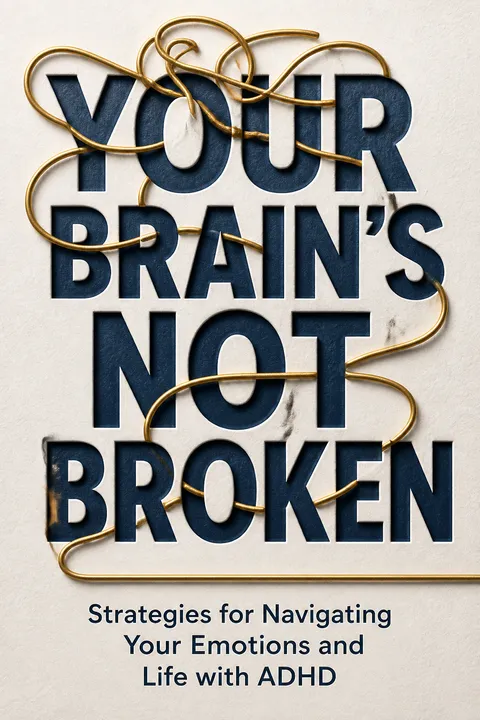
- Focus on ADHD: "Your Brain's Not Broken" by Tamara Rosier is a guide for individuals with ADHD, offering strategies to navigate emotions and life challenges.
- Understanding ADHD: The book emphasizes that ADHD is not a character flaw but a neurological difference that affects attention, motivation, and emotional regulation.
- Practical Strategies: It provides actionable ideas and tools to help manage ADHD symptoms and improve daily functioning.
- Emotional Aspect: The book highlights the often-overlooked emotional volatility associated with ADHD and offers ways to manage it.
Why should I read "Your Brain's Not Broken"?
- Empowerment: The book aims to empower individuals with ADHD by helping them understand their unique brain wiring and how to work with it.
- Practical Advice: It offers practical, relatable strategies that can be applied immediately to improve life with ADHD.
- Emotional Insight: Readers gain insight into the emotional challenges of ADHD, which are often ignored in other resources.
- Supportive Tone: The author, Tamara Rosier, writes in a supportive and understanding tone, making readers feel less alone in their struggles.
What are the key takeaways of "Your Brain's Not Broken"?
- ADHD is Manageable: ADHD is a neurological condition that can be managed with the right strategies and understanding.
- Emotional Regulation: Managing emotions is crucial for individuals with ADHD, as emotional dysregulation can impact all areas of life.
- Divergent Thinking: ADHD brains often engage in divergent thinking, which can be a strength if harnessed correctly.
- Energy Management: Understanding and managing one's energy levels is essential for productivity and well-being.
How does Tamara Rosier suggest managing ADHD emotions?
- Emotional Awareness: Recognize and understand the intensity of emotions and how they affect behavior.
- Emotional Ladder: Use the ADHD Emotional Health Ladder to assess and manage emotional states, moving from reactive to proactive responses.
- Mindfulness Practices: Incorporate mindfulness and breathing techniques to calm the mind and body.
- Reframing Thoughts: Learn to reframe negative thoughts and emotions to reduce their impact on daily life.
What is the Solve-It Grid in "Your Brain's Not Broken"?
- Task Categorization: The Solve-It Grid helps categorize tasks based on their fun factor and emotional intensity.
- Four Quadrants: Tasks are divided into Red (urgent, high emotion), Yellow (boring, low emotion), Blue (relaxing, low emotion), and Green (fun, high emotion) quadrants.
- Energy Management: It aids in managing energy by identifying which tasks drain or recharge one's emotional battery.
- Strategic Planning: Use the grid to plan and prioritize tasks, ensuring a balance of activities across different quadrants.
How does "Your Brain's Not Broken" address motivation issues in ADHD?
- Interest-Based Motivation: ADHD individuals are often motivated by interest rather than importance or deadlines.
- Emotional Hyperarousal: Emotions play a significant role in motivation, with intense feelings driving action.
- Avoid Malicious Motivation: The book warns against using negative emotions like shame or anger as motivators.
- Positive Strategies: It suggests finding personal interest in tasks and using positive reinforcement to boost motivation.
What are some practical strategies from "Your Brain's Not Broken"?
- Task Breakdown: Break tasks into smaller, manageable steps to reduce overwhelm and increase completion rates.
- Time Management: Use timers and schedules to manage time effectively, accounting for ADHD's time perception challenges.
- Routine Establishment: Establish consistent routines to create structure and predictability in daily life.
- Rehearsal Techniques: Mentally rehearse tasks to improve performance and reduce anxiety.
What role does divergent thinking play in ADHD according to Tamara Rosier?
- Creative Strength: Divergent thinking is a natural strength of ADHD brains, leading to creativity and innovation.
- Problem Solving: It allows for unique problem-solving approaches, seeing connections others might miss.
- Potential Pitfalls: Without management, it can lead to distraction and difficulty completing tasks.
- Harnessing Potential: The book offers strategies to harness divergent thinking for productive outcomes.
How does "Your Brain's Not Broken" suggest managing energy levels?
- Battery Awareness: Be aware of personal energy levels and how different tasks affect them.
- Quadrant Balance: Use the Solve-It Grid to balance tasks across quadrants, ensuring a mix of energy-draining and recharging activities.
- Peak Times: Identify and protect peak productivity times for high-focus tasks.
- Rest and Recharge: Incorporate rest and enjoyable activities to recharge emotional and physical energy.
What are the best quotes from "Your Brain's Not Broken" and what do they mean?
- "Your brain is not broken." This quote reassures readers that ADHD is not a defect but a different way of processing the world.
- "Pills don’t teach skills." It emphasizes that while medication can help, developing skills and strategies is crucial for managing ADHD.
- "Emotions are powerful motivators." Highlights the role of emotions in driving behavior and the importance of managing them effectively.
- "Divergent thinking is a strength." Encourages readers to embrace their creative thinking style as a valuable asset.
How does Tamara Rosier address ADHD in relationships?
- Understanding Differences: Recognize and respect the differences in how ADHD affects communication and behavior.
- Setting Boundaries: Establish clear boundaries to protect personal space and emotional well-being.
- Empathy and Patience: Practice empathy and patience, understanding that ADHD behaviors are not intentional.
- Teamwork Approach: Work together as a team to manage ADHD symptoms and support each other.
What resources does "Your Brain's Not Broken" recommend for further support?
- ADHD Coaching: The book highlights the benefits of ADHD coaching for personalized support and strategy development.
- Support Organizations: It recommends organizations like CHADD and ADDA for resources and community support.
- Professional Help: Encourages seeking professional help from therapists or psychiatrists specializing in ADHD.
- Educational Materials: Suggests reading additional books and articles to deepen understanding of ADHD.
Download PDF
Download EPUB
.epub digital book format is ideal for reading ebooks on phones, tablets, and e-readers.








