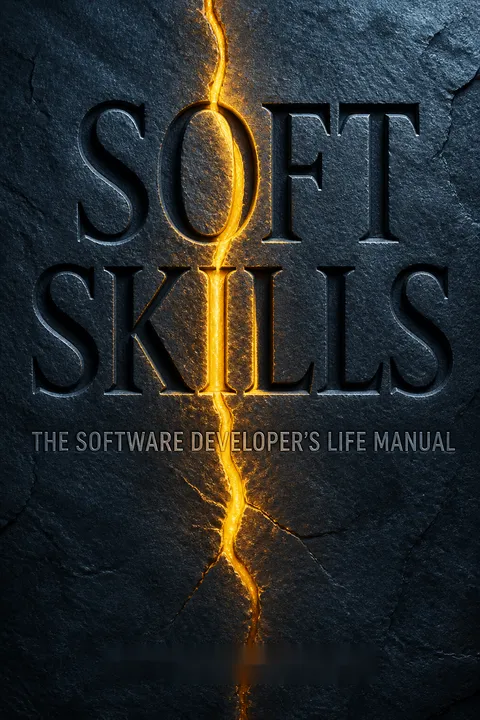


Key Takeaways
Own your career as a business, even when one employer pays you.
Career as enterprise. Sonmez’s central idea is that a developer’s career belongs to the developer, not the current employer. An employer is one customer for a service: turning ideas into working software. That shift encourages active choices about what skills to build, what problems to solve, and how to make that value visible.
Choose a destination. Set a long-term direction, then break it into milestones that can be reviewed and adjusted. Sonmez describes goals as a route across open water: a destination lets a person steer, while smaller targets show whether the course is working. His own weight-loss goal became manageable when divided into repeated five-pound milestones.
What's valuable about the business metaphor is its emphasis on agency: skills, reputation, and relationships accumulate across jobs. It resembles portfolio thinking, where no single client or employer should define the whole asset base. Yet the metaphor has limits. Workers do not control hiring markets, layoffs, discrimination, or family constraints, and treating every setback as a personal business failure can become unfair self-blame. The strongest use of the idea is strategic, not ideological: take responsibility for decisions that are genuinely yours while recognizing that career outcomes are also shaped by institutions and luck.
Specialize, share useful work, and let your reputation negotiate for you.
Make expertise legible. A language name alone, such as C# or Java, may not tell employers what problems a developer can solve. Sonmez recommends choosing a clear specialty, then adjusting its depth to the size of the market. His example is printer software: a narrow skill could be unusually valuable to a small number of employers, provided the developer was willing to search broadly.
Build public proof. A blog, tutorial, talk, or open-source contribution shows ability more clearly than a résumé alone. Sonmez’s personal brand combines a message, visual identity, consistency, and repeated exposure. He recommends giving away most content to build trust. Familiarity also strengthens job prospects: a referral or an existing relationship can make an interview less anonymous and salary discussions more balanced.
This is a practical account of signaling. In labor markets, employers cannot directly observe every candidate’s ability, so visible work and trusted referrals reduce uncertainty. A useful niche makes that signal easier to interpret. The advice is strongest when public work demonstrates real competence rather than merely producing a polished persona. It also deserves a caveat: blogging and speaking reward time, confidence, and access that not everyone has. A thoughtful portfolio, internal documentation, or mentoring can serve the same purpose without requiring a public audience.
Treat collaboration and reliability as core engineering skills.
Code serves people. Requirements come from people, software is read by people, and projects depend on communication. Sonmez urges developers to understand what colleagues care about, listen before arguing, and frame proposals in terms of the other person’s needs. He draws on Dale Carnegie’s advice to recognize others’ contributions and avoid humiliating criticism.
Make professionalism visible. A professional takes responsibility, maintains a quality bar, admits uncertainty, and follows through. Sonmez suggests keeping a work log and sending a concise weekly summary to a manager. That record can make contributions easier to recognize and gives concrete evidence for reviews. In interviews, technical skill matters, but employers also look for someone who can work independently and move tasks forward without constant supervision.
The book usefully treats communication as part of technical work rather than decoration around it. In complex projects, shared understanding is a form of risk control: a clear explanation can prevent expensive rework. Still, avoiding criticism at all costs would be a mistake. Psychological safety depends on being able to raise problems without personal attack, not on suppressing disagreement. The most durable version of Sonmez’s advice is to criticize decisions and evidence with respect, while preserving the other person’s dignity and making the next step clear.
Test independence before exchanging a paycheck for uncertainty.
Know the trade-offs. Employees get more predictable income and less business overhead. Independent consultants gain control over clients and rates, but must find work, handle taxes, and pay for nonbillable time. Entrepreneurs may build products with larger upside, but income and success are less certain. Sonmez cites a roughly 75% failure estimate for venture-backed startups, underscoring that a startup is a high-risk choice, not a guaranteed escape.
Build a runway. Before quitting, try the business on the side. A fictional freelancer in the book saves a year of essential expenses and spends six months building client work before leaving a job. The point is to test both demand and the workload. Sonmez estimates a freelancer may need to bill around twice an employee’s hourly wage to cover benefits, taxes, overhead, and gaps between paid projects.
This is staged commitment: a small experiment buys information before a large irreversible decision. Entrepreneurship research often distinguishes a testable hypothesis from a founder’s attachment to an idea, and side work can reveal whether customers will actually pay. The approach is not cost-free, however. Maintaining a job while building a business can consume evenings, family time, and health. A runway should include more than cash: it should account for contract restrictions, insurance, caregiving, and a credible plan for returning to employment if the experiment fails.
Build something early, then study the questions your experiments reveal.
Plan before diving in. Sonmez’s 10-step process begins by surveying a subject, narrowing its scope, defining what success looks like, finding varied resources, creating a learning plan, and filtering those resources. This avoids the common trap of trying to learn an entire technology without knowing what practical ability is needed.
Learn through cycles. For each topic, learn enough to begin, experiment, study what the experiment exposes, and teach the result. Sonmez calls this sequence learn, do, learn, teach. When learning a programming language, the first target might be a small working program, not mastery of every feature. He says this approach helped him learn technologies quickly enough to produce dozens of developer courses, because it tied study to concrete questions and useful outcomes.
The method combines goal-directed study with active learning. A small project creates feedback, while explaining the result forces retrieval and exposes gaps that passive reading can hide. This is more than a motivational trick: knowledge becomes easier to use when it is practiced in the setting where it matters. The caution is that experimentation without a sound reference can reinforce misconceptions. The best loop alternates exploration with reliable documentation, code review, and tests, especially when errors carry safety, security, or financial consequences.
Count focused work, then set quotas that survive ordinary weeks.
Measure attention, not busyness. The Pomodoro Technique divides work into a 25-minute focused interval followed by a short break, with a longer break after four intervals. Sonmez found it most useful when he counted completed intervals and used them to estimate capacity. His own target was about 10 intervals a day and 50 to 55 a week, not the theoretical maximum suggested by an eight-hour schedule.
Make progress repeatable. A quota sets how often a recurring task must happen in a fixed period. Sonmez used three weekly course modules as a production target and one chapter a day while writing this book. He also plans work on a Kanban board, breaking projects into small tasks and leaving some slack. A sustainable target is more useful than a heroic one that collapses after a few days.
The system turns vague effort into observable behavior, a useful move in project management and behavior design. Counting focused intervals can reveal that a calendar full of work is not the same as sustained attention. Quotas also reduce the daily negotiation over whether to begin. But a timer measures input, not value: ten intervals spent polishing low-priority work may be worse than four spent solving the right problem. Measures should stay subordinate to outcomes, and quotas need room for interruptions, recovery, and work whose progress cannot be neatly counted.
Shrink intimidating projects into clear steps, and act while the cost is low.
Turn size into sequence. A large task is often vague as well as frightening. Sonmez broke a client’s continuous-integration project into steps: first make the code build from the command line, then configure a build server to retrieve it, then connect those pieces. Each small task had a clearer definition and could expose missing information before the project was far along.
Prefer motion to paralysis. Sonmez tells of a couple who argued for years over whether to install a curtain or glass enclosure in a guest shower, leaving it unusable. When choices are reversible and the downside is limited, a reasonable decision can create momentum and teach what to change. A routine can preserve that momentum: scheduled daily or weekly effort turns a distant goal into repeated, finishable work.
Decomposition is both a psychological aid and a way to improve project control. Small deliverables create earlier feedback, making errors cheaper to correct and estimates less speculative. The decision rule needs one distinction: reversible choices invite quick experiments, while decisions with lasting financial, legal, or human costs warrant more deliberation. In software, a prototype is often a good reversible move; deploying unreviewed changes to production is not. The useful principle is not speed for its own sake, but matching the depth of analysis to the cost of being wrong.
Use paychecks to buy future income, not just larger monthly payments.
Think beyond the next bill. Sonmez contrasts assets that generate income with liabilities that consume it. A new car can feel affordable when its cost is converted into monthly payments, although a cheaper used car may provide similar transportation and leave more money to save or invest. He notes that working 30 years while paid every two weeks means 780 paychecks, so repeated decisions matter.
Build financial options. The author describes combining software-course royalties, app sales, blog income, and rental properties to reach about $5,000 in monthly passive income and leave full-time employment at 33. His route included years of difficult property management, debt, and hard work. The story illustrates diversification and long-term planning, not a guaranteed formula. Sonmez favors rental real estate, but also discusses retirement accounts, stocks, debt, and the importance of calculating expenses.
The strongest lesson is about cash flow and optionality: income that does not depend on the next hour of labor can widen career choices. The personal story makes that compounding process concrete, while also showing that early retirement was neither immediate nor effortless. The investment advice is notably shaped by Sonmez’s real-estate experience and U.S. financial context. Rental property brings concentration, leverage, vacancies, repairs, and illiquidity, while retirement accounts have tax rules that vary by country. Readers should treat the examples as prompts for due diligence, not individualized financial recommendations.
Treat health as working equipment, and make the plan livable.
Set measurable targets. Sonmez argues that fitness affects energy, confidence, and the ability to work, especially in a sedentary profession. Choose one primary goal, such as improving cardiovascular fitness, gaining strength, or losing fat, then set milestones and track progress. He describes losing about 90 pounds by aiming for five pounds every two weeks rather than fixating on the full amount.
Start with basics. The book explains weight change through energy intake and expenditure, while noting that calorie estimates are imperfect. It recommends regular exercise, progressive resistance training, and a diet that can be maintained after a goal is reached. Sonmez also points to a Stanford study in which walking improved performance on creativity tasks by about 60%, and gives practical options such as walking meetings, a standing desk, or short runs.
Linking physical health with professional capacity is persuasive because attention, mood, and stamina are embodied, not purely mental resources. The emphasis on milestones and repeatable routines can help a desk-bound worker replace abstract intentions with specific behavior. The calorie model is a useful starting approximation, but bodies adapt, measurement is noisy, and weight is not a complete measure of health. Fitness advice should also accommodate disability, injury, medication, and individual medical needs. A sustainable minimum is generally more useful than an extreme plan that cannot survive normal life.
Act with honest confidence, and let failure supply the next lesson.
Practice the person you want to become. Sonmez’s phrase fake it till you make it does not mean lying about skills. It means entering unfamiliar situations with the confidence to learn, while being candid about what is not yet known. He connects this to self-image: repeated behavior can make a new identity feel more natural, whether that means speaking publicly or tackling an unfamiliar technology.
Separate failure from finality. A first presentation may be awkward; a new project may not work. Those results are information, not proof that the person is incapable. Sonmez urges readers to take small risks, accept rejection, and persist. He applies the same logic to relationships: confidence and mutual interest are more constructive than treating one person’s response as a verdict on one’s worth.
This advice aligns with self-efficacy, the belief that capability can grow through effort and feedback. Confidence is most credible when it is grounded in evidence of learning, not merely repeated self-affirmation. The book’s optimism is useful as an antidote to avoidance, but it should not imply that mindset alone controls outcomes. Structural barriers, illness, and other people’s choices are real. A sound practice is to focus on controllable behaviors, assess results honestly, and revise the approach without converting one failure into a global judgment about the self.
Analysis
Soft Skills is less a single productivity system than a field manual for a developer who wants greater agency across work, money, health, and identity. Its organizing claim is that coding skill alone does not determine a career. Relationships shape collaboration and hiring; reputation changes who notices a developer; financial choices determine how much freedom a paycheck buys; and routines determine whether intentions become durable output. The book’s strongest recurring move is to replace abstraction with an operating procedure: define a destination, break it down, measure behavior, and review the result.
Its narrative gains force from Sonmez’s own uneven path. He recounts failed ventures, difficult rental properties, and the unusually productive stretch that yielded dozens of training courses. The story makes opportunity look neither purely lucky nor fully controllable. Preparation, networking, persistence, and a timely connection all mattered. That combination is more credible than a simple success formula, though the author sometimes draws broad lessons from personal experience more confidently than the evidence warrants.
The book is also unusually broad, which creates both its value and its risk. A developer can find useful guidance on negotiating, learning, remote work, exercise, and investing in one place. But financial and fitness claims are time-sensitive, country-specific, or dependent on individual circumstances. The original text’s enthusiasm for real estate and early retirement should not be mistaken for neutral financial planning. Its more transferable insights are process-oriented: understand costs, preserve options, test assumptions, and avoid decisions made only for immediate comfort.
The adaptation’s central takeaway is therefore not that every reader should become an entrepreneur, publish a blog, or retire early. It is that a technical career becomes more resilient when a person deliberately develops the capabilities around the code: communication, self-directed learning, focused execution, financial literacy, health, and the courage to revise a failing plan. The book is best used as a menu of experiments, not a universal blueprint.
Review Summary
Soft Skills: The Software Developer's Life Manual receives mixed reviews. Many praise its comprehensive coverage of career development, productivity, finance, and health for developers. Readers appreciate the practical advice and motivation it provides, particularly for early-career professionals. However, some criticize the book for being too broad and superficial, lacking depth in certain topics. The financial advice is particularly divisive, with some finding it valuable and others questioning its credibility. Despite its flaws, many readers find the book useful for gaining a holistic perspective on a developer's life and career.
People Also Read










Glossary
10-step process
structured self-learning planSonmez’s method for learning a subject in a focused, practical way. The first six steps survey the topic, narrow its scope, define success, gather resources, create a learning plan, and select the most useful resources. The final four steps are repeated for each learning module: learn enough to begin, experiment, study what is needed for a useful result, and teach the material.
learn, do, learn, teach (LDLT)
practice-centered learning cycleA repeated learning sequence used in the 10-step process. First, acquire enough information to begin. Next, experiment and notice questions or problems. Then study the relevant material in greater depth and apply it to something useful. Finally, teach the result through a conversation, post, presentation, or demonstration. Teaching tests understanding and exposes gaps that passive review can leave hidden.
Pomodoro Technique
timed focus intervalsA work method that uses a timer to protect focused effort. In the version described in the book, a person works on one task for 25 minutes, takes a five-minute break, and takes a longer break after four work intervals. Sonmez emphasizes tracking completed intervals to estimate capacity, plan tasks, and judge effort, rather than treating an unchecked to-do list as a measure of productivity.
quota system
recurring output commitmentSonmez’s method for ensuring steady progress on repeatable work. Choose a task, specify the time interval, set a feasible count for that interval, and commit to completing it. Examples include publishing one post each week or completing a set number of course modules. Quotas can be adjusted between intervals, but changing them mid-interval weakens the commitment.
inbound marketing
attracting interested clientsA marketing approach that draws potential customers toward a service by offering useful content or resources. For a developer, this can include blog posts, tutorials, talks, books, webinars, or podcasts. The content helps an audience discover the developer and assess their expertise. Compared with directly chasing clients, inbound marketing can take longer to produce results but may create a steady source of interested leads.
Kanban board
visual work-tracking boardA board that organizes tasks into columns representing their status or planned timing. Sonmez adapts the idea for weekly planning, with columns for individual days, current work, completed work, and tasks moved to the next week. Each task is represented separately, making workload and progress visible and allowing priorities to be rearranged when plans change.
floating
rental costs roughly coveredSonmez’s informal term for a rental property whose rent covers its ongoing costs, including the mortgage and other expenses, but produces little or no extra monthly cash. A property that floats may still build equity as a loan is paid down, but unexpected repairs, vacancies, taxes, or financing changes can turn an apparently balanced investment into a cash drain.
assets and liabilities
income-producing versus costly holdingsSonmez uses these terms as a personal-finance lens rather than strictly in the accounting sense. An asset is something whose income or utility exceeds its costs of ownership; a liability costs more than the value it provides. Under this framing, rental property or dividend-paying investments may be assets, while unnecessary car payments or expensive debt may be liabilities.
self-image
internal picture of oneselfThe book’s term for a person’s underlying view of who they are and what they can do. Sonmez argues that this picture can influence behavior by making some actions feel natural and others impossible. He recommends deliberately practicing desired behaviors and using repeated reminders to reshape that view, while distinguishing confidence-building from falsely claiming skills or experience.
FAQ
What's Soft Skills: The Software Developer's Life Manual about?
- Holistic Development: The book emphasizes that success in software development requires more than just technical skills, covering career management, personal finance, fitness, and mental well-being.
- Focus on Self-Improvement: John Z. Sonmez encourages continuous learning and self-improvement, urging developers to enhance all areas of their lives.
- Practical Advice: It offers actionable strategies for career enhancement, productivity improvement, and maintaining a healthy work-life balance.
Why should I read Soft Skills: The Software Developer's Life Manual?
- Comprehensive Resource: It serves as a one-stop guide for improving both technical and soft skills, as well as overall life management.
- Real-World Experience: The author shares insights from his own experiences and those of other successful developers, making the advice relatable.
- Diverse Topics: The book covers a wide range of topics, from marketing yourself to managing finances and health, crucial for personal and professional success.
What are the key takeaways of Soft Skills: The Software Developer's Life Manual?
- Career Management: Developers should actively manage their careers by setting clear goals and seeking growth opportunities.
- Importance of People Skills: Effective communication and interpersonal skills are critical for success in software development.
- Continuous Learning: Sonmez emphasizes lifelong learning and adaptability to stay relevant in the tech landscape.
What are the best quotes from Soft Skills: The Software Developer's Life Manual and what do they mean?
- Ownership of Career: "The biggest mistake that you can make is to believe that you are working for somebody else." This highlights the importance of treating your career as a business.
- Value to Others: "If you help enough people get what they want, you will get what you want." This suggests that providing value to others is key to personal success.
- Professional Expertise: "You aren’t a professional resume writer." This encourages leveraging professional expertise for tasks like resume writing.
How does [Author] suggest managing your career in Soft Skills: The Software Developer's Life Manual?
- Set Clear Goals: Define career goals clearly and create a plan to achieve them, regularly reviewing and adjusting as necessary.
- Take on Responsibility: Actively seek opportunities to take on more responsibility to demonstrate value to the organization.
- Increase Visibility: Keep a record of accomplishments and share them with management to increase visibility and recognition.
What methods does Soft Skills: The Software Developer's Life Manual recommend for improving productivity?
- Time Management Techniques: Discusses strategies like the Pomodoro Technique, which involves working in focused bursts followed by short breaks.
- Developing Good Habits: Emphasizes forming productive habits and routines to support consistent work output and minimize distractions.
- Accountability: Suggests tracking progress and staying committed to personal productivity plans.
How can I market myself as a software developer according to Soft Skills: The Software Developer's Life Manual?
- Build a Personal Brand: Create a personal brand that reflects unique skills and values, with a clear message and visual identity.
- Utilize Blogging and Social Media: Engage on platforms to share knowledge and connect with others in the industry.
- Provide Value: Offer value through free content, advice, or services to build a reputation and attract opportunities.
What does [Author] say about the importance of fitness in Soft Skills: The Software Developer's Life Manual?
- Health Impacts Performance: Physical health directly affects mental performance and productivity, so fitness should be a priority.
- Setting Fitness Goals: Recommends setting specific fitness goals and creating a plan to achieve them, similar to career goals.
- Incorporating Fitness: Suggests practical ways to integrate fitness into a busy schedule, like using standing desks or short workouts.
How does Soft Skills: The Software Developer's Life Manual address financial literacy for developers?
- Understanding Personal Finance: Emphasizes financial literacy, including budgeting, saving, and investing for long-term stability.
- Negotiating Salary: Provides strategies for salary negotiation and understanding one's worth in the job market.
- Investing Wisely: Discusses investment options like real estate and stock market basics to make informed financial decisions.
What strategies does Soft Skills: The Software Developer's Life Manual suggest for dealing with failure?
- Embrace Failure as Learning: Encourages viewing failure as a necessary part of the learning process and a stepping stone to success.
- Resilience and Persistence: Highlights the importance of resilience and the ability to bounce back from setbacks.
- Reflect and Adjust: Advises reflecting on failures to learn from the experience and adjust future strategies.
What networking strategies does [Author] recommend in Soft Skills: The Software Developer's Life Manual?
- Utilize Social Media: Suggests having a presence on platforms like Twitter and LinkedIn to connect with professionals and share work.
- Engage in Communities: Recommends joining user groups and attending meetups to build relationships and learn from others.
- Ask for Endorsements: Encourages requesting endorsements on LinkedIn to enhance your profile and provide social proof of skills.
What is the significance of mindset in Soft Skills: The Software Developer's Life Manual?
- Mindset Shapes Reality: Discusses how a positive mindset can influence outcomes, encouraging a growth-oriented perspective.
- Overcoming Challenges: A strong mindset helps face challenges with resilience, viewing them as growth opportunities.
- Self-Image: Highlights the importance of a positive self-image, impacting actions and success significantly.
About the Author

Download PDF
Download EPUB
.epub digital book format is ideal for reading ebooks on phones, tablets, and e-readers.








