

Plot Summary
Prologue
In the theatrical prelude, a director, a poet, and a comic performer dispute whether a play should satisfy the crowd, preserve artistic seriousness, or do both. The action then shifts to Heaven, where Mephistopheles argues that human beings misuse reason and remain dissatisfied.
The Lord allows him to tempt Faust, trusting that even a confused seeker can still recognize the right path. Their wager gives Faust’s private crisis a cosmic frame: his hunger for more becomes a test watched by powers that do not agree on what human striving means.
The opening makes the play’s form part of its argument. The director wants spectacle, the poet wants inward truth, and the comic performer knows that audiences also want pleasure; the drama will refuse to choose just one. Heaven’s wager then turns Faust into both a person and an experiment. The Lord permits temptation without claiming that suffering is harmless, while Mephistopheles treats dissatisfaction as evidence of human weakness. Their arrangement establishes the central moral danger: Faust’s restless desire may produce insight, but the people caught in its wake risk becoming mere proof in an argument about him.
The Scholar at the Edge
Faust has mastered philosophy, law, medicine, and theology, yet sees no improvement in himself or the students he teaches. Surrounded by books and instruments, he turns to magic in search of the forces that hold the world together.
A cosmic sign briefly fills him with confidence; when he summons the Earth Spirit, however, its appearance overwhelms him and it rejects his claim to kinship. Wagner, his dutiful assistant, interrupts the encounter with academic chatter.
Later, as townspeople celebrate Easter, Faust admits that his father’s remedies may have killed more people than they cured, despite the crowd’s gratitude. The memory deepens his distrust of inherited knowledge. He raises a poison cup, but Easter music stirs childhood memories and draws him back from death.
Faust’s crisis is not simple ignorance. He knows enough to recognize that knowledge can be sterile, inherited, or actively harmful, and this awareness leaves him without a trustworthy standard for action. His father’s medical failures sharpen the point: expertise can carry authority while producing damage. The Earth Spirit’s rejection punctures Faust’s fantasy that intensity grants access to divine powers. Yet Easter music reaches him through memory rather than argument, briefly reconnecting him to other people and to a shared ritual. The scene therefore places two forms of inheritance in tension: intellectual systems that disappoint him and communal traditions that still have emotional force.
The Poodle's Bargain
A black poodle follows Faust and Wagner home from their Easter walk. Once Faust is alone, the dog swells into a monstrous shape and reveals Mephistopheles, who has been caught by a gap in the protective pentagram at the threshold. After escaping by trickery, Mephistopheles offers to serve Faust on earth in return for service beyond it.
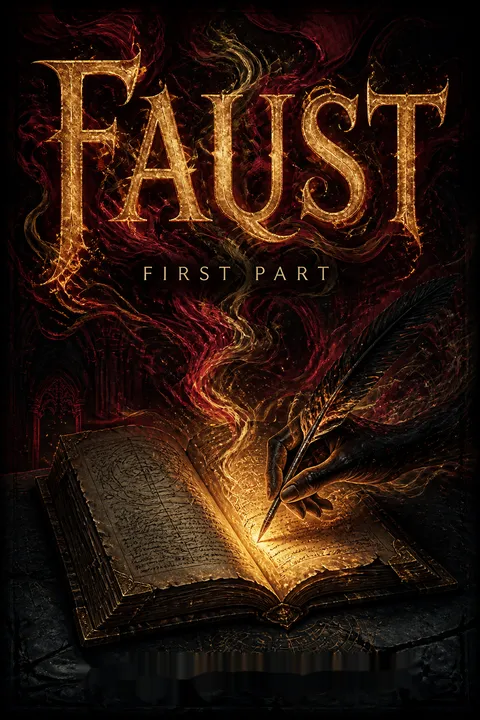
Faust proposes a wager: if any experience makes him wish it would last, Mephistopheles may claim him. He signs the agreement in blood, though his attention is fixed on earthly intensity rather than the afterlife. Before they leave, Mephistopheles disguises himself as Faust and misleads a new student with cynical advice about university learning. Faust and the devil then set out together.
The agreement converts Faust’s dissatisfaction into a rule that can be tested. He does not ask for a particular achievement or pleasure; instead, he defines failure as the moment he becomes content. That condition makes perpetual appetite look like freedom, even as it binds him to a logic of endless escalation. The blood signature nods to the older Faust legend, but Faust’s casual attitude toward its consequences weakens the pact’s solemnity. Mephistopheles’s advice to the student extends the temptation beyond Faust: institutional learning can be reduced to formulas, labels, and opportunism. The devil’s method is not merely to corrupt knowledge, but to make its corruption seem practical.
Wine, Witches, and Helen
Mephistopheles brings Faust to a Leipzig cellar, where he entertains drinkers with wine conjured from holes in their table. When the men turn on him, he bends their perceptions and escapes with Faust, leaving them bewildered by the vanished feast. At a witch’s kitchen, Faust objects to the grotesque animals and the witch’s absurd ritual, but he drinks the potion Mephistopheles secures.
A mirror then shows him an idealized woman whose beauty overwhelms him. The potion renews his senses, and the vision gives his renewed appetite a target. Mephistopheles promises that a real woman will soon stand before him. Faust leaves the kitchen no longer pursuing only knowledge or cosmic power; he is prepared to pursue desire through another person.
The cellar and the kitchen stage two versions of appetite. The drinkers accept an illusion because it satisfies them in the moment, while Faust rejects their coarse pleasures but willingly enters a more consequential enchantment. His rejuvenation is presented not as restored wisdom but as sharpened capacity to desire. The mirror’s ideal woman arrives before Gretchen does, so Faust first encounters her as an image shaped by his own longing. That order matters: the person he will meet is already at risk of being measured against a fantasy. Mephistopheles’s magic does not create Faust’s hunger; it gives that hunger speed, youth, and a convenient object.
Gretchen and the Jewels
On the street, Faust approaches Margarete, known as Gretchen, but she refuses his offer to escort her home. Mephistopheles learns that she is young and devout, then helps Faust pursue her by leaving a jewel box in her room. Gretchen admires the ornaments, but her mother turns the first set over to the Church. Mephistopheles supplies another box, and Gretchen’s neighbor, Marthe, lets her wear the jewels privately.
Mephistopheles also invents a story that Marthe’s absent husband has died in Padua, then arranges for Faust to pose as a witness to the supposed death. Marthe agrees to host the meeting. The gifts and the false testimony bring Faust within Gretchen’s domestic circle while disguising his courtship as a respectable visit.
Gretchen’s first refusal establishes that she is not simply waiting to be swept into Faust’s life. Mephistopheles works around that boundary by changing the material and social conditions of their meeting. The jewels promise Gretchen a glimpse of status that her ordinary labor cannot provide, while the Church’s seizure of the first box exposes a competing institution eager to claim moral authority and material wealth. Marthe’s loneliness makes her susceptible to the fabricated death notice, and Mephistopheles uses that vulnerability to arrange access. Courtship becomes a chain of manipulations in which ordinary desires, including beauty, companionship, and security, are converted into openings for Faust.
A Garden Made for Two
At Marthe’s garden, Faust and Gretchen walk together while Mephistopheles keeps Marthe occupied. Gretchen describes the chores she manages at home and the care she gave her younger sister after their mother fell ill.
Her tenderness and modesty move Faust, and their guarded meeting gives way to mutual affection. Gretchen later meets him in a summerhouse and returns his kiss. Yet Mephistopheles has arranged the encounter through a lie about Marthe’s husband, and Faust has already treated Gretchen as the answer to the idealized woman he saw in the witch’s mirror.
Her trust is genuine; his motives remain entangled with appetite and the wager. Their intimacy begins under conditions she cannot see, making her openness both real and dangerously unequal.
The garden scene gives Gretchen a life beyond the role Faust assigns her. Her account of household work and the sister she raised reveals practical competence and an ethic of care, not merely innocence. Faust responds to these qualities, but the surrounding deception prevents his admiration from becoming an equal relationship. He has already imagined a perfect woman, and Mephistopheles has engineered the circumstances that allow him to approach this particular one. The contrast between Gretchen’s candid self-disclosure and Faust’s concealed purpose makes intimacy ethically unstable. Affection may be sincere in the moment, but sincerity cannot erase the imbalance created when one person controls the terms of the encounter.
The Sleeping Draught
Gretchen worries that Faust does not share her religious beliefs, and she distrusts Mephistopheles, whose presence makes her feel that something is wrong. Faust evades her questions with a private, expansive account of spiritual feeling rather than a clear declaration of faith.
When Gretchen says her mother is a light sleeper, Faust gives her a small bottle and claims its contents will make the older woman sleep safely. Trusting him, Gretchen adds the drops to her mother’s drink so she and Faust can be alone.
Her mother dies. Faust, meanwhile, is drawn away from Gretchen into solitary communion with nature, while Mephistopheles mocks his idealized self-image and reminds him of her longing. The secret meeting has become a harm Gretchen cannot undo.
Gretchen’s suspicion is precise: she notices both Faust’s religious evasions and Mephistopheles’s corrosive presence. Faust answers the first concern with eloquent ambiguity, giving her emotional resonance where she seeks moral clarity. The sleeping draught turns that imbalance into action. Gretchen risks her mother’s safety because Faust presents the danger as manageable and because she trusts him more than her own misgivings. His retreat into nature afterward makes his divided self visible: he can lament the harm he may cause while continuing to pursue experience on his own terms. The scene distinguishes remorse from responsibility. Feeling troubled does not repair the consequences of an act arranged through manipulation.
Valentin's Last Judgment
At the town well, Lieschen gossips about another unmarried woman who has become pregnant and been abandoned. Gretchen recognizes that she once judged such women without mercy, and now fears the same disgrace.
She prays before an image of the sorrowing Virgin, then faces her brother Valentin, a soldier who feels his family’s honor has been stained. When Faust and Mephistopheles approach, Valentin challenges them. Mephistopheles disables him and Faust wounds him; as he dies, Valentin publicly condemns Gretchen.
Later, during a church service, an evil presence forces her to confront her mother’s death, her brother’s blood, and her pregnancy. The music and accusations overwhelm her until she faints. The consequences of her relationship have become both communal punishment and private terror.
Gretchen’s collapse begins before the church scene: the wellside gossip gives her a social script for shame, and she recognizes herself in the woman she once condemned. Valentin then makes that script violent. His defense of family honor depends on humiliating his sister, while Faust and Mephistopheles answer accusation with a killing that compounds her isolation. In the cathedral, religious imagery does not console Gretchen; it gives her guilt an absolute, inescapable scale. Her fainting registers the body’s limit under social and spiritual prosecution. Goethe places public judgment, male violence, and religious fear together, showing how each can intensify a young woman’s vulnerability without offering her a path back.
The Brocken's Pale Vision
Mephistopheles takes Faust to the witches’ gathering on the Brocken during Walpurgis Night. The mountain’s shifting shapes, dancing crowds, and grotesque pageant pull Faust into spectacle. At the celebration, he catches sight of a pale, slow-moving girl who resembles Gretchen, with a red mark around her throat.
Mephistopheles dismisses the image as an apparition and draws Faust away. After the revels, Faust learns that Gretchen has been imprisoned for killing her child.
Her mother is dead, Valentin is dead, and now the baby is dead as well. Enraged that Mephistopheles concealed her worsening condition, Faust demands that the devil take him to the prison. The vision he ignored becomes the last warning before he confronts the real cost of his escape.
Walpurgis Night offers Faust a world in which sensation multiplies faster than reflection. The spectacle does not simply tempt him with pleasure; it makes distraction feel like participation in a larger, freer reality. Gretchen’s pale image interrupts that illusion with a specific sign of injury, but Mephistopheles reframes it as meaningless magic, and Faust allows himself to be diverted. His later fury is real, yet it arrives after the damage is done. The sequence exposes a recurring moral convenience: Faust can experience himself as horrified by suffering while remaining susceptible to diversions that keep him from acting. The vision is not a mystery to solve so much as a warning he chooses not to heed.
The Prison Door Opens
Mephistopheles clouds the jailer’s senses while Faust enters Gretchen’s cell with keys. Gretchen, disoriented and convinced at first that an executioner has come, gradually recognizes Faust. Her chains fall away, but she cannot return to the life they once shared.
She admits that she killed their child and remembers the mother and brother who also died; she asks Faust to see that her family is buried properly. Faust urges her to flee, while she fears capture and cannot make herself leave.
As dawn approaches, Mephistopheles warns that delay will endanger them. Gretchen turns instead to divine judgment and protection. A voice from above declares her saved. Mephistopheles takes Faust away, while Gretchen’s fading call follows him from the cell.
The rescue fails as a practical escape because Gretchen’s inner world has been altered beyond Faust’s power to reverse. She recognizes him, but recognition cannot restore trust, safety, or a future outside prison. Her fragmented memories of the child and family reveal how guilt and grief have overtaken ordinary time. Faust offers movement, yet he cannot give her a life in which the consequences disappear. Her final appeal shifts authority away from him and Mephistopheles toward a divine judgment the play leaves mysterious. The declaration of salvation does not cancel her suffering or make Faust’s conduct harmless. It separates spiritual mercy from the human damage that no last-minute rescue can undo.
Analysis
Faust, Part I sets intellectual hunger against the claims of ordinary human life. Faust is not punished simply for asking difficult questions; the danger begins when he treats dissatisfaction as proof that every limit should be crossed. His wager makes this posture explicit. If contentment counts as defeat, then no person, pleasure, or achievement can be encountered as an end in itself. Everything becomes material for a further test. Gretchen’s tragedy gives that abstraction a human scale. Her affection is sincere, but the courtship is shaped by unequal knowledge: Faust and Mephistopheles know about the gifts, the false story, and the sleeping draught, while Gretchen must make consequential choices with incomplete information. Her errors are real, yet they occur inside pressures made by seduction, domestic vulnerability, public sexual judgment, and religious fear. The play does not distribute responsibility evenly. Faust’s capacity for regret does not undo the harm he helped cause, and Mephistopheles’s wit does not make his manipulation morally weightless.
The work also resists a clean division between spiritual and secular authority. Easter music preserves a bond Faust cannot explain away, while the Church’s seizure of Gretchen’s jewels exposes institutional appetite. The cathedral’s terror magnifies her guilt, but the final declaration of salvation suggests a mercy that human judgment cannot claim to control. That ending offers no easy repair: Gretchen remains imprisoned, and Faust leaves with Mephistopheles. The distinction between spiritual deliverance and worldly consequence is therefore essential. The drama grants grace without pretending that grace restores the lives damaged by Faust’s striving.
Review Summary
Faust is widely regarded as a masterpiece of German literature, though reactions vary. Many praise Goethe's poetic language, philosophical depth, and exploration of human nature. The complex narrative follows Faust's deal with Mephistopheles, blending tragedy, comedy, and social commentary. While some find it challenging or confusing, particularly Part II, others consider it a profound meditation on ambition, knowledge, and morality. The work's enduring influence and literary significance are widely acknowledged, even by those who struggle with its dense content.
People Also Read



Characters
Faust
Restless scholarFaust is a celebrated scholar who has exhausted the confidence that academic mastery once promised him. He wants direct access to the forces of life, not more inherited explanations, and his frustration makes him vulnerable to Mephistopheles’s offer of experience. He can feel awe before nature, tenderness toward Gretchen, and shame about the harm he may cause, but these feelings do not reliably govern his choices. His central contradiction is that he longs to encompass the whole of human experience while treating particular people as instruments of that ambition. He is intellectually alert and emotionally intense, yet often mistakes intensity for insight and remorse for responsibility.
Mephistopheles
Tempting devilMephistopheles is a devil who specializes in skepticism, mockery, and the manipulation of human appetites. He serves Faust under the terms of their wager, offering access to pleasures and experiences while undermining Faust’s confidence in ideals, institutions, and other people. His cleverness is practical rather than grand: he uses disguises, forged stories, magical spectacles, and social weaknesses to make wrongdoing easier. He treats destruction as a natural counterforce to creation, yet repeatedly finds that life continues despite his efforts to negate it. His jokes expose Faust’s vanity, but they also shield him from sympathy for those harmed by the schemes he helps set in motion.
Margarete, or Gretchen
Devout young womanMargarete, usually called Gretchen, is a young woman whose religious faith, household responsibility, and modest social position shape how she understands the world. She works hard, cares for her family, and approaches love with a mixture of curiosity and caution. Her questions about Faust’s beliefs and her discomfort around Mephistopheles show that she is perceptive, even when affection makes her vulnerable to persuasion. She is not defined only by innocence: she has strong convictions, an active conscience, and a history of judging others by the moral standards she has inherited. Her relationship with Faust places those values under pressure, exposing the costs of unequal power and concealed intentions.
Wagner
Academic assistantWagner is Faust’s learned, dutiful assistant, more comfortable with books and formal study than with the unruly world outside. He respects accumulated knowledge and hopes to become more accomplished through disciplined reading. His exchanges with Faust reveal the difference between scholarship as a stable profession and Faust’s demand for immediate, total understanding. Wagner is not malicious; his limitation is that he trusts systems Faust has come to distrust. His presence also makes Faust’s isolation visible, since even a familiar companion cannot meet the deeper crisis driving his search.
Marthe
Gretchen's neighborMarthe is Gretchen’s neighbor, a married woman whose husband has been absent for a long time. She wants the facts of her domestic life made official, and Mephistopheles exploits that wish with a fabricated death notice. Marthe is sociable, attentive to appearances, and willing to help Gretchen enjoy the jewels that have entered the girl’s life. Her loneliness does not make her foolish, but it does leave her receptive to the company and assurances Mephistopheles offers. She helps create the setting for Faust and Gretchen’s meetings without understanding the larger deception behind them.
Valentin
Protective soldier brotherValentin is Gretchen’s soldier brother, proud of his reputation and deeply invested in the honor he believes her virtue gives the family. His protective affection is real, but it is bound to a rigid code that gives him little room to understand her circumstances. Once he believes her name has been stained, he turns from brotherly pride to public condemnation. His role exposes how social honor can become a form of control, especially when a woman’s conduct is treated as the measure of a family’s standing.
The Lord
Heavenly wager-makerThe Lord frames Faust’s story by allowing Mephistopheles to test him. He believes human beings may err while striving and does not equate confusion with a settled rejection of the good. His confidence contrasts with Mephistopheles’s cynicism, though the wager places a human life inside a cosmic contest. The Lord’s role is less that of an intervening rescuer than an authority who permits the test and leaves its consequences to unfold.
The Earth Spirit
Unreachable natural forceThe Earth Spirit appears when Faust tries to summon a power that embodies the active processes of nature. Faust initially expects kinship, but the Spirit’s presence overwhelms him and it rejects his claim to understand it. The brief encounter marks the limit of Faust’s confidence and distinguishes intellectual longing from genuine access to the powers he admires.
The Witch
Potion-making sorceressThe Witch runs the strange kitchen where Faust drinks a potion that renews his senses. Her rituals are deliberately theatrical and nonsensical, but the mixture serves Mephistopheles’s purpose. She is a comic figure within the supernatural world, representing the uneasy blend of folk magic, performance, and practical consequence.
Lieschen
Gossiping acquaintanceLieschen is an acquaintance Gretchen meets at the well. She recounts the public disgrace of another young woman who has become pregnant, treating the story as evidence that the woman deserves her fate. Her judgment gives Gretchen an unwelcome mirror of her own situation and prompts her to recognize how quickly a community can turn against a woman.
The Student
Naive university newcomerThe Student seeks guidance after arriving at university, hoping to learn broadly and make a good start. Mephistopheles, disguised as Faust, redirects that ambition into cynical lessons about academic disciplines and language. His brief visit shows how easily the devil’s wit can masquerade as experienced counsel.
Plot Devices
Faust's wager
Appetite as a testMephistopheles offers to serve Faust in earthly life in exchange for service beyond it. Faust adds a wager: the devil may claim him if he ever becomes so satisfied with a moment that he wants it to last. This condition turns experience itself into a contest. Faust believes that his desire will never rest, but the wager also encourages him to treat each new pleasure as something to consume and surpass. The blood signature connects the bargain to the older Faust legend, while Faust’s indifference to its consequences shows how lightly he treats the danger he has invoked.
The witch's potion
Desire made urgentThe Witch’s potion rejuvenates Faust and intensifies his physical appetite. Before meeting Gretchen, he sees an idealized woman in a magic mirror, so desire begins as a projection rather than a response to a known person. Mephistopheles then promises to bring the image into reach. The device links Faust’s inner hunger to the later courtship and underscores how magic accelerates an impulse without giving it wisdom or ethical direction.
The jewel boxes
Courtship by manipulationMephistopheles places jewels in Gretchen’s room to attract her, then replaces the first set after her mother gives it to the Church. The ornaments appeal to Gretchen’s wish to feel beautiful and admired, while Marthe helps her wear them discreetly. Their function is practical as well as symbolic: the gifts create a private bond with Faust before Gretchen knows who arranged them or why. They make the courtship appear to answer Gretchen’s desires even as Mephistopheles is engineering the encounter.
The sleeping draught
A trust turned dangerousFaust gives Gretchen a liquid he claims will put her mother safely to sleep so the lovers can meet alone. Gretchen believes him and administers it, making her own trust the means by which the scheme enters her household. The draught converts a private romantic obstacle into an irreversible family crisis. Its importance lies not only in its physical effect, but in how Faust transfers risk to Gretchen while presenting the act as harmless.
The pentagram
A devil caught by rulesA protective pentagram is drawn on the threshold of Faust’s study, but one point is left open. Mephistopheles enters in the poodle’s form and then finds himself unable to leave because the other angles block his exit. He escapes by having a rat gnaw through the gap. The episode makes supernatural power oddly procedural: even a devil must obey limits, and those limits can be defeated through attention to a small physical flaw.
FAQ
Synopsis & Basic Details
What is Faust, First Part about?
- A scholar's discontent: The story follows Dr. Faust, a brilliant but deeply dissatisfied scholar, who feels that traditional knowledge has failed him. He yearns for a deeper understanding of life and the universe.
- A pact with the devil: Driven by despair, Faust makes a pact with Mephistopheles, a devilish figure, who promises him worldly pleasures and knowledge in exchange for his soul. This pact sets the stage for Faust's journey.
- A tragic love story: The narrative also focuses on Faust's infatuation with Gretchen, a young and innocent woman. Their relationship becomes a central part of the story, leading to tragic consequences for Gretchen.
Why should I read Faust, First Part?
- Exploration of human nature: The play delves into the complexities of human ambition, desire, and the struggle between good and evil, offering a timeless exploration of the human condition.
- Rich symbolism and allegory: Goethe's work is filled with rich symbolism and allegory, providing layers of meaning and inviting readers to engage with the text on multiple levels.
- A blend of genres: Faust, First Part combines elements of tragedy, romance, and philosophical inquiry, creating a unique and compelling reading experience that challenges and provokes thought.
What is the background of Faust, First Part?
- German literary movement: The play is rooted in the Sturm und Drang movement, which emphasized emotion, individualism, and a rejection of rationalism, influencing the play's themes and style.
- Faust legend: Goethe drew inspiration from the traditional Faust legend, a story of a scholar who makes a pact with the devil, but he infused it with his own philosophical and artistic vision.
- Personal and cultural context: Goethe's own intellectual and emotional struggles, as well as the social and political climate of his time, are reflected in the play's themes and characters, making it a product of its era.
What are the most memorable quotes in Faust, First Part?
- "Here I am, about as wise today, poor fool, as I ever was.": This quote encapsulates Faust's initial disillusionment with traditional knowledge and his yearning for something more, setting the stage for his pact with Mephistopheles.
- "A part of that power which eternally wills evil and eternally works good.": This quote, spoken by Mephistopheles, reveals his paradoxical nature and the complex relationship between good and evil in the play.
- "If ever I settle on a bed of ease, let me be done for there and then.": This quote highlights Faust's insatiable desire for experience and his willingness to risk his soul for a moment of perfect satisfaction, driving the plot forward.
What writing style, narrative choices, and literary techniques does Johann Wolfgang von Goethe use?
- Dramatic verse: Goethe employs a variety of verse forms, including iambic pentameter and rhyming couplets, to create a dynamic and engaging dramatic experience, blending high and low styles.
- Symbolism and allegory: The play is rich in symbolism and allegory, with characters, objects, and events often representing deeper philosophical or moral concepts, inviting multiple interpretations.
- Shifting perspectives: Goethe uses shifting perspectives and narrative techniques, such as the "Prologue in Heaven" and the "Walpurgis Night" scene, to explore different viewpoints and create a complex and multifaceted narrative.
Hidden Details & Subtle Connections
What are some minor details that add significant meaning?
- The poodle's transformation: The seemingly innocuous black poodle that follows Faust home transforms into Mephistopheles, foreshadowing the devil's deceptive nature and his ability to take on different forms.
- The red loop on Gretchen's neck: The detail of the red loop around Gretchen's neck in the Walpurgis Night scene foreshadows her tragic fate and the violence associated with her death.
- The mirror in the Witch's Kitchen: The mirror in the Witch's Kitchen shows Faust a vision of female beauty, which is later revealed to be a foreshadowing of both Gretchen and Helen of Troy, highlighting the duality of his desires.
What are some subtle foreshadowing and callbacks?
- Faust's initial despair: Faust's early contemplation of suicide and his dissatisfaction with life foreshadow his later willingness to make a pact with the devil, highlighting his desperation.
- The Easter hymns: The Easter hymns that interrupt Faust's suicide attempt are a callback to his childhood faith and foreshadow the possibility of redemption, contrasting with his later actions.
- The "King in Thule" song: Gretchen's song about the "King in Thule" foreshadows her own tragic fate, as it speaks of a love that transcends death, mirroring her own devotion to Faust.
What are some unexpected character connections?
- Mephistopheles and the Lord: The "Prologue in Heaven" reveals a surprising connection between Mephistopheles and the Lord, suggesting that even evil plays a role in the divine plan, challenging traditional notions of good and evil.
- Wagner and Mephistopheles: Wagner, the embodiment of conventional knowledge, is indirectly linked to Mephistopheles through their shared disdain for Faust's restless spirit, highlighting the limitations of both extremes.
- Gretchen and Lilith: The connection between Gretchen and Lilith, Adam's first wife, is subtle but significant, as both represent different aspects of female power and sexuality, with Gretchen embodying innocence and Lilith representing temptation.
Who are the most significant supporting characters?
- Wagner: As Faust's assistant, Wagner represents the limitations of traditional scholarship and serves as a foil to Faust's restless spirit, highlighting the contrast between conventional and unconventional knowledge.
- Valentin: As Gretchen's brother, Valentin embodies societal norms and the destructive power of honor, his death and curse contributing to Gretchen's tragic downfall.
- Marthe: As Gretchen's neighbor, Marthe represents the complicity of society in Gretchen's seduction, her actions highlighting the role of gossip and social pressures in the tragedy.
Psychological, Emotional, & Relational Analysis
What are some unspoken motivations of the characters?
- Faust's fear of mortality: Beyond his desire for knowledge, Faust is driven by an unspoken fear of mortality and a desperate attempt to transcend the limitations of human existence.
- Mephistopheles's desire for validation: Mephistopheles's actions are not solely driven by malice but also by a desire to prove his power and undermine the divine order, seeking validation for his rebellious nature.
- Gretchen's longing for love and acceptance: Gretchen's actions are motivated by a deep longing for love and acceptance, making her vulnerable to Faust's advances and leading to her tragic downfall.
What psychological complexities do the characters exhibit?
- Faust's internal conflict: Faust is torn between his intellectual aspirations and his sensual desires, creating a complex psychological portrait of a man struggling with his own nature.
- Mephistopheles's paradoxical nature: Mephistopheles is not simply evil but a complex figure who embodies both destructive and creative forces, reflecting the ambiguity of good and evil.
- Gretchen's descent into madness: Gretchen's psychological journey from innocence to madness is a powerful portrayal of the devastating effects of guilt, shame, and societal pressure on a fragile mind.
What are the major emotional turning points?
- Faust's encounter with the Earth Spirit: This encounter reveals Faust's deep sense of inadequacy and sets him on a path of seeking fulfillment through unconventional means, marking a turning point in his emotional state.
- Gretchen's seduction: The seduction of Gretchen marks a major emotional turning point, as it leads to her downfall and the tragic consequences that follow, highlighting the destructive power of desire.
- Gretchen's refusal to escape: Gretchen's refusal to escape prison and her acceptance of divine judgment mark a significant emotional shift, as she chooses spiritual redemption over earthly freedom.
How do relationship dynamics evolve?
- Faust and Mephistopheles: The relationship between Faust and Mephistopheles evolves from a master-servant dynamic to a complex partnership, with both characters using and manipulating each other for their own purposes.
- Faust and Gretchen: The relationship between Faust and Gretchen begins with infatuation and desire but quickly devolves into a tragic cycle of seduction, guilt, and despair, highlighting the destructive nature of their connection.
- Gretchen and her family: Gretchen's relationships with her mother and brother are strained by her actions, reflecting the societal pressures and moral judgments that contribute to her downfall.
Interpretation & Debate
Which parts of the story remain ambiguous or open-ended?
- The nature of Mephistopheles: The true nature and motivations of Mephistopheles remain ambiguous, as he is both a tempter and a force that drives Faust's journey, leaving his role open to interpretation.
- The meaning of "striving": The concept of "striving," which is presented as a saving grace, is open to interpretation, as it is not clear whether it is a purely positive force or if it can lead to destructive consequences.
- The ending of Part I: The ending of Part I, with Gretchen's salvation and Faust's escape, leaves the question of Faust's ultimate fate open, setting the stage for the complexities of Part II.
What are some debatable, controversial scenes or moments in Faust, First Part?
- The "Prologue in Heaven": The "Prologue in Heaven" is controversial for its seemingly casual treatment of divine figures and its implication that God allows evil to exist, raising questions about free will and divine justice.
- Faust's treatment of Gretchen: Faust's seduction and abandonment of Gretchen are often debated, with some viewing him as a tragic hero and others as a morally reprehensible figure.
- The Walpurgis Night scene: The Walpurgis Night scene is controversial for its grotesque and fantastical imagery, which some interpret as a critique of human folly and others as a descent into moral chaos.
Faust, First Part Ending Explained: How It Ends & What It Means
- Gretchen's salvation: Despite her tragic actions, Gretchen is declared "saved" by a voice from above, suggesting that divine mercy and repentance can offer redemption even in the face of great sin.
- Faust's escape: Faust is whisked away by Mephistopheles, leaving Gretchen to face her fate alone, highlighting his inability to take responsibility for his actions and his continued dependence on the devil.
- Ambiguous conclusion: The ending of Part I is ambiguous, as it does not resolve Faust's moral dilemma or his pact with Mephistopheles, leaving the reader to ponder the ultimate consequences of his choices and setting the stage for Part II.
About the Author
Other books by Johann Wolfgang von Goethe


Download PDF
Download EPUB
.epub digital book format is ideal for reading ebooks on phones, tablets, and e-readers.








