

Key Takeaways
Distinguish a world contained in God from a world identical with God.
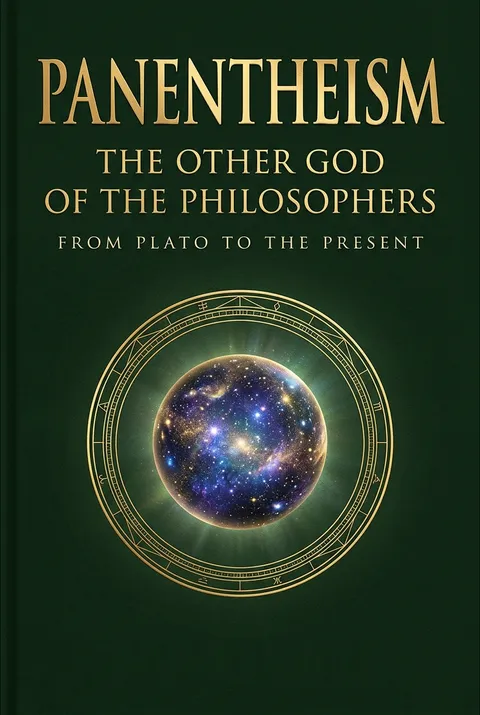
The central distinction. Panentheism means that the world exists within God, while God exceeds the world. Pantheism identifies God with the world, or treats the world as divine; classical theism instead insists that Creator and creation are wholly distinct, though God is present to all creatures. Cooper argues that modern theologians often set up a false choice: reject classical theism and supposedly return to a purely biblical, philosophy-free view of God. But every account of God uses philosophical ideas, including relational alternatives.
A family, not a creed. Panentheism names a broad family of views, not one agreed doctrine. Its members disagree about whether God is personal, whether creatures are parts of God or related to God, and whether creation is necessary or freely chosen. The book’s historical survey asks readers to examine those differences before adopting the label.
The distinction is valuable because it prevents a common shortcut: treating every claim that God is present in the world as pantheism. It also highlights the real debate, which concerns what kind of presence is meant. The taxonomy, however, is Cooper’s interpretive map, not a neutral boundary accepted by every thinker he discusses. Readers should test each view by its account of creation, divine freedom, and creaturely independence rather than relying on labels alone.
Trace panentheism’s roots from Plato’s World-Soul to Plotinus’s nested cosmos.
Two Platonic legacies. In the Timaeus, Plato describes the cosmos as a living being animated by a World-Soul. The world is within that Soul, though Plato does not clearly identify the Soul with the eternal God who made it. Plotinus develops the idea into the Great Chain of Being, a hierarchy in which the One gives rise to Mind, then Soul, then the physical world. Each level depends on, and exists within, a higher one.
A Christian route. Pseudo-Dionysius blends Neoplatonic ideas with Christian language, influencing medieval thinkers such as Eriugena, Eckhart, and Nicholas of Cusa. Their accounts often place all things in God while insisting that God transcends them. Cooper stresses that this tradition influenced classical theism too, so a shared philosophical ancestry does not make the two positions equivalent.
The historical genealogy explains why the same metaphors recur across very different centuries: a world within a soul, a hierarchy of being, and a return to divine unity. Historical influence is not proof that a later theology is false or derivative in a dismissive sense. Nor does a common ancestor settle what a thinker means by creation. The useful question is how each writer preserves the difference between the divine source and the world that depends on it.
Watch God move from timeless source to a being realized through history.
The modern turning point. Schelling and Hegel recast the old hierarchy of emanations as a historical process. Their shared tool is dialectic, a way of explaining how opposing positions can be reconciled within a more comprehensive unity. In their theologies, God’s eternal essence is not the whole story: God’s existence develops through nature, human freedom, and history.
Two different paths. Hegel presents this development as rational and broadly determined, with philosophy bringing God’s self-knowledge into focus. Schelling emphasizes personal freedom and an open history shaped by both God and creatures. Both draw on Jakob Böhme’s speculative account of a dynamic Trinity. Cooper sees them as founders of modern panentheism because they make the world part of God’s own historical realization.
This shift changes more than the language used for God. It changes history from a stage on which God acts into a process that helps constitute God’s life. That move can make divine involvement and human agency feel less remote. It also raises a demanding question: if God’s identity develops through events, how can a theology explain God’s reliability without treating the outcome as either predetermined or uncertain? Hegel and Schelling answer differently, and their disagreement remains central to later debates.
Treat Teilhard’s Omega as a theological reading of evolution, not scientific proof.
Evolution toward a center. Jesuit scientist Pierre Teilhard de Chardin reads cosmic history as a movement from matter to life, consciousness, and human community. He proposes an Omega point, the future culmination of evolution in a unified, fully personal community. Teilhard identifies this goal with the Cosmic Christ: Jesus is not merely one event in history but the clearest expression of God’s presence in an evolving universe.
A sweeping synthesis. The world becomes progressively united with God, while remaining distinct through love rather than being absorbed. Teilhard calls his view Christian pantheism, but Cooper classifies it as panentheism. He also notes tensions with traditional Christianity: Teilhard’s account can make evil and death seem built into creation, and it can blur the distinction between natural development and supernatural grace.
Teilhard’s synthesis is compelling because it takes science seriously without treating the cosmos as spiritually empty. But evolutionary change by itself does not establish that history has a destination, much less that the destination is Christ. That conclusion depends on theological interpretation. Keeping those claims distinct lets readers appreciate Teilhard’s imaginative vision without asking scientific evidence to prove more than it can.
In process theology, God persuades because each creature helps shape divine experience.
A world made of events. Alfred North Whitehead describes reality as a succession of actual occasions, brief events of experience that take account of the past and move toward possible futures. Complex beings, including people, are organized sequences of these events. God is not exempt from this process. God has a primordial nature that orders possibilities and a consequent nature that takes the actual world into divine experience. This two-sided account is called dipolar theism.
Influence without control. God offers creatures possibilities and draws them toward better outcomes but does not determine their choices. The world, in turn, affects God. Christian process theologians John Cobb and David Griffin use this framework to explain divine love, human freedom, and evil. Cooper notes the cost: God’s persuasive power does not guarantee that history reaches its hoped-for end.
Process theology makes a strong case that relationships matter to what beings become, and it takes creaturely agency seriously. Its event-based picture also avoids treating matter as inert stuff. The pressure point is whether persuasive influence can support confidence in redemption when creatures can refuse it. The framework gives a clear account of why God is not the direct cause of every evil, but its account of ultimate victory is correspondingly less secure.
Recognize panentheism across religions without pretending all versions mean the same thing.
A shared pattern, varied meanings. Cooper finds views resembling panentheism in Jewish, Muslim, Hindu, Buddhist, and Wiccan thought. Martin Buber’s Jewish account centers on reciprocal I-Thou relationships with God. Muslim thinker Muhammad Iqbal describes finite selves participating in the life of an ultimate Self. Hindu philosopher Sarvepalli Radhakrishnan sees the world as within God, though he also holds that ultimate reality surpasses the distinction between God and world.
Not one interfaith doctrine. Zen thinkers Masao Abe and Alan Watts, and Wiccan writer Starhawk, use different concepts of ultimate reality, personhood, and nature. Their views may share the idea that the divine includes the world, but the resemblance does not erase doctrinal differences. Cooper presents panentheism as a possible common language for dialogue, not evidence that religions secretly teach the same thing.
The cross-cultural comparison is strongest when it opens questions rather than smoothing them away. Shared language about divine immanence can create useful conversation, but terms such as person, self, and world carry different assumptions across traditions. Interfaith dialogue benefits from translation, not forced equivalence. A careful comparison asks both what a tradition shares with panentheism and what its own concepts resist.
Moltmann turns the Trinity’s mutual indwelling into a model for all reality.
From the cross outward. Jürgen Moltmann begins with the crucifixion, interpreting it as an event within the life of the Trinity: the Son suffers, the Father suffers with him, and the Spirit is the bond of love. He then extends perichoresis, the mutual indwelling of the three persons, to relations among creatures and between creation and God. The world is not merely made by God; it is drawn into God’s life.
A world within God. Moltmann also adopts zimsum, a Jewish mystical idea in which God contracts or withdraws to make room for creation. The world’s time and space arise within this divine self-limitation. At the end, God and creation fully indwell one another. Cooper admires the theological ambition but questions whether this account makes evil and the world necessary elements in God’s own life.
Moltmann’s approach makes solidarity with suffering central to the doctrine of God, rather than an optional emotional response. The idea of mutual indwelling also gives a powerful relational account of community. Yet extending a model of communion to all reality does not by itself explain how personal distinctions, natural processes, and evil fit together. The metaphors carry real theological weight, so their limits deserve as much attention as their appeal.
Pannenberg makes history’s future the arena where the Trinity becomes fully manifest.
The future as power. Wolfhart Pannenberg argues that the resurrection of Jesus anticipates the final truth of history. God’s full reality is not yet visible, but the future kingdom already shapes the present. His distinctive image is the divine force field: God’s Spirit is the encompassing power within which the world exists and develops. The Trinity is not separate from this history but becomes fully manifest through it.
A disputed classification. Pannenberg rejects the label panentheist, yet Cooper considers his account an implicit form of it: creatures exist within the divine Spirit, while God exceeds them. Pannenberg insists that creation is a free act and that God remains God beyond the world. Cooper questions whether this independence fits neatly with Pannenberg’s claim that the economic Trinity, God’s historical activity, is identical with the immanent Trinity, God’s eternal life.
Pannenberg’s future-centered account offers a striking way to connect historical knowledge, Christian hope, and theology. It also exposes a genuine conceptual strain: a future can orient present action, but calling it already actual in a way that determines the present requires further argument. Cooper’s panentheistic classification is persuasive as an interpretation of the system, though Pannenberg’s rejection of the label signals a real disagreement about what counts as being in God.
Use science and liberation theology to test what a world-in-God model explains.
Many contemporary applications. Scientist-theologians Ian Barbour, Paul Davies, Arthur Peacocke, and Philip Clayton explore whether an evolving universe points toward God. Their models differ: some emphasize divine persuasion, some continuous creation, and some the analogy between God’s relation to the world and a mind’s relation to a body. Liberation theologians use related ideas to connect God with struggles for racial, economic, and gender justice. Feminist and ecological writers extend the concern to the earth itself.
An ethical payoff, not a proof. These approaches make divine presence relevant to ordinary history and environmental responsibility. But science’s description of an evolving, complex cosmos does not by itself establish that the universe is God’s body or that evolution has a divine goal. Those are theological interpretations that need their own arguments.
The ethical strength of these models is that they make human action and ecological care matter within a larger spiritual picture. Their explanatory reach should still be distinguished from their moral force. A model can motivate responsibility without being demonstrated by science. Keeping that distinction clear helps prevent theology from borrowing scientific authority for claims that remain philosophical or religious.
Compare panentheism’s relational God with classical theism’s independent, sovereign Creator.
Cooper’s final judgment. Writing from a Reformed Christian perspective, Cooper argues that classical theism better preserves God’s freedom to create, the Creator-creature distinction, and God’s holiness. He accepts biblical language about living in God but denies that it requires the world to be part of God. He also argues that many panentheisms make evil intrinsic to finite existence and reduce God’s ability to guarantee the final kingdom.
A live disagreement. Cooper does not claim every classical theist is beyond criticism. He acknowledges challenges concerning divine action, time, and response, and allows that some limited modifications of classical theism may be defensible. His conclusion is narrower: panentheism is not automatically more biblical or less philosophical simply because it emphasizes relationship and divine involvement.
The conclusion is clearest when read as a case for one tradition, not a neutral verdict on every possible panentheism. Cooper’s Reformed commitments shape which biblical readings and accounts of freedom he finds convincing. That does not invalidate the argument, but it makes the premises visible. The larger lesson is methodological: compare complete accounts of creation, evil, salvation, and divine freedom, rather than awarding victory to whichever view sounds most relational.
Analysis
Cooper’s central achievement is historical rather than merely definitional. He shows that panentheism is not a recent compromise between belief and science but a long-running family of answers to one hard question: how can the world be genuinely distinct from God and yet exist within divine life? The answer changes as the intellectual setting changes. Plotinus gives it a hierarchical structure, Schelling and Hegel make it historical, Whitehead makes it processive, and contemporary theologians connect it to evolution, liberation, and ecology.
The history is also an argument about inheritance. Classical theism and panentheism share Platonic roots, but they select different features of that inheritance. Cooper’s strongest corrective is that rejecting classical theism does not free theology from philosophy. Relational theology has its own metaphysics, often less visible because it presents itself as closer to lived experience or modern science.
The main limitation is that the book’s organizing category can gather unlike positions under one name. A nonpersonal Ground, a triune God whose life develops through history, and Whitehead’s social deity do not make the same claims about agency, freedom, or salvation. Cooper acknowledges this diversity, yet his narrative sometimes makes Neoplatonic ancestry seem more decisive than a thinker’s own arguments. Historical influence explains a view’s vocabulary, not its truth.
His final Reformed defense is therefore most convincing as a disciplined comparison of commitments. Classical theism protects divine freedom and holiness; panentheism offers a more immediate account of reciprocal relationship and divine solidarity. Neither advantage settles the matter alone. The reader must ask what each model can explain without sacrificing its central claims, especially how a good God relates to evil, how creatures remain free, and how salvation can be certain. The book succeeds by making those questions difficult to avoid.
Review Summary
Panentheism receives strong praise for its brilliant historical treatment, tracing the concept from Plato through modern theologians while distinguishing classical and modern strands. Reviewers appreciate its value as a reference, though some note the author isn't a panentheist himself. Criticisms include its Eurocentric focus with minimal coverage of non-Christian perspectives, repetitive content, and occasionally arbitrary statements presented as fact. Despite these limitations, readers find it useful for understanding theological terminology and philosophical doctrines, with most recommending further reading for deeper nuances.
Glossary
Panentheism
World exists within GodA family of views holding that the world exists within God, while God is more than the world. It differs from pantheism, which identifies God with the world or treats the world as divine. Panentheists disagree about whether the world is part of God, how God transcends it, and whether creation is freely chosen or necessary.
Great Chain of Being
Hierarchy of dependent existenceA hierarchical picture of reality in which lower levels depend on higher ones. In Plotinus’s Neoplatonism, the One gives rise to Mind, Mind to Soul, and Soul to the physical world. The world is therefore within a sequence of realities that ultimately depends on and returns toward the divine One.
Dialectic
Opposites reconciled in unityA method of reasoning, and in some thinkers an account of reality, in which a position encounters its opposite and both are reconciled within a more comprehensive unity. Hegel uses dialectic to explain how God or Spirit becomes manifest through nature, human history, and philosophical understanding.
Actual occasions
Brief events of experienceWhitehead’s basic units of reality. Each actual occasion is a short-lived event that takes account of its past, considers possible futures, and realizes one outcome. Enduring things, from physical objects to living beings, are organized sequences or societies of actual occasions rather than permanent substances.
Dipolar theism
God has two complementary aspectsA view, especially associated with process theology, that God has both an unchanging or eternal aspect and a changing or temporal aspect. In Whitehead’s account, God’s primordial nature orders possibilities, while the consequent nature takes the actual world into divine experience. The world therefore affects God without exhausting the divine reality.
Perichoresis
Mutual indwellingA traditional Christian term for the mutual indwelling or communion of the persons of the Trinity. Moltmann extends the idea beyond the Trinity, using it to describe relationships among creatures and between God and creation. In this expanded account, reality is structured by mutual participation rather than isolated existence.
zimsum
God contracts to make roomA Jewish mystical idea used by Moltmann to describe creation as beginning with divine self-contraction or withdrawal. God makes room within himself for finite existence, including the world’s space and time. The concept helps explain how creation can be distinct from God while existing within divine life.
Omega point
Evolution’s personal culminationTeilhard de Chardin’s name for the projected culmination of cosmic and human evolution in a unified, fully personal community. Teilhard identifies this goal with the Cosmic Christ, who draws creation toward God. Cooper notes that this is a theological interpretation of evolution, not a conclusion established by science alone.
supernatural existential
God’s presence in human existenceKarl Rahner’s term for God’s gracious presence as a constitutive condition of human existence. It gives every person an openness to God and to possible divine revelation. Gutiérrez draws on the concept to connect God’s saving presence with all humanity, a move Cooper regards as implying panentheism.
divine force field
Spirit encompassing the cosmosPannenberg’s image for the Spirit as the encompassing dynamic power in which the universe exists and develops. He relates the idea to scientific field concepts and uses it to connect God’s creative presence with the world’s processes. Cooper interprets this account as implicitly panentheistic because creatures exist within the divine Spirit.
Download PDF
Download EPUB
.epub digital book format is ideal for reading ebooks on phones, tablets, and e-readers.








