

Key Takeaways
Diagnose the person, not the symptom checklist
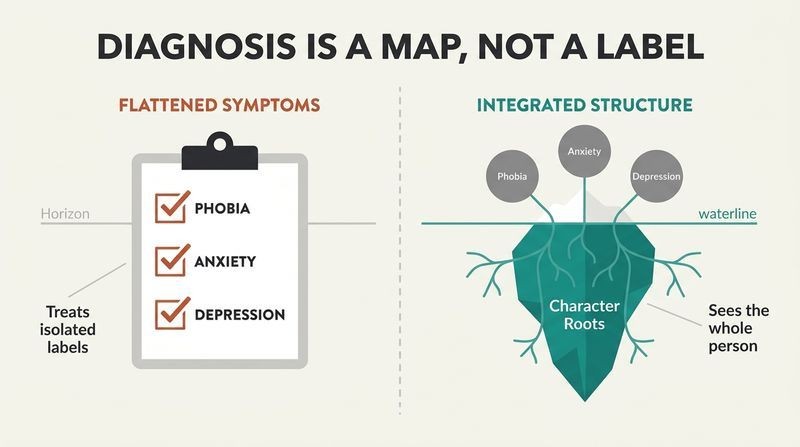
Diagnosis is a map, not a label. McWilliams defends an older, dying art: inferential, dimensional, contextual assessment that sees a human being as a coherent whole rather than a bundle of comorbid symptoms. She lists five practical payoffs of careful diagnosis: treatment planning, realistic prognosis, consumer protection (honest "truth in advertising" about what therapy can deliver), communicating genuine empathy, and keeping skittish patients from fleeing treatment.
The insurance-driven DSM approach flattens suffering. She compares symptom-based diagnosis to describing music by naming its key, tempo, and length: technically accurate, utterly missing the experience. A phobia in a depressive person is a different phenomenon from a phobia in a characterologically phobic one. Knowing the deeper structure tells you whether a sympathetic comment will bring relief, contempt, or devastation.
What's striking is how McWilliams frames diagnosis as an act of care rather than bureaucratic pigeonholing, inverting the common therapeutic suspicion that labels dehumanize. Her position echoes personalized-medicine debates in oncology, where the same tumor label demands different treatments based on genetic subtype. The tension she names between insurers wanting discrete billable disorders and clinicians wanting to treat whole persons remains unresolved and arguably worse now. One caveat worth holding: dimensional inference depends heavily on clinician skill and is harder to validate empirically than checklists, which is precisely why the field drifted toward categories despite their shallowness.
Ask two questions: how disturbed, and in what way

Personality maps onto two axes. McWilliams organizes all character along a grid. The vertical axis is developmental level or severity: how much psychological damage exists. The horizontal axis is type: the particular flavor of a person's habitual coping. Her non-clinical friend put it bluntly: people are either "nuts" or "not nuts." Her refinement: everyone is somewhat irrational, so the real questions are how nuts, and nuts in what particular way.
The two axes interact but stay distinct. A paranoid person can be relatively healthy (thriving in detective work) or floridly psychotic. An obsessive person can be a brilliant scholar or a delusional ruminator. Each character type spans the full range from psychotic to neurotic-to-healthy. Knowing someone's overall level of organization often matters more clinically than pinning down their exact type.
The biaxial grid is McWilliams's signature pedagogical device, and its power is that it separates two variables clinicians routinely conflate: sickness and style. This mirrors dimensional models now ascendant in personality research, such as the DSM-5 alternative model and HiTOP, which likewise split severity from stylistic traits. A useful challenge: McWilliams concedes the grid is arbitrary and oversimplified, and modern developmental science questions whether "levels" are discrete rather than continuous. Still, as a first orientation for a novice drowning in a century of contradictory analytic jargon, the two-question heuristic is elegant, memorable, and clinically load-bearing.
Defenses began as brilliant survival adaptations, not flaws

Calling someone defensive is an insult; it shouldn't be. McWilliams reframes defenses as automatic, originally healthy ways of managing overwhelming feeling and protecting self-esteem. A baby overstimulated to the point of distress simply falls asleep. That withdrawal is not pathology, it is adaptation. Defenses only become problems when they fail to reduce anxiety, block genuine living, or operate rigidly to the exclusion of other options.
Preference for a defense is overdetermined. Four forces shape which defenses become someone's signature: innate temperament, the specific stresses of early childhood, the defenses modeled by caregivers, and the consequences of using particular strategies (reinforcement). Research by Cramer confirms defenses operate outside awareness, mature in predictable order, exist in healthy people, and intensify under stress. Mental health is not the absence of primitive defenses but the presence of flexible, mature ones alongside them.
This reframing rescues the concept of defense from its pejorative drift and aligns it with modern affective neuroscience, where dissociation and denial map onto autonomic survival responses rather than moral weakness. The insight parallels evolutionary psychology's argument that anxiety and even depression may be adaptive alarm systems misfiring in modern contexts. McWilliams's key clinical corollary, that psychosis reflects too few defenses rather than too many, upends the layperson's intuition. The overdetermination model is honest about causal complexity, resisting single-cause explanations. It also implies a humane therapeutic stance: you are not stripping away a patient's badness, you are expanding their repertoire of coping.
Primitive defenses blur self and world; mature ones manage inner boundaries
Two tiers of defense. Primary or primitive defenses (withdrawal, denial, omnipotent control, primitive idealization and devaluation, projection, introjection, splitting, dissociation, somatization) operate globally and predate a child's grasp that self and others are separate. Denial is more archaic than repression: "this isn't happening" is more magical than "this happened but I'll forget it." Splitting sorts everything into all-good or all-bad because it predates the capacity to hold ambivalence toward one constant person.
Secondary defenses transform inner content. Repression, isolation of affect, intellectualization, rationalization, moralization, reaction formation, displacement, undoing, turning against the self, and sublimation all require a more developed self. Projective identification is especially potent: the patient not only projects a disowned feeling onto you but unconsciously pressures you to actually feel it, so the therapist starts genuinely feeling the hostility the patient disavows.
The primitive-mature distinction has real empirical support: Vaillant's decades-long longitudinal work found that reliance on mature defenses like sublimation and humor predicts life success and health, while primitive defenses predict dysfunction. Projective identification deserves special attention because it dissolves the tidy boundary between transference and reality, anticipating the relational turn's insistence that the clinician is never a neutral observer. A sharp reader might note the developmental sequencing is cleaner in theory than in life; trauma can reactivate primitive defenses in otherwise mature adults. The framework's lasting value is diagnostic: identifying which defensive tier dominates instantly signals how fragile a patient's grip on reality is.
Generic warmth heals some patients and destroys others
One therapeutic style does not fit all. McWilliams's most practical contribution is that empathic, non-directive warmth (the default humanistic stance) is essential for neurotic-level and depressive patients but backfires with others. Neurotic patients quickly form a working alliance and can tolerate uncovering difficult truths. Psychotic-level patients, gripped by annihilation terror, need active safety, honesty, self-disclosure, education, and normalization; ambiguity throws gasoline on their fear.
Borderline-level work inverts intuition. With patients who swing between engulfment terror and abandonment panic, the therapist must fastidiously hold boundaries, name contrasting feeling states, interpret primitive defenses in the here-and-now, and crucially discourage regression while rewarding assertiveness, even hostile assertiveness. Standard interpretations that soothe a neurotic ("you're reacting to me as you did to your mother") produce "so what?" or fury in a borderline patient. Match the intervention to the level of organization.
This is where McWilliams is quietly radical for a psychoanalyst: she argues technique must bend to structure, prefiguring the evidence base showing that borderline patients respond to structured, boundaried treatments like DBT and transference-focused psychotherapy rather than open-ended exploration. The insight that rewarding helplessness breeds more helplessness resonates with behavioral extinction principles and with attachment research on how contingent responsiveness shapes autonomy. The counterintuitive move, being warmest when a patient is assertive and coolest when regressed, runs against most therapists' rescue instincts. It is a durable reminder that kindness without diagnostic discernment can be iatrogenic, actively worsening the very dependency it means to soothe.
Your gut reaction to a patient is diagnostic gold
Countertransference is information, not contamination. Freud originally saw the therapist's emotional reactions as evidence of the analyst's own unfinished business. Object relations theorists reversed this: your visceral response often reveals what the patient cannot say in words. McWilliams distinguishes two types, borrowing from Racker. Concordant countertransference: you feel what the patient felt as a child. Complementary countertransference: you feel what the patient's parent or persecutor felt toward the child.
Different characters induce signature reactions. Boredom, sleepiness, and a sense of being obliterated as a real person signal narcissistic dynamics. Cold dread and the sense of being conned signal psychopathy. A pull to rescue signals depression. Mounting rage at a helpless complainer signals masochism. She recounts drifting into a self-aggrandizing daydream mid-session, only to realize her patient was describing a mother interested in him mainly as an enhancer of her reputation.
The elevation of countertransference from obstacle to instrument is one of psychoanalysis's most exportable ideas, and it converges with contemporary work on embodied cognition and interoception: the therapist's body registers relational patterns before the conscious mind names them. Mirror-neuron research and studies of right-brain-to-right-brain affective transmission give this a plausible mechanism. The danger McWilliams flags honestly is attribution error: not every feeling in the room was planted by the patient. Skilled use requires the humility to ask whether a reaction is the patient's projection or the clinician's own history. Offered as hypothesis rather than pronouncement, these gut signals become a uniquely rich, otherwise inaccessible data stream.
With psychopaths, prove strength, never kindness
Antisocial patients respect power, not warmth. The psychopathic personality is organized around omnipotent control, the compulsion to "get over on" others and feel one's raw effect on the world. This has nothing to do with criminality per se; McWilliams notes corporate "snakes in suits" who never break a law. Their affect is blocked, their language a manipulation tool rather than a vehicle for feeling, and they scorn sympathy as weakness to be exploited.
Incorruptibility is the treatment. She insists on payment at the start of each session, no exceptions, no matter how reasonable the excuse. A therapist who bends boundaries hoping to be seen as caring earns only sadistic triumph. What works is uncompromising honesty, consistency, and a refusal to appear invested in the patient's change, since visible investment becomes something to sabotage. One colleague earned a car thief's respect by matching his toughness, not his need.
McWilliams's stance is bracing and evidence-adjacent: Hare's research documents psychopaths' blunted autonomic reactivity and near-absent startle response, consistent with her claim that they genuinely lack anxiety rather than hiding it. The therapeutic implication, that mirroring fear or offering tenderness fails, aligns with forensic findings that traditional empathic therapy can make psychopathy worse by teaching better manipulation. A humane nuance she preserves: many antisocial people "burn out" in midlife as hormones and physical power wane, becoming more treatable. The chilling insight that a skilled interrogator elicits tearful confessions through respect rather than warmth suggests even profoundly detached people retain a flicker of accountability worth reaching.
Behind every grandiose narcissist hides a shame-soaked child
Narcissism is a self-esteem regulation disorder. Whether arrogant (thick-skinned) or self-effacing (thin-skinned), narcissistic people share an inner sense of insufficiency and a terror of exposure. They rank everything: the "best" college, the "finest" doctor. Their governing defenses are idealization and devaluation, complementary poles where inflating one thing deflates another. They need "selfobjects," people who exist to prop up their self-worth rather than as separate beings.
Shame, not guilt, drives them. Guilt says "I did something bad"; shame says "I am seen as defective." Early analysts made guilt-oriented interpretations that felt unempathic. McWilliams stresses that these patients often feel subjectively empty rather than full of critical voices, which distinguishes them from depressives. The therapist frequently feels bored, sleepy, or invisible, because the patient relates to a function, not a person. Confrontation shames; the work requires tactful attention to fragile self-states.
McWilliams's distinction between shame and guilt is now central to affect science, where Tangney and others show shame predicts withdrawal, aggression, and poor outcomes while guilt predicts reparative action. Her sociological claim, that modern mobile, image-saturated culture manufactures narcissists by rewarding persona over substance, anticipates data on rising narcissism scores and the attention economy's incentives. Tocqueville's 1831 observation that egalitarian societies breed status anxiety gives the argument deep roots. The Kohut-versus-Kernberg debate she summarizes, whether to empathically supply what was missing or confront the grandiosity, remains genuinely unsettled, and her pragmatic conclusion that different patients fit different models is more honest than doctrinaire allegiance to either camp.
Depressives need acceptance; sympathy makes masochists worse
Two depressively toned psychologies, opposite treatments. Depressive patients turn hostility inward, believe they are fundamentally bad, and expect abandonment. They need steadfast non-judgmental acceptance, and crucially the experience that the therapist returns after separations. McWilliams distinguishes introjective depression ("I am bad, guilty, flawed") from anaclitic depression ("I am empty, hungry, alone"). Supporting an introjective depressive directly often backfires, so you "attack the superego" instead: "So what's so terrible about that? Join the human race."
Masochists need you to stop rescuing. Self-defeating patients learned that suffering was the only reliable route to care or moral victory. If the therapist extends extra generosity, reduces the fee, or takes crisis calls, the patient regresses further, proving that helplessness pays. The antidote is modeling healthy self-respect, welcoming the patient's anger, and matter-of-factly refusing to be the rescuer, so assertiveness rather than misery starts eliciting warmth.
The depressive-masochistic distinction has real stakes: McWilliams warns that giving antidepressants to a characterological masochist merely confirms the pathogenic belief that relief must come from an external authority. Blatt's anaclitic-introjective research, drawn from a major NIMH depression study, gives empirical spine to her subtypes and even predicts differential treatment response. The masochism material is her boldest, because it risks sounding like victim-blaming, a charge she carefully preempts by clarifying that masochists do not enjoy pain, they endure it hoping for connection. The clinical paradox, that withholding rescue is the more loving act, echoes family-systems work on how over-functioning caregivers inadvertently entrench a dependent's under-functioning.
Dissociation is common, invisible, and mistaken for everything else
Multiplicity is an adaptation, not an exotic freak show. Chronic dissociation is a childhood post-traumatic survival strategy in a person constitutionally gifted at self-hypnosis. Kluft's four-factor theory: the child has hypnotic talent, suffers severe trauma, has dissociative responses shaped and rewarded, and receives no comfort during or after the trauma. Nobody wiped away the tears. The self never integrated because integration was never safe.
Its invisibility causes years of misdiagnosis. Because dissociation is "a pathology of hiddenness," patients rarely announce it; switches between self-states look like moodiness. McWilliams recounts teaching a dissociative student for a whole term without noticing. On average, patients spent years cycling through mutually exclusive labels (schizophrenic, bipolar, borderline) and failed medication trials before accurate diagnosis. The tell: multiple prior serious diagnoses, trauma history, lost time, and voices experienced inside rather than outside the head.
McWilliams writes at the crest of a genuine paradigm shift, integrating attachment research (disorganized "Type D" attachment, where the caregiver is both safe haven and source of terror) with affective neuroscience showing trauma-induced glucocorticoids shut down the hippocampus, so episodic memory of abuse may never encode. This elegantly reframes the "false memory" wars: trauma genuinely corrupts memory, making both patients and clinicians vulnerable to confusion. Her practical diagnostic tip, asking whether hallucinated voices come from inside or outside the head to distinguish dissociation from schizophrenia, is the kind of concrete clinical wisdom rarely taught. The forensic stakes are sobering: reliably distinguishing dissociative from psychopathic offenders could reshape who receives treatable-versus-hopeless designations.
Every nonjudgmental label eventually curdles into an insult
Language sanitization is a doomed treadmill. McWilliams observes that any term for a disturbing condition inevitably acquires a pejorative charge, prompting a new euphemism that then curdles too. "Moral insanity" became "psychopathy," then "sociopathy," then "antisocial personality disorder." The phenomenon's power to unsettle contaminates each successive word. The same cycle ran through terms for sexual orientation and cognitive disability. The older a clinical tradition, the more quaint and judgmental its vocabulary sounds.
Popularization also flattens meaning. As analytic concepts entered common speech, they lost precision. "Trauma" came to mean mere discomfort, "depression" the ordinary blues, "paranoid" simply fearful. "Masochistic" gets misread as loving pain. McWilliams keeps traditional terminology, asking readers to suspend the reflex to hear judgment, because renaming endlessly obscures rich, hard-won clinical concepts rather than clarifying them.
This is a linguistic version of the euphemism treadmill that Steven Pinker independently named, and it generalizes far beyond psychiatry: the deep driver is that stigma attaches to the referent, not the word, so no lexical swap can outrun the underlying attitude. McWilliams's refusal to keep renaming is partly principled and partly a scholar's fatigue, and reasonable critics counter that patient-preferred language does reduce felt stigma in the moment even if the effect decays. The more durable point is her warning about conceptual erosion: when a public borrows a technical term and dilutes it, clinicians lose a precise tool. Preserving old vocabulary preserves accumulated observational nuance that flashy relabeling discards.
Analysis
McWilliams occupies a peculiar historical moment: she writes to preserve a craft the mental health system was busy dismantling. First published in 1994 and revised in 2011, Psychoanalytic Diagnosis is simultaneously a teaching text for novice therapists and a polemic against the managed-care and pharmaceutical forces that reduced person-oriented treatment to symptom suppression. Its enduring achievement is synthesis. She takes a century of contentious, jargon-clogged analytic theory, drive theory, ego psychology, object relations, self psychology, the relational turn, and organizes it onto a single usable grid: how disturbed, and in what way.
What makes the book unusual is its refusal to be doctrinaire. She openly presents the Kohut-Kernberg dispute over narcissism without forcing a winner, admits her developmental schema is arbitrary, and invites readers to outgrow her constructions. This intellectual humility is rare in a field prone to schools and gurus, and it models the very clinical stance she recommends: hold formulations tentatively, revise with new evidence.
The book's greatest strength is also its vulnerability. Its claims rest largely on accumulated clinical observation rather than randomized trials, precisely the evidentiary weakness that let critics dismiss psychodynamic thinking as unfalsifiable. Yet McWilliams marshals convergent support where it exists: attachment research, affective neuroscience, Vaillant's defense studies, Blatt's depression subtypes, Shedler's outcome meta-analyses. The result reads less like ideology than like disciplined naturalistic observation awaiting fuller validation.
Her most transferable ideas travel well beyond the consulting room. The insight that defenses are adaptations gone rigid, that one's emotional reaction to a person is diagnostic data, that generic kindness can harm, and that shame and guilt drive opposite behaviors, all illuminate ordinary relationships, management, and self-understanding. The book ultimately argues that understanding precedes helping, and that seeing a person whole, in their particular suffering and strength, is itself a form of respect the checklist can never provide.
Review Summary
Psychoanalytic Diagnosis is highly praised for its insightful, compassionate approach to understanding personality structures and disorders from a psychodynamic perspective. Readers appreciate McWilliams' clear writing style, clinical examples, and integration of various theories. The book is considered valuable for both professionals and laypeople interested in psychoanalysis. While some note outdated language or disagree with certain concepts, most find it an essential resource for therapists. Many readers report returning to the book multiple times, finding new insights with each reading.
Download PDF
Download EPUB
.epub digital book format is ideal for reading ebooks on phones, tablets, and e-readers.








