

Key Takeaways
Forecast exponential change by tracking paradigm shifts, not straight lines
Exponential curves start quietly. A quantity that doubles repeatedly can seem nearly static until its growth suddenly becomes visible. Kurzweil illustrates this with lily pads that cover a lake after a few final doublings, and with computer chess: Garry Kasparov dismissed computer play in 1992, then lost to IBM’s Deep Blue in 1997. His Law of Accelerating Returns argues that technology builds on earlier advances, increasing the pace of progress.
Watch the curve’s shape. A particular technology often follows an S-curve: slow beginnings, rapid improvement, then a plateau. A new approach can start another curve. In the book, Kurzweil estimates that information technology’s capabilities were doubling about yearly, while the rate of major technological change doubled roughly every decade. These are his historical estimates, not universal guarantees.
What's striking is how the model corrects a real forecasting error: people often extend a short, nearly straight segment into the distant future. Yet exponential growth is not a force of nature that guarantees any particular outcome. It depends on what is measured, whether a new technical approach arrives, and whether institutions, materials, or demand become bottlenecks. The framework is most useful as a prompt to ask which curves are accelerating, and which assumptions would have to hold for them to continue.
Treat the Singularity as a merger, not a machine takeover
Evolution changes its medium. Kurzweil organizes the history of information into six epochs: physics and chemistry, DNA-based biology, brains, human technology, a merger of human intelligence with technology, and intelligence spreading through the universe. Each stage uses the products of an earlier one to create new ways of storing and processing information.
The fifth epoch is the hinge. The Singularity is Kurzweil’s name for a period when technological change becomes so fast and consequential that familiar ideas about humanity, work, and mortality are transformed. He imagines biological intelligence combining with machines’ speed, memory, and ability to share knowledge. His central claim is not that humans simply disappear, but that human intelligence extends beyond its biological limits. The sixth epoch, a universe saturated with intelligence, is a much more speculative extension.
The epoch framework makes a sprawling history legible by tracing how information is preserved and acted upon, from genetic inheritance to engineered tools. Its strength is continuity: technology becomes an extension of evolution rather than an alien interruption. Its weakness is the temptation to mistake a useful pattern for a fixed destination. Evolution has no single goal, and technologies are shaped by competing social choices as well as by technical capabilities. The framework illuminates a possible trajectory, not proof that history must follow it.
A brain-sized computer is not a human mind
Hardware is only half the problem. The book estimates that a computer might need around 10^16 calculations per second to reproduce the brain’s overall functions, and around 10^19 to model detailed activity in its neurons and connections. Kurzweil argues that increasingly powerful computers are only useful for human-level intelligence if researchers also understand how the brain organizes information.
Model the operating principles. Brain reverse engineering means using scans, experiments, and simulations to uncover how brain regions process information. Examples in the book include models of hearing and of the cerebellum, a brain region involved in movement and learning skills. Kurzweil projected that machines would pass a Turing test, a text-based test of humanlike conversation, around 2029. That date and other timelines are forecasts made in the 2005 book, not established milestones.
This distinction between processing capacity and cognitive organization remains essential. A system can perform many calculations without understanding language, emotion, or context in a humanlike way. Conversely, brain-inspired models need not reproduce every biological detail if they capture the functions that matter. The hard question is deciding what counts as functional equivalence. Success on a conversation test would demonstrate convincing behavior, but it would not by itself settle whether a machine has subjective experience or whether its intelligence generalizes reliably.
See genetics, nanotechnology, and AI as one linked revolution
Three fields reinforce each other. Kurzweil groups genetics, nanotechnology, and robotics, meaning advanced artificial intelligence, under the label GNR. Genetics treats biological processes as information that can be altered, for example by controlling gene expression or replacing damaged cells. Nanotechnology aims to build and manipulate matter at molecular scales. Advanced AI could use both more capable computing and knowledge of the brain to expand what machines can do.
Benefits carry risks. The book projects that these fields could help prevent disease, repair the body, and create immersive virtual experiences. It also imagines nanobots, tiny engineered devices, working inside the bloodstream and brain. These are forecasts, not demonstrated medical capabilities. Kurzweil’s Human Body Version 2.0 describes a future of increasingly redesigned biological systems, but each proposed intervention would still need to prove safe and effective in practice.
The useful insight is the interaction among fields: advances in computing can speed biological research, while biological designs can inspire new machines. This convergence can make progress difficult to regulate one discipline at a time. At the same time, a plausible engineering concept is not the same as a clinically viable treatment. Biological systems are interconnected, and changing one pathway can produce consequences elsewhere. The grand vision is valuable for asking what might become possible, but practical claims require evidence at each step.
Preserve identity as a pattern, but do not confuse copying with survival
The body is not fixed matter. Kurzweil’s patternism is the view that a person’s continuing identity lies primarily in the organized pattern of the body and brain, not in the particular particles that compose them. He argues that much of the body’s material changes over time while memories, habits, and relationships preserve a sense of continuity.
A copy creates a dilemma. Uploading, in the book’s terminology, means capturing the important features of a brain and recreating them in another computing system. Such a copy might remember a person’s life and behave just like them, yet the original could still remain alive. Gradual replacement of brain functions creates a different puzzle: continuity might feel uninterrupted even as the underlying system changes. Kurzweil treats consciousness and personal identity as open questions, not problems resolved by copying information.
This is a powerful way to separate personal identity from a particular set of atoms, but it does not settle whether a copied mind is the same person. Philosophers such as Derek Parfit have examined a related distinction between psychological continuity and strict identity: memories and personality may persist even when there is no simple answer to who survives. The practical issue is more than metaphysics. A society would need criteria for consent, rights, responsibility, and the status of copies, especially when technological resemblance cannot prove subjective experience.
Falling technology costs can widen abundance without ensuring fairness
Capability gets cheaper. Kurzweil argues that information technologies tend to move from expensive and limited to inexpensive and widely used. He applies this pattern to computing, communications, education, and eventually manufacturing. In his view, nanotechnology could make physical goods cheap to produce, shifting much of their value toward the information used to design them.
Work and learning change with it. The book anticipates more education delivered online, routine tasks increasingly automated, and human work moving toward services, science, and creative production. It also expects intellectual property to become more important as products become more information intensive. Kurzweil sees these shifts as engines of wealth and poverty reduction. But he distinguishes the potential for widespread access from the difficulty of adopting new systems: early and late users may experience technological change very differently.
Lower costs can expand access, but they do not automatically distribute income, bargaining power, or political influence fairly. The book’s economic optimism treats productivity and falling prices as powerful forces, yet market outcomes depend on ownership, labor institutions, public policy, and who can afford early access. Digital education, for example, makes material available at scale but does not guarantee reliable connectivity or effective teaching. The strongest version of the argument is that technology enlarges the available resource pool. Whether that becomes shared prosperity is a separate social decision.
Pair every powerful technology with defenses, not blanket retreat
The same tools can heal or harm. Kurzweil describes GNR technologies as dual use: genetic tools might treat disease or create dangerous pathogens; nanotechnology might clean pollution or enable destructive self-replication; advanced AI might solve problems or act against human interests. He cites the rapid sequencing of the SARS virus, completed in 31 days, as an example of technology supporting a faster response to a new threat.
Build safeguards alongside capability. The book favors targeted rules over broad bans. One proposal, the broadcast architecture, would make a self-replicating system depend on controlled external instructions rather than carrying all replication instructions itself. Kurzweil also calls for investment in defensive technologies, monitoring, and international coordination. These protections are not foolproof, especially against deliberate misuse, but he argues that suppressing whole fields could also slow the development of defenses.
This section’s strongest contribution is to treat safety as an engineering and governance problem that must be designed alongside capability. The idea resembles defense in cybersecurity: no single barrier is sufficient, so systems need layered safeguards, monitoring, and rapid response. Yet technical controls cannot eliminate risks driven by political conflict, poor incentives, or unequal access. The book’s opposition to broad prohibition is understandable, but its confidence in defensive innovation should be balanced against the possibility that offensive tools spread faster than institutions can adapt.
Treat a conscious universe as speculation, not a forecast
The cosmic argument starts with silence. The Drake equation estimates the number of radio-transmitting civilizations by multiplying uncertain estimates about planets, life, intelligence, and communication. The Fermi paradox asks why, if advanced civilizations are common, the universe appears quiet. Kurzweil reasons that technological civilizations could advance from radio communication to enormous computational power in a short time, making their apparent absence surprising.
The ending is an extrapolation. He proposes that intelligence could spread through the universe, reorganizing matter for computation until the cosmos becomes something like a vast thinking system. But this depends on assumptions about how often intelligence arises, how civilizations behave, and whether interstellar expansion is feasible. Kurzweil’s image of the universe awakening is a philosophical vision built on technological projections, not a result established by the book’s evidence about computing trends.
The Drake equation is useful partly because it exposes how uncertainty compounds: a small change in each of several speculative inputs can produce radically different answers. The absence of detected signals is not proof that humanity is alone, but neither does it establish a hidden population of advanced civilizations. The leap from improving computation on Earth to intelligence filling the cosmos involves many additional assumptions about energy, coordination, and survival. The cosmic vision is evocative as a question about intelligence’s possible reach, but it should remain distinct from the book’s more measurable claims.
Analysis
Kurzweil’s case is strongest when it is treated as a method for noticing technological acceleration, and weakest when a measured trend is used to underwrite a specific social or cosmic destiny. The history of computing does show that individual technical approaches plateau while new approaches extend performance. That supports watching a family of technologies rather than extrapolating one device or one manufacturing method. It does not establish that every information process accelerates at the same rate, or that exponential curves continue smoothly through political, economic, and physical constraints.
The book also makes three different arguments that are easy to blur together. First, computing capacity has improved rapidly. Second, brain functions may be modeled and implemented on nonbiological systems. Third, such systems would be conscious continuations of human beings. Each step requires a different kind of evidence. Faster processors do not demonstrate general intelligence; functional similarity does not resolve subjective experience; and a digital copy that preserves memories does not prove personal survival.
The ambition remains valuable precisely because it forces these distinctions into public view. Kurzweil asks readers to imagine the consequences of technologies before they arrive, rather than treating them as merely technical tools. The best response is neither faith in the timeline nor reflexive dismissal. It is disciplined scenario thinking: identify the assumptions, test near-term capabilities, anticipate uneven benefits, and govern dual-use systems before their effects become difficult to reverse.
Review Summary
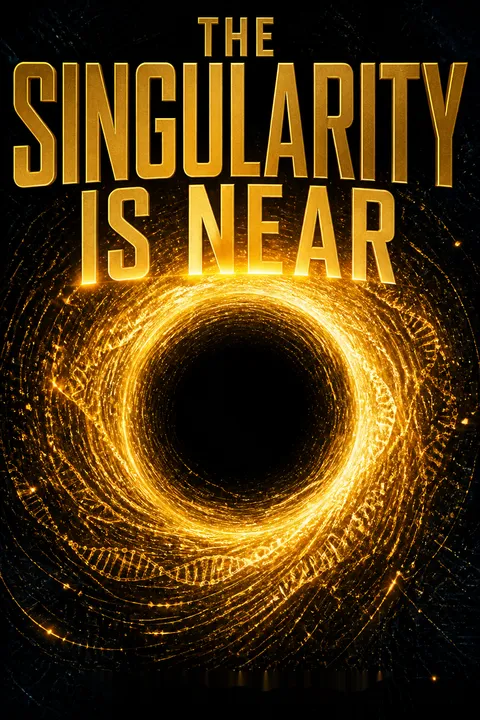
The Singularity Is Near presents Kurzweil's vision of a future where human intelligence merges with artificial intelligence, leading to unprecedented technological advancements. While some readers praise its thought-provoking ideas and well-researched predictions, others criticize its optimism and repetitiveness. The book explores concepts like exponential growth, nanotechnology, and the potential for human immortality. Reviews are mixed, with some finding it inspiring and others dismissing it as unrealistic. Overall, it's seen as a significant work in futurism, though its predictions and timeline remain controversial.
People Also Read





Glossary
Law of Accelerating Returns
Technology builds on prior gainsKurzweil’s proposed explanation for why evolutionary processes, especially technology, can accelerate. Each stage uses more capable tools and knowledge from the previous stage to produce the next. He argues that this creates exponential growth in technological capabilities, and sometimes growth in the rate of that growth. It is a framework for interpreting historical trends, not a universal physical law.
The Singularity
A transformative human-technology mergerKurzweil’s term for a future period when technological change becomes so rapid and far-reaching that human life is fundamentally altered. Its central feature is the merger of biological intelligence with nonbiological systems that offer greater speed, memory, and information sharing. The book associates this transition with the mid-21st century, while acknowledging that its consequences are difficult to predict.
The Six Epochs
Stages in information’s evolutionKurzweil’s framework for describing the history of increasing information processing. The epochs proceed from physics and chemistry, to biology and DNA, brains, human technology, the merger of human intelligence with technology, and intelligence spreading through the universe. Each stage builds on processes made possible by the previous stage. The final two epochs are forward-looking projections rather than established historical events.
GNR
Genetics, nanotechnology, roboticsKurzweil’s shorthand for three linked technological revolutions: genetics, nanotechnology, and robotics, where robotics refers chiefly to advanced artificial intelligence. Genetics makes biological processes more open to intervention; nanotechnology aims to manipulate matter at molecular scales; and AI extends information processing. Their interaction, he argues, could produce major medical and social benefits while creating new hazards.
Strong AI
Broad, human-level machine intelligenceArtificial intelligence capable of the broad range of flexible, subtle abilities associated with human intelligence, rather than a single specialized task. Kurzweil expects it to combine humanlike pattern recognition with machine advantages in speed, memory, and knowledge sharing. In the book, strong AI is a forecast and a pivotal part of the Singularity, not a capability the text claims has already been achieved.
Patternism
Identity as an enduring patternKurzweil’s view that a person’s deepest continuity lies in the organized pattern of information expressed by the body and brain, rather than in the specific particles that compose them at any moment. The idea helps frame questions about bodily change, brain replacement, and uploading. It does not by itself establish that a copied pattern would be the same conscious individual.
Broadcast architecture
Replication controlled by external instructionsA proposed safety design for molecular manufacturing in which a replicating device does not carry all the instructions needed to make copies of itself. Instead, it must receive instructions from a controlled external source. Kurzweil presents this as one way to limit unintended replication. The approach could reduce certain risks, but it would not prevent every deliberate attempt to bypass safeguards.
FAQ
What's The Singularity is Near about?
- Technological Singularity Concept: The book explores the idea of the Singularity, a future point where technological growth becomes uncontrollable and irreversible, leading to profound changes in human civilization.
- Human-Machine Integration: Ray Kurzweil discusses the merging of human intelligence with nonbiological intelligence, enhancing human capabilities beyond biological limits.
- Exponential Growth: It emphasizes the law of accelerating returns, suggesting that technological progress is accelerating exponentially, with rapid advancements in AI, nanotechnology, and biotechnology.
Why should I read The Singularity is Near?
- Insightful Predictions: The book offers a compelling vision of the future, predicting that machines will surpass human intelligence, which is crucial for understanding upcoming societal changes.
- Informed Discussion: It provides a foundation for discussions about the implications of advanced technologies, including ethical considerations and potential risks.
- Broad Scope: Kurzweil covers a wide range of topics, from technology evolution to human-machine integration, making it a comprehensive resource for future-oriented readers.
What are the key takeaways of The Singularity is Near?
- Technological Singularity: The Singularity is defined as a future point when technological growth becomes uncontrollable, fundamentally altering human life.
- Human Enhancement: Through technology, humans will transcend biological limitations, leading to enhanced intelligence, longevity, and creativity.
- Interconnected Technologies: The convergence of genetics, nanotechnology, and robotics (GNR) will drive the next wave of technological advancement.
What is the law of accelerating returns in The Singularity is Near?
- Exponential Growth Principle: Kurzweil's law states that technological progress is accelerating exponentially, with each advancement building on previous ones at an increasing pace.
- Historical Context: It contrasts the intuitive linear view of progress with the historical exponential view, showing past technological advancements have occurred at an accelerating rate.
- Implications for the Future: This law suggests unprecedented changes in technology and society, with rapid advancements in AI and other fields.
How does Ray Kurzweil define the Singularity in The Singularity is Near?
- Transformative Event: The Singularity is a future period during which the pace of technological change will be so rapid that human life will be irreversibly transformed.
- Merging of Intelligences: It involves the integration of human intelligence with nonbiological intelligence, leading to a new civilization.
- Unpredictable Outcomes: The changes brought about by the Singularity will be profound and unpredictable, altering our understanding of life and existence.
What are the six epochs described in The Singularity is Near?
- Epoch One: Physics and Chemistry - The foundation of matter and energy patterns.
- Epoch Two: Biology and DNA - The emergence of life and genetic information storage.
- Epoch Three: Brains - The evolution of organisms capable of processing information.
- Epoch Four: Technology - The development of human-created tools and machines.
- Epoch Five: Merger of Human Technology with Human Intelligence - The integration of human and machine intelligence.
- Epoch Six: The Universe Wakes Up - The spread of intelligence throughout the universe.
What is the significance of reverse engineering the human brain in The Singularity is Near?
- Understanding Intelligence: Reverse engineering aims to uncover the principles of human cognition, which can then be applied to create more advanced AI systems.
- Improving Technology: Insights from understanding the brain can lead to the development of more efficient and powerful computational systems.
- Addressing Neurological Issues: This research can provide solutions for neurological disorders, enhancing our ability to treat conditions like Alzheimer's and Parkinson's disease.
How does Ray Kurzweil view the future of artificial intelligence in The Singularity is Near?
- Inevitability of Strong AI: Kurzweil believes achieving human-level AI is not only possible but imminent, with machines surpassing human intelligence within a few decades.
- Integration with Humanity: AI will not replace humans but will enhance our capabilities, leading to a symbiotic relationship between humans and machines.
- Exponential Growth in AI: Rapid advancements in AI technology will lead to unprecedented changes in society, economy, and personal lives.
What are the potential risks associated with the Singularity as described in The Singularity is Near?
- Existential Risks: Rapid technological advancement could pose significant risks, including the potential for misuse of AI and biotechnology.
- Need for Ethical Guidelines: Developing ethical frameworks and regulations is crucial to manage the implications of powerful technologies.
- Balancing Promise and Peril: A balanced approach to technological advancement is necessary, recognizing both transformative potential and dangers.
How does The Singularity is Near address the concept of consciousness?
- Consciousness as a Pattern: Kurzweil suggests consciousness can be viewed as a pattern of information, which can be replicated in nonbiological systems.
- Philosophical Dilemmas: The book explores philosophical implications, particularly in the context of uploading human minds into machines.
- Emergence of Nonbiological Consciousness: Future nonbiological intelligences may exhibit consciousness and emotional experiences similar to humans.
What role does nanotechnology play in The Singularity is Near?
- Molecular Manufacturing: Nanotechnology enables manipulation of matter at the molecular level, creating new materials and devices with unprecedented capabilities.
- Health and Longevity: Nanobots could repair cells, deliver drugs, and enhance bodily functions, contributing to radical life extension and improved health.
- Environmental Impact: Nanotechnology can address environmental challenges by creating cleaner manufacturing processes and efficient energy solutions.
What are the best quotes from The Singularity is Near and what do they mean?
- "The future is not something we enter. The future is something we create.": Emphasizes the proactive role humanity plays in shaping its future through technology.
- "We are the species that seeks to extend its physical and mental reach beyond current limitations.": Highlights the inherent drive of humans to innovate and improve.
- "The Singularity is near.": Encapsulates the book's central theme, indicating that profound changes in technology and society are imminent.
About the Author
Other books by Ray Kurzweil



Download PDF
Download EPUB
.epub digital book format is ideal for reading ebooks on phones, tablets, and e-readers.








