

Key Takeaways
Treat heroism as a spectrum you can practice, not a rare identity.
One rescue, one life. Skydiving instructor Dave Hartsock had seconds to react when his and passenger Shirley Dygert’s parachutes tangled. He turned his body beneath hers, cushioning her landing. Dygert survived; Hartsock was paralyzed. His choice looks like classic physical heroism, but the book also recognizes social heroes who risk reputation or livelihood to defend others, and quieter helpers who commit years to a community.
A wider definition. These acts differ in danger and scale, yet all involve putting another person’s welfare ahead of personal comfort or interest. The line between altruism and heroism is therefore not a hard border. Repeated, ordinary service can be a form of heroism, and practice in noticing others may prepare people to respond when the stakes rise.
The spectrum makes heroism less dependent on spectacular emergencies and more available as a civic practice. It also prevents a common error: treating one dramatic act as the whole measure of a person. Still, broadening the word carries a tradeoff. If every generous gesture is called heroic, the term can lose its force and obscure the unusual danger faced by rescuers or whistle-blowers. A useful distinction is not between worthy and unworthy helpers, but between different levels of risk, sacrifice, and consequence.
Use biology to explain generous impulses, not to excuse ignoring them.
A social inheritance. The book describes helping among animals, toddlers, and adults, suggesting that cooperation is not an unnatural exception to self-interest. Evolutionary explanations include kin selection, where helping relatives can preserve shared genes, and group selection, where cooperation may help a community survive and reproduce. In one example, breeder William Muir found that selecting chickens for group productivity reduced destructive competition compared with breeding only the individually most productive birds.
Capacity is not destiny. Chimpanzee Jakie helped an elderly companion free a water-filled tire, while Anuradha Koirala built support for women escaping sex trafficking. Biology can help explain why social concern exists, but it cannot fully explain why a particular person chooses to act. Genes and brain circuits create possibilities; judgment, values, and circumstances shape what people do with them.
Evolutionary accounts are strongest when treated as explanations of capacities, not moral verdicts. Cooperation can benefit groups, but groups also compete, and evolutionary usefulness does not make a behavior ethically good. The chicken example usefully shifts attention from individual performance to system outcomes, a distinction relevant to workplaces and schools as well as biology. It also raises a practical question: which environments reward cooperation rather than merely praising it? Good intentions struggle when institutions consistently pay people to compete.
Make giving small and rewarding enough to repeat.
Generosity has rewards. In brain-scanning studies, charitable giving activated regions associated with pleasure and reward. In economist Bill Harbaugh’s experiment, people could donate real money or keep it, and voluntary giving produced a rewarding response. But motives varied: alumni donations clustered around amounts that earned public recognition, and people tend to give more when they know others are watching. The evidence suggests that giving can be sincerely helpful and personally rewarding at once.
Start within reach. A cash reward for donating blood sometimes reduced participation among already motivated donors, suggesting that payment can turn a meaningful act into a transaction. Harbaugh’s work points toward modest requests: when the cost feels manageable, the good feeling of giving may outweigh the reluctance to part with money or time. Repeated giving can make returning easier, even if the motive is not perfectly selfless.
This account resists the unhelpful purity test that dismisses generosity whenever the giver benefits. In behavioral economics, incentives can either support a valued action or crowd out its meaning, depending on how they are framed. The blood-donation finding illustrates that risk, while the reward-system findings show why positive feedback can sustain a habit. Still, brain activity cannot certify motive. A pleasure response tells researchers that an action is rewarding, not that the giver’s concern is either shallow or profound.
Give suffering a face, then use reason to honor every life.
Numbers lose emotional force. Psychologist Paul Slovic found that people’s concern does not grow in proportion to the number of lives at risk. In one study, participants valued a grant to save lives less highly when the threatened population grew from 15,000 to 290,000, even though the potential intervention remained important. In another, donors gave more to a single named child, Rokia, than to statistics about millions of hungry people. Adding the statistics to Rokia’s story reduced donations rather than increasing them.
Feeling needs a bridge. Researchers call the weakening of compassion as victims multiply the collapse of compassion. Personal stories can make distant suffering vivid, but stories alone are not a fair measure of whose life matters. Pair a specific person’s experience with deliberate reasoning about the larger group, and allow emotional concern rather than shutting it down as a defense against helplessness.
Individual stories are powerful because human attention is built for faces, relationships, and specific events more than abstractions. That makes storytelling a bridge into complex problems, not a complete theory of them. Campaigns can exploit the same bias by showcasing one compelling case while ignoring less photogenic needs. A sound response combines narrative with rules that distribute attention fairly, such as consistent criteria for aid. Emotion can motivate action; evidence and institutions help ensure that attention does not become arbitrary.
Train attention to stay present when another person's pain tempts escape.
Attention is a skill. In compassion training, participants first practiced focusing on their breath, then faced images or thoughts of another person’s suffering. The point was not to manufacture a dramatic feeling, but to notice the impulse to turn away and remain present. Buddhist tonglen practice takes this further: practitioners imagine breathing in another’s suffering and breathing out wishes for relief. The book presents it as a way to practice openness, not as a substitute for practical help.
Early evidence, careful claims. Neuroscientist Richard Davidson compared experienced meditators, each with at least 10,000 lifetime hours, with novices. Experienced meditators showed stronger brain responses to distressing sounds. In another study, 67 percent of meditators wrote to a convicted murderer, compared with 44 percent of nonmeditators. Such findings suggest training can affect attention and empathy, but do not prove it reliably changes everyday behavior.
The practice addresses an important bottleneck: compassionate action often begins with the ability to notice distress without immediately numbing or fleeing. This resembles attention training in clinical approaches, where observing discomfort can interrupt automatic avoidance. Yet contemplation is not inherently prosocial. A person can become more attentive without becoming more helpful, and inward practice can even become an excuse to avoid external obligations. Its value depends on whether increased awareness connects to concrete, accountable action.
Let hardship deepen empathy only after support helps you heal.
Pain can widen concern. Jodee Blanco turned memories of severe school bullying into anti-bullying work that reached hundreds of thousands of students. Psychologist Ervin Staub, who survived the Holocaust as a child after rescuers protected his family, studied how adversity can lead some people to help others facing similar pain. In his research, people who had experienced trauma were more likely to express empathy for victims of a distant disaster and to take steps to help them.
Suffering does not guarantee goodness. Trauma can also produce anger, withdrawal, or lasting harm. Staub emphasizes conditions that make transformation more possible: healing, reliable relationships, support from others, and a chance to make meaning of what happened. Help received during hardship can provide a model for helping in turn. Pain may sharpen recognition of another person’s distress, but it is not a moral education by itself.
This distinction matters because stories of resilience can unintentionally romanticize trauma, as if injury were valuable because it might produce wisdom. The more defensible insight is conditional: past suffering may increase empathy when people have safety, support, and room to interpret their experience. That aligns with trauma-informed practice, which prioritizes agency and stability rather than demanding a redemptive narrative. No survivor owes anyone a lesson or a public service. Compassion should follow from choice, not from pressure to turn pain into a gift.
Help regularly for others, and relationships may help you thrive.
Helping can benefit helpers. Allan Luks surveyed more than 3,000 volunteers; 95 percent reported a pleasurable physical feeling associated with helping, which he called the helper’s high. In that survey, people who helped weekly on a personal basis were ten times more likely to report good health than those who helped once a year. Other studies linked volunteering with better mood, lower stress, and, among older adults, lower mortality risk. These results are encouraging, though many are associations rather than proof of cause.
Connection matters. Volunteers often describe mentoring, supporting peers, or working alongside people as more satisfying than anonymous gestures. Helping can build ties that reduce isolation and give a person a sense of contribution. But motives complicate the picture: one study found the longevity benefit was strongest among volunteers motivated by concern for others, not simply by a desire to improve their own health.
The helper’s benefit is more than a pleasant side effect. Social connection, purpose, and repeated activity are plausible routes through which service supports well-being. But self-selection matters: people who are healthier or more socially connected may be more able to volunteer in the first place. The practical conclusion is not that service is medicine for everyone, but that meaningful, sustainable helping can support both sides of a relationship. Programs should make room for volunteers’ needs without turning recipients into instruments of the helper’s wellness.
Rehearse moral courage before authority, fear, or conformity tests it.
Good intentions buckle under pressure. The book draws on the bystander effect, in which people may hesitate to help when others are present, and Milgram’s obedience experiments, where many participants followed an authority’s instructions to administer what they believed were painful shocks. In a separate Good Samaritan study, people in a hurry were less likely to help someone in distress. Situational pressures, not just personal character, shape action.
Practice the difficult moment. Corporate ethics programs adapted role-playing methods to prepare employees to raise concerns with colleagues or superiors. Participants rate their discomfort on the Subjective Units of Distress scale, challenge exaggerated fears, and rehearse a calm response. One student practiced intervening when a man spoke abusively to his pregnant wife. The method does not remove risk; it gives people a plan, language, and experience before the pressure is real.
Rehearsal is valuable because moral decisions are partly performances under stress: a principle must be converted into words, timing, and a feasible next step. This connects to emergency training, where repeated simulations reduce the burden of improvisation. But individual courage cannot compensate for a system that punishes dissent. Organizations need credible reporting channels, protection from retaliation, and leaders who act on concerns. Otherwise, ethics workshops risk teaching employees how to endure pressure without changing the conditions that create it.
Offer practical aid as an equal, and let recipients define need.
Concrete help opens doors. New York’s real-life superheroes organized street patrols and delivered clothing, toiletries, and food to people experiencing homelessness. Their costumes helped members inhabit a purposeful role, but their most useful work depended on listening to what people actually needed. During her own outreach, Svoboda offered care packages in San Francisco. Some people accepted them, some declined, and one man challenged her assumptions. Another recipient, Walter, welcomed toothpaste because he had run out and said the gesture inspired him to help someone else.
Respect is part of the aid. The experience shows both the limits and value of small interventions. A kit cannot solve homelessness, and a stranger’s rejection is not a failure that must be overcome. Conversation, consent, and practical attention can make a modest offer humane. Real-life superheroes also face safety risks, so good intentions should be paired with judgment about when to act directly and when to seek trained help.
The strongest element of this story is not the costume or the symbolism, but the recipient’s authority to accept, reject, or redefine help. That principle echoes participatory service design: programs work better when the people affected have influence over what is provided. One-off aid can meet immediate needs, but it can also preserve a giver-centered view of the problem. Humility means treating direct assistance as one useful layer, while recognizing that durable solutions require housing, income, health care, and public policy.
Build a heroic routine around causes, allies, and a clear code.
Make service repeatable. The book’s closing guidance is practical: choose a cause that genuinely matters, start with manageable commitments, and find people who will support the effort. Mentoring, volunteering, or giving modestly can build familiarity with others’ needs. A clear personal code helps translate values into decisions, while mental rehearsal prepares for moments when fear or group pressure rises. Shared identity can also widen concern: experiments found that people who moved in rhythm with another person were more likely to help that person afterward.
Shape the setting too. The Heroic Imagination Project taught students about social pressures and practiced ways to intervene. The book also considers defaults and institutional prompts, such as making charitable giving or service easier to choose. Personal practice matters, but so do environments that reward ethical action and make helping accessible. A heroic life is not a single vow; it is a pattern supported by motivation, relationships, skills, and structures.
This is a useful synthesis of individual agency and behavioral design. Habits and supportive peers lower the effort required to act, while clear codes help when a situation is ambiguous. Yet the analogy between repeated practice and future heroism has limits: helping in one setting does not automatically prepare someone for danger or whistle-blowing in another. Training should match the task, and systems should reduce preventable risks. The strongest model combines personal readiness with institutions that do not leave every rescue or ethical stand to lone individuals.
Analysis
The book’s central argument is that heroism is less a rare personality type than a set of choices shaped by biology, attention, relationships, practice, and circumstance. Its narrative structure helps make that case: a skydiving rescue establishes the extreme end of self-sacrifice, while the author’s encounters with volunteers, meditators, students, and street-level helpers reveal smaller routes into service. The result is both a scientific tour and a gradual invitation to test the claims in ordinary life.
Its strongest contribution is joining inner motivation to social context. Helping can feel rewarding, but reward does not erase concern for others. People may be biologically prepared to cooperate, yet still fail to notice suffering, become numb to large numbers, obey authority, or follow a crowd. The book therefore treats compassion as a capacity that needs attention and rehearsal, not merely a sentiment. Its examples of workplace role-play and student training make the moral argument operational: prepare for predictable obstacles before they arrive.
The evidence deserves calibrated confidence. Brain imaging identifies activity associated with giving or empathy, not a definitive measure of virtue. Many reported health benefits of volunteering are correlational, and early training studies often measure attitudes or laboratory choices rather than durable conduct in real emergencies. The book acknowledges some of these limits, but its expansive optimism can make promising preliminary findings sound more settled than they are.
A further tension is that stories of individual aid can make suffering vivid while directing attention away from structural causes. A care package may matter profoundly to one person, but it cannot replace stable housing or public services. Conversely, structural reform depends on people willing to notice, organize, and accept personal costs. The most persuasive reading holds both scales together: cultivate individuals who can respond, and build institutions that make humane responses safer, more effective, and less dependent on exceptional courage. Heroism then becomes neither genetic destiny nor private sainthood, but a practiced form of responsibility within a shared world.
Review Summary
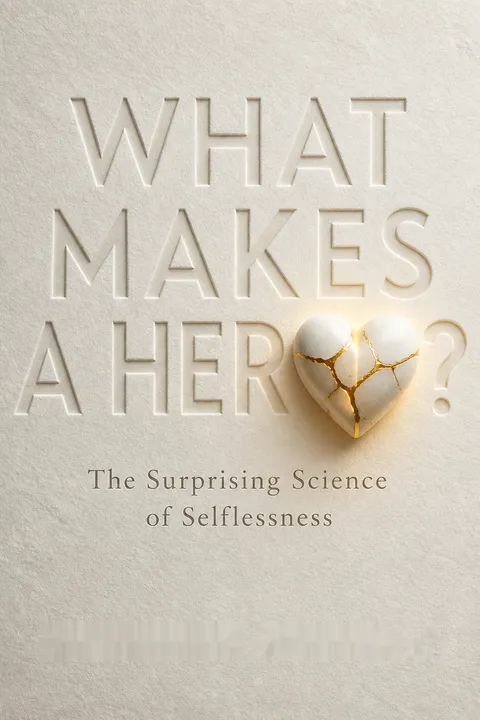
What Makes a Hero? receives mixed reviews (3.34/5 stars). Readers appreciate its exploration of altruism's science and the message that heroism can be developed through practice. Many find the research and real-life examples compelling. However, critics note the book focuses more on altruism than heroism, relies heavily on debunked psychology experiments (Zimbardo, Milgram), uses overly complex vocabulary, and reads more like a textbook. Some found the author's personal anecdotes self-absorbed. Positively, readers value its insights on empathy, compassion, and volunteering, though effectiveness varies individually.
People Also Read

Glossary
Banality of heroism
Ordinary capacity for sacrificeThe idea that heroism is not reserved for people born unusually brave or virtuous. Ordinary people can take meaningful action for others when circumstances, preparation, and choice align. The term reverses the darker idea that ordinary people can also commit harmful acts under powerful social pressures.
Kin selection
Helping genetic relativesAn evolutionary explanation for apparently self-sacrificing behavior. An individual may help relatives because they share genes, allowing some of the helper’s genetic material to persist even if the helper loses resources or reproductive opportunities. The theory explains one pathway to altruistic behavior, but does not by itself explain help offered to strangers.
Hamilton’s Rule
A test for kin altruismAn evolutionary inequality expressed as r × b > c. Here, r represents genetic relatedness, b the reproductive benefit to the recipient, and c the cost to the helper. The rule describes when a gene promoting assistance to another may spread because the benefit to related individuals outweighs the helper’s cost.
Group selection
Selection among groupsAn evolutionary theory proposing that groups with cooperative traits can sometimes survive or reproduce more successfully than less-cooperative groups. The book illustrates this with chicken breeding, where selecting productive groups reduced aggression and increased collective output. The theory is debated, and cooperation within groups can coexist with competition between groups.
Collapse of compassion
Compassion weakens as victims multiplyA pattern in which people feel less compassion, and may give less help, when suffering involves several victims or a large population rather than one identifiable person. Experiments described in the book found that adding statistics about widespread need could reduce donations to a named child. The effect can reflect emotional overload or an effort to avoid distress.
Tonglen
Meditation on suffering and reliefA Buddhist compassion practice in which a meditator imagines taking in suffering with the breath and sending peace or relief outward. It can focus on one person or a wider group. In the book, tonglen is presented as a way to practice staying present with pain and extending concern, not as a replacement for practical assistance.
Helper’s high
Pleasure associated with helpingAllan Luks’s term for the positive physical feeling many volunteers report during or after helping others. Survey respondents described warmth, energy, and improved well-being. The term captures a reported experience rather than proving that helping directly causes better health in every case.
Bystander effect
Inaction among multiple witnessesThe tendency for an individual to be less likely to help in an emergency when other people are also present. Each witness may assume someone else has already acted or should take responsibility. Learning about the effect can help people notice hesitation, but awareness alone does not guarantee intervention.
Subjective Units of Distress scale
A rating of personal discomfortA self-rating scale used in the book’s workplace courage training to describe how distressing a situation feels, commonly from 0 to 100. Participants use the rating to identify difficult conversations, practice them at manageable levels, and build confidence gradually. It is a practical training measure, not an objective reading of danger.
Professional moral courage
Ethical action under workplace pressureThe capacity to uphold ethical principles at work despite discomfort, social pressure, or possible personal costs. The book describes it as a practiced ability involving emotional awareness, a reflective pause, reduced self-interest, and preparation for difficult conversations. It is not the same as fearlessness or certainty that speaking up will be rewarded.
Positive deviance
Finding solutions within communitiesAn approach that looks for people within a community who succeed despite sharing the same constraints as others, then identifies and spreads their effective practices. In the book’s example, an aid worker improved children’s nutrition in Vietnamese villages by studying families whose children were already eating well, rather than imposing an outside solution.
Heroic Imagination Project
Training for everyday heroismA program associated with psychologist Philip Zimbardo that teaches people to recognize social pressures that can encourage passivity or harmful behavior. Its educational work uses examples such as obedience and the bystander effect, then asks participants to practice responses and undertake service projects. Its aim is to make ordinary people more prepared to act ethically and helpfully.
Download PDF
Download EPUB
.epub digital book format is ideal for reading ebooks on phones, tablets, and e-readers.








