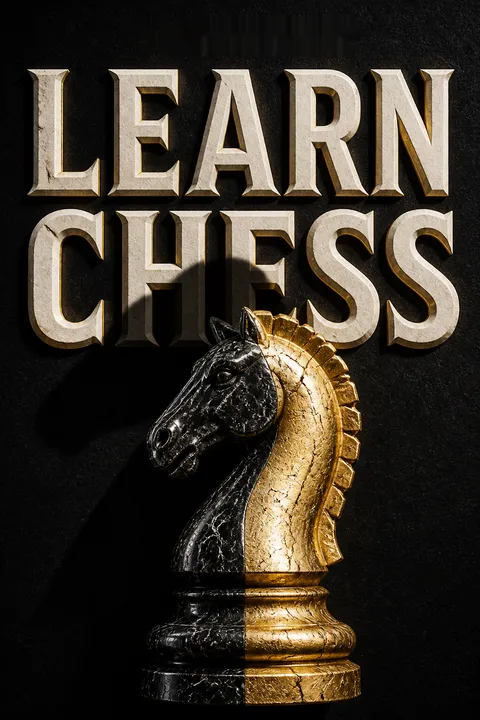


Key Takeaways
Master the rules first; chess strategy rests on a few precise mechanics
Learn what each piece can do. Rooks move along ranks and files, bishops along diagonals, queens combine those paths, and knights jump over other pieces. Kings move one square, while pawns move forward but capture diagonally. A king is in check when threatened. Checkmate ends the game when escape is impossible; stalemate is a draw when a player has no legal move but is not in check.
Know the special moves. Castling moves the king and rook together under specific conditions. A pawn reaching the far edge must promote, usually to a queen. En passant is a one-move opportunity to capture a pawn that has just advanced two squares. Algebraic notation records moves using the board's letter-number coordinates, making games easier to replay.
What's useful about this foundation is its emphasis on precise rules before strategic ambition. Chess can look like a storm of possibilities, but legality sharply narrows the choices at each turn. Learning the rules also teaches a general discipline: distinguish what seems possible from what is actually permitted. The special moves deserve deliberate practice because they are exceptions with lasting consequences. A player who knows the pieces but forgets that castling depends on the game's history, for instance, may misread a position even while looking directly at it.
Develop pieces, contest the center, and castle before launching plans
Use opening moves to mobilize. The center, especially the four squares d4, d5, e4, and e5, gives pieces room to influence both sides of the board. Moving a central pawn often opens paths for a bishop and queen. Knights commonly develop before bishops because their useful squares are easier to identify, though that is a guide, not a law.
Bring the king to safety. The opening has three practical jobs: develop pieces, contest the center, and castle. Moving the same piece repeatedly, pushing too many pawns, or sending the queen out early can waste time. White's first move gives a small advantage; the book notes that White scores about 55 percent in grandmaster games, but that edge is not automatic.
The opening is best understood as a resource-allocation problem. Each move spent advancing a pawn, rescuing a piece, or chasing a target is a move not spent developing the rest of the army. Center control matters because it creates options, not because occupying central squares is a ritual. The advice to castle early is similarly practical: a safer king reduces the number of emergencies that can disrupt development. Still, opening principles are not a memorized recipe. An opponent's plan can change which piece should move, or whether a standard pawn advance is safe.
Count attackers and defenders, then check the value of every exchange
Treat material values as a guide. Nunn's rough scale assigns a pawn one point, a knight or bishop three, a rook five, and a queen nine. These numbers help compare exchanges, but they do not capture every position: a trapped piece or a pawn close to promotion may be worth much more or less than its nominal value.
Calculate the whole sequence. Before capturing a defended piece, count how many attackers and defenders can recapture, then compare what each side gives up. Tactics are short operations with a concrete goal. A fork attacks multiple targets at once; a pin restricts a piece; a skewer attacks a valuable piece that must move to expose another. Karpov resigned against Christiansen in 1993 after a queen fork threatened two pieces.
The point scale works like a first-pass accounting system: it catches obviously bad trades and gives beginners a shared vocabulary for comparing forces. Its weakness is also its strength. A simple scale is memorable precisely because it leaves out context, so it must be followed by a board-level check. Is a piece active? Can it escape? Does a pawn threaten to promote? Tactical calculation is not merely counting; it is tracing how the position changes after each forced reply. The best practical habit is to use the scale to raise questions, not to settle them.
Attack the king only when your pieces can reach it together
Wait for favorable conditions. A direct attack becomes more plausible when the enemy king is stuck in the center, its pawn cover has been weakened, or its defenders are far away. Attacking without enough pieces nearby can leave the attacker down material and out of position. Checks are forcing, but aimless checks do not create a sound attack.
Coordinate the assault. In the book's example, grandmaster Mohammed Al Modiahki punished Tin Htun Zaw for delaying king safety and blocking his queen's defense. White sacrificed a bishop on f7, drew the king into danger, and used a knight check to win the queen. Familiar mating patterns, such as queen and knight attacks on a castled king, help players recognize when a position has crossed from promising to decisive.
A king attack is a coordination test, not a test of aggression. The attacker must assemble enough force before the defender can reorganize, and the defender's missing pieces can matter as much as the attacker's present ones. This resembles a broader principle in adversarial decision-making: an action is only strong when the supporting resources arrive in time. Pattern recognition makes the decision faster, but patterns can mislead when a key square is defended or a supposed sacrifice has no follow-up. The right question is not simply whether the king looks exposed, but whether the available pieces can exploit that exposure.
Plan around stable weaknesses, not just the last move
Build a multi-move plan. When no immediate tactic or king attack is available, improve a piece, claim an open file, occupy a useful square, or make an enemy piece retreat. A strategy is a longer-term plan; unlike a tactic, it may not promise an immediate gain. The pawn structure, meaning the arrangement of pawns, often guides such plans because pawns move slowly and cannot reverse course.
See the plan through. Against Hanreck, Nunn noticed that Black's pawn advance had weakened control of c6. He first exchanged a knight, then routed another knight through a5 to c6, where it became a powerful outpost and attacked Black's rook. The plan worked because White identified a lasting weakness and coordinated several moves around it, rather than responding mechanically to each new move.
The distinction between tactics and strategy is a distinction between timescales. Tactics ask what can be forced now; strategy asks which features are likely to remain useful after the immediate sequence ends. Pawn structure gives strategic thought an anchor, but it should not be treated as permanent destiny: a pawn break can transform the whole position. The knight's route to c6 illustrates how a plan can be concrete without being a forced combination. It also shows why good planning includes anticipation: a piece may need several quiet moves before its eventual placement matters.
In endgames, escort passed pawns with an active king
Recognize the promotion race. A passed pawn has no enemy pawn able to stop it from advancing toward promotion. It often forces an opposing piece to stay in front of it, tying that piece down. Two connected passed pawns, side by side, can be especially hard to stop because each may protect the other's advance.
Bring the king into play. When queens and rooks disappear, the king becomes an active piece rather than a liability. It can support its own pawns, attack enemy pawns, and help escort a passer. In one example, White's king drove away a knight blocking an advanced pawn while a bishop restrained Black's passer. A king and queen can force mate against a lone king; a king with only one bishop or one knight cannot.
Endgames reward a change in risk assessment. Earlier, a king's exposure invites attack; with fewer pieces, the same king can become the strongest escort on the board. The passed-pawn idea captures the endgame's central tension: one pawn can demand the attention of an entire piece. Yet advancing is not automatically wise. A passer that moves without support can be surrounded and lost, so the king's route and the opponent's counterplay must be considered together. Promotion is the goal, but coordination is what makes the goal reachable.
Treat every opponent move as a threat, especially when winning
Pause before acting. Players often become absorbed in their own plans and fail to notice a direct threat. The danger is greatest when a position feels won: attention drifts, and a single oversight can reverse the result. Before moving, ask what the opponent's last move attacks and what they intend next.
Distrust free material. A piece that appears undefended may be bait. In one example, a player captured a bishop without noticing that the reply threatened mate and a fork. The book's practical advice is not to fear every sacrifice, but to examine the consequences before accepting one. The same vigilance applies to your own traps: a move that works only if the opponent overlooks it is not a dependable plan.
This lesson treats attention as part of playing strength. Calculation can be accurate and still fail if it begins from the wrong question. A player may analyze a beautiful attack while overlooking that the opponent has a forcing check. A brief threat scan acts as a safeguard against that attentional tunnel. The warning about traps is equally valuable: expecting the opponent to miss something is a fragile strategy. Chess rewards imagination, but it rewards verification more reliably. Confidence should increase care, not replace it.
Review your games, and use computers as assistants, not pilots
Turn games into feedback. Recording games lets players revisit decisions and identify recurring errors. A post-game review can reveal whether the main weakness is opening development, missed tactics, poor planning, or endgame technique. Playing opponents near one's ability also makes games more instructive than repeatedly facing overwhelming mismatches. Clubs, tournaments, and online services can all provide that practice.
Use software with judgment. Beginner-friendly programs can show legal moves, warn about threats, and adjust their playing strength. Strong engines and databases can also help analyze games, but their explanations may be shallow, and recorded games can contain human-entered errors. Ratings offer a rough way to compare competitive results, not a complete measure of enjoyment or learning. The goal is to use tools to sharpen independent judgment.
The strongest learning loop is not simply playing more, but connecting play to diagnosis. A saved game turns a fleeting decision into something inspectable, while software can reveal candidate moves a beginner did not consider. That feedback is most useful when the player first explains their own reasoning, then compares it with the computer's analysis. Otherwise, engine recommendations can become answers without understanding. Ratings can help match opponents and track results, but they are only a proxy for skill and say little about whether a player is learning or enjoying the game.
Analysis
Learn Chess is a practical primer, not a tour of chess theory. Its structure follows the learner's path: understand the rules, make opening moves, recognize tactical wins, attack the king, plan in quieter positions, and convert advantages in the endgame. The book's defining choice is restraint. Rather than flood a beginner with opening variations, it repeatedly returns to a few durable questions: What is threatened? Which piece is poorly placed? Can a pawn promote? Is the king safe?
That restraint makes the instruction coherent. The material scale gives an initial way to judge trades, but the examples repeatedly show why numerical values are not enough. A knight fork, a pinned piece, or an exposed king changes the calculation. Likewise, opening principles provide direction without guaranteeing a best move. The reader is taught to use general rules as a starting filter, then inspect the actual position. This is a sound model of expertise: flexible principles, tested against local evidence.
The game examples preserve the book's narrative force. A small oversight can turn an apparently routine move into a queen loss; a patient knight maneuver can make a quiet advantage decisive. That contrast helps explain chess's appeal. The game combines visible rules with consequences that are difficult to foresee, and a player's understanding can deepen without the rules changing. Nunn's use of modern games also makes the demonstrations feel connected to living competitive practice rather than museum pieces.
The approach has a deliberate boundary. It teaches reliable first principles, not a complete system for every opening, strategic structure, or endgame. Its advice to develop and castle is useful, but skilled play often requires exceptions. That is not a flaw in a beginner's guide so long as the reader understands the principles as heuristics. The lasting value lies in learning a disciplined way to look: assess threats, calculate forcing moves, make a plan, and remain alert to the opponent's reply.
Review Summary
Learn Chess receives mixed reviews, with an average rating of 3.73/5. Readers praise its step-by-step approach for beginners, covering basics to advanced tactics. The book's use of real-world examples and introduction to chess notation are appreciated. However, some find the later chapters challenging for novices, with complex algebraic notation and difficult exercises. The book is recommended for beginners and those refreshing their knowledge, though some suggest there are more approachable resources available. Overall, it's considered a solid choice for learning chess fundamentals.
People Also Read



Glossary
Material
Pieces and pawns ownedMaterial is the total force a player has on the board, usually discussed by comparing the two sides' pieces and pawns. A rough scale assigns one point to a pawn, three to a bishop or knight, five to a rook, and nine to a queen. These values guide comparisons but do not account for a piece's position or activity.
Tactics
Short-term forcing operationsTactics are short-term operations aimed at a concrete result, such as winning material, forcing mate, or creating a decisive threat. They commonly depend on checks, captures, and threats that restrict the opponent's choices. Forks, pins, skewers, and discovered attacks are recurring tactical devices.
Combination
Elaborate tactical sequenceA combination is a tactical operation, often more elaborate than a single trick and sometimes involving a sacrifice. Its moves work together toward a specific result, such as exposing the enemy king or winning material. The sequence depends on concrete replies, so its success must be calculated rather than assumed.
Strategy
Long-term positional planStrategy concerns longer-term plans whose aims may be less immediate than a tactical gain. Examples include improving a poorly placed piece, controlling an open file, occupying a useful square, or preparing an attack. Strategic decisions are often shaped by the pawn structure and by which features of the position are likely to remain stable.
Pawn-structure
Arrangement of the pawnsPawn-structure, also called the pawn skeleton, is the arrangement of pawns on the board. Because pawns cannot move backward and often remain in place for many moves, their formation shapes long-term plans. Pawn advances can create space or passed pawns, but they can also leave lasting weaknesses that pieces may exploit.
Passed pawn
Pawn no enemy pawn stopsA passed pawn is a pawn that cannot be stopped from advancing toward promotion by an opposing pawn. The opponent usually must use a piece or king to block it, which can tie that defender down. Two connected passed pawns on neighboring files can support each other's progress and become especially dangerous.
Algebraic notation
Coordinate-based move recordingAlgebraic notation records chess moves using the board's coordinates. Files are labeled a through h, and ranks 1 through 8, so each square has a unique name. Piece symbols or letters identify the moving piece, while captures, checks, castling, and promotion have standard markers. The system allows games to be recorded and replayed.
Stalemate
Draw without legal movesStalemate occurs when a player has no legal move available, but their king is not in check. The game ends immediately as a draw. It differs from checkmate, where the king is under attack and cannot escape. A player who is winning must therefore avoid leaving the opponent without moves by accident.
En passant
Special pawn captureEn passant is a special pawn capture available immediately after an opposing pawn advances two squares from its starting square and passes an adjacent pawn. The capturing pawn moves diagonally to the square the advancing pawn crossed, and the advanced pawn is removed. If the capture is not made on the next move, the opportunity disappears.
Castling
King and rook move togetherCastling is a special move in which the king moves two squares toward a rook, and that rook moves to the square beside the king. It is legal only if neither piece has moved, the squares between them are clear, the king is not in check, and the king does not cross or land on an attacked square.
Elo system
Numerical chess rating methodThe Elo system is a method for rating chess players, named after its inventor, Professor Elo. A player's expected score is calculated from their rating and those of their opponents. Results above that expectation tend to raise the rating, while results below it tend to lower it. The number estimates competitive performance, not every aspect of a player's ability.
Download PDF
Download EPUB
.epub digital book format is ideal for reading ebooks on phones, tablets, and e-readers.








