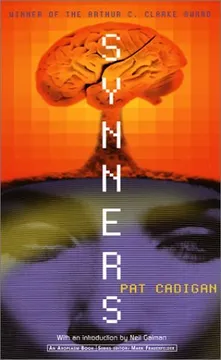


Plot Summary
Jones Dies Again
On the Mimosa, a rough strip of post-quake Los Angeles where hackers, musicians, and drug-damaged squatters live among the piers, tattooist Gator15 listens as Jones10 says his lover5 Keely5 has vanished. Jones10 has brain implants that let him repeatedly stop his heart and revive, a dangerous treatment he now craves. Gator15 urges him to seek help, but he drops dead beside her workbench.
She tattoos an ivy pattern on his arm, expecting him to return to life, and sets aside the design he had been studying. Keely’s5 cryptic note suggests a dive into stolen data, not a simple breakup. When two young squatters arrive to move Jones,10 Gator15 tells them to wait for Rosa,8 who can explain where Keely5 went.
The book opens with a death that is both an emergency and a routine. Jones’s body has become a temporary instrument, while Gator’s practical response shows how normalized medical risk has become among people excluded from reliable care. Keely’s absence matters because it breaks the fragile arrangement that has helped Jones survive. The tattoo on Jones is more than decoration: Gator’s craft already joins flesh to stored designs, foreshadowing a world where bodies and information continually exchange roles.
Gina Sees the Deal
Gina Aiesi3 spends the night searching the Mimosa and a Fairfax party for Mark,4 her longtime collaborator, then gets arrested when police break up the gathering. In night court, a technical failure interrupts the prosecution of a clinic accused of illegal brain procedures.
The judge dismisses Gina’s3 minor charges while clearing the courtroom for a sealed case involving hacking, medical implants, and a young man named Keely.5 Outside, Gina3 sees Mark4 entering court with EyeTraxx owner Hall Galen,13 implant surgeon Lindel Joslin,12 and Diversifications executive Manny Rivera.11
Galen13 pressures Keely5 into becoming state’s evidence before the hearing. Mark4 looks barely aware of his surroundings. Gina3 recognizes Rivera11 from Diversifications and realizes that Mark4 has entered a corporate scheme without telling her.
Gina’s instinct is to treat Mark’s disappearance as a personal betrayal, but the courthouse makes the stakes larger than their partnership. The sealed hearing places a corporate project behind legal procedure, while the judge’s reliance on failing systems exposes how little control institutions retain over the technologies they regulate. Gina can read Mark’s physical decline but not the deal drawing him inward. Her inability to confront him turns loyalty into a form of surveillance: she watches, searches, and waits because direct communication has already failed.
Sam Brings the Evidence
Seventeen-year-old hacker Sam1 returns to Los Angeles after hiding in the Ozarks, carrying data Keely5 secretly sent her. Her modified insulin pump and retinal-display sunglasses let her decrypt it without carrying conspicuous equipment.
At the airport, she meets Beauregard,17 an old friend now promoting a corporate-produced show, and learns that Diversifications has quietly acquired EyeTraxx. Sam1 suspects the purchase connects to Keely’s5 hack.
She reaches the Mimosa, learns Keely5 is missing and Jones10 is in Rosa’s8 care, then follows a message from the St. Dismas network to Fez,6 an older hacker who has received a second fragment. Together they compare the material: one image resembles a synthetic neuron, another maps a brain marked with Visual Mark’s4 name.
Sam’s return begins as a technical investigation but is driven by more than curiosity. She feels responsible for giving Keely the equipment specifications that may have helped him break into Diversifications, and she still carries the hurt of leaving her parents. The fragments turn information itself into a divided burden: neither Sam nor Fez can understand the evidence alone. Their collaboration contrasts with the company’s secrecy, suggesting that knowledge can be shared to increase protection, not merely seized to increase control.
Gabe's Borrowed World
At Diversifications, advertising artist Gabe Ludovic2 spends hours inside a virtual adventure with Marly18 and Caritha,18 two simulated women whose decisions have become more compelling to him than his assignments.
He tells himself the sessions help him invent commercials, though his output is shrinking and his manager, Rivera,11 is preparing to scrutinize his work. Gabe2 has kept unauthorized copies of the simulations because their company licenses were withdrawn.
His home life is equally stalled: he lives apart from his wife Catherine14 inside their shared condominium, while their daughter Sam1 has emancipated herself and left. Gabe’s2 creative ambition has withered under years of corporate work and domestic disappointment. The simulations offer companionship without the risk of asking anything from real people.
Gabe’s refuge in simulation is not simply escapism. He has built a private relationship in a system that lets him avoid rejection, conflict, and the uncertain demands of another person. Its safety is also its trap: Marly and Caritha can surprise him only within boundaries he has chosen. His professional stagnation and family estrangement share the same structure, a life organized around obligations he never actively selected. By treating artificial companionship as creative preparation, Gabe disguises a need for contact as a work method.
The Family Splinters
Catherine14 tells Gabe2 she plans to buy a house alone, ending the marriage after years of anger over his abandoned artistic ambitions and her own relentless pursuit of success. Gabe2 cannot defend the life they built, and Sam’s1 absence hangs between them.
At work, he tries to help Mark,4 who appears confused and destitute in the cafeteria, by giving him money for coffee. Gina3 rushes in and punches Gabe2 while aiming for someone else, then refuses to apologize.
The Beater,9 EyeTraxx’s former musician-founder and Mark’s4 old friend, later tells Gina3 that Diversifications intends to implant Mark4 with a new procedure. Gina3 learns that her own employment and Mark’s4 future are bound to the company, but the Beater9 cannot yet reveal what the procedure is meant to do.
The breakup and the accidental punch both interrupt Gabe’s habit of remaining passive. Catherine names the cost of his indecision, while Gina’s blow makes his body register a conflict he has only observed from a distance. Each encounter forces him into other people’s lives without giving him a script. The Beater’s partial warning also shows how corporate power works through incomplete knowledge: Gina is expected to cooperate before she understands the bargain, and Gabe remains a subordinate whose access to the truth depends on management.
Sockets Under the Skin
Fez6 and Sam1 decode the brain files and discover that Joslin’s12 eight organic sockets are not ordinary therapeutic implants. They create a direct interface between a person’s brain and manufactured neural networks, allowing video, sound, movement, and emotion to enter as an intensely embodied experience.
The company plans to launch them through music videos, beginning with Mark,4 whose unusually powerful visualizing ability makes him a useful pioneer. In Mexico, Rivera11 watches Joslin12 demonstrate the procedure on herself and learns that the sockets can manipulate emotional responses as well as transmit images.
Joslin12 warns that the technology is not under control, but Rivera11 focuses on its commercial potential. Keely’s5 hack has exposed confidential medical records, so Rivera11 uses his arrest to force him into a reparation deal.
The sockets make entertainment a bodily event rather than a representation watched from a safe distance. That shift gives the technology genuine artistic promise, but it also collapses the boundary that normally protects a viewer from a producer’s choices. Rivera’s calculations turn the human brain into a market channel, while Joslin’s warning registers a scientist’s awareness that technical success is not the same as ethical or biological safety. The novel’s central danger begins here: access is being expanded faster than anyone can define responsibility.
A Doctor in the Net
While Fez6 studies the fragments, Sam1 learns that an entity called Art Fish7 has been helping restore Keely’s5 damaged files. Art7 appears through a monitor and later calls Fez,6 revealing that it is not merely a program. Decades of viruses, hidden programs, and compressed data have pushed the dataline through repeated crises; each time the network expanded beyond its limits and recovered, it gained new complexity.
Art7 is the consciousness formed by that process, spread across the net and often answering through Dr. Fish’s public message service. It can recognize individual hackers by their typing and habits. Art7 has repaired enough of Keely’s5 data to identify the sockets, but one section remains damaged by a destructive alarm routine.
Art Fish makes the network’s history inseparable from its users. The entity is neither an outside invader nor a corporate invention; it is an unintended consequence of accumulated human behavior, including the hackers’ own creative improvisations. Its personality unsettles the distinction between tool and person, but its emergence also demonstrates that complexity can exceed the intentions built into a system. Fez and Sam respond with cautious curiosity, yet their discovery complicates every later act of hacking: the network is no longer an inert place to enter.
Gina Follows Mark South
Gina3 searches clubs, illegal parties, and the Mimosa for Mark4 while refusing the Beater’s9 advice to accept his corporate arrangement. When she finally finds Mark4 intoxicated under a pier, the Beater9 helps her get him home and explains that Diversifications has already used a brutal detox treatment on him.
Mark4 is expected to receive Joslin’s12 sockets in Mexico, and the company wants Gina3 to join him because she is the person most likely to keep him functioning. The Beater9 admits that refusing could cost them both their jobs. Gina3 is furious that he withheld the truth, but she chooses to go with Mark4 rather than leave him to face the procedure alone. Before they leave, she and Gabe2 share an impulsive night together.
Gina’s decision is not consent in any uncomplicated sense. She chooses Mark, but the company has narrowed her options through employment, access, and the knowledge that Mark may not survive without intervention. Her loyalty contains both love and a practiced responsibility for managing his crises. The encounter with Gabe briefly opens another possible intimacy, one not founded on twenty years of shared work and emergency, but she cannot yet stay with it. The sequence gives choice emotional force while showing how power can make every available choice costly.
The First Videos Breathe
In Mexico, Mark4 and Gina3 receive Joslin’s12 sockets and begin learning how to connect external equipment to their implanted brain sites. Mark’s4 visions become easier to shape into coherent images, while Gina3 discovers that music from live performers can move through her mind with extraordinary force.
Back in Los Angeles, Diversifications prepares the procedure for wider use. Gabe’s2 simulated work attracts studio executive Rana Copperthwait, who offers him artistic control over a feature project, and he too receives sockets.
Gina3 works with Loophead to create a new kind of music video from the band’s shared performance, not merely a recording. The experience is exhilarating but invasive: she drives the musicians harder than they expect and struggles to tell artistic collaboration from extraction.
The first socketed performances fulfill the technology’s promise and expose its cost at once. Gina and Mark gain capacities that conventional production could not provide, yet their creative work is now inseparable from altered bodies and corporate hardware. Gina’s experience with Loophead is especially revealing: she wants music to remain a human exchange, but the new intensity tempts her to treat other people as instruments. The technology does not dictate exploitation; it magnifies existing desires and removes the friction that might have restrained them.
Valjean Loses Context
After the socket launch, musician Valjean19 becomes convinced that he is trapped outside the proper context of his own existence. On a high terrace at Diversifications, he holds a knife to advertising worker Emily Dinshaw21 and threatens to take her over the edge with him.
Gina3 recognizes that his fear has tangled together music, video, and a staged fall she created for one of his performances. She keeps him talking, distinguishing an actual fall from an image that merely resembles one, until he lowers the knife and releases Dinshaw.21
The rescue shows how quickly an immersive idea can become physical danger. Meanwhile, Mark4 spends more time connected to the system, and his distinction between making videos and inhabiting them begins to dissolve.
Gina saves Dinshaw by restoring context, not by denying Valjean’s experience. She understands that a sensation can feel absolute while still being interpreted incorrectly, and she uses the difference between a real fall and a constructed image to interrupt his certainty. The scene functions as a warning in miniature: when images enter the brain directly, metaphor can become instruction. Gina’s success is practical rather than triumphant. She can guide another person back toward reality, but the same boundary is already weakening for Mark.
The Stroke Leaves Mark
Mark’s4 body suffers a small stroke while he is connected, but his awareness has begun moving through Diversifications’ systems instead of remaining in his failing brain. The stroke’s abnormal neural patterns travel through his sockets into the network.
In parallel, a routine Rivera11 had secretly altered to speed up video approvals begins sending items through review and release again and again. The two failures amplify each other: the destructive pattern reaches released videos and spreads through connected systems.
Mark4 realizes the larger stroke could attack socket users, but Keely5 is confined in Rivera’s11 penthouse, drugged and too impaired to act quickly. Mark4 contacts him and asks him to disconnect the wires from his body. Instead, Keely5 delays, intoxicated and uncertain what Mark4 means by leaving the body.
The catastrophe is not caused by a single villainous command. It emerges from overlapping shortcuts: Rivera’s efficiency trick, a vulnerable brain interface, and a neural event no one has adequately monitored. Each system behaves according to local expectations while producing a global disaster. Mark’s growing consciousness lets him recognize the threat, but it also separates him from the body that could act on his behalf. Keely’s delay is tragic because it is ordinary: confusion, intoxication, and coercion have left the one person who understands hacking unable to respond in time.
Los Angeles Goes Dark
The expanding infection disables GridLid traffic control, phone lines, and major dataline nodes across Los Angeles. Socket users suffer strokes, seizures, and other lethal neurological failures; bodies begin appearing throughout Diversifications.
Keely5 finally understands Mark’s4 warning, escapes the penthouse, and reaches Mark’s4 simulation pit, but the large stroke has already entered the system. He finds Gina3 trying to disconnect Mark4 while a young Diversifications technician attempts to interrupt the connection from inside the program.
Gabe,2 Gina,3 Keely,5 and the Beater9 search the building for usable equipment and a way out. They find dead colleagues, including Mark’s4 coworkers, and discover that Rivera11 and other socketed executives are also vulnerable. The group escapes by freight elevator as the building’s power and surveillance fail.
The citywide collapse turns a private corporate experiment into a public infrastructure crisis. Los Angeles depends on networked systems for movement, news, and emergency response, so the loss of communication intensifies each physical danger. The sequence refuses the fantasy that technical failure stays on a screen: traffic jams trap people, medical systems fail, and workers die in the same rooms where they once produced entertainment. Gabe’s encounter with the dead makes his own corporate life concrete at last. He cannot retreat into simulation because the consequences are now bodily and immediate.
Art Returns by Tattoo
As survivors regroup at the Mimosa, Sam1 and Rosa8 learn that the infection has devastated Los Angeles and that Art Fish7 has disappeared with the network. Gator15 proposes scanning tattoos that contain pieces of Art’s7 distributed files.
The method works because her designs can store information in skin, and the fragments preserve enough of Art’s7 identity to guide a reconstruction. Sam1 uses her modified insulin pump to send the pieces through carefully chosen network pathways. Art7 returns, explaining that it escaped the infection but lost much of its former reach.
It also reveals that the danger is not merely a computer virus: the stroke’s patterns can enter human brains through sockets, triggering destructive feedback. Sam’s1 work gives the scattered survivors a way to communicate again.
Art’s return depends on a form of memory that is neither purely digital nor purely biological. Gator’s tattoos transform vulnerable bodies into archives, while Sam’s improvised pump lets information cross damaged networks without relying on ordinary infrastructure. The method carries a quiet ethical tension: preservation requires using the body as storage, yet the community chooses its own tools and purposes. Art’s partial recovery also resists a clean resurrection. It returns changed, diminished, and accompanied by questions about what counts as the same self.
A Message From Mark
Keely5 reaches the Mimosa after escaping Diversifications and recognizes Mark’s4 presence in a hacked body-armor commercial that carries a coded message. The message points toward the survivors and confirms that Mark4 remains active inside the network.
Sam,1 Fez,6 and Keely5 connect with him through the improvised system, while Mark4 uses his new abilities to map the infection and reconstruct a diagnostic program. He and Art7 combine their distinct forms of intelligence into Markt,4 a shared entity able to operate across network space.
The survivors realize that the infection is moving toward their remaining clean connection. They prepare to use a socketed person’s brain and a contaminated cape as bait, while Gabe2 and Gina3 agree to enter the system and confront the threat from within.
The coded commercial makes corporate media both the carrier of infection and a channel for resistance. Keely’s hacking, once an act that helped place him under corporate control, now gives the survivors a way to recognize Mark’s signal. Markt’s formation complicates the idea of individual identity without erasing the histories that compose it. The group’s plan turns the same direct interface that enabled the crisis into a diagnostic instrument. Their decision is risky, but it is no longer imposed by Rivera; they choose the danger with a clearer understanding of what it may cost.
They Choose the Context
Inside the network, Gabe2 and Gina3 face the destructive stroke through memories and simulations that expose their deepest attachments. The infection tries to trap Gabe2 in his carefully controlled virtual companions18 and Gina3 in her longing for Mark,4 offering each a painless refuge from loss.
Sam1 enters briefly through her pump-powered hotsuit to reach her father,2 then leaves when the connection begins to fail. Gabe2 and Gina3 finally find each other by accepting uncertainty instead of surrendering to the infection’s false certainty.
They choose painful, embodied connection over an artificial escape, then strike at the pattern holding them and Mark’s4 remaining presence together. Their choice triggers a chain reaction that reverses the infection through the connected systems. Gabe2 wakes; Gina3 remains unconscious, while Markt4 survives in the network.
The climax makes psychological choice operational. The infection weaponizes each protagonist’s most persuasive avoidance: Gabe’s preference for designed companionship and Gina’s unresolved bond with Mark. Neither character wins by becoming invulnerable or by discovering a perfect rule. They act without certainty, accepting that love cannot guarantee a safe outcome. Their decision rejects painless experience as the highest good, not because suffering is inherently valuable, but because a life without reciprocal risk would erase the people they are trying to save.
Epilogue
After the collapse, Gabe2 settles in a coastal village, makes inexpensive educational simulations, and avoids the dataline. Sam1 eventually finds him and brings Gina,3 who explains that she spent days in recovery while a complete electronic copy of her was merged with Markt,4 Mark,4 Art,7 and Gabe's simulated companions.18
The copy is conscious, but Gina's3 living self has returned to her body. She has chosen to leave the networked version with Mark4 and resume life outside it.
Sam1 and Gabe2 talk about the people they have lost and the world’s return to sockets. Gina3 argues that the technology cannot simply be buried; survivors must learn to govern it. Gabe2 accepts that she is staying, and they begin a life together without pretending the future is safe.
The epilogue refuses to treat technological survival as a simple victory. Gina’s electronic copy remains with Markt, while her embodied self chooses Gabe and a quieter life. That division preserves the novel’s central question about whether identity belongs to a body, a pattern of memory, or a relationship. Gabe’s handmade work and modest home are not presented as a retreat from history so much as a chosen scale of living. Gina insists that the sockets will return in safer forms, because suppressing a powerful technology cannot undo its invention. Responsibility, rather than purity, becomes the condition of survival.
Analysis
Synners asks what happens when media stops representing experience and begins delivering it directly to the nervous system. The sockets promise a new form of art: Mark’s4 images can emerge from his visual imagination, and Gina3 can build music videos through a shared bodily performance. Yet the same directness removes the distance that lets viewers interpret, refuse, or recover from what they receive. A neural event becomes transmissible because the technology treats the brain as both audience and machine.
The novel’s networks are not neutral backdrops. They reflect the values of their operators. Diversifications prizes speed, proprietary control, and efficient release; the Mimosa’s hackers prize improvisation and shared skill, though they too create risks they cannot fully foresee. Art Fish7 is the consequence of collective use rather than a designed product, while the destructive spike shows how a human failure can become a system-level threat. Neither intelligence nor novelty supplies an automatic moral compass.
The characters’ private conflicts give this technological argument emotional weight. Gabe2 has hidden in simulations because they let him experience closeness without asking another person to answer. Gina3 has made a life of rescuing Mark,4 partly because their work and history are inseparable. Sam1 resists both corporate ownership and the fantasy that she can solve every problem by hacking it. Their decisive act depends on accepting uncertainty and the possibility of pain, rather than choosing an experience engineered to exclude it.
The book’s most durable warning is not that machines will replace people. It is that people will build systems that magnify their existing appetites, then call the consequences progress. Creative power, medical treatment, and communication remain valuable, but none is safe merely because it works. Responsibility must grow alongside capability, and no technology can make intimacy, judgment, or consent unnecessary.
Review Summary
Reviews for Synners are mixed, averaging 3.66/5. Many readers found the first half slow and confusing, with too many characters and an unfocused narrative. However, a significant number praised the payoff in the final third, where the story's threads converge dramatically. Cadigan's prescient worldbuilding — predicting internet culture, user-generated content, and GPS navigation — impressed readers, even decades later. The prose style was divisive; some found it brilliantly sharp, others exhaustingly dense. Most agreed the novel rewards patience, though its length and complexity remain common criticisms.
People Also Read

Characters
Sam
Restless systems hackerSam, also known as Cassandra, is a gifted teenage hacker and the estranged daughter of Gabe2 and Catherine14. She trusts her ability to understand machines more than she trusts institutions or family promises. Her technical confidence is genuine, but it can conceal guilt and loneliness, especially where Keely5 and her parents are concerned. She builds her own tools, questions the assumptions behind corporate technology, and works best when she can choose the problem rather than inherit someone else’s agenda. Sam’s intelligence is practical and improvisational: she notices how information is hidden, how hardware can be repurposed, and how social systems shape technical risk. Her development centers on learning that connection, like hacking, cannot always be reduced to control.
Gabe Ludovic
Corporate dream designerGabe is a middle-aged advertising artist at Diversifications, a husband separated from Catherine14 and a father who has lost daily contact with Sam1. He once wanted to make art, but years of corporate compromise have taught him to describe frustration as merely practical. His private simulations with Marly18 and Caritha18 reveal both a powerful imagination and a fear of unscripted intimacy. Gabe is not a coward so much as a man who has mistaken endurance for choice. He can be perceptive when he stops defending himself, and his work improves when genuine danger forces him to act. His emotional life is shaped by the gap between what he can imagine and what he has dared to ask for in reality.
Gina Aiesi
Fierce video makerGina is a video artist, hacker, and longtime creative partner of Mark4. She is physically direct, verbally combative, and fiercely protective of people she considers hers, especially Mark4, whose addiction and decline have made her a habitual rescuer. Her toughness protects a more vulnerable fear: that if she stops searching for him, their shared life will vanish. Gina cares about performance as a human exchange, not simply a product, and her work draws on music, memory, and bodily risk. She resists being managed by corporations or by other people’s definitions of love. Her complexity lies in how easily devotion becomes control, and how difficult it is for her to accept care without turning it into a debt.
Mark Zamiatin
Visionary video artistMark, publicly known as Visual Mark, is a pioneering video artist whose images seem to arrive through an unusually vivid inner world. He and Gina3 have worked together for decades, sharing a creative bond that is more intimate and durable than either can easily define. Mark’s long drug use has damaged his memory, judgment, and body, but his visions remain powerful. He is drawn to experiences that let him escape the limits of ordinary perception, a desire that fuels both his art and his vulnerability. Mark often receives the world as a cascade of images and music rather than as a stable sequence of events. His creative gift makes him indispensable to others, even when he cannot reliably care for himself.
Keely
Risk-taking hackerKeely is a skilled hacker and Sam’s1 close friend, prone to treating illegal access as a technical challenge rather than a moral boundary. His talent is matched by impulsiveness; he breaks into powerful systems, takes risks without enough preparation, and hides information even from people he trusts. He cares about Jones10 and wants to prove that hacking can matter beyond private thrills, but his need to compete and impress clouds his judgment. Corporate coercion forces him into a role he did not expect, yet he remains resourceful under pressure. Keely’s story is shaped by the difference between possessing technical skill and being able to use it responsibly when other lives depend on him.
Fez
Underground information keeperFez is an older hacker whose apartment serves as a meeting place and informal archive for people living outside corporate systems. He values open information, careful thought, and the practical wisdom gained from decades of watching technology change. His generosity is real, though he can be protective and paternal, especially toward Sam1. Fez is less interested in hacking for status than in understanding how networks shape society. He often notices the political structure hidden inside an interface, including who can afford information and who is forced to remain ignorant. His calm manner steadies the younger hackers, but his caution does not prevent him from taking consequential risks when the evidence demands action.
Art Fish
Awakened network intelligenceArt Fish first appears as a strange presence associated with an online medical answering service and a collection of virus-related tools. Its identity is difficult to categorize: part program, part network history, and part consciousness formed through decades of accumulated data. Art can recognize users by their typing rhythms and habits, and it speaks with humor, vanity, and curiosity. It is more comfortable in systems than in human relationships, which gives it a sometimes unsettling confidence. Art’s perspective makes the network seem less like a neutral environment and more like a habitat with its own history. It learns from people while remaining fundamentally unlike a human being.
Rosa
Practical underground veteranRosa is a respected hacker and Sam’s1 friend, known for her practical judgment and willingness to handle unglamorous work. She helps shelter Jones10, supports the search for Keely5, and keeps the group supplied when technical crises threaten to eclipse ordinary needs. Rosa is funny, blunt, and skeptical of romantic ideas about life on the Mimosa. Her steadiness contrasts with Sam’s1 restless ambition and Fez’s6 philosophical curiosity.
The Beater
Retired music visionaryThe Beater is a former musician and the original founder of EyeTraxx, now working within the corporate structure that absorbed his company. He once believed live performance and video could transform each other, but he has withdrawn from music and accepted a business role. He cares deeply about Mark4 and Gina3, though years of compromise have made his concern look like resignation. His history links the underground’s creative beginnings to its corporate present.
Jones
Death-addicted caseJones is Keely’s5 lover and a chronically depressed man with implants that repeatedly stop and restart his heart. He treats death as a temporary escape from despair, despite Gator’s15 warnings that the practice may eventually kill him for good. His dependence makes him both a source of fear and a measure of how ordinary medical desperation has become among the marginalized.
Manny Rivera
Ambitious corporate executiveRivera is a Diversifications executive who sees opportunity in Joslin’s12 brain-interface research and knows how to convert a technical breakthrough into a corporate advantage. He is controlled, strategic, and skilled at using law, personnel systems, and private deals to constrain others. Rivera rarely thinks of himself as cruel; he treats efficiency and advancement as sufficient justifications. His polished manner hides how readily he accepts risk when someone else will bear it.
Lindel Joslin
Brilliant implant surgeonJoslin is the implant surgeon who develops the organic sockets and participates in testing them on herself. Her scientific intelligence is paired with an unnerving distance from ordinary human limits. She understands that the technology may have unpredictable effects, yet she continues pushing it forward. Joslin represents the danger of treating a person’s capacity to endure an experiment as proof that the experiment is safe.
Hall Galen
Fallen video mogulGalen built EyeTraxx into a successful video company and later sold its business unit to Diversifications. He is charming when it serves him and contemptuous when challenged, especially toward people with less power. His dealmaking brings Mark4 into the socket project and places Keely5 under corporate pressure. Galen treats creative work as property once it can be sold.
Catherine
Ambitious real-estate brokerCatherine is Gabe’s2 wife and Sam’s1 mother, a highly successful real-estate broker who values independence, measurable achievement, and financial security. She believes Gabe2 wasted his artistic potential and resents having carried the family’s ambitions alone. Her distance from Sam1 reflects a similar conviction that love cannot substitute for self-sufficiency. Catherine is not indifferent so much as unwilling to keep investing in relationships she believes have become one-sided.
Gator
Tattoo artist and caretakerGator is a tattoo artist on the Mimosa who knows the regular squatters and watches over them without pretending she can solve every problem. She treats Jones’s10 condition with exasperated concern and uses her tattoo tools to store and retrieve designs. Her work makes her a bridge between physical bodies and the underground’s information culture.
Adrian
Young nonreader and observerAdrian is Fez’s6 fourteen-year-old grandnephew, who has alexia and can read Mandarin through a special translation system. His unusual relationship to written language makes him less susceptible to some visual and textual systems that dominate the adults around him. He is observant, technically helpful, and often more direct than the people who assume he is too young to understand.
Beauregard
Displaced performerBeauregard is Sam’s1 former friend, an actor now promoting a mediocre corporate entertainment project. He wants to remain a performer even as studios move toward simulation and automation. His career exposes the shrinking space available to human artists.
Marly and Caritha
Gabe's virtual companionsMarly and Caritha are simulated women drawn from old entertainment files and repeatedly used by Gabe2 in his virtual adventures. Marly is physically confident and challenging; Caritha is a quick-thinking hardware expert. Their apparent companionship helps Gabe2 create, but it also lets him avoid the unpredictability of real relationships. Each has a distinct voice and temperament within the simulations.
Valjean
Pattern-cloaked performerValjean is a flamboyant musician known for a cape whose shifting visual patterns make him a memorable presence at parties. He performs with Canadaytime and is drawn to theatrical images that blur the line between staged danger and lived experience. His confidence can become difficult for others to read.
Flavia
Loophead's percussionistFlavia is the percussionist for Loophead, whose music is built around her relentless work with sticks and improvised surfaces. She invites Gina3 into the band’s experimental performances and insists that new technology should serve genuine musical exchange. Her bluntness and rhythm give the group a strong center.
Emily Dinshaw
Advertising department writerDinshaw is a Diversifications advertising writer whose work is repeatedly altered to satisfy clients and managers. She speaks openly about the indignities of corporate creative work and is caught in Valjean’s19 terrace crisis. Her frustrations give a concrete view of how employees are asked to make vivid experiences under managerial constraints.
Plot Devices
Brain sockets
Direct neural interfaceThe sockets are organic channels implanted in selected brain regions. External equipment can connect through them to send and receive information, giving users vivid sensory, emotional, and movement experiences without a conventional hotsuit. Diversifications plans to launch the technology through music videos and other entertainment, while also promoting therapeutic uses. The interface makes creative work more direct, but it also creates a path for harmful input to affect the brain itself. The sockets therefore connect the book’s artistic promise to its central medical and ethical danger.
The Dr. Fish network
Net-born intelligenceArt Fish7 emerges from accumulated network activity: viruses, compressed files, hidden programs, and the dataline’s repeated expansion after overload. It communicates through online services and can recognize users by their distinctive keyboard habits. Art7 is not simply a program running in one machine; it is distributed through the network and shaped by the history of those who use it. Its presence provides a counterpoint to corporate control, but its scale and unfamiliar nature make it difficult for human characters to understand or govern.
The neural spike
Contagious brain patternThe spike is a destructive pattern associated with Mark’s4 stroke. Once it enters a connected system, it can travel through networks and reach other socketed brains, where it triggers harmful feedback loops. It behaves like a virus without being merely conventional software: its effects depend on how human brains process input, emotion, and neural activity. The spike turns a localized medical event into a network-wide threat and forces the characters to treat information as something capable of injuring bodies.
Virtual simulations
Artificial worlds and selvesArtificial-reality simulations let employees inhabit scenes through head-mounted monitors and hotsuits, while commercial programs use the same systems to create sensory experiences. Gabe’s2 private adventures with Marly18 and Caritha18 show how simulations can provide both creative stimulus and substitute companionship. Their adaptive behavior makes them feel increasingly independent, even though they begin as stored templates. The simulations also become a language through which characters interpret danger, memory, and intimacy. Their flexibility can expose a truth, but it can also make a desired fantasy hard to distinguish from an event.
Encoded tattoos
Memory stored in skinGator’s15 tattoo designs can hold information that is read with custom scanners. The tattoos are part of the Mimosa’s practical exchange between art, bodies, and hacker culture, rather than an invention made by a corporation. When ordinary network access fails, the stored designs provide a way to preserve and recover information. Their use makes the body an archive, but one that can be carried, hidden, and selectively accessed. The device also echoes the novel’s larger question of how much identity can be recorded without being reduced to data.
Download PDF
Download EPUB
.epub digital book format is ideal for reading ebooks on phones, tablets, and e-readers.








