

Key Takeaways
Specialize so you can win work without giving away your thinking
Focus changes the contest. Blair Enns argues that a broad creative firm is easy to compare with many substitutes, leaving clients to set the terms, demand unpaid ideas, or choose by price. Specialization makes the firm more recognizably expert. In this book, positioning means choosing a business focus, stating a credible claim of expertise, and building the capabilities that prove it.
Expertise creates leverage. The practical test is whether the firm wins more often while charging more. If not, it may be competing outside its focus or has not built enough distinction. Specialization can also give the firm more influence over how the work is bought and carried out. The book frames this choice as a business decision, not a demand that creative people abandon curiosity.
What's useful here is the link between strategy and bargaining power. In economics, differentiation reduces how easily a buyer can substitute one supplier for another, which can support better terms. A narrow specialty can also improve learning because similar problems recur. The risk is overconcentration: a firm tied to one shrinking market or one kind of client may lose resilience. Specialization works best as a deliberate market position backed by real capability, with adjacent skills retained where they strengthen the central promise.
Trade the big reveal for structured, client-involved conversations
Presentations create an audition. Enns sees creative firms drawn to the drama of unveiling a finished idea, even when the work is unpaid. That format puts the client in the judge's seat and the firm in the performer role. It can also keep the client distant while the firm makes assumptions, then magnify the risk of a mismatch at the reveal.
Collaborate without surrendering leadership. Set rules for working together: agree on the strategic direction before developing creative work, invite the client's input on that direction, and retain room to explore how it is expressed. Offer a small number of well-considered options and recommend one. The goal is not to eliminate all presentations, but to stop relying on surprise as proof of value.
This approach resembles good collaborative problem solving: make assumptions visible early, then use feedback to correct them before they become expensive. It also addresses a common asymmetry in expert work. Clients know their organization, while practitioners bring an outside perspective and specialized methods. Neither side has complete knowledge. The balance can fail if a firm treats its expertise as a reason to dismiss client insight, or if the client dictates every execution detail. Explicit collaboration rules make that tension discussable rather than personal.
Do not prescribe creative work before diagnosing the business problem
Start with the problem. The book describes engagements as a sequence: understand the challenge, recommend an approach, carry it out, and adjust as needed. A client may arrive convinced that a particular deliverable is needed, yet investigation can reveal a different underlying problem. Producing the requested solution without checking the diagnosis can waste money and damage trust.
Own the method. Enns compares this responsibility to a doctor being asked for a specific treatment before symptoms have been assessed. He also retells the fable of a frog carrying a scorpion across a river: the point is not that clients are malicious, but that successful leaders often instinctively take charge. The practitioner must define and explain a sound diagnostic process instead of letting the client replace it with a rushed one.
The diagnostic-first principle is a strong defense against solution bias, the tendency to settle on a remedy before enough evidence has been gathered. It is especially valuable when the client has power to define the brief. Still, the medical analogy has limits: creative services do not carry the same regulatory duties as clinical care, and clients may have valid reasons to constrain scope. A clear diagnostic phase can reconcile both realities by identifying what is known, what remains uncertain, and what the proposed work can responsibly address.
Match your help to the buyer's readiness, not your sales script
Read the buying moment. Enns treats selling as helping a client move toward an appropriate next step, not persuading someone to hire the firm. A person who has not recognized a problem needs useful education. Someone considering action may benefit from examples that make a better outcome imaginable. A person ready to act often needs reassurance about the risks and practical steps.
Respond to the real concern. The book warns against using inspiration at every stage. A prospect who is still unaware may feel pressured by a pitch. Someone who has decided to proceed may instead be anxious about making a costly mistake. A defined process, a small initial engagement, or relevant evidence of past work can offer reassurance without supplying a free strategy. The next step should follow the client's need, not a seller's checklist.
This model connects selling to behavior change: people need different support when noticing a problem, considering action, and committing to it. It also helps explain why more persuasion can backfire. Pressure may increase defensiveness when a person has not accepted the premise, while practical certainty can matter more than enthusiasm at the moment of decision. The stages are not always neat or linear, however. A buyer may move backward when new stakeholders appear, so a useful seller checks for readiness rather than assigning a permanent label.
Stop using unpaid proposals to prove expertise
Talk through the offer. Enns argues that the proposal should be made in conversation: clarify the work, timing, price, and basic terms together. The written document then records the agreement rather than trying to persuade the client. A lengthy unpaid proposal can signal that the firm is overinvested, make it harder for the prospect to say no honestly, and give away diagnosis or recommendations before the work is purchased.
Charge for discovery. Sometimes the problem is complex enough that responsible scoping requires substantial investigation. In that case, the firm can sell a first diagnostic phase, then present findings and a plan for the next phase. The book identifies several motives behind proposal requests, including comparing suppliers, seeking inspiration, stalling, or shopping for a lower price. Ask what the client needs the document to accomplish before agreeing to write it.
The distinction between a sales conversation and a contract is useful because it separates decision-making from documentation. It can save time and reduce the incentive to produce speculative work. Yet some organizations require written proposals for compliance, budget approval, or accountability. The practical response need not be refusal: provide a bounded document that confirms agreed scope and assumptions, while withholding unpaid diagnosis. The principle is not that paper is useless, but that a document should not quietly become a free consulting engagement.
Pursue the right clients by making it easy to say no
Select for fit. Enns argues that many creative firms do not need more clients so much as better ones. A firm's best relationships may begin with strategic work and gradually shift toward routine production. That change is normal, so client turnover can create room for stronger opportunities rather than signal failure.
Test the opportunity early. Raise concerns about budget, expertise, or the client's willingness to follow a sound process before investing heavily. The book's sequence for difficult opportunities is to try to win outside a competitive pitch, seek a change to the process, negotiate meaningful access and concessions if participation is unavoidable, and walk away if the firm still has no fair chance. Retreating can reveal whether the client values the firm's expertise enough to engage differently.
Selectivity is more than a status performance. It is a form of capacity management: limited attention can be allocated to work where the firm has stronger knowledge and better economics. Early refusal also reduces sunk-cost pressure, the tendency to keep investing because time has already been spent. The caveat is that a firm's bargaining power varies. A new practice may need a broader client base to learn and survive. Selectivity should be calibrated to actual demand, not performed as a substitute for building a credible market.
Turn a narrow claim into expertise through writing and repeatable work
Make the claim real. A specialty is not proof by itself. Enns says firms must build the skills, capabilities, and methods that support what they tell clients. Writing about a focused subject can expose weak reasoning, organize experience, and help demonstrate expertise to prospective clients. It is not merely promotion; the act of explaining ideas can deepen understanding.
Improve the work system. Repeatedly solving similar problems creates opportunities to document and refine a process. Better methods can make results more consistent and help clients understand how the firm works. That knowledge must be shared through training and professional development, with leaders setting the pace. The book places consulting judgment and the ability to guide a client ahead of execution alone, because distinctive creative output is easier to copy than the expertise that directs it.
Writing and process documentation serve complementary purposes. Writing tests whether an idea can be explained; process records what a team has learned by doing. Together, they turn individual intuition into organizational capability, reducing dependence on a single star practitioner. Standardization does not have to flatten creativity. It can reserve creative effort for the parts of a problem that are genuinely novel. The caution is that documented methods can become stale, so process should be treated as a revisable learning tool, not a script that overrides evidence.
Set your fee floor before enthusiasm hides a budget mismatch
Talk about money early. The Minimum Level of Engagement is the approximate annual fee level below which a firm generally does not want to take on a client. Enns suggests using it to identify financial fit before either side spends heavily on the sales process. The book gives roughly 10 percent of the firm's annual target fee income as a possible reference point, not an inflexible formula.
Keep the boundary honest. State the minimum early, while reserving the right to waive it for a sound reason. A smaller project may make sense if it is profitable, capacity is available, and it does not displace more appropriate work. Mentioning the floor still matters, even when an exception is possible. This makes the firm's criteria visible and keeps a limited project from quietly becoming the foundation of its entire business model.
A fee floor makes an implicit resource constraint explicit. It can protect a small firm from filling its calendar with work that cannot sustain the people or expertise clients depend on. The figure itself should not be mistaken for a universal benchmark: revenue targets, delivery costs, and market conditions differ. Used thoughtfully, the minimum functions as an opening for an honest budget conversation. Used mechanically, it can exclude promising clients before the firm has understood the opportunity or the value of a phased engagement.
Wait for payment before investing your best thinking
Treat commitment as a sequence. A prospect may privately decide to proceed, say so aloud, and sign an agreement, but Enns argues that these steps do not guarantee follow-through. Payment is a clearer signal that the client has committed resources. The firm should not begin substantive problem-solving while the prospect is still deciding or before a new client has paid the agreed deposit.
Set the rule plainly. The book recommends collecting about one-third to one-half of the fee, or the full fee for an initial phase, before work starts. A simple, consistent payment policy avoids the awkwardness of negotiating compensation after work is underway. It also protects paying clients from having the firm's best minds diverted to prospects who have not yet hired the firm. The boundary concerns unpaid work, not ordinary early conversations that establish whether a fit exists.
The payment rule aligns incentives: both parties have something at stake before substantial work begins. It also prevents a common commitment error, where friendly intent is mistaken for a completed business decision. Deposits are not a substitute for trust, though. Clear scope, accessible payment terms, and fair cancellation conditions protect the client as well as the firm. Especially for smaller organizations, a staged fee can make the initial commitment manageable without asking the practitioner to finance the client's uncertainty.
Price expertise for value, then use margin to protect the work
Profit supports service. Enns rejects the idea of accepting an unprofitable first project in the hope of earning better margins later. As a client relationship matures, the firm may lose influence and the work can become more tactical. Healthy margins give the team room to correct mistakes, handle small changes, and invest in its people. The book argues that a premium can therefore improve the client's experience rather than merely enrich the supplier.
Charge for thinking differently. Strategic diagnosis and recommendations should not be priced as though their value were simply the hours they consume. The firm can set a fixed fee for that work, while using hourly billing where time-based implementation is appropriate. Before discounting, consider payment terms or a limited guarantee for an initial phase. If a discount is necessary, make it explicit and use it only after other concerns are resolved.
The strongest case for premium pricing is reinvestment: durable margins can fund expertise, quality control, and recovery when a project goes wrong. Pricing by the hour can obscure this value by making speed look like a penalty. Still, value-based fees require disciplined scoping and a credible account of expected benefits. A higher price alone does not prove expertise, and clients deserve transparency about what the fee covers. The book's test of occasionally losing work on price is useful as a signal, not a goal in itself.
Analysis
The book's central argument is that free pitching is not mainly a client-behavior problem. It is a business-design problem. A firm that presents itself as interchangeable has little leverage to reject a buyer's process, so it competes through compliance, price, or unpaid demonstration. Enns offers a sequence for changing that position: specialize, make expertise visible, lead diagnosis, sell through conversation, qualify clients, and protect the economics that sustain the work. The advice is unusually integrated. Sales behavior, delivery methods, pricing, and firm identity are treated as parts of one system rather than isolated techniques.
The strongest insight is that the way a firm wins work shapes the work it can later do. A speculative pitch rewards performance and premature answers. A diagnostic engagement rewards inquiry and permits the practitioner to learn before prescribing. This resembles a principal-agent problem: clients cannot easily evaluate intangible expertise before purchase, while practitioners cannot produce their best work without access, trust, and compensation. The book responds by making process, specialization, and paid first steps visible signals of competence.
Its power-based language is useful but requires care. Clients are not merely obstacles to be managed, and procurement processes can serve legitimate purposes such as fairness, accountability, and budget control. Likewise, specialization can create bargaining power while increasing dependence on a narrow market. The prescription is most persuasive when interpreted as disciplined negotiation, not a universal license to refuse client constraints. New firms may need deliberate experiments, including limited low-cost work, to build the proof that mature firms already possess.
The deepest practical lesson is therefore conditional: earn the right to lead by developing real expertise, explaining how it improves outcomes, and accepting responsibility for the quality of the process. Boundaries without competence become posturing. Expertise without boundaries becomes free labor. The book's model aims to connect the two so a creative practice can remain both commercially viable and creatively ambitious.
Review Summary
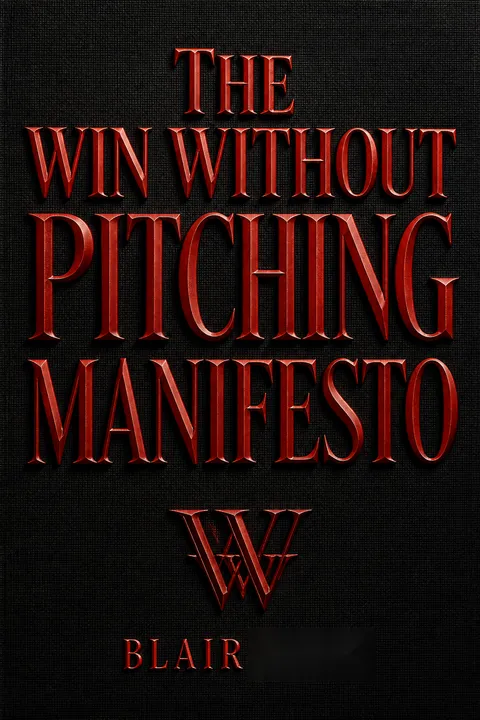
The Win Without Pitching Manifesto is highly praised by creative professionals for its transformative approach to business. Readers appreciate its clear, actionable advice on specializing, valuing expertise, and changing client relationships. The book's 12 proclamations offer guidance on positioning, pricing, and maintaining integrity. Many reviewers wish they had read it earlier in their careers. While some find it lacking in practical examples, most consider it an invaluable resource for creatives seeking to build respected, profitable businesses without compromising their worth.
Glossary
Win Without Pitching
Win work without free pitchingA business-development approach for creative firms that seeks to secure clients without giving away substantial diagnostic or creative thinking in competitive selection exercises. It depends on having a clear expertise, leading conversations about fit, and proposing paid ways to investigate or solve the client's problem.
Positioning
Focus, claim, and proofThe strategic work of choosing a market focus, expressing a clear claim of expertise, and building the skills, capabilities, and processes that substantiate it. In the book, effective positioning reduces the client's perceived alternatives and can help a firm win work more often while charging a premium.
Minimum Level of Engagement
Minimum viable client feeA firm's approximate minimum annual fee level for taking on a client. It is introduced early in conversations to test whether the financial relationship is viable before either party invests too much time. The book treats it as a useful boundary that can be waived deliberately, rather than a rigid rule for every situation.
Four Priorities of Winning New Business
A fallback order for opportunitiesA hierarchy for handling prospective work: first seek to win without entering a competitive pitch, then try to change the selection process, then seek meaningful access and concessions within it, and finally walk away if the firm still lacks a fair opportunity. The sequence preserves flexibility while favoring expert-led engagement.
phased sale
Sell discovery before deliveryA way to sell complex work in stages. The first paid phase investigates the client's situation and produces findings and recommendations. Once that diagnosis is complete, the firm can scope and price subsequent work more responsibly. The approach lets the client buy clarity without requiring the firm to produce substantial unpaid analysis.
The Difficult Business Decision
Choosing a business focusEnns's recurring label for deciding what kind of firm to build and what work to stop pursuing. Creative professionals may resist narrowing their options because they enjoy novelty and variety. The book argues that avoiding the choice leaves a firm undifferentiated, while making it creates the basis for developing recognizable expertise.
FAQ
What's "The Win Without Pitching Manifesto" about?
- Overview: "The Win Without Pitching Manifesto" by Blair Enns is a guide for creative firms to win business without giving away their ideas for free. It challenges the traditional pitching process.
- Purpose: The book aims to empower creative professionals to reclaim their value and position themselves as expert advisors rather than order-takers.
- Structure: It is structured around twelve proclamations that provide a roadmap for transforming business practices in creative firms.
- Focus: The manifesto emphasizes specialization, expertise, and respectful selling as key strategies for success.
Why should I read "The Win Without Pitching Manifesto"?
- Empowerment: It offers strategies to help creative professionals regain control over their client relationships and business practices.
- Practical Advice: The book provides actionable steps to avoid free pitching and speculative work, which can devalue creative services.
- Industry Insight: It sheds light on the challenges faced by creative firms and offers a revolutionary approach to overcoming them.
- Professional Growth: Reading it can lead to a more satisfying and lucrative business model for creative professionals.
What are the key takeaways of "The Win Without Pitching Manifesto"?
- Specialization: Focus on developing deep expertise in a specific area to differentiate from competitors.
- Conversations Over Presentations: Replace traditional presentations with meaningful conversations to build stronger client relationships.
- Diagnosis Before Prescription: Always diagnose a client's problem thoroughly before offering solutions.
- Value of Expertise: Charge more for services as expertise deepens and impacts client businesses significantly.
What is the first proclamation in "The Win Without Pitching Manifesto"?
- Specialization: The first proclamation is "We Will Specialize," emphasizing the importance of deep expertise over being a generalist.
- Power Shift: Specialization reduces client alternatives, shifting power from the client to the firm.
- Positioning: It involves positioning the firm as an expert to command higher prices and better control engagements.
- Business Success: Specialization is foundational for business development and overall success.
How does "The Win Without Pitching Manifesto" suggest replacing presentations with conversations?
- Addiction to Presentation: The book identifies a tendency in creative professionals to rely on presentations for validation.
- Conversations: It advocates for replacing presentations with conversations to foster collaboration and understanding.
- Client Engagement: Engaging clients in discussions rather than one-way presentations helps build trust and rapport.
- Outcome: This approach reduces the pressure of the "big reveal" and focuses on solving client problems collaboratively.
What does "The Win Without Pitching Manifesto" say about diagnosing before prescribing?
- Professional Obligation: The third proclamation stresses the importance of diagnosing a client's problem before offering solutions.
- Malpractice: Prescribing without diagnosis is likened to malpractice in other professions.
- Process: The book outlines a four-phase process: diagnose, prescribe, apply, and reapply.
- Client Control: It warns against letting clients dictate the diagnostic process, which can lead to poor outcomes.
How does "The Win Without Pitching Manifesto" redefine selling?
- Misunderstanding of Selling: The book addresses the fear and misunderstanding of selling as persuasion.
- Facilitator Role: It redefines selling as facilitating change and determining a fit between client needs and firm expertise.
- Respectful Selling: Selling should be done respectfully, focusing on helping, inspiring, and reassuring clients.
- Avoiding Persuasion: The goal is not to convince clients to hire but to assess mutual suitability for collaboration.
What is the significance of the fifth proclamation, "We Will Do With Words What We Used to Do With Paper"?
- Proposal Misconception: The book challenges the necessity of written proposals, advocating for verbal agreements instead.
- Efficiency: It argues that written proposals often waste time and resources and do not secure business.
- Contractual Role: Written documents should serve as contracts after verbal agreements are reached.
- Client Conversations: Emphasizes the importance of direct conversations to establish agreements and avoid unnecessary documentation.
How does "The Win Without Pitching Manifesto" address issues of money?
- Early Discussions: The ninth proclamation encourages addressing money issues early in client conversations.
- Minimum Level of Engagement: Establishing a minimum fee level helps weed out clients who cannot afford the firm's services.
- Stress Reduction: Early money discussions reduce stress and prevent overinvestment in unsuitable opportunities.
- Cultural Norms: It challenges cultural norms that discourage talking about money in business settings.
What does "The Win Without Pitching Manifesto" say about working at a loss?
- Profitability Focus: The tenth proclamation insists on building a practice with profitable assignments only.
- No Loss Leaders: It discourages using loss leaders or discounting to win business, as profit margins diminish over time.
- Alternatives to Discounting: Suggests alternatives like guarantees or favorable terms instead of cutting prices.
- Pro Bono Work: Encourages pro bono work for charities as a separate, fulfilling endeavor, not as a business development strategy.
How does "The Win Without Pitching Manifesto" suggest charging more?
- Reflecting Expertise: As expertise deepens, pricing should increase to reflect the impact on clients' businesses.
- Positioning Tool: Higher pricing positions the firm as confident and capable, attracting quality clients.
- Service Improvement: Profit margins from higher pricing allow for better service and reinvestment in the firm.
- Client Commitment: Premium pricing ensures client commitment and enhances the likelihood of acting on advice.
What are the best quotes from "The Win Without Pitching Manifesto" and what do they mean?
- Mark Twain Quote: "Whenever you find yourself on the side of the majority, it is time to pause and reflect." This encourages creative firms to challenge industry norms and think independently.
- Power of Specialization: "The world does not need another generalist design firm." Highlights the importance of deep expertise over being a jack-of-all-trades.
- Value of Expertise: "Our thinking is our highest value product." Emphasizes the need to charge appropriately for intellectual contributions.
- Respect Over Money: "We will seek respect above money." Suggests that respect as experts will naturally lead to financial success.
About the Author
Other books by Blair Enns

Download PDF
Download EPUB
.epub digital book format is ideal for reading ebooks on phones, tablets, and e-readers.








