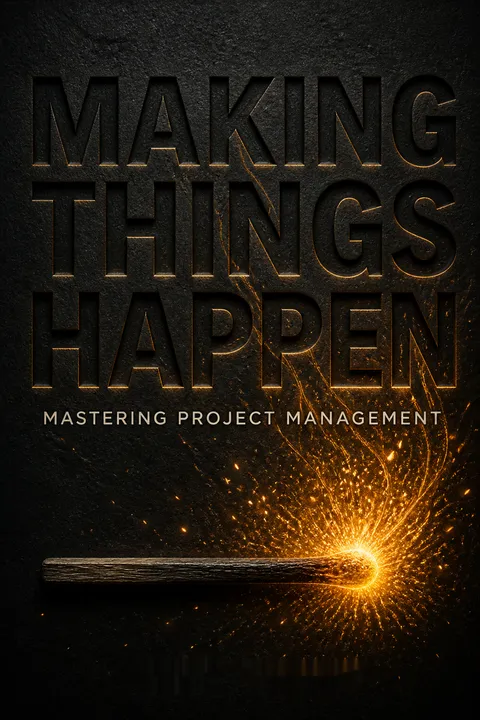


Key Takeaways
Manage the work by amplifying the team, not by worshipping process
The work is people. Berkun treats project management as a role, not necessarily a job title: it means helping a group define, organize, and deliver useful work. A manager adds value by connecting people, clarifying priorities, making decisions, and removing obstacles, not by producing ever larger spreadsheets. He learned this while managing Internet Explorer 4.0. His elaborate tracking system had begun to distract him from the team, until his manager pointed out that the people doing the work, not the checklists, were the project.
Borrow lessons widely. Software teams share core challenges with builders, kitchens, and emergency rooms: coordinating expertise, making decisions under pressure, and combining individual contributions into a whole. The technologies differ, but human coordination recurs. The book also argues that failure deserves careful review. Boeing’s practice of preserving lessons from engineering failures illustrates how organizations can turn costly mistakes into shared knowledge rather than repeating them.
The chapter’s most useful distinction is between coordination and control. In human factors engineering, reliable performance depends not only on individual competence but also on whether people can notice problems, communicate them, and adapt together. That supports Berkun’s case for managers who improve the team’s information flow instead of adding oversight for its own sake. The checklist story is a warning about proxy measures: tracking can make work legible, but legibility is not delivery. Yet informal coordination is not automatically better. As teams grow or work across locations, lightweight records and clear ownership can prevent knowledge from disappearing.
Treat every schedule as a probability, not a promise from the future
Schedules do three jobs. They set commitments, reveal dependencies between people’s work, and divide a large effort into trackable pieces. Even an inaccurate draft can help expose assumptions and make coordination possible. Berkun’s rough rule of thirds reserves time for design, implementation, and testing. It is a starting point, not a universal formula: unusual projects need different allocations, but all three kinds of work carry costs.
Estimates improve with evidence. The book reports Barry Boehm’s finding that early software schedule estimates could be wrong by as much as 400 percent in either direction, while estimates during implementation still had about a 20 percent margin of error. Each estimate is uncertain, and uncertainty accumulates: if two independent milestones each have a 90 percent chance of success, the chance both succeed is 81 percent. Break big schedules into shorter milestones, revisit them as knowledge improves, and account for risks, holidays, absences, and dependencies.
A schedule is valuable partly because it makes coordination problems visible, not because its dates possess predictive magic. This resembles probabilistic forecasting: a useful estimate states its assumptions and confidence, then changes as evidence arrives. The distinction between precision and accuracy matters here. A date written to the hour can still be a guess dressed as certainty. The rule of thirds gives teams a useful challenge to implausible plans, but it should not become a quota. Work that is genuinely exploratory, regulated, or safety-critical may need a very different balance of design, execution, and verification.
Plan where customer needs, engineering reality, and business value intersect
Three views complete the plan. Business analysis asks why the effort matters and what it costs. Engineering asks what can be built and how it will work. Customer research asks what people actually need and struggle to do. Berkun argues that planning fails when one perspective dominates. Engineers can prize elegant technology that customers cannot use; business teams can promise a product without understanding its technical cost; teams can mistake a customer’s requested feature for the underlying problem.
Define the problem first. A problem statement describes a specific user difficulty without prescribing the solution. For example, saying that search results are hard to scan leaves room for several designs; demanding a particular layout prematurely narrows the options. Teams can translate validated problems into customer-facing scenarios, then assess feasibility and business value. Research methods have different blind spots: surveys reveal broad patterns, site visits show work in context, and usability studies test whether people can complete tasks. Combining methods helps counter any one method’s bias.
This three-perspective model resembles the discipline of systems design: a solution must work for users, fit its technical environment, and remain viable for the organization that sustains it. Its insistence on observing behavior rather than accepting feature requests at face value is especially important. People often know where work hurts without knowing the best remedy. Still, customer evidence does not speak with one voice. Users differ, and the loudest or easiest-to-reach group may not represent everyone affected. Research therefore needs an explicit account of whose needs count, and how those needs are weighed against feasibility and cost.
Make the vision short enough to guide Tuesday’s decisions
A vision is a working tool. It gathers the project’s purpose, customer value, major priorities, and boundaries in a form the team can use. Its proper size depends on the project: Berkun describes documents ranging from a few pages to fifty. The test is usefulness, not length. A good vision clarifies choices, makes the intended outcome memorable, and gives people a reason to care. The Palm Pilot project, for instance, was guided by goals such as fitting in a pocket, costing less than a luxury paper organizer, and remaining as simple to use as paper.
Goals must connect. On larger projects, the overall vision should shape team goals, which in turn shape individual responsibilities. Keep the top-level aims few and clear, and make the vision visible in everyday decisions. It should help the team reject attractive but irrelevant requests, while remaining open to deliberate revision if the underlying facts change. A single capable writer can unify the document, but the thinking should be tested with people who will build, support, and use the result.
A concise vision reduces the mental cost of repeatedly reconstructing why work matters. In cognitive terms, it gives people a shared reference point they can retrieve during local decisions, rather than requiring every contributor to hold the entire strategy in memory. The example of the Palm Pilot also shows how demanding simplicity can be: a short goal statement can imply substantial design and engineering work. A caution is warranted, though. A vivid vision can create commitment before its assumptions are tested. Its motivational force is strongest when paired with evidence and a clear account of what the project will not do.
Give ideas room to spread, then move them toward a tested choice
Design is exploration. Requirements identify the problem and its constraints; they do not usually reveal the solution. Teams need time to examine alternatives, because an early idea may look compelling simply because nothing has been compared with it. Berkun’s improvisation exercise encourages participants to build on one another’s suggestions instead of judging each idea immediately. That approach is for generating possibilities, not for deciding what to build.
Make ideas visible. An affinity diagram groups many suggestions into a handful of directions, often by moving written ideas into clusters on a wall. Teams can then prototype promising options. A prototype is a low-cost model used to answer a question before committing to full implementation; it might be a sketch, a simulated interface, or a technical experiment. As deadlines approach, use checkpoints to narrow alternatives, and track unresolved questions in an open-issues list. The goal is not to preserve every idea, but to learn which ones meet the project’s needs and can be built.
The movement from divergent thinking to convergence is a practical antidote to two familiar errors: rejecting ideas before they develop, and allowing ideation to continue until decisions become late and expensive. Prototypes are especially useful because they turn disagreement about imagined futures into examination of a shared object. This connects to experimental science: a model earns its place by answering a question, not by looking finished. The limitation is that prototypes can anchor a team to the first plausible design. Teams should label assumptions clearly and test more than one direction when the consequences of choosing poorly are substantial.
Spend decision time where mistakes would be hardest to reverse
Choose how carefully to choose. Project leaders make too many decisions to give every one equal attention. First identify the real problem, how long the decision will matter, what happens if it is wrong, and who has the expertise to advise. For routine, low-stakes choices, accepting the first adequate option can save time. For consequential or unfamiliar choices, compare alternatives before committing.
Externalize the tradeoffs. A simple pros-and-cons list makes assumptions visible and invites other perspectives. Include doing nothing, consider hybrid options, and ask how each claim is known. Data can illuminate a choice, but it does not make the choice automatically. Berkun recounts a browser design problem where the available options were a costly fix, a temporary workaround, or no change before a beta release. He chose no change, despite the discomfort. A programmer independently fixed it soon after. The outcome did not prove the decision process right or wrong; it shows why decisions must be judged using what was knowable at the time.
This is a form of bounded rationality: people make decisions with limited time, information, and attention, so good judgment includes deciding where analysis is worth its cost. The advice to compare options is valuable because a single proposed solution can conceal the fact that the problem itself is poorly understood. Yet comparison can become a ritual that delays action. Reversibility offers a useful additional lens: a choice that can be cheaply changed may need less scrutiny than one that locks in architecture, budget, or public commitments. Debriefs should examine reasoning and execution, not reward or punish outcomes alone.
Earn trust through reliable commitments, candid listening, and real delegation
Trust is demonstrated in ordinary work. It grows when people make considered commitments, clarify who will do what and when, and give advance notice if circumstances change. It erodes when someone repeatedly reverses decisions or leaves others to plan around unreliable promises. Berkun’s example of a manager who regularly abandoned agreements in front of more senior colleagues shows how inconsistency forces a team to spend energy compensating for its leader.
Communication is more than delivery. A message can be sent and received without being understood, agreed to, or acted upon. Conversations, clear roles, and active listening help close those gaps. Managers can ask contributors what would help them do their best work, then remove obstacles or delegate authority. Delegation is not merely assigning tasks; it can mean giving someone the right to make decisions in a defined area. That trust gives people room to act while making responsibility visible.
Trust functions as coordination infrastructure. When people expect one another to follow through, they can make plans without building elaborate safeguards around every interaction. That expectation is not sentimental; it reduces friction and makes it easier to surface bad news early. Psychological safety, the shared sense that questions and mistakes can be raised without humiliation, supports this kind of learning. But trust does not mean unlimited autonomy or blind confidence. Clear boundaries, feedback, and follow-up help distinguish genuine delegation from abandonment, especially when decisions affect other teams or customers.
Make every process earn its cost in progress or avoided failure
Process should serve the team. Berkun defines a process as a repeatable set of actions used to produce a desired result. It is worthwhile when it prevents likely problems or makes work faster, clearer, or easier to track. A process that does neither is overhead. Before imposing one, ask what failure it prevents, how likely that failure is, and what the procedure costs people in design, learning, and daily use. Pilot a change on a small scale, gather feedback, and revise it before expanding it.
Respect people’s attention. Email should make the request, owner, and deadline easy to find. Meetings should fit their purpose: small groups for interactive problem-solving, larger ones for reporting or review. A facilitator keeps discussion focused and records decisions and next steps. Recurring meetings should have a useful agenda, not survive by habit. These practices matter because every meeting consumes the time of everyone present, and every unnecessary message adds another demand to a crowded day.
This section treats attention as a limited team resource, a useful correction to organizations that count process compliance more readily than interruptions. Its pilot-first approach also reflects sound change management: a procedure is a hypothesis about how people will work, and actual use can reveal friction that design did not anticipate. The caution is that the people most burdened by a process may not have the authority to remove it. Leaders need both a way to collect criticism and the willingness to act on it. Otherwise, asking for feedback becomes another ritual that consumes time without improving work.
Keep delivery sane with visible priorities, checkpoints, and controlled recovery
Priorities make progress adjustable. Berkun recommends keeping goals, features, and engineering tasks connected in ranked lists. A small must-have set gives the team a basis for cutting work when time is short and for rejecting additions that do not support the project. During implementation, keep the next work ready, remove blockers, and check that completed tasks actually meet their intended requirements. Short milestones and regular reviews help teams adjust before change becomes costly.
Finish by criteria, not mood. Define what must be complete, what quality is acceptable, and what can wait before a deadline approaches. Daily builds make the current product inspectable; bug triage helps sort issues by importance and urgency. If the team falls behind, the real options are to move the date, reduce scope, or accept lower quality, each with consequences. In a crisis, calm the team, clarify the problem, involve the right people, choose a simple response, and review what happened afterward. Extra effort can help briefly, but repeated crunch damages the next stretch of work.
Visible priorities and explicit completion criteria make tradeoffs less arbitrary, particularly when deadlines create pressure to call unfinished work complete. This is closely related to safety engineering, where teams define acceptable conditions in advance rather than improvising standards during a failure. The book’s warning about crunch is also important: deadline recovery is not free if it leaves a depleted team facing another milestone. However, metrics such as bug counts can distort behavior when treated as targets. They are most useful alongside direct inspection, context, and honest discussion about what the numbers omit.
Treat politics as a map of constraints, not proof of corruption
Power shapes project work. It comes from formal authority, expertise, access to decision makers, relationships, and the ability to persuade. Political conflict is not automatically selfish: people may simply disagree about what best serves the project. Berkun’s understanding changed when a senior manager explained the competing constraints behind a troubled feature and asked for his judgment. The conversation replaced blame with a clearer view of the limited choices available.
Make the playing field clearer. Identify what is actually needed, who can provide it, and what interests or constraints shape that person’s decision. Frame requests around shared project goals, not personal entitlement. When authority or resources are lacking, seek advice, build support, or negotiate a different path. Managers can also create a fair local environment by making decision rights and goals explicit, even if the wider organization is confusing. This does not eliminate politics; it makes influence more accountable to the work.
This account avoids the convenient fiction that organizations can run without power. Decision rights, expertise, and access are unevenly distributed, so effective collaboration requires understanding how influence actually works. Treating politics as problem-solving can replace resentment with questions about constraints, alternatives, and legitimate authority. Yet the approach has limits: a clear-eyed map of power does not make an unjust system fair, and persuasion cannot substitute for accountability when leaders misuse authority. The practical value lies in distinguishing a structural obstacle from a personal slight, then deciding whether to negotiate, escalate, protect the team, or leave.
Analysis
Making Things Happen is a practical management book organized around the life of a project: define the work, plan it, explore designs, make decisions, coordinate people, and deliver under changing conditions. Its central claim is that project leadership is not primarily administration. It is the judgment to connect goals, people, information, and action. The recurring narrative comes from Berkun’s Microsoft experience, particularly his mistakes and uneasy decisions, which give the advice a useful quality of lived revision rather than idealized certainty.
The book’s strongest contribution is its resistance to single-factor explanations. A methodology cannot compensate for weak goals; a schedule cannot repair bad design; a polished specification cannot replace shared understanding; and formal authority cannot manufacture trust. Its tools are deliberately modest: ranked lists, prototypes, issue tracking, facilitated meetings, and explicit commitments. Their value comes less from novelty than from putting hidden assumptions where a team can examine them.
The same pragmatism creates a limitation. Many examples assume software teams with enough flexibility to change scope, negotiate dates, or inspect daily builds. In tightly regulated work, public infrastructure, or organizations with severe power imbalances, those choices may be constrained. The book acknowledges authority and politics, but its advice often presumes leaders can create healthier local practices. Some cannot, at least without organizational support.
Its strongest modern reading is therefore not a universal recipe but a set of diagnostic questions: What problem is being solved? Who decides? What evidence supports the plan? What is the cost of being wrong? Does this process improve the work? These questions link technical delivery with organizational behavior. The book is most useful when its heuristics remain heuristics, open to evidence and adapted to project risk, rather than hardened into another checklist that teams follow instead of thinking.
Review Summary
Making Things Happen is highly regarded as a practical guide to project management, particularly in software development. Readers appreciate its real-world examples, actionable advice, and comprehensive coverage of topics like planning, leadership, and team dynamics. The book's method-agnostic approach and focus on the human aspects of project management are praised. While some find it occasionally wordy or outdated, most consider it an essential resource for both novice and experienced project managers. The book's exercises and thought-provoking questions are seen as valuable tools for applying the concepts in real-life situations.
People Also Read








Glossary
Forcing function
Prompts a change in behaviorA condition, tool, or visible commitment that naturally shifts how people think or act. In project work, a draft schedule can function this way by making dependencies and promised contributions explicit. Its value does not depend on the plan being perfectly accurate; the act of making it can prompt useful questions and coordination.
Rule of thirds
Roughly divides project effortBerkun’s informal scheduling heuristic divides available time among design, implementation, and testing, often in roughly equal portions. It is intended as a quick diagnostic, not a law. If a project departs from the balance, the team should understand why and account for the costs of the work receiving less time.
Problem statements
Describe customer difficultiesShort descriptions of specific problems experienced by users or customers. They state what is difficult or missing without prescribing a feature or technical solution. A team can use them to preserve the customer’s perspective, examine evidence, and consider multiple possible ways to address the underlying need.
Work breakdown structure
Breaks work into trackable tasksA structured description of the individual pieces of work required to complete a project or feature. It helps teams decide what comes first, who is responsible, and how progress can be tracked. The format can be simple or formal, depending on the project’s size and coordination needs.
Affinity diagram
Groups related ideas visuallyA collaborative way to organize many ideas by placing short descriptions where a group can see and rearrange them. Participants cluster related suggestions into broader themes, making patterns and possible design directions easier to discuss. The method helps reduce a large, scattered pool of ideas to a manageable set of alternatives.
Open-issues list
Tracks unresolved project questionsA simple record of decisions, facts, or approvals still needed to complete a design or specification. Each issue should have an owner and a sense of when it must be resolved. Separating issues that block implementation from those that can wait helps teams focus attention without pretending uncertainty has disappeared.
Zone of indifference
Area where options are adequateA decision-making situation in which several alternatives meet the essential needs closely enough that fine-grained comparison has little value. Recognizing this zone lets a team accept a satisfactory option and reserve analysis for choices with meaningful differences, higher risks, or harder-to-reverse consequences.
Management by walking around
Learns through informal conversationsA management practice of regularly speaking with people across a team, often in their work areas, to understand progress, concerns, and connections that formal reports may miss. The point is not surveillance. Informal contact builds relationships and helps useful information move to the people who can act on it.
Coding pipeline
Keeps implementation work readyThe sequence of work items prepared for programmers to implement. A healthy pipeline gives contributors enough clear, prioritized work to continue while blockers are resolved, without planning so far ahead that likely changes become expensive. Project leaders help keep the pipeline supplied and remove issues that stall it.
Exit criteria
Define a milestone’s completion stateConditions that must be met before a milestone or project phase is considered complete. They can specify completed work, required quality, test results, defect limits, or acceptable exclusions. Defining them early gives teams a shared standard and reduces late arguments about what counts as good enough.
Triage
Sorts issues by project priorityA recurring process for reviewing incoming problems, improving the information recorded about them, investigating their impact, and deciding which deserve action. In software projects, triage helps direct limited engineering time toward the defects that matter most to the milestone’s goals and completion criteria.
BATNA
Best alternative to agreementThe best option available if a negotiation does not produce an agreement. Understanding each party’s alternatives clarifies the real stakes and bargaining power, rather than focusing only on what people say they want. The term comes from negotiation practice discussed in the book as a way to assess options before bargaining.
FAQ
What's Making Things Happen: Mastering Project Management about?
- Comprehensive Guide: The book is a detailed guide to mastering project management, focusing on practical strategies and real-world applications.
- Real-World Examples: It includes anecdotes and lessons from Scott Berkun's experiences at Microsoft, making the content relatable and applicable.
- Broad Applicability: While rooted in software development, the principles are applicable across various industries, enhancing its value for diverse readers.
Why should I read Making Things Happen: Mastering Project Management?
- Practical Advice: Offers actionable strategies that can be immediately implemented to improve project management skills.
- Enhances Team Dynamics: Focuses on trust and communication, crucial for achieving project goals and maintaining a positive work environment.
- Broad Appeal: Relevant for both novice and experienced project managers across different industries and project types.
What are the key takeaways of Making Things Happen: Mastering Project Management?
- Importance of Trust: Trust is essential for successful project management, fostering better collaboration and decision-making.
- Effective Prioritization: Creating ordered lists helps teams focus on what truly matters, driving progress.
- Learning from Failure: Encourages learning from past mistakes to gain valuable insights for future projects.
What are the best quotes from Making Things Happen: Mastering Project Management and what do they mean?
- "The simpler your view...": Highlights the importance of maintaining a clear and straightforward approach to enhance effectiveness.
- "Trust is insurance against adversity.": Emphasizes that building trust within a team creates resilience against challenges.
- "The world responds to action...": Stresses the need for proactive leadership to drive teams toward achieving results.
How does Scott Berkun define project management in Making Things Happen?
- Practical Approach: Defines project management as the art of getting things done through effective leadership, organization, and communication.
- Core Tasks: Outlines tasks like planning, scheduling, requirements gathering, and crisis management.
- Interdisciplinary Nature: Draws from various fields, including psychology, business, and engineering, to manage projects effectively.
What is the role of a project manager according to Making Things Happen?
- Leadership and Coordination: Responsible for leading the team and ensuring alignment with project goals.
- Decision-Making Authority: Makes critical decisions regarding project direction and resource allocation.
- Communication Hub: Serves as the primary point of communication between team members and stakeholders.
What is the significance of trust in project management according to Berkun?
- Foundation of Leadership: Trust allows team members to rely on each other, fostering a collaborative environment.
- Building Commitments: Built through consistent behavior and fulfilling commitments, enhancing team morale.
- Navigating Difficult Decisions: Established trust leads to team support for difficult decisions, even if there are disagreements.
How does Berkun suggest handling changes in project management?
- Change Control Process: Advocates for a structured process like a Design Change Request (DCR) system to manage changes.
- Assessing Impact: Evaluates the potential impact on project goals and timelines before implementing changes.
- Communicating Changes: Stresses the importance of informing the team and involving them in decision-making to maintain trust.
What are the common mistakes in project management highlighted in Making Things Happen?
- Ignoring History: Failing to learn from past projects can lead to repeating mistakes.
- Over-Reliance on Processes: Warns against fixating on processes, which can stifle creativity and adaptability.
- Poor Communication: Lack of clear communication can lead to misunderstandings and jeopardize project success.
How does Making Things Happen suggest managing ideas during a project?
- Structured Checkpoints: Recommends clear checkpoints to manage the flow of ideas and maintain focus.
- Encouraging Collaboration: Emphasizes open communication among team members to foster creativity and innovation.
- Iterative Process: Advocates for continuously refining ideas based on feedback and new insights.
What is the affinity diagram method mentioned in Making Things Happen?
- Organizing Ideas: A visual tool to organize ideas and identify relationships, aiding effective brainstorming.
- Facilitating Collaboration: Encourages team collaboration by allowing idea contribution without immediate judgment.
- Iterative Process: Allows for regrouping ideas as discussions evolve, leading to clearer project goals.
How can I improve my project management skills based on Making Things Happen?
- Practice Active Learning: Reflect on past projects to identify areas for improvement.
- Seek Feedback: Regularly solicit feedback from team members and stakeholders for diverse perspectives.
- Embrace Flexibility: Adapt approaches and methodologies based on specific project needs rather than rigid adherence.
About the Author


Download PDF
Download EPUB
.epub digital book format is ideal for reading ebooks on phones, tablets, and e-readers.








