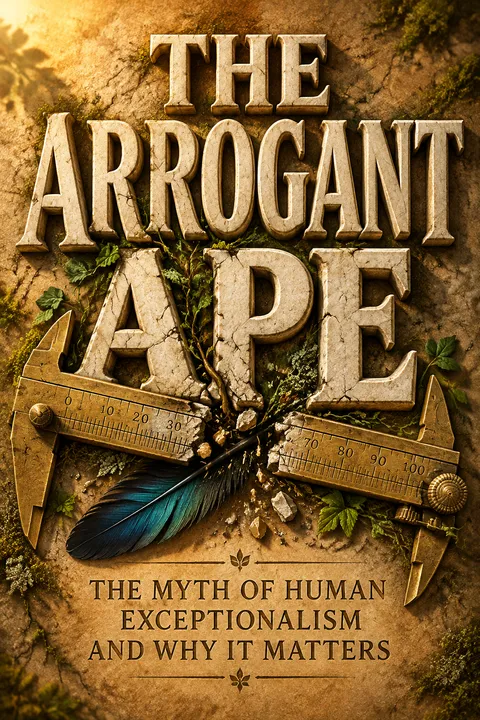


Key Takeaways
Unlearn human supremacy: the story that turns living worlds into human property.

A learned hierarchy. Webb’s argument begins with a baboon named Bear. After a troop had frightened a colleague, Bear approached Webb the next morning and made a gesture she understood as an attempt to ease the conflict. The encounter unsettled assumptions she had been taught about animals’ ability to understand another’s perspective. Her larger claim is not that humans lack distinctive abilities, but that distinctiveness does not establish superior worth.
A story with consequences. Human exceptionalism casts people as separate from, above, and entitled to use the rest of life. Webb argues that this worldview helps normalize habitat destruction and other forms of exploitation, while making ecological damage seem like an acceptable price of progress. Because the belief is rarely stated plainly, it can pass as common sense, including in scientific research.
The book’s sharpest move is to treat a worldview as a cause with practical effects, not merely a mistaken opinion. Ideas about who counts as a subject can shape laws, research priorities, and what consumers are willing to ignore. Yet a cultural story does not operate alone: industries, political power, and economic incentives help sustain destructive practices. The account is most useful when human exceptionalism is understood as a legitimizing framework, not a complete explanation of ecological collapse. That distinction preserves the argument’s force while leaving room for institutional change alongside personal and scientific reconsideration.
Measure each species by its adaptations, not by a human ladder.

A ladder mistaken for nature. For centuries, influential Western thought arranged life from supposedly lower organisms to humans at the top. Darwin’s account of branching descent challenged that picture: species share ancestry and evolve along different paths, rather than climbing toward a human endpoint. Yet ladder-shaped diagrams and language about “higher” and “lower” life still suggest that evolution is a ranking system.
The goalposts keep moving. Humans have claimed special status through reason, toolmaking, culture, language, and other capacities. But tool use appears in crows, elephants, and octopuses; socially learned traditions occur in macaques; and animals use forms of communication suited to their lives. The repeated search for a single human-only trait, which the book calls the Differential Imperative, can reveal more about our need to rank than about nature’s variety.
This argument resonates with a basic principle of evolutionary biology: an adaptation is intelligible in relation to the environment where it developed, not against a universal scorecard. It also cautions against replacing one ranking with another. Showing that crows make tools or that chimpanzees share food does not require proving they match humans on every human-defined measure. The more productive question is what capacities solve which problems, and how those abilities fit together. That approach allows comparison without turning difference into deficiency, while still permitting precise claims about particular skills.
Audit the experiment before declaring one species smarter.

Unequal starting lines. Many human-ape comparisons put captive chimpanzees in restricted settings and compare them with people living freely. The human participants are often WEIRD: Western, educated, industrialized, rich, and democratic, a narrow sample that does not represent humanity as a whole. The tasks may also favor human experience, using touch screens or materials unfamiliar to apes. A result from such a comparison cannot cleanly separate species differences from differences in upbringing, environment, and test design.
Wild settings change the picture. Wild chimpanzees hunt together, share food with unrelated group members, and cooperate beyond close kin. Webb argues that captive studies can reveal real abilities, but their findings cannot automatically stand for an entire species. Environments shape cognition. The book’s example of enriched “Rat Park” settings, where rats consumed far less drug solution than conventionally caged rats, makes the broader point: behavior can reflect the conditions of the test.
This is a lesson in measurement, as much as animal research. A test can be carefully controlled and still fail to measure the capacity its label claims to capture. Better sampling and tasks relevant to each species improve both fairness and explanatory power. The caution cuts in both directions: naturalistic observation can reveal abilities that laboratory tests miss, but it can also be harder to isolate causes. Strong comparisons therefore need multiple methods, transparent limits, and a clear distinction between what a study demonstrates and what it suggests.
Study the world an animal senses, not just the one humans see.
A species-specific world. The term umwelt means the environment as experienced by a particular organism, including the signals it can detect and use. Humans see only one slice of reality. Birds can perceive ultraviolet patterns on flowers; elephants can detect scents over great distances; and some animals navigate through sound, electric fields, or Earth’s magnetic field.
The test can miss the trait. A classic mirror test asks whether an animal uses its reflection to notice a mark on its body. That method favors vision. Dogs, who rely heavily on smell, have shown self-directed responses when researchers tested odor instead. Likewise, honey bees appeared unable to distinguish colors in one laboratory setup, but learned color differences when tested in a feeding context. Webb’s point is methodological: abilities become visible when researchers ask questions suited to how a species encounters the world.
The umwelt is a useful corrective in cognitive science: a task is not neutral simply because the instructions are standardized. It carries assumptions about which senses matter, what counts as a meaningful problem, and how success should look. Designing species-relevant tests does not mean abandoning comparison; it means comparing functional abilities through measures that make sense for the subjects. Still, researchers should avoid treating sensory difference as proof of hidden sophistication. A good design makes a capacity testable without deciding in advance what the result must be.
Judge animal minds by converging evidence, not impossible certainty.
Private experience is indirect. No one directly observes another being’s subjective experience. People infer it from behavior, bodily signs, and communication, even though human self-reports can be mistaken or shaped by social pressure. Webb argues that scientists should not demand perfect proof of consciousness in other species while treating human consciousness as obvious. The book calls one habit of explaining away animal abilities through exaggerated assumptions about human psychology anthropofabulation.
Evidence has ethical weight. The distinction between nociception, detecting harmful stimuli, and pain, the felt experience of suffering, is important but difficult to settle from behavior alone. Injured trout, for example, showed lasting changes in feeding and movement, and those responses eased with painkillers. Such findings support concern without making every question settled. Webb also notes that debate over plant consciousness remains open; uncertainty should invite careful inquiry, not automatic dismissal.
This is a case for calibrated inference rather than certainty in either direction. In medicine and psychology, hidden states are routinely assessed through multiple imperfect indicators. The same logic can guide animal research, provided that behavioral evidence is interpreted with care and alternative explanations remain visible. Ethical decisions also need not wait for a final theory of consciousness: where serious suffering is plausible, precaution can reduce avoidable harm. That principle should be applied proportionately, since uncertainty is not proof that every organism experiences the world in the same way.
Make reciprocal attention part of rigorous observation.
Detachment is not neutrality. Primatologist Barbara Smuts learned to adjust her movements, gaze, and responses to gain the trust of wild baboons. She found that ignoring them was not neutral: the baboons treated her as a social presence, and her silence had meaning to them. Attentive engagement helped her understand their social rules, including how they signaled whether another baboon could approach.
Relationships affect results. Webb describes this neglected influence as the empathy taboo, the pressure to avoid treating research animals as feeling individuals. Yet an experimenter’s presence can alter animal behavior. In one rodent study, mice and rats showed different pain responses depending on whether a man or woman conducted the test. The cautionary tale of Clever Hans, a horse who responded to subtle cues from his questioner, shows why controls matter. Webb’s point is that controls should account for relationships, not pretend they do not exist.
The strongest version of this claim does not replace rigor with affection. It treats the researcher-subject relationship as a variable that should be observed, documented, and managed. In fields such as ethnography, rapport is already recognized as a condition of access to meaningful behavior, not an automatic source of contamination. The same insight can improve animal studies. At the same time, empathy can invite projection. Researchers need safeguards, independent coding, and transparent methods so that responsiveness deepens observation without making desired interpretations immune to scrutiny.
Replace the contest for dominance with attention to interdependence.
Competition is not the whole story. Popular readings of evolution emphasize struggle, but Webb highlights cooperation and symbiosis as major forces in life’s history. Lichens join fungi with photosynthetic partners; mitochondria inside human cells descend from ancient bacteria that entered a mutually beneficial relationship with other cells. The human body itself hosts a vast microbial community that contributes to digestion, immunity, and other functions.
Dependence changes the meaning of mastery. Forest roots and fungi can exchange resources, although these relationships are not always beneficial to every plant. This complexity matters: nature is neither a perfect community nor a simple contest. Webb argues that treating humans as exempt from ecological limits encourages risky attempts to control natural systems. The COVID-19 pandemic and the possibility of animal-to-human disease illustrate how human health is entangled with relationships among species and habitats.
Interdependence is a stronger account than either pure competition or a sentimental picture of universal harmony. Ecology studies systems of exchanges, conflicts, and feedbacks, where cooperation can coexist with exploitation and competition. That complexity also sharpens the policy lesson: resilience often depends on maintaining relationships and diversity, not maximizing one output in isolation. However, interdependence alone does not guarantee fair outcomes; some partnerships are exploitative, and ecological systems can be harsh. Recognizing connection should therefore lead to better questions about whose interests are served and which relationships sustain life.
Learn across knowledge systems without taking Indigenous knowledge out of context.
Knowledge belongs to relationships. Many Indigenous traditions understand humans as participants in a living world, responsible for reciprocal relations with other beings and places. Webb describes Etuaptmumk, or Two-Eyed Seeing, as bringing the strengths of Indigenous and Western knowledge together without flattening either into the other. Place-Thought names a related view in which knowledge and a particular place cannot be separated.
Respect requires more than citation. In 2008, Ecuador recognized legal rights for Nature; New Zealand later granted legal personhood to Te Urewera, a forest tied to Māori sovereignty and homeland. The book reports that Indigenous peoples manage or hold rights to more than a quarter of the world’s land, and that these territories safeguard a large share of remaining biodiversity. Webb warns that research partnerships can still be extractive unless Indigenous communities have authority and meaningful participation.
Two-Eyed Seeing is valuable not as a device for adding local observations to a Western research project, but as a challenge to who sets the questions and controls the work. Genuine collaboration requires consent, credit, resources, and decision-making power. It also requires resisting romantic generalizations: Indigenous peoples are diverse, and no single account represents all communities or histories. The book’s emphasis on reciprocity is therefore essential. Knowledge exchange can enrich conservation, but it cannot substitute for sovereignty or repair the unequal conditions that have often made such exchange possible.
Practice humility through sustained attention to the lives around you.
Awe can resize the self. Webb recounts a charge by a mountain gorilla that left her physically vulnerable and acutely aware that she was in the gorilla’s world. Research on awe, as she presents it, links encounters with vastness to a reduced focus on the self and stronger feelings of connection. Humility here is not self-contempt; it is a more realistic sense of human limits alongside recognition of other beings’ value.
Attention can become practice. Webb’s “slow looking” exercise asks students to spend extended time attending to a living or natural subject, without requiring a discovery or product. She connects this shift in perception with restoration, habitat protection, community gardens, and other efforts to build more sustainable relationships. The point is not to replace structural change with private wonder, but to let a richer sense of belonging inform what people support and how they act.
The practical strength of this ending is that it connects perception to conduct without pretending that a walk outdoors can solve an institutional crisis. Sustained attention can expose what hurried categories conceal: variation, behavior, and dependence. It can also make environmental loss more personally legible. Yet awe is not automatically ethical; people can admire nature while still supporting its exploitation. The useful bridge is repeated practice joined to concrete choices, collective organization, and policy. Humility matters most when it changes whose interests count in decisions.
Analysis
Webb’s central achievement is to shift the question from whether humans are exceptional to why human abilities are treated as the standard of value. The answer spans scientific methods, language, cultural history, and everyday habits. This makes the book more than a plea for animal empathy: it argues that distorted comparisons both misdescribe other life and reinforce systems that treat it as usable material. Its narrative strategy helps. Bear’s conciliatory gesture, captive primates tested in barren labs, and sensory worlds beyond human perception give an abstract critique a human scale without reducing the argument to a single anecdote.
The strongest evidence concerns research design. Comparing captive animals with freely living humans, or using tests tailored to human senses, creates obvious inferential problems. The book is also persuasive in showing how environmental conditions shape measured abilities and how uncertainty about another mind does not logically justify assuming its absence. These points are methodologically valuable even for readers unconvinced by the broader philosophical case.
The largest interpretive risk is making anthropocentrism sound like a single root cause of ecological crisis. The text recognizes economic and political power, but its emphasis on worldview can understate how institutions and material incentives constrain behavior. A change in perception may motivate action, yet it cannot by itself redistribute land, regulate industry, or protect habitats. The book’s strongest formulation is that human supremacy helps legitimate destructive systems, not that it explains them all.
A second tension concerns how readily the book extends mental vocabulary to plants and other organisms. Its call to investigate unfamiliar forms of cognition is intellectually fertile, but evidence of adaptive behavior does not by itself establish subjective experience. The distinction matters both scientifically and ethically. Webb is most compelling when she asks researchers to keep questions open, define claims precisely, and avoid human-centered assumptions. The result is a useful invitation to replace ranking with contextual study, and mastery with accountable participation in a shared living world.
Glossary
Human exceptionalism
Human superiority ideologyThe belief that humans are not merely distinctive but more valuable, advanced, or entitled than other forms of life. Webb argues that this assumption separates humanity from nature and helps justify using other species and ecosystems for human benefit. It differs from recognizing that humans, like every species, have particular evolutionary traits.
Differential Imperative
Compulsion to distinguish humansA term used for the recurring effort to identify a trait that supposedly separates humans from other animals and confirms human superiority. Proposed traits have included reason, language, tool use, culture, and morality. Webb argues that the repeated replacement of disproved candidates suggests the underlying desire for a hierarchy deserves scrutiny.
scientific speciesism
Species bias in researchA bias in scientific research that favors human abilities and assumptions when choosing subjects, designing tests, or interpreting results. It can make animals appear deficient when they are tested in unfamiliar settings or by human-centered measures. Webb compares this pattern to other forms of confirmation bias, where expectations shape what researchers notice and conclude.
umwelt
An organism’s experienced worldThe world as perceived and experienced by a particular organism, including the sensory information that matters to its way of life. An umwelt differs among species: a dog relies heavily on smell, while some birds detect ultraviolet patterns. The concept encourages researchers to design tests around the senses and ecological problems relevant to the species being studied.
anthropofabulation
Human-centered overinterpretationA term for defining a psychological ability through an exaggerated account of how humans perform it, then using that definition to deny the ability to other species. For example, researchers may assume that human memory requires conscious replay of past events, despite evidence that human memory is often unconscious and unreliable. This creates an unfair standard for animal comparisons.
empathy taboo
Prohibition on empathic scienceThe expectation that researchers should suppress empathic responses to animals in order to remain objective. Webb argues that detachment is not the same as impartiality: ignoring an animal can affect the interaction and obscure its behavior. Empathic attention can improve observation when paired with transparent methods that guard against projection and experimenter bias.
Two-Eyed Seeing
Two knowledge traditions togetherEtuaptmumk, a Mi’kmaq concept introduced by Elder Albert Marshall, means learning through the strengths of Indigenous knowledge and Western knowledge at the same time. In Webb’s account, it calls for collaboration without blending away the distinctiveness of either tradition. Its use in research and conservation requires respectful partnerships, meaningful Indigenous participation, and attention to power.
Place-Thought
Knowledge inseparable from placeA concept developed by Haudenosaunee and Anishinaabe scholar Vanessa Watts. It describes a worldview in which thought and place are inseparable, and land is understood as alive and capable of agency. Knowledge is therefore local and relational, shaped through engagement with the people, animals, plants, and other presences of a particular place.
holobiont
Host and microbial communityA living whole made up of an organism and the community of microorganisms associated with it. Webb uses the term to challenge the idea that an individual body is entirely autonomous. Microbes contribute to processes such as digestion, immunity, and neurological function, although relationships between hosts and microbes are not always harmonious or mutually beneficial.
ecological generational amnesia
Degraded nature becomes normalA pattern in which each generation forms its idea of a normal environment from the conditions it encounters while growing up. As ecosystems decline, younger people may accept increasingly degraded conditions as ordinary because they did not experience earlier levels of abundance. The concept explains how environmental loss can become culturally harder to notice.
neuroexceptionalism
Brain required for cognitionThe assumption that intelligence or cognition must depend on a brain or nervous system. Webb argues that this definition risks excluding organisms such as plants or slime molds before their abilities are investigated. She recommends asking how evolution may produce functions such as learning or flexible responses through different structures, while distinguishing those functions from unproven claims about consciousness.
Download PDF
Download EPUB
.epub digital book format is ideal for reading ebooks on phones, tablets, and e-readers.








