

Key Takeaways
Turn inaccessible distances into solvable triangles, anchored by one measured length.
A photograph can measure. In 2012, a hot-air balloon’s burners frightened pigs on a Yorkshire farm. The balloon company said its GPS data put it high above the animals. Mathematician Chris Fewster used a photograph, the balloon’s known size, and measurements of nearby trees to reconstruct the viewing geometry. His calculation put the balloon 750 to 760 meters from the camera, about 300 meters from the pigs, and helped the farmers win a settlement.
One length unlocks scale. Triangle angles alone cannot tell whether a shape is tiny or enormous. But once a side is measured, the relationships among sides and angles can reveal the rest. The same principle lets surveyors, engineers, and astronomers infer distances that cannot be reached with a tape measure.
What's striking is that the photograph acts as a measurement instrument only when paired with independent reference information. This is a classic inverse problem: infer a hidden scene from its visible effects. Similar reasoning underlies medical imaging and remote sensing, where a result depends on both mathematical reconstruction and trustworthy inputs. The method is powerful, but its precision is conditional. A mistaken balloon size, tree location, or camera model would distort the answer. The memorable lesson is not that geometry makes evidence automatic, but that it turns observations into testable claims when assumptions are made explicit.
Every astronomical distance rests on a humble, calibrated baseline.
Distances need a ladder. Astronomers estimate faraway objects through a chain of methods. Redshift relates a galaxy’s light to its recession; standard candles estimate distance from known brightness; parallax uses apparent shifts in nearby stars. Each rung depends on the one beneath it, ultimately requiring a known length on Earth.
A French road set the scale. In the 1700s, Delambre and Méchain measured a chain of 115 triangles across about 1,500 kilometers from Dunkirk to Barcelona. They spent 41 days and 43 days measuring two straight road sections with calibrated rods. Angles carried the measurements across the triangle chain, while those directly measured lengths grounded the calculation. Their work helped define the meter, connecting a road measurement to the scale used to estimate structures billions of light-years away.
This chain is a vivid example of calibration: a measurement system gains reach by connecting local observations to standards that can be checked. Metrology, the science of measurement, relies on precisely this architecture, from laboratory standards to satellite navigation. The chain also exposes a risk. Uncertainty can travel upward through every rung, so a distant estimate may be less secure than its impressive precision suggests. Strong science therefore tracks uncertainty along with the number. The achievement is not eliminating error, but making the links visible enough to estimate where error enters and how much it matters.
Use triangle laws as a compact toolkit for dividing, measuring, and building.
Small rules do big work. A triangle’s area is half its base times its height, regardless of its angles. Parker applies this to sharing a square sandwich: cut from the center toward evenly divided points on the crust, and the resulting triangular portions have equal areas. For right-angle triangles, the Pythagorean theorem turns two perpendicular lengths into a third, making it useful for calculating the distance of a basketball shot from court coordinates.
Triangles also resist distortion. A rectangle can skew into a parallelogram unless it is braced. Add a diagonal and it becomes two rigid triangles. Engineers use this property in framed structures because fixed side lengths determine a triangle’s shape, while a four-sided frame can flex without changing its sides.
These examples show why mathematical laws are most memorable when they do more than solve textbook exercises. The area rule becomes a fairness tool, while rigidity becomes a design principle. The deeper pattern is constraint: fewer degrees of freedom make a shape easier to reason about and harder to deform. That same tradeoff appears in engineering, where simplicity can improve reliability. Still, a mathematically rigid triangle is not automatically a safe structure. Material strength, joints, loads, and construction quality determine whether the real object behaves like the idealized diagram.
Model complex surfaces with triangle meshes, but choose shapes for the job.
Triangles approximate the irregular. A triangle mesh represents a surface as many connected triangular pieces. Because any three points lie in a plane, each triangle can be a flat panel, even when the whole surface curves. The British Museum’s glass roof uses 3,212 individually shaped triangles to cover a complex space. In 3D printing, a digital model is likewise commonly stored as triangles, including models of objects that appear to have square faces.
The tool depends on the task. Engineers use meshes to estimate how forces act across complex structures. Film effects often favor quadrilateral meshes because their connected edges follow surface contours more neatly, though non-flat quadrilaterals are processed as pairs of triangles. A mesh is an approximation, so finer pieces improve detail while demanding more computation and fabrication effort.
A mesh turns a continuous object into a finite problem a computer or builder can handle. This is a form of discretization, the same broad strategy used in climate simulation and fluid mechanics. Its power comes with a choice: where to place the boundaries, how fine to make them, and which errors are acceptable. A dense mesh can still misrepresent reality if its underlying assumptions are poor. The book’s examples also resist a simple pro-triangle slogan. Triangles are versatile, but quadrilaterals can be better aligned with particular surfaces. Mathematical tools earn their value through fit, not loyalty.
Let packing constraints, not mystical design, explain nature's repeated hexagons.
Hexagons use space efficiently. Bees need honeycomb cells that hold capacity while using little wax. A lone bee begins with a roughly circular cell, but neighboring bees push the flexible wax from opposite sides. As the cells press against one another, they settle into hexagonal openings. The geometry emerges from material behavior and interaction, not from bees measuring angles.
Different problems converge. Hexagons also fit together with few gaps in structures such as the segmented mirror of the James Webb Space Telescope. The mirror’s edges create six-pointed diffraction patterns around stars in its images. Hexagons are not the only shape that tiles a plane, but their combination of tight packing and usable area makes them especially valuable in contexts ranging from honeycomb to engineered surfaces.
The bee story is a neat case of emergence: a large-scale pattern arises from local physical interactions, without any individual agent planning the final form. Similar explanations appear in materials science, where microscopic forces produce ordered structures, and in biology, where behavior can be adaptive without being deliberate. The hexagon’s recurrence is not evidence that nature has one universal favorite shape. It reflects particular constraints, such as packing and material cost. Different boundary conditions or materials can favor different geometries, so the useful question is not why hexagons appear everywhere, but what problem each hexagon is solving.
Explore constraints: computers can reveal shapes humans overlooked for centuries.
A shape can be a discovery. In 2023, recreational mathematician David Smith found a 13-sided shape, now called the Hat, that tiles a surface without ever forming a repeating pattern. This kind of shape is an aperiodic monotile: one tile that covers a plane, but only in non-repeating arrangements. Smith began by arranging cutouts; mathematicians then used software and proof to establish the result.
Computation expands the search. A computer search in 1962 found a previously unknown polyhedron with eight vertices that enclosed more volume than known alternatives. In biology, mathematical modeling helped identify the scutoid, a cell shape whose unusual middle vertex helps explain how curved layers of tissue fit together. Computers do not replace insight; they make searches across many constrained possibilities practical.
These discoveries illustrate a productive partnership between human intuition and exhaustive computation. People formulate a promising search space; machines test combinations at a scale that unaided inspection cannot match; proofs or observations then establish what the result means. That is increasingly common across science, from protein structure prediction to automated theorem proving. Yet a computer-generated candidate is not automatically an explanation. A search can find a pattern without revealing why it must exist, as the Hat’s initial computer proof did. Discovery, verification, and understanding are related achievements, but they are not the same one.
Translate angles into ratios when geometry needs more than right angles.
Trigonometry encodes direction. Sine, cosine, and tangent turn an angle into ratios among a right triangle’s sides. A road marked with a 21 percent gradient has a rise-to-run ratio of 0.21, equivalent to an angle of about 11.86 degrees. The ratio can be more intuitive than the angle when communicating how steep a road feels.
The rules travel beyond right triangles. Snell’s law uses the ratio of sines to describe how light bends between materials. The same relationship can identify the best route for a person running along a beach before swimming to someone in the water. The sine rule and cosine rule extend triangle-solving further, allowing missing angles or lengths to be calculated even when the triangle has no right angle.
The striking move is to treat an angle not as a single number, but as a relationship that can be expressed in several useful forms. That flexibility supports measurement, optics, navigation, and design. In applied mathematics, choosing the representation that makes a problem simpler is often as important as performing the calculation. The beach example also connects geometry to optimization: the best route balances speeds across two environments rather than minimizing distance in either one alone. A ratio is not inherently clearer than degrees, however. The best representation depends on what a person needs to compare or act upon.
Keep Earth's shape, time, and reference frames in every coordinate calculation.
Maps require measured Earth. Eratosthenes estimated Earth’s circumference by comparing the Sun’s angle at Alexandria with its position over Syene, then scaling up the measured distance between the cities. Centuries of triangulation improved the mapmaking that followed. Today, satellite navigation uses timed radio signals and known satellite positions to calculate location, extending the same geometric logic beyond the ground.
Coordinates depend on conventions. Latitude and longitude describe positions on a curved Earth, while flat maps require projections that distort some relationships. Even north has different meanings: true north follows Earth’s rotation axis, grid north follows a map’s coordinate system, and magnetic north follows a shifting magnetic field. Satellite clocks also need relativistic corrections: without them, time on GPS satellites would run ahead by about 38.4 microseconds per day.
Coordinates look objective, but they are always coordinates within a model and reference system. Geodesy, the science of Earth’s shape and position, makes those choices explicit because small inconsistencies can accumulate into meaningful location errors. Satellite navigation is a particularly clear example of physics becoming infrastructure: relativity is not an abstract ornament when timing errors would undermine positioning. The account also shows why maps should not be treated as the territory. A projection is a useful compromise, not a neutral flattening. Good navigation depends on knowing which distortions and corrections matter for the task.
Treat pictures as geometric projections, not transparent windows onto reality.
A camera compresses space. Light from a three-dimensional scene is projected onto a flat sensor. A circle viewed from an angle can appear elliptical, and distant objects appear smaller. Those distortions helped analysts infer the direction and height of the satellite that photographed an Iranian launch site, after a public image of the printout exposed details about the scene.
Artists exploit the same geometry. Renaissance perspective uses vanishing points to make parallel lines appear to converge, producing a convincing view from a particular position. Anamorphic images deliberately stretch artwork so it looks normal from one chosen viewpoint. The first-down line added to televised American football uses similar projection mathematics to appear painted onto the field, even as the camera moves.
Perspective is not merely an artistic convention; it is a model of how a three-dimensional scene generates a two-dimensional image. Human vision also makes inferences beyond the retinal image, often correcting for distance and familiar object size without conscious effort. That helps perception work in daily life, but it can make people overconfident about what an image proves. Computer vision faces the same challenge: a projected image can be consistent with several different scenes. Geometry clarifies the evidence, while context and independent measurements help distinguish among plausible interpretations.
Recognize sine waves as geometry's bridge to sound, light, and data.
A circle generates a wave. As a point moves around a circle, its changing vertical coordinate follows a sine wave. The same mathematical pattern describes a vibrating guitar string when its restoring force grows in proportion to its displacement. Light also behaves as an electromagnetic wave, while ocean waves follow different fluid dynamics and are not exact sine waves.
Complex signals can be decomposed. A Fourier transform represents a complicated signal as a combination of sine waves. This makes it possible to analyze animal calls in spectrograms, separate signal from noise in gravitational-wave detections, and infer atomic structures from X-ray patterns. The technique connects a simple repeating curve to practical work in audio, astronomy, and chemistry.
Fourier analysis is powerful because it changes the question from what a complicated signal looks like to which frequencies compose it. That shift enables filtering, compression, and measurement across fields. It is also a reminder that useful representations need not resemble the object being studied: a monkey call can become a frequency image, and a crystal can be inferred from diffraction patterns. The method has limits. Real data are finite, noisy, and sampled at particular rates, so the recovered components are estimates shaped by those choices. Mathematical decomposition is a lens on evidence, not a guarantee of perfect recovery.
Test mathematical models against reality before trusting their elegant predictions.
A model needs ground truth. Before attempting to predict asteroid impacts, researchers used computer simulations to compare different collision angles with the buried Chicxulub crater, whose shape preserves clues about the impact that helped end the age of non-avian dinosaurs. Models suggested that a steep impact could eject especially large amounts of material into the atmosphere.
DART supplied a rare test. In 2022, NASA crashed a spacecraft into Dimorphos, a small asteroid orbiting Didymos. The orbit changed, and images showed an ejecta cone roughly 131 to 139 degrees wide. Sabina Raducan and colleagues compared those observations with simulations to infer that Dimorphos was a loosely bound rubble pile. Such tests matter because another asteroid may have a different composition and respond differently to an impact.
This case captures a central discipline of science: prediction gains credibility when it survives contact with independent observation. The DART experiment was unusually valuable because it tested a real collision without waiting for a dangerous asteroid to arrive. The comparison also shows that matching one result does not uniquely identify every hidden property. Several combinations of material characteristics can produce similar orbital changes, so images and additional measurements narrow the possibilities. Models are strongest when treated as revisable explanations, with clear evidence about what they reproduce and what remains uncertain.
Analysis
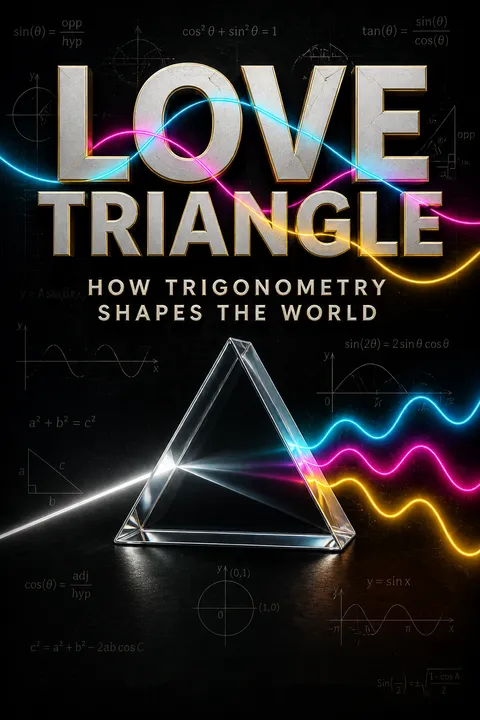
Love Triangle is a popular mathematics book organized as a journey from elementary geometry to the mathematical structures behind modern technology. Its central argument is not literally that every object is triangular. Rather, triangles are a remarkably efficient bridge between physical observation and formal calculation. They let people infer what cannot be measured directly, represent curved surfaces as manageable pieces, and express changing phenomena through trigonometric functions and waves.
The book’s strongest structural choice is its repeated movement from an ordinary puzzle to an unexpectedly large consequence. A photograph resolves a farm dispute; a road measurement supports astronomical distances. A guitar string leads toward Fourier analysis, which helps scientists decode animal calls, gravitational waves, and crystal structures. These shifts make mathematics feel less like a sealed school subject and more like a collection of tools that travel between disciplines. The author’s jokes and personal experiments lower the barrier without pretending that every calculation is effortless.
The title claim needs a productive qualification. Triangles are foundational, but the book also shows that geometry depends on choosing the right representation. Film visual effects often favor quadrilateral meshes, hexagons pack efficiently in particular settings, and ocean waves are not simple sine waves. The larger lesson is therefore not that one shape rules all, but that mathematical structures become powerful when their constraints match the problem. Triangle-based models work because three points define a plane, triangles are rigid, and their side-angle relations are unusually tractable.
The book also demonstrates that mathematical certainty has layers. A formula may be exact within an ideal model, while an application depends on noisy photographs, uncertain measurements, approximated surfaces, or incomplete physical knowledge. The most trustworthy stories pair calculation with calibration, comparison, or experiment. That is why the book’s best examples are not just clever solutions. They show how people make assumptions visible, test them, and revise models when reality refuses to cooperate. The result is an accessible account of mathematics as both an abstract language and a practical craft.
Review Summary
Love Triangle by Matt Parker receives mostly positive reviews, with readers praising its humor, accessibility, and engaging writing style. Many appreciate Parker's ability to make mathematics interesting and fun, even for those who disliked the subject in school. The book covers various applications of triangles and trigonometry in real life, from engineering to art. Some readers found certain sections challenging or overly detailed, but overall, the book is well-received for its entertaining approach to mathematics and Parker's infectious enthusiasm for the subject.
Glossary
Parallax
apparent position shiftParallax is the apparent change in an object's position relative to more distant objects when the observer changes viewpoint. Astronomers use the small shift in a nearby star's apparent position, viewed from opposite points in Earth's orbit, to estimate its distance. The method requires knowing the baseline between viewpoints.
Standard candle
known intrinsic brightnessA standard candle is an astronomical object whose actual brightness can be estimated independently. Comparing that intrinsic brightness with how faint the object appears from Earth allows astronomers to estimate its distance. Certain variable stars and supernovae serve this role, helping calibrate the broader astronomical distance scale.
Triangle Inequality
distance constraintThe Triangle Inequality states that, in any triangle, the sum of the lengths of any two sides must be at least as long as the remaining side. In generalized forms of distance, it captures the idea that going directly between two points cannot be longer than taking a route through a third point.
Triangle mesh
surface of linked trianglesA triangle mesh represents a surface as connected triangular regions whose corners are points in space. Because three points always lie in a plane, each triangular face can be flat even when the overall surface is curved. Meshes are used in digital models, engineering analysis, 3D printing, and construction.
Delaunay triangulation
well-shaped point meshDelaunay triangulation is a way to connect a set of points into triangles while avoiding excessively small angles where possible. One aim is to maximize the smallest angle among the triangles. This reduces long, narrow sliver triangles that can make a mesh less useful for computation or surface representation.
Angle of repose
stable pile slopeThe angle of repose is the steepest angle at which a loose granular material remains stable when heaped. It depends on factors including friction between particles and gravity. Different materials form piles at different angles, making this measure useful for understanding granular flows and estimating the frictional behavior of materials.
Aperiodic monotile
single nonrepeating tiling shapeAn aperiodic monotile is one shape that can cover a plane without gaps, but only in arrangements that do not repeat periodically. The Hat, discovered by David Smith and subsequently proved to have this property, is a 13-sided example. Some versions of its tiling require reflected copies of the tile.
n-Simplex Interpolation
interpolation across dimensionsn-Simplex Interpolation estimates unknown values by dividing a multidimensional data region into simplexes, the higher-dimensional counterparts of triangles. In three dimensions, the relevant simplex is a tetrahedron. The method can use a smaller set of surrounding values than cube-based interpolation, reducing the calculation and storage needed for applications such as color conversion.
Haversine
spherical distance calculationThe haversine is a trigonometric function related to the sine of half an angle. The haversine formula uses latitude and longitude differences to calculate the central angle between two locations on a spherical Earth, then combines that angle with Earth's radius to estimate surface distance.
Anamorphic art
viewpoint-dependent imageAnamorphic art is deliberately distorted so that it appears correctly proportioned from a particular viewpoint or through a particular reflective surface. The geometry maps the intended image back onto the physical surface. Road markings, pavement illusions, and digitally inserted sports graphics use related projection methods.
Fourier transform
signal into frequenciesA Fourier transform expresses a signal as a combination of sinusoidal components at different frequencies. This representation lets analysts inspect, filter, or compare the frequency content of sound, light, and other data. Fourier methods are used in fields such as audio processing, crystallography, and the analysis of gravitational-wave signals.
Spectrogram
frequency pattern over timeA spectrogram displays how the frequencies in a signal change over time. Time typically runs horizontally, frequency vertically, and shading or color indicates the strength of each frequency. It can make patterns in animal calls or gravitational-wave signals visible, allowing researchers to compare signals without relying only on listening.
CORDIC
iterative trig calculationCORDIC, short for Coordinate Rotation Digital Computer, is an algorithm developed for calculating trigonometric values through repeated rotations of a point. Its simple operations made it practical for early electronic calculators and other hardware with limited computing resources. The method helped make functions such as sine, cosine, and tangent readily available.
GNSS
satellite navigation systemsGNSS means Global Navigation Satellite System, the generic category that includes GPS and other satellite-based positioning systems. A receiver compares accurately timed signals from satellites whose positions are known to estimate its location. Precise operation depends on geometry, accurate clocks, and corrections for effects such as relativity.
FAQ
What's Love Triangle: How Trigonometry Shapes the World about?
- Exploration of Triangles: The book delves into the significance of triangles in mathematics and their applications across various fields, arguing their fundamental role in understanding geometry and trigonometry.
- Real-World Examples: Matt Parker uses engaging anecdotes, such as court cases and engineering scenarios, to illustrate how triangles impact daily life, emphasizing their practical utility.
- Celebration of Geometry: Parker aims to rekindle interest in geometry by showcasing the beauty and utility of triangles in both historical and contemporary contexts.
Why should I read Love Triangle: How Trigonometry Shapes the World?
- Engaging Writing Style: Matt Parker's humorous and accessible writing makes complex mathematical concepts enjoyable and relatable, drawing readers in with anecdotes and storytelling.
- Practical Applications: The book highlights how triangles are used in various professions, demonstrating their relevance in real-world scenarios and inspiring readers to see the value of mathematics.
- Increased Appreciation for Math: Parker's enthusiasm is infectious, encouraging readers to explore mathematics beyond the classroom and develop a newfound love for triangles and geometry.
What are the key takeaways of Love Triangle: How Trigonometry Shapes the World?
- Triangles are Everywhere: Triangles are foundational shapes in geometry, present in many aspects of life, from architecture to nature, unlocking a deeper appreciation for the world.
- Mathematical Laws: Important laws related to triangles, such as the Triangle Inequality and Pythagoras's Theorem, are essential for solving geometric problems and understanding complex concepts.
- Historical Context: Historical anecdotes about mathematicians and their discoveries related to triangles enrich the reader's understanding of the subject and illustrate the evolution of mathematical thought.
What is Pythagoras's Theorem, and why is it important in Love Triangle?
- Definition of Pythagoras's Theorem: It states that in a right-angled triangle, the square of the hypotenuse's length equals the sum of the squares of the other two sides, a fundamental relationship in geometry.
- Applications in Real Life: Widely used in fields like architecture, engineering, and physics to calculate distances and angles, crucial for anyone working with measurements and spatial relationships.
- Cultural Significance: Pythagoras is a cultural symbol for mathematics, often referenced in popular media, shaping our understanding of geometry and remaining relevant today.
How do triangles contribute to engineering and architecture according to Love Triangle?
- Structural Integrity: Triangles create stable structures that do not deform under pressure, essential in designing bridges, roofs, and other architectural elements.
- Efficient Use of Materials: Triangular shapes minimize material usage while maximizing strength, crucial in construction for cost and resource management.
- Design Flexibility: Triangles allow for creative architectural designs, accommodating various aesthetic and functional requirements, enabling innovative structures.
What is Heron’s Formula, and how is it used in Love Triangle?
- Definition of Heron’s Formula: It calculates the area of a triangle when the lengths of all three sides are known, expressed as ( A = \sqrt{s(s-a)(s-b)(s-c)} ), where ( s ) is the semi-perimeter.
- Practical Applications: Useful when measuring the height of a triangle is difficult, allowing area calculation using only side lengths, applicable in fields like surveying and construction.
- Historical Context: Credited to Heron of Alexandria, showcasing the long-standing importance of triangles in mathematics and their historical use in solving practical problems.
What is the Triangle Inequality, and why is it significant in Love Triangle?
- Definition of Triangle Inequality: It states that the sum of the lengths of any two sides of a triangle must be greater than the length of the third side, fundamental in determining triangle feasibility.
- Applications in Geometry: Crucial for understanding triangle properties, often used in proofs and problem-solving, establishing the feasibility of constructing triangles with given side lengths.
- Broader Implications: Influences fields like optimization and network theory, serving as a foundational concept in various mathematical disciplines.
How does Love Triangle explain the significance of the Law of Sines?
- Foundation of Trigonometry: The Law of Sines relates the angles and sides of triangles, essential for solving geometric problems, with utility in both theoretical and practical applications.
- Real-World Applications: Used in fields like navigation, architecture, and astronomy, showcasing its relevance beyond the classroom and helping readers appreciate its importance in everyday life.
- Connection to Other Concepts: Connects to other trigonometric identities and principles, demonstrating how they work together to solve complex problems, reinforcing the interconnectedness of mathematical concepts.
How does Love Triangle relate trigonometry to sound waves?
- Vibrating Strings: Sound waves produced by vibrating strings, like those on a guitar, are sine waves due to proportional restorative forces, illustrating the mathematical basis of sound production.
- Fourier Analysis: Allows decomposition of complex sound waves into constituent sine waves, enabling better understanding of audio signals, essential in music production and sound engineering.
- Practical Applications: Highlights real-world applications in music technology and acoustics, demonstrating the relevance of trigonometry in everyday life and emphasizing the importance of understanding sound waves.
What role do triangles play in the history of mathematics as discussed in Love Triangle?
- Historical Figures: Highlights key mathematicians like Eratosthenes and Archimedes, who utilized triangles in their work, showcasing their historical significance in triangular geometry.
- Development of Trigonometry: Discusses the evolution from ancient civilizations to contemporary applications, emphasizing triangles' central role in this development.
- Cultural Impact: Explores how different cultures approached the study of triangles and geometry, illustrating the universal nature of these concepts and enriching the reader's understanding.
What is the relationship between trigonometry and art as described in Love Triangle?
- Perspective in Painting: Explores how trigonometric principles, like vanishing points, influenced perspective depiction in art, highlighting mathematical foundations of artistic techniques.
- Anamorphic Art: Discusses anamorphic art, where images are distorted to appear correct from a specific viewpoint, showcasing the interplay between mathematics and visual perception.
- Modern Applications: Highlights contemporary uses of trigonometry in art and design, demonstrating how mathematical principles continue to shape creative expressions and emphasizing ongoing relevance.
What are the best quotes from Love Triangle: How Trigonometry Shapes the World and what do they mean?
- “Triangles are everything and everything is triangles.”: Emphasizes the foundational role of triangles in mathematics and their pervasive presence in the world, suggesting deeper comprehension across disciplines.
- “I want everyone to love triangles.”: Reflects Parker's passion for triangles and his desire to share that enthusiasm, highlighting the book's aim to inspire a love for mathematics and geometry.
- “The triangle is a surprisingly complex shape for a mere three sides.”: Reflects the depth and richness of triangles as a subject of study, inviting readers to explore their intricacies and applications.
Download PDF
Download EPUB
.epub digital book format is ideal for reading ebooks on phones, tablets, and e-readers.








